Hereditas(Beijing) ›› 2026, Vol. 48 ›› Issue (8): 828-841.doi: 10.16288/j.yczz.25-318
• Research Article • Previous Articles Next Articles
Genomic diversity and selection pressure analyses of low-virulence Yersinia pestis lineages
Jiayi Zhang1,2( ), Yihua Jia2,3, Kai Mu2, Mengnan Cui2, Haifeng Pan1, Yujun Cui1,2(), Yarong Wu2()
- 1
School of Public Health ,Anhui Medical University Hefei 230032, China
2State Key Laboratory of Pathogen and Biosecurity ,Academy of Military Medical Sciences Beijing 100071, China
3School of Pharmacy ,Suzhou Medical College, Soochow University Suzhou 215000, China
-
Received:2025-12-03Revised:2026-02-06Online:2026-08-20Published:2026-02-27 -
Contact:Yujun Cui, Yarong Wu E-mail:2345010442@stu.ahmu.edu.cn;cuiyujun.new@gmail.com;wuyarong525@126.com -
Supported by:National Key Research and Development Program of China(2024YFC2310100);National Natural Science Foundation of China(32500006)

Cite this article
Jiayi Zhang, Yihua Jia, Kai Mu, Mengnan Cui, Haifeng Pan, Yujun Cui, Yarong Wu. Genomic diversity and selection pressure analyses of low-virulence Yersinia pestis lineages[J]. Hereditas(Beijing), 2026, 48(8): 828-841.
share this article
Add to citation manager EndNote|Reference Manager|ProCite|BibTeX|RefWorks
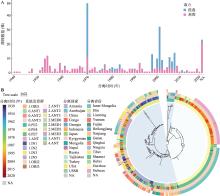
Fig. 1
Phylogenetic tree and temporal distribution of Y. pestis genomes"

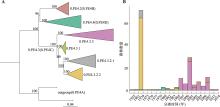
Fig. 2
Genetic diversity and spatiotemporal distribution of low-virulence Y. pestis populations"

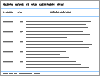
Table 1
Statistics of SNP and indel variants in low-virulence Y. pestis strains"
| 变异 | 突变类型 | 突变个数 | 占比(%) | 总计* |
|---|---|---|---|---|
| SNP | 同义突变 | 131 | 20.66 | 634 |
| 非同义突变 | 332 | 52.36 | ||
| 无义突变 | 18 | 2.84 | ||
| 间区 | 153 | 24.13 | ||
| Indel | 移码突变 | 775 | 57.75 | 1,342(1,329) |
| 非移码突变 | 254 | 19.71 | ||
| 间区 | 283 | 23.24 |
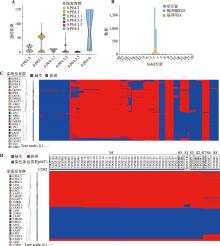
Fig. 3
Basic characteristics of three types of genomic variations in Y. pestis"

Table 2
Functional annotation of eight deleted fragments specific to the low-virulence Y. pestis population and its subclades"
| 片段 | 参考 | 染色体/质粒 | 起始 | 终止 | 长度 | 基因数 | 基因编号 | 基因名 | 功能 |
|---|---|---|---|---|---|---|---|---|---|
| S1 | CO92 | pMT1质粒 | 73881 | 74369 | 489 | 1 | YPMT1.73 | - | 磷脂代谢与信号传导 |
| S2 | CO92 | 染色体 | 2253549 | 2257250 | 3702 | 3 | YPO1985、YPO1986、YPO1987 | - | 糖基化修饰 |
| S3 | CO92 | 染色体 | 2350433 | 2352337 | 1905 | 1 | YPO2071 | - | DNA解旋酶DinG样蛋白 |
| S4 | CO92 | 染色体 | 2370557 | 2403064 | 32508 | 42 | YPO2096~YPO2134 | tnpA、rzpR、 y1062 | 噬菌体相关功能 |
| S5 | CO92 | 染色体 | 2789116 | 2790121 | 1006 | 2 | YPO2488、YPO2489 | - | DUF2247 家族蛋白 |
| S6 | CO92 | 染色体 | 1923715 | 1924944 | 1230 | 1 | YPO1687 | alr | 广谱型氨基酸消旋酶 |
| S7 | CO92 | 染色体 | 2537797 | 2538729 | 933 | 1 | YPO2258 | araC | AraC 家族转录调控因子 |
| S8 | CO92 | 染色体 | 3402002 | 3404908 | 2907 | 2 | YPO3046、YPO3047 | ydeN | 硫酸酯酶 |
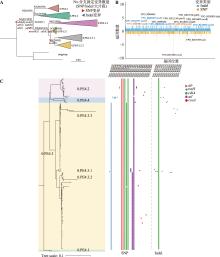
Fig. 4
Selection pressure analysis of low-virulence Y. pestis populations"

| [1] |
Achtman M, Morelli G, Zhu PX, Wirth T, Diehl I, Kusecek B, Vogler AJ, Wagner DM, Allender CJ, Easterday WR, Chenal-Francisque V, Worsham P, Thomson NR, Parkhill J, Lindler LE, Carniel E, Keim P. Microevolution and history of the plague bacillus, Yersinia pestis. Proc Natl Acad Sci USA, 2004, 101(51): 17837-17842.
pmid: 15598742 |
| [2] |
Perry RD, Fetherston JD. Yersinia pestis--etiologic agent of plague. Clin Microbiol Rev, 1997, 10(1): 35-66.
pmid: 8993858 |
| [3] |
Stenseth NC, Atshabar BB, Begon M, Belmain SR, Bertherat E, Carniel E, Gage KL, Leirs H, Rahalison L. Plague: past, present, and future. PLoS Med, 2008, 5(1): e3.
pmid: 18198939 |
| [4] | World Health Organization. Plague fact sheet. 2022. https://www.who.int/news-room/fact-sheets/detail/plague. |
| [5] | World Health Organization. Pathogens prioritization: a scientific framework for epidemic and pandemic research preparedness. 2024, 38. |
| [6] |
Inglesby TV, Dennis DT, Henderson DA, Bartlett JG, Ascher MS, Eitzen E, Fine AD, Friedlander AM, Hauer J, Koerner JF, Layton M, McDade J, Osterholm MT, O'Toole T, Parker G, Perl TM, Russell PK, Schoch-Spana M, Tonat K. Plague as a biological weapon: medical and public health management. Working group on civilian biodefense. JAMA, 2000, 283(17): 2281-2290.
pmid: 10807389 |
| [7] |
Yang R, Atkinson S, Chen Z, Cui Y, Du Z, Han Y, Sebbane F, Slavin P, Song Y, Yan Y, Wu Y, Xu L, Zhang C, Zhang Y, Hinnebusch BJ, Stenseth NC, Motin VL. Yersinia pestis and plague: some knowns and unknowns. Zoonoses. 2023, 3(1): 5.
pmid: 37602146 |
| [8] |
Li YJ, Cui YJ, Hauck Y, Platonov ME, Dai E, Song YJ, Guo ZB, Pourcel C, Dentovskaya SV, Anisimov AP, Yang RF, Vergnaud G. Genotyping and phylogenetic analysis of Yersinia pestis by MLVA: insights into the worldwide expansion of Central Asia plague foci. PLoS One, 2009, 4(6): e6000.
pmid: 19543392 |
| [9] | Zhou DS, Tong ZZ, Song YJ, Zhang L, Pei DC, Pang X, Han YP, Li M, Cui BZ, Wang J, Guo ZB, Qi ZZ, Jin LX, Zhai JH, Du ZM, Wang XY, Wang J, Huang PT, Yang RF. Molecular mechanism of biovar conversion of Yersinia pestis and the proposition of a new biovar: microtus. PLA Medical Journal, 2004, 29(3): 211-215. |
| 周冬生, 童宗中, 宋亚军, 张玲, 裴德翠, 庞昕, 韩延平, 李敏, 崔百忠, 王津, 郭兆彪, 祁芝珍, 金丽霞, 翟俊辉, 杜宗敏, 王效义, 汪建, 黄培堂, 杨瑞馥. 鼠疫耶尔森菌生物型变异遗传基础的研究和新生物型--田鼠型的提出. 解放军医学杂志, 2004, 29(3): 211-215. | |
| [10] |
Zhang XA, Hai R, Wei JC, Cui ZG, Zhang EM, Song ZZ, Yu DZ. MLVA distribution characteristics of Yersinia pestis in China and the correlation analysis. BMC Microbiol, 2009, 9: 205.
pmid: 19775435 |
| [11] |
Zhou DS, Tong ZZ, Song YJ, Han YP, Pei DC, Pang X, Zhai JH, Li M, Cui BZ, Qi ZZ, Jin LX, Dai RX, Du ZM, Wang J, Guo ZB, Wang J, Huang PT, Yang RF. Genetics of metabolic variations between Yersinia pestis biovars and the proposal of a new biovar, microtus. J Bacteriol, 2004, 186(15): 5147-5152.
pmid: 15262951 |
| [12] |
Cui YJ, Yu C, Yan YF, Li DF, Li YJ, Jombart T, Weinert LA, Wang ZY, Guo ZB, Xu LZ, Zhang YJ, Zheng HC, Qin N, Xiao X, Wu MS, Wang XY, Zhou DS, Qi ZZ, Du ZM, Wu HL, Yang XW, Cao HZ, Wang H, Wang J, Yao SS, Rakin A, Li YR, Falush D, Balloux F, Achtman M, Song YJ, Wang J, Yang RF. Historical variations in mutation rate in an epidemic pathogen, Yersinia pestis. Proc Natl Acad Sci USA, 2013, 110(2): 577-582.
pmid: 23271803 |
| [13] |
Wu YR, Xin YQ, Yang XY, Song K, Zhang QW, Zhao HH, Li CX, Jin Y, Guo Y, Tan YF, Song YJ, Tian HY, Qi ZZ, Yang RF, Cui YJ. Hotspots of genetic change in Yersinia pestis. Nat Commun, 2025, 16(1): 388.
pmid: 39755708 |
| [14] | Zheng HY, Yan L, Yang C, Wu YR, Qin JL, Hao TY, Yang DJ, Guo YC, Pei XY, Zhao TY, Cui YJ. Population genomics study of Vibrio alginolyticus. Hereditas(Beijing), 2021, 43(4): 350-361. |
| 郑宏源, 闫琳, 杨超, 武雅蓉, 秦婧靓, 郝彤宇, 杨大进, 郭云昌, 裴晓燕, 赵彤言, 崔玉军. 溶藻弧菌群体基因组学研究. 遗传, 2021, 43(4): 350-361. | |
| [15] | 樊振亚, 罗运珩, 王身荣, 金玲玲, 周祥, 刘俊, 张耀星, 李凤. 布氏田鼠鼠疫不危害人类. 中国地方病防治杂志, 1995, 10(1): 56-57. |
| [16] |
Zhang QW, Wang Q, Tian G, Qi ZZ, Zhang XC, Wu XH, Qiu YF, Bi YJ, Yang XY, Xin YQ, He J, Zhou JY, Zeng L, Yang RF, Wang XY. Yersinia pestis biovar Microtus strain 201, an avirulent strain to humans, provides protection against bubonic plague in rhesus macaques. Hum Vaccin Immunother, 2014, 10(2): 368-377.
pmid: 24225642 |
| [17] | Chen H, Yang W, Li FZ, Jiang HZ, Xu GR, Li GQ, Yan DL, Luo ZBD, Duan YJ, Deng JY, Zhu XP, Wang LM. The study of harm to Yersinia pestis of Microtus fuscus in Qinghai-Tibet Plateau. Chin J Ctrl Endem Dis, 2006, 21(6): 324-326. |
| 陈虹, 杨文, 李富忠, 蒋和柱, 许光荣, 李光清, 严冬丽, 罗志丹巴, 段勇军, 邓佳云, 祝小平, 汪立茂. 青藏高原青海田鼠型鼠疫菌危害性研究. 中国地方病防治杂志, 2006, 21(6): 324-326. | |
| [18] | 樊振亚, 罗运珩, 李凤, 张春华, 苏晓仙, 王身荣. 鼠疫耶尔森菌锡林郭勒高原型对人致病性试验. 中国地方病防治杂志, 1994, 9(6): 340-342. |
| [19] |
Song YJ, Tong ZZ, Wang J, Wang L, Guo ZB, Han YP, Zhang JG, Pei DC, Zhou DS, Qin HO, Pang X, Han YJ, Zhai JH, Li M, Cui BZ, Qi ZZ, Jin LX, Dai RX, Chen F, Li ST, Ye C, Du ZM, Lin W, Wang J, Yu J, Yang HM, Wang J, Huang PT, Yang RF. Complete genome sequence of Yersinia pestis strain 91001, an isolate avirulent to humans. DNA Res, 2004, 11(3): 179-197.
pmid: 15368893 |
| [20] |
Li YJ, Dai EH, Cui YJ, Li M, Zhang YJ, Wu MS, Zhou DS, Guo ZB, Dai X, Cui BZ, Qi ZZ, Wang ZY, Wang H, Dong XQ, Song ZZ, Zhai JH, Song YJ, Yang RF. Different region analysis for genotyping Yersinia pestis isolates from China. PLoS One, 2008, 3(5): e2166.
pmid: 18478120 |
| [21] |
Wu YR, Yang C, Mu K, Guo Y, Song YJ, Yang RF, Cui YJ. Insights into Yersinia pestis evolution through rearrangement analysis of 242 complete genomes. Nat Genet, 2025, 57(8): 1994-2003.
pmid: 40759755 |
| [22] |
Bolger AM, Lohse M, Usadel B. Trimmomatic: a flexible trimmer for Illumina sequence data. Bioinformatics, 2014, 30(15): 2114-2120.
pmid: 24695404 |
| [23] |
Bankevich A, Nurk S, Antipov D, Gurevich AA, Dvorkin M, Kulikov AS, Lesin VM, Nikolenko SI, Pham S, Prjibelski AD, Pyshkin AV, Sirotkin AV, Vyahhi N, Tesler G, Alekseyev MA, Pevzner PA. SPAdes: a new genome assembly algorithm and its applications to single-cell sequencing. J Comput Biol, 2012, 19(5): 455-477.
pmid: 22506599 |
| [24] | Seemann T. Shovill: faster SPAdes assembly of Illumina reads. 2017. https://github.com/tseemann/shovill. |
| [25] |
Seemann T. Prokka: rapid prokaryotic genome annotation. Bioinformatics, 2014, 30(14): 2068-2069.
pmid: 24642063 |
| [26] |
Delcher AL, Salzberg SL, Phillippy AM. Using MUMmer to identify similar regions in large sequence sets. Curr Protoc Bioinformatics, 2003, Chapter 10: Unit 10.3.
pmid: 18428693 |
| [27] | Li H. Aligning sequence reads, clone sequences and assembly contigs with BWA-MEM. arXiv: 1303.3997, 2013, 1-3. |
| [28] |
Van der Auwera GA, Carneiro MO, Hartl C, Poplin R, Del Angel G, Levy-Moonshine A, Jordan T, Shakir K, Roazen D, Thibault J, Banks E, Garimella KV, Altshuler D, Gabriel S, DePristo MA. From FastQ data to high confidence variant calls: the genome analysis toolkit best practices pipeline. Curr Protoc Bioinformatics, 2013, 43(1110): 11.10.1-11.10.33.
pmid: 25431634 |
| [29] |
Benson G. Tandem repeats finder: a program to analyze DNA sequences. Nucleic Acids Res, 1999, 27(2): 573-580.
pmid: 9862982 |
| [30] |
Altschul SF, Gish W, Miller W, Myers EW, Lipman DJ. Basic local alignment search tool. J Mol Biol, 1990, 215(3): 403-410.
pmid: 2231712 |
| [31] |
Nguyen LT, Schmidt HA, von Haeseler A, Minh BQ. IQ-TREE: a fast and effective stochastic algorithm for estimating maximum-likelihood phylogenies. Mol Biol Evol, 2015, 32(1): 268-274.
pmid: 25371430 |
| [32] | Rambaut A. FigTree - v1.4.4. 2016. http://tree.bio.ed.ac.uk/software/figtree/. |
| [33] |
Letunic I, Bork P. Interactive Tree Of Life (iTOL) v5:an online tool for phylogenetic tree display and annotation. Nucleic Acids Res, 2021, 49(W1): W293-W296.
pmid: 33885785 |
| [34] |
Tonkin-Hill G, MacAlasdair N, Ruis C, Weimann A, Horesh G, Lees JA, Gladstone RA, Lo S, Beaudoin C, Floto RA, Frost SDW, Corander J, Bentley SD, Parkhill J. Producing polished prokaryotic pangenomes with the Panaroo pipeline. Genome Biol, 2020, 21(1): 180.
pmid: 32698896 |
| [35] |
Li RQ, Li YR, Kristiansen K, Wang J. SOAP: short oligonucleotide alignment program. Bioinformatics, 2008, 24(5): 713-714.
pmid: 18227114 |
| [36] |
O'Leary NA, Wright MW, Brister JR, Ciufo S, Haddad D, McVeigh R, Rajput B, Robbertse B, Smith-White B, Ako-Adjei D, Astashyn A, Badretdin A, Bao YM, Blinkova O, Brover V, Chetvernin V, Choi J, Cox E, Ermolaeva O, Farrell CM, Goldfarb T, Gupta T, Haft D, Hatcher E, Hlavina W, Joardar VS, Kodali VK, Li WJ, Maglott D, Masterson P, McGarvey KM, Murphy MR, O'Neill K, Pujar S, Rangwala SH, Rausch D, Riddick LD, Schoch C, Shkeda A, Storz SS, Sun HZ, Thibaud-Nissen F, Tolstoy I, Tully RE, Vatsan AR, Wallin C, Webb D, Wu W, Landrum MJ, Kimchi A, Tatusova T, DiCuccio M, Kitts P, Murphy TD, Pruitt KD. Reference sequence (RefSeq) database at NCBI: current status, taxonomic expansion, and functional annotation. Nucleic Acids Res, 2016, 44(D1): D733-745.
pmid: 26553804 |
| [37] |
Cantalapiedra CP, Hernández-Plaza A, Letunic I, Bork P, Huerta-Cepas J. eggNOG-mapper v2: functional annotation, orthology assignments, and domain prediction at the metagenomic Scale. Mol Biol Evol, 2021, 38(12): 5825-5829.
pmid: 34597405 |
| [38] |
Crispell J, Balaz D, Gordon SV. HomoplasyFinder: a simple tool to identify homoplasies on a phylogeny. Microb Genom, 2019, 5(1): e000245.
pmid: 30663960 |
| [39] |
Wang DP, Zhang YB, Zhang Z, Zhu J, Yu J. KaKs_ Calculator 2.0: a toolkit incorporating gamma-series methods and sliding window strategies. Genomics Proteomics Bioinformatics, 2010, 8(1): 77-80.
pmid: 20451164 |
| [40] | Zhang ZM, Zhou H, Huang XZ, Zhang DY, Zhang JY, Lin Y, Fang LW, Zhang XC, Cui YJ, Wu YR, Li YJ. Study on population genomics of Bacillus anthracis based on multiple types of genetic variations. Hereditas(Beijing), 2025, 47(6): 681-693. |
| 张祖铭, 周豪, 黄学治, 张多悦, 张佳怡, 林昱, 方立崴, 张秀昌, 崔玉军, 武雅蓉, 李艳君. 基于多类型变异的炭疽芽孢杆菌群体基因组学研究. 遗传, 2025, 47(6): 681-693. | |
| [41] |
Wu YR, Hao TY, Qian XW, Zhang XL, Song YJ, Yang RF, Cui YJ. Small insertions and deletions drive genomic plasticity during adaptive evolution of Yersinia pestis. Microbiol Spectr, 2022, 10(3): e0224221.
pmid: 35438532 |
| [42] |
Craig NL. Transposon Tn7. Curr Top Microbiol Immunol, 1996, 204: 27-48.
pmid: 8556868 |
| [43] |
Young R. Phage lysis: three steps, three choices, one outcome. J Microbiol, 2014, 52(3): 243-258.
pmid: 24585055 |
| [44] |
Walsh CT. Enzymes in the D-alanine branch of bacterial cell wall peptidoglycan assembly. J Biol Chem, 1989, 264(5): 2393-2396.
pmid: 2644260 |
| [45] |
Gallegos MT, Schleif R, Bairoch A, Hofmann K, Ramos JL. Arac/XylS family of transcriptional regulators. Microbiol Mol Biol Rev, 1997, 61(4): 393-410.
pmid: 9409145 |
| [46] |
Felek S, Krukonis ES. The Yersinia pestis Ail protein mediates binding and Yop delivery to host cells required for plague virulence. Infect Immun, 2009, 77(2): 825-836.
pmid: 19064637 |
| [47] |
Tsang TM, Wiese JS, Felek S, Kronshage M, Krukonis ES. Ail proteins of Yersinia pestis and Y. pseudotuberculosis have different cell binding and invasion activities. PLoS One, 2013, 8(12): e83621.
pmid: 24386237 |
| [48] |
Aoki SK, Pamma R, Hernday AD, Bickham JE, Braaten BA, Low DA. Contact-dependent inhibition of growth in Escherichia coli. Science, 2005, 309(5738): 1245-1248.
pmid: 16109881 |
| [49] |
Cathelyn JS, Crosby SD, Lathem WW, Goldman WE, Miller VL. RovA, a global regulator of Yersinia pestis, specifically required for bubonic plague. Proc Natl Acad Sci USA, 2006, 103(36): 13514-13519.
pmid: 16938880 |
| [50] |
Basler M, Pilhofer M, Henderson GP, Jensen GJ, Mekalanos JJ. Type VI secretion requires a dynamic contractile phage tail-like structure. Nature, 2012, 483(7388): 182-186.
pmid: 22367545 |
| [51] |
Zhao XN, Cui YJ, Yan YF, Du ZM, Tan YF, Yang HY, Bi YJ, Zhang PP, Zhou L, Zhou DS, Han YP, Song YJ, Wang XY, Yang RF. Outer membrane proteins ail and OmpF of Yersinia pestis are involved in the adsorption of T7-related bacteriophage Yep-phi. J Virol, 2013, 87(22): 12260-12269.
pmid: 24006436 |
| [1] | Zhiyong Jiang, Jianping Xie. Progress on the function of Mycobacterium T7SS (ESX) secretion system [J]. Hereditas(Beijing), 2023, 45(12): 1100-1113. |
| [2] | Hongyuan Zheng, Lin Yan, Chao Yang, Yarong Wu, Jingliang Qin, Tongyu Hao, Dajin Yang, Yunchang Guo, Xiaoyan Pei, Tongyan Zhao, Yujun Cui. Population genomics study of Vibrio alginolyticus [J]. Hereditas(Beijing), 2021, 43(4): 350-361. |
| [3] | Chen Xuemei, Wei Yunlin, Ji Xiuling. Research progress of prophages [J]. Hereditas(Beijing), 2021, 43(3): 240-248. |
| [4] | Dewei Yang, Shengping Li, Haitao Cui, Shenghao Zou, Wei Wang. Molecular genetic mechanisms of interaction between host plants and pathogens [J]. Hereditas(Beijing), 2020, 42(3): 278-286. |
| [5] | Wei Peng, Mengjie Feng, Hao Chen, Baoyu Han. Progress on genome sequencing of Dipteran insects [J]. Hereditas(Beijing), 2020, 42(11): 1093-1109. |
| [6] | Wenwen Deng, Caiwu Li, Siyue Zhao, Rengui Li, Yongguo He, Daifu Wu, Shengzhi Yang, Yan Huang, Hemin Zhang, Likou Zou. Whole genome sequencing reveals the distribution of resistance and virulence genes of pathogenic Escherichia coli CCHTP from giant panda [J]. Hereditas(Beijing), 2019, 41(12): 1138-1147. |
| [7] | Wenchao Zou, Linlin Shen, Jianguo Shen, Wei Cai, Jiasui Zhan, Fangluan Gao. A multigene phylogentic analysis of Potato virus Y and its application in strain identification [J]. Hereditas(Beijing), 2017, 39(10): 918-929. |
| [8] | Jianzhong Chang, Fengxia Yan, Linyi Qiao, Jun Zheng, Fuyao Zhang, Qingshan Liu. Genome-wide identification and expression analysis of SBP-box gene family in Sorghum bicolor L. [J]. HEREDITAS(Beijing), 2016, 38(6): 569-580. |
| [9] | Linqi Wang. Adaptation strategies: how environmental fungi become fatal? [J]. HEREDITAS(Beijing), 2015, 37(5): 436-441. |
| [10] | Jidong Zhou,Yudong Li. Study on an inquiry-based teaching case in genomics curriculum: identifying virulence factors of Escherichia coli by using comparative genomics [J]. HEREDITAS(Beijing), 2015, 37(2): 214-218. |
| [11] | Xuejuan Li, Yuan Huang, Fumin Lei. Comparative and phylogenomic analyses on mitochondrial genomes of Arborophila species [J]. HEREDITAS(Beijing), 2014, 36(9): 912-920. |
| [12] | GUAN Ling-Liang HOU Kai CHEN Jun-Wen XU Ying-Wen WU Wei. Phylogeny and functional divergence of ω-6 and ω-3 fatty acid desaturase families [J]. HEREDITAS, 2013, 35(5): 643-654. |
| [13] | FENG Jun LI Guang WANG Yi-Quan. Research progress of conserved non-coding elements in metazoan [J]. HEREDITAS, 2013, 35(1): 35-44. |
| [14] | FU Jing, QIN Qi-Wei. Pan-genomics analysis of 30 Escherichia coli genomes [J]. HEREDITAS, 2012, 34(6): 765-772. |
| [15] | ZHANG Xin, JIANG Hua, WANG Yan-Li, ZHANG Zhen, MAO Xue-Qin, CHAI Rong-Yao, QIU Hai-Ping, DU Xin-Fa, WA Jiao-Yu, SUN Guo-Chang. Bioinformaticresearch of the family of PEX11, peroxisomeproliferous factor in fungus [J]. HEREDITAS, 2012, 34(5): 635-646. |
| Viewed | ||||||
|
Full text |
|
|||||
|
Abstract |
|
|||||

