
Genomic prediction of growth trait phenotypes in Large White pigs using a chromosome-encoded multi-head self-attention model
Received date: 2025-08-20
Revised date: 2025-10-29
Online published: 2026-01-12
Supported by
National Pig Technology Innovation Center Pioneering Science and Technology Project(NCTIP-XD/B01);Sichuan Provincial Department of Science and Technology Project(2020YFN0024);Sichuan Provincial Department of Science and Technology Project(2021ZDZX0008);Sichuan Provincial Department of Science and Technology Project(2021YFYZ0030);Sichuan Pig Innovation Team(sccxtd-2022-08)
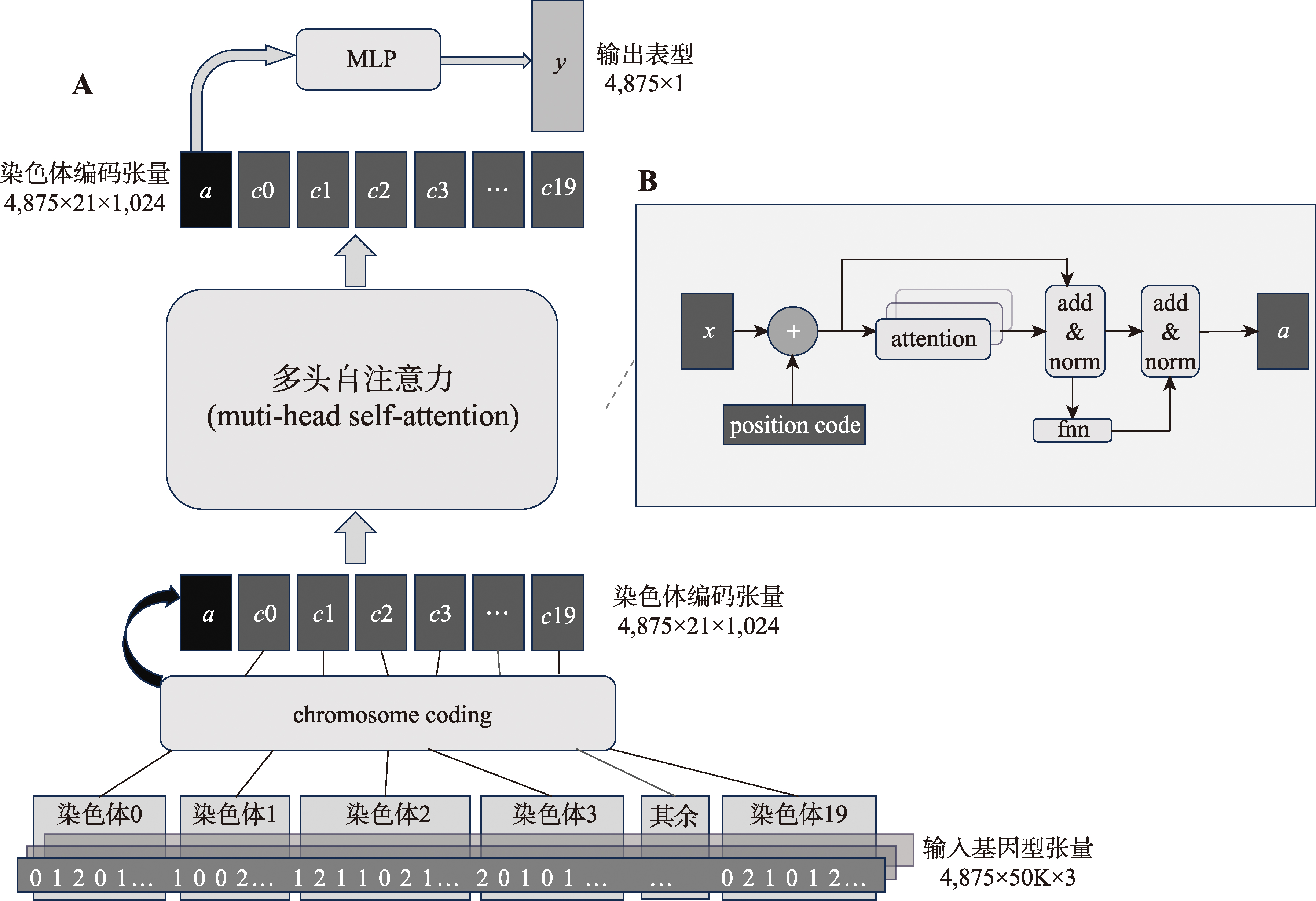
With the widespread adoption of genome sequencing technologies, predicting complex traits using genomic markers has become a key component in breeding programs. However, the high dimensionality and sparsity of genomic data, along with the complex nonlinear interactions among genetic markers, significantly increase the difficulty of accurate data analysis and the cost of hardware deployment. Therefore, this study proposes a chromosome-encoded multi-head self-attention model, named ChrFormer, for genomic prediction. The model employs a chromosome encoder to compress whole-genome SNP data into 20 chromosome-specific feature vectors and one global feature vector. It leverages the multi-head self-attention mechanism to dynamically capture long-range interactive effects across chromosomes, and a multilayer perceptron (MLP) precisely predicts phenotype from the refined genomic features. The study selected genotyping data from 50,000 SNPs of 4,875 Large White pigs, along with four key production traits, including backfat thickness at 100 kg and 115 kg, and age at 100 kg and 115 kg. A ten-fold cross-validation approach and the Pearson correlation coefficient were used to evaluate prediction accuracy. The predictive performance of ChrFormer was systematically compared with genomic best linear unbiased prediction (GBLUP), Bayesian method A (BayesA), and representative deep learning methods, including the visual geometry group (VGG) network and the feedforward neural network (FNN). Furthermore, the study analyzed the strengths and weaknesses of each deep learning model from multiple aspects, including the number of model parameters, training time, and the extent of overfitting. The results show that ChrFormer significantly outperforms the VGG and FNN deep learning models in predictive accuracy across all tested traits. For three of the traits (backfat thickness at 100 kg and 115 kg, and days to 115 kg), its prediction accuracy surpasses that of the traditional GBLUP and BayesA methods. Although ChrFormer requires a longer training time per iteration (54.88 s), its number of parameters is only about one-tenth of that of VGG and FNN, and it demonstrates more stable resistance to overfitting. These results demonstrate that the self-attention-based ChrFormer is a practical tool for genomic phenotype prediction in animal breeding, and its lightweight architecture and stable performance offer a readily deployable solution for breeding stations with limited computational resources.
Wenxuan Zhou, Zhenjian Zhao, Dong Chen, Shengdi Cui, Junge Wang, Ziyang Chen, Shixin Yu, Jiamiao Chen, Yaoxi Zhou, Runjie Huang, Guoqing Tang . Genomic prediction of growth trait phenotypes in Large White pigs using a chromosome-encoded multi-head self-attention model[J]. Hereditas(Beijing), 2026 , 48(3) : 331 -340 . DOI: 10.16288/j.yczz.25-228
| [1] | Daetwyler HD, Calus MPL, Pong-Wong R, de Los Campos G, Hickey JM. Genomic prediction in animals and plants: simulation of data, validation, reporting, and benchmarking. Genetics, 2013, 193(2): 347-365. |
| [2] | VanRaden PM. Efficient methods to compute genomic predictions. J Dairy Sci, 2008, 91(11): 4414-4423. |
| [3] | Yang WZ, Tempelman RJ. A Bayesian antedependence model for whole genome prediction. Genetics, 2012, 190(4): 1491-1501. |
| [4] | Usai MG, Goddard ME, Hayes BJ. LASSO with cross- validation for genomic selection. Genet Res (Camb), 2009, 91(6): 427-436. |
| [5] | Zhou BH, Mei BJ, Lv Q, Wang ZY, Su R. Research progress of machine learning and its application in animal genetics and breeding. China Anim Husb Vet Med, 2024, 51(12): 5348-5358. |
| 周铂涵, 梅步俊, 吕琦, 王志英, 苏蕊. 机器学习及其在动物遗传育种中的应用研究进展. 中国畜牧兽医, 2024, 51(12): 5348-5358. | |
| [6] | Bellot P, de Los Campos G, Pérez-Enciso M. Can deep learning improve genomic prediction of complex human traits? Genetics, 2018, 210(3): 809-819. |
| [7] | Hayes BJ, Visscher PM, Goddard ME. Increased accuracy of artificial selection by using the realized relationship matrix. Genet Res (Camb), 2009, 91(1): 47-60. |
| [8] | González-Camacho JM, Crossa J, Pérez-Rodríguez P, Ornella L, Gianola D. Genome-enabled prediction using probabilistic neural network classifiers. BMC Genomics, 2016, 17: 208. |
| [9] | Lee HJ, Lee JH, Gondro C, Koh YJ, Lee SH. deepGBLUP: joint deep learning networks and GBLUP framework for accurate genomic prediction of complex traits in Korean native cattle. Genet Sel Evol, 2023, 55(1): 56. |
| [10] | Huang ZM, Wang J, Yan ZM, Guo MZ. Differentially expressed genes prediction by multiple self-attention on epigenetics data. Brief Bioinform, 2022, 23(3): bbac117. |
| [11] | Azodi CB, Bolger E, McCarren A, Roantree M, de Los Campos G, Shiu SH. Benchmarking parametric and machine learning models for genomic prediction of complex traits. G3 (Bethesda), 2019, 9(11): 3691-3702. |
| [12] | Pérez P, de los Campos G. BGLR: a statistical package for whole genome regression and prediction. Genetics, 2014, 198(2): 483-495. |
| [13] | Daetwyler HD, Pong-Wong R, Villanueva B, Woolliams JA. The impact of genetic architecture on genome-wide evaluation methods. Genetics, 2010, 185(3): 1021-1031. |
| [14] | He KM, Zhang XY, Ren SQ, Sun J. Deep residual learning for image recognition. In: Conference on Computer Vision and Pattern Recognition (CVPR), 2016, 770-778. |
| [15] | Gao PF, Zhao HN, Luo Z, Lin YF, Feng WJ, Li YL, Kong FJ, Li X, Fang C, Wang XT. SoyDNGP: a web-accessible deep learning framework for genomic prediction in soybean breeding. Brief Bioinform, 2023, 24(6): bbad349. |
| [16] | Choromanski K, Likhosherstov V, Dohan D, Song X, Gane A, Sarlos T, Hawkins P, Davis J, Mohiuddin A, Kaiser L, Belanger D, Colwell L, Weller A. Rethinking Attention with Performers. In: International Conference on Learning Representations (ICLR), 2021. |
| [17] | Rodgers JL, Nicewander WA. Thirteen ways to look at the correlation coefficient. Am Stat, 1988, 42(1): 59-66. |
| [18] | Gianola D, Fernando RL, Stella A. Genomic-assisted prediction of genetic value with semiparametric procedures. Genetics, 2006, 173(3): 1761-1776. |
| [19] | Mackay TFC. Epistasis and quantitative traits: using model organisms to study gene-gene interactions. Nat Rev Genet, 2014, 15(1): 22-33. |
| [20] | Meuwissen TH, Hayes BJ, Goddard ME. Prediction of total genetic value using genome-wide dense marker maps. Genetics, 2001, 157(4): 1819-1829. |
| [21] | Emani PS, Geradi MN, Gürsoy G, Grasty MR, Miranker A, Gerstein MB. Assessing and mitigating privacy risks of sparse, noisy genotypes by local alignment to haplotype databases. Genome Res, 2023, 33(12): 2156-2173. |
| [22] | Cortes C, Mansour Y, Mohri M. Learning bounds for importance weighting. Adv Neural Inf Process Syst, 2010, 23: 442-450. |
| [23] | Srivastava N, Hinton G, Krizhevsky A, Sutskever I, Salakhutdinov R. Dropout: a simple way to prevent neural networks from overfitting. J Mach Learn Res, 2014, 15(1): 1929-1958. |
| [24] | Kitaev N, Kaiser Ł, Levskaya A. Reformer:the efficient transformer. In: International Conference on Learning Representations (ICLR), 2020. |
| [25] | Feng XD, Yun LJ, Gao HF, Meng FJ. A review of research on attention mechanisms in machine vision. J Yunnan Minzu Univ(Nat Sci Ed), 2025, 34(4): 453-463. |
| 冯小丹, 云利军, 高海峰, 孟凤菊. 机器视觉注意力机制研究综述. 云南民族大学学报(自然科学版), 2025, 34(4): 453-463. | |
| [26] | Luo WJ, Li YJ, Urtasun R, Zemel R. Understanding the effective receptive field in deep convolutional neural networks. In: Annual Conference on Neural Information Processing Systems, 2016, 4356-5100. |
/
| 〈 |
|
〉 |

www.chinagene.cn
备案号:京ICP备09063187号
