
Application efficacy evaluation of the STRSeqTyper122 kit and the FASTASeq 300 second generation sequencer in kinship identification
Received date: 2025-12-13
Revised date: 2026-02-14
Online published: 2026-03-20
Supported by
Technical Research Program of the Ministry of Public Security of China(2025JSYJC10);Institute of Forensic Science of the Ministry of Public Security of China(2024JB046)
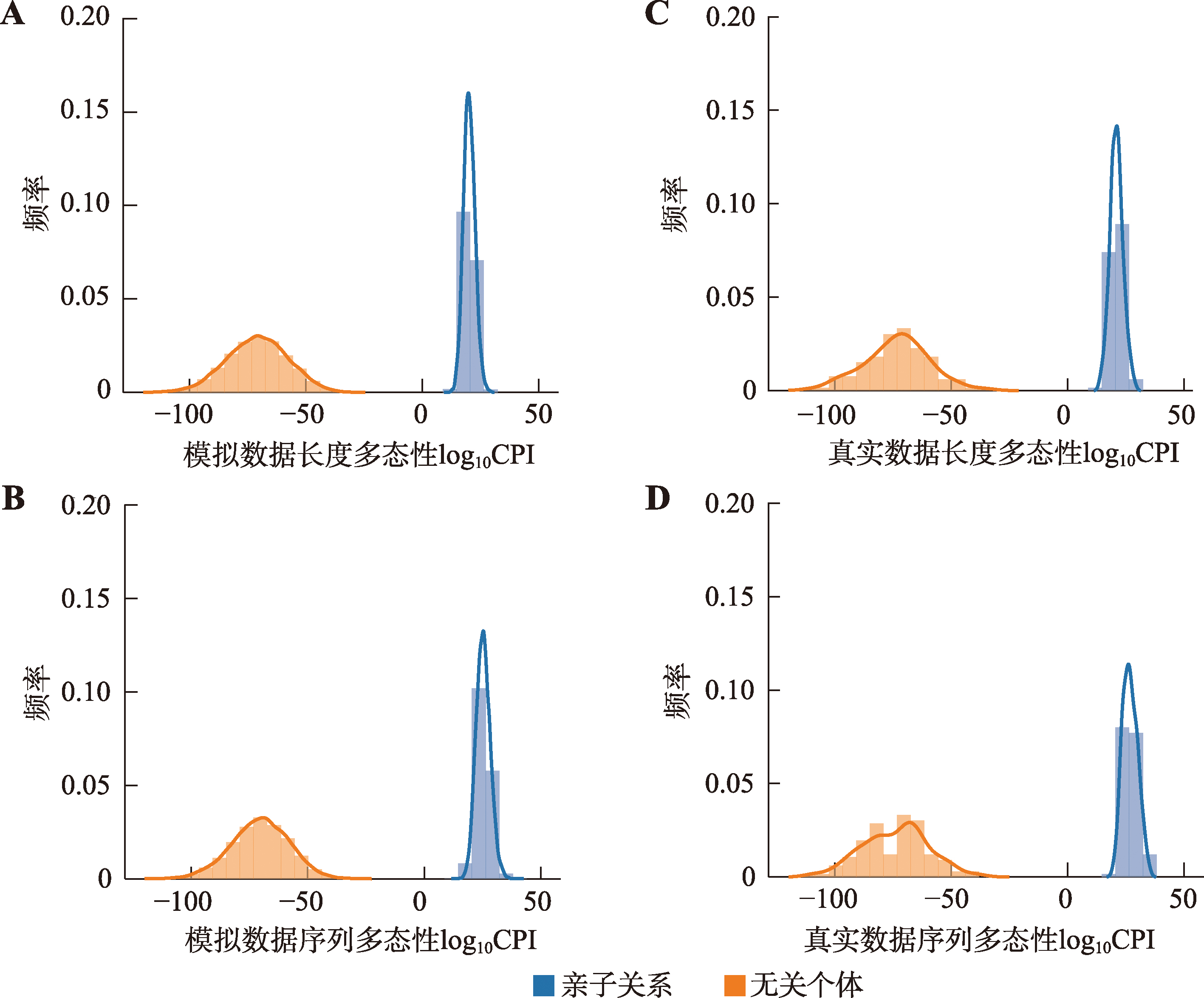
Forensic DNA technology is the method of choice for kinship identification. However, existing standard methods still have certain limitations in accurately determining the range of kinship relationships. China’s independently developed second generation sequencing technology and equipment are expected to enhance the capability of forensic DNA kinship identification. In this study, we utilized the STRSeqTyper122 second generation sequencing STR typing kit and the FASTASeq 300 second generation sequencer to analyze 107 real kinship samples. The analysis included 63 autosomal STR loci, 42 Y-STR loci, 16 X-STR loci, and one gender-determining locus, Amel. The samples covered various kinship relationships, including 113 parent-child pairs, 48 full-sibling pairs, 76 uncle-nephew pairs, 66 grandparent-grandchild pairs, and 4 half-sibling pairs. Combined with simulated data, the ITO method was applied to calculate the cumulative likelihood ratio (CLR) for different levels of kinship based on the length polymorphism and sequence polymorphism of autosomal STR loci, systematically evaluating the practical application performance of this system in kinship identification. The results showed that, using log10CLR values of 4 and −4 as thresholds, the system achieved 100% efficiency in identifying real parent-child and full-sibling relationships. For second degree kinship identification, the system efficiency based on simulated length polymorphism data was 55.2%, while sequence polymorphism improved it to 75.11%. For real sample data, length polymorphism based efficiency was 54.45%, and sequence polymorphism based efficiency reached 76.71%. The findings indicate that the STRSeqTyper122 kit holds significant value in first degree kinship identification. Sequence polymorphism can improve second degree kinship identification efficiency to over 75%.
Zhi Chen , Yaosen Feng , Hui Xu , Qingzhen Meng , Chi Zhang , Kelai Kang , Shiyu Tong , Zhe Zhang , Jian Ye , Le Wang . Application efficacy evaluation of the STRSeqTyper122 kit and the FASTASeq 300 second generation sequencer in kinship identification[J]. Hereditas(Beijing), 2026 , 48(9) : 878 -891 . DOI: 10.16288/j.yczz.25-241
| [1] | Li M, Li SY, Zhang BB, Lin ZQ. Research progress on complex kinship analysis. Journal of Forensic Medicine, 2020, 36(5): 691-698. |
| 李梅, 李诗莹, 张倍倍, 林子清. 复杂亲缘关系鉴定的研究进展. 法医学杂志, 2020, 36(5): 691-698. | |
| [2] | 司法鉴定科学研究院, 四川大学华西基础医学与法医学院, 北京市公安局, 中山大学., 亲权鉴定技术规范: GB/T 37223-2018. 北京: 中国标准出版社, 2018. |
| [3] | 司法鉴定科学研究院, 中山大学, 复旦大学, 四川大学, 河北医科大学, 北京市公安局, 最高人民检察院检察技术信息研究中心. 生物学全同胞关系鉴定技术规范: GB/T 43641-2024. 北京: 中国标准出版社, 2024. |
| [4] | 司法鉴定科学研究院, 中山大学, 复旦大学, 河北医科大学, 四川大学, 北京市公安局. 生物学半同胞关系鉴定技术规范:SF/T 0131-2023. 北京: 中国标准出版社, 2023. |
| [5] | Nothnagel M, Schmidtke J, Krawczak M. Potentials and limits of pairwise kinship analysis using autosomal short tandem repeat loci. Int J Legal Med, 2010, 124(3): 205-215. |
| [6] | Zhang QZ, Zhou Z, Wang L, Quan C, Liu QQ, Tang ZB, Liu LY, Liu YC, Wang SQ. Pairwise kinship testing with a combination of STR and SNP loci. Forensic Sci Int Genet, 2020, 46: 102265. |
| [7] | Xu QN, Wang ZW, Kong QQ, Wang XX, Huang A, Li CT, Liu XL. Improving the system power of complex kinship analysis by combining multiple systems. Forensic Sci Int Genet, 2022, 60: 102741. |
| [8] | Carboni I, Iozzi S, Nutini AL, Torricelli F, Ricci U. Improving complex kinship analyses with additional STR loci. Electrophoresis, 2014, 35(21-22): 3145-3151. |
| [9] | Wen SB, Chen M, Kong QQ, Huang A, Wang ZW, Xu QN, Liu XL. Systematically improving the efficiency of complex kinship identification through the addition of genetic markers and reference individuals. Int J Legal Med, 2025, 139(4): 1-15. |
| [10] | Aly SM, Sabri DM. Next generation sequencing (NGS): a golden tool in forensic toolkit. Arch Med Sadowej Kryminol, 2016, 65(4): 260-271. |
| [11] | Wang L, Ji AQ, Ye J. Progress and prospects on next generation sequencing-based full resolution STR genotyping. Chin J Forensic Med, 2017, 32(2): 159-163+167. |
| 王乐, 季安全, 叶健. 基于下一代测序的全解析度STR分型研究进展与展望. 中国法医学杂志, 2017, 32(02): 159-163+167. | |
| [12] | Wang L, Ye J, Bai X, Yang F, Zhao XC. Next generation sequencing and its application in forensic genetics. Forensic Sci Technol, 2015, 40(5): 353-358. |
| 王乐, 叶健, 白雪, 杨帆, 赵兴春. 二代测序技术及其在法医遗传学中的应用. 刑事技术, 2015, 40(5): 353-358. | |
| [13] | 公安部鉴定中心, 四川大学, 中国科学院北京基因组研究所(国家生物信息中心), 河北医科大学, 中山大学, 国家毒品实验室广东分中心, 辽宁省公安厅, 北京生物医药研究所, 北京市公安局, 中国政法大学, 北京爱普益生物科技有限公司, 序列多态STR等位基因命名规则: GB/T 44393-2024. 北京: 中国标准出版社, 2024. |
| [14] | Miao L, Kang KL, Zhang C, Liu S, Jiao RL, Yuan L, Wang L. Sequence features of forensic core short tandem repeat loci. Hereditas (Beijing), 2025, 47(11): 1214-1230. |
| 缪磊, 康克莱, 张驰, 刘爽, 焦瑞莲, 袁丽, 王乐. 法庭科学核心STR基因座的序列特征. 遗传, 2025, 47(11): 1214-1230. | |
| [15] | Li CY, Fan X, Guo X, Liu YF, Wang M, Zhao XC, Wu P, Yan Q, Sun L. Accuracy benchmark of the GeneMind GenoLab M sequencing platform for WGS and WES analysis. BMC Genomics, 2022, 23(1): 533. |
| [16] | Meng X, Wang M, Luo MJ, Sun L, Yan Q, Liu YF. Systematic evaluation of multiple NGS platforms for structural variants detection. J Biol Chem, 2023, 299(12): 105436. |
| [17] | Guo LL, Yuan JH, Zhang C, Zhao J, Yao YR, Guo KL, Meng Y, Ji AQ, Kang KL, Wang L. Developmental validation of the STRSeqTyper122 kit for massively parallel sequencing of forensic STRs. Int J Legal Med, 2024, 138(4): 1255-1264. |
| [18] | Miao L, Liu S, Pan KP, Jiao RL, Zhang Q, Xu TY, Tong SY, Kang KL, Zhao J, Zhang C, Wang KD, Ji AQ, Wu J, Wang L. Improved understanding of sequence polymorphisms at 42 Y chromosome short tandem repeats for the Chinese Han population. Forensic Sci Int Genet, 2025, 75: 103181. |
| [19] | Zhang JP, Zhao GB, Hao SC, Chen C, Shi Y, Xiao XY, Wang L, Yuan L. A case of two full sisters share identical genotypes on the X chromosome. J Forensic Sci Med, 2024, 10(3): 255-260. |
| [20] | 公安部鉴定中心, 四川大学, 中国医学科学院阜外医院, 广东省公安厅, 中央军委政法委员会侦查技术中心, 中国政法大学, 北京生物医药研究所. 法庭科学DNA二代测序检验规范: GB/T 43636-2024. 北京: 中国标准出版社, 2024. |
| [21] | Zhao SM, Zhang SH, Que TZ, Zhao ZM, Lin Y, Li L, Li CT. Establishment of universal algorithms for commonly used kinship indices between two individuals. Journal of Forensic Medicine, 2011, 27(5): 330-333. |
| 赵书民, 张素华, 阙庭志, 赵珍敏, 林源, 李莉, 李成涛. 两个个体间常用亲缘关系指数的统一算法. 法医学杂志, 2011, 27(5): 330-333. | |
| [22] | Pan KP. Study on sequence polymorphism of 122 STR loci in Chinese Han population[Dissertation]. Kunming Medical University, 2023. |
| 潘坤鹏. 中国汉族人群122个STR基因座序列多态性研究[学位论文]. 昆明医科大学, 2023. | |
| [23] | 陆惠玲, 杨庆恩. 用ITO法计算两个体间的血缘关系机会. 中国法医学杂志, 2002, 17(3): 188-191. |
| [24] | Li R, Li CT, Zhao SM, Li HX, Li L, Wu RG, Zhang CC, Sun HY. Full sibling identification by IBS scoring method and establishment of the query table of its critical value. Journal of Forensic Medicine, 2017, 33(2): 136-140+147. |
| 李燃, 李成涛, 赵书民, 李海霞, 李莉, 乌日嘎, 张楚楚, 孙宏钰. IBS评分法鉴定全同胞关系及其临界值查询表的构建. 法医学杂志, 2017, 33(2): 136-140+147. | |
| [25] | Liao Y, Wu F, Hou DL, Wu YL, Tao H, Li CT, Wan HJ. Application of multiple genetic markers in determination of full and half sibling relationship: a case report. Journal of Forensic Medicine. 2019, 35(3): 319-323. |
| 廖勇, 吴峰, 侯东林, 吴艳玲, 陶欢, 李成涛, 万华靖. 应用多种遗传标记甄别全同胞和半同胞关系1例. 法医学杂志, 2019, 35(3): 319-323. | |
| [26] | Lu HL, Zhou KW, Lv DJ, Yao YN, Zhang YQ. Application of ITO method and discriminant functions in full sibling and half sibling identification. Journal of Forensic Medicine, 2009, 25(2): 118-122. |
| 陆惠玲, 周科伟, 吕德坚, 姚亚楠, 章雅清. ITO法和判别函数法在同胞关系鉴定中的应用. 法医学杂志, 2009, 25(2): 118-122. | |
| [27] | Peng JJ, Guo LL, Wu H, Zhang C, Zhao J, Kang KL, Ji AQ, Wang L. Correlation study between TC ratios of STR loci and the forward/reverse sequencing depths in next generation sequencing. Life Sci Instrum, 2022, 20(5): 39-45. |
| 彭加金, 郭立亮, 吴浩, 张驰, 赵杰, 康克莱, 季安全, 王乐. STR基因座TC比例与二代测序正反向深度关联研究. 生命科学仪器, 2022, 20(5): 39-45. | |
| [28] | Tillmar AO, Kling D, Butler JM, Parson W, Prinz M, Schneider PM, Egeland T, Gusmão L. DNA commission of the International Society for Forensic Genetics (ISFG): guidelines on the use of X-STRs in kinship analysis. Forensic Sci Int Genet, 2017, 29: 269-275. |
| [29] | 公安部鉴定中心, 浙江省公安厅, 北京市公安局, 江苏省公安厅, 广东省公安厅. 法庭科学 DNA数据库建设规范: GB/T 21679-2023. 北京: 中国标准出版社, 2023. |
| [30] | Liu ZY, Ren H, Chen C, Zhang JJ, Zhang XM, Shi Y, Shi YL, Chen Y, Cheng F, Jia L, Chen M, Fan QW, Zhang JR, Li WT, Wang MC, Ren ZL, Liu YC, Ni M, Sun HY, Yan JW. Actual mutational research of 19 autosomal STRs based on restricted mutation model and big data. Hereditas(Beijing), 2021, 43(10): 949-961. |
| 刘志勇, 任贺, 陈冲, 张京晶, 张晓梦, 石妍, 石林玉, 陈滢, 程凤, 贾莉, 陈曼, 范庆炜, 张家榕, 李万婷, 王萌春, 任子林, 刘雅诚, 倪铭, 孙宏钰, 严江伟. 基于有限突变模型和大规模数据的19个常染色体STR的实际突变率研究. 遗传, 2021, 43(10): 949-969. | |
| [31] | 许晓芝, 王晓珊, 孔庆千. 广东惠州汉族人群4016例亲子案例STR基因突变分析. 广东公安科技, 2025, 33(2): 34-36. |
| [32] | Han W, Zhang QZ, Yang J, Zhou Z. A DNA typing panel of 201 genetic markers for degraded samples: development and validation. Hereditas(Beijing), 2024, 46(4): 306-318. |
| 韩伟, 张庆珍, 杨静, 周喆. 适用于降解样本的201个遗传标记检测体系的构建和验证. 遗传, 2024, 46(4): 306-318. | |
| [33] | Tan LS, Jin X, Feng YS, Kang KL, Ma WH, Li MG, Zhang C, Zhao J, Ye J, Wang L. Evaluating the application efficiency of the MHSeqTyper 47 kit in kinship identification. Chin J Forensic Med, 2024, 39(1): 75-81. |
| 檀莉帅, 金鑫, 冯耀森, 康克莱, 马温华, 李明广, 张驰, 赵杰, 叶健, 王乐. MHSeq Typer47试剂盒在亲缘关系鉴定中的应用效能评估. 中国法医学杂志, 2024, 39(1): 75-81. | |
| [34] | Zhen XY, Wen SB, Yang F, Xia RC, Lai JH, Li CT, Tao RY. Improved second-degree kinship analysis using the FGID forensic four-in-one DNA typing kit. Int J Legal Med, 2025, 139(5): 2159-2163. |
| [35] | Li X, Wang HY, Cao YY, Zhu Q, Shu PY, Hou TY, Wang YT, Zhang J. Forensic genomics research on microhaplotypes. Hereditas(Beijing), 2021, 43(10): 962-971. |
| 李茜, 王浩宇, 曹悦岩, 朱强, 舒潘寅, 侯婷芸, 王雨婷, 张霁. 微单倍型遗传标记的法医基因组学研究. 遗传, 2021, 43(10): 962-971. |
/
| 〈 |
|
〉 |

www.chinagene.cn
备案号:京ICP备09063187号
