
Activation mechanism of the wheat CCG10-NLR immune receptor
Received date: 2026-03-31
Online published: 2026-03-31
Supported by
National Key Research and Development Program of China(2022YFF1001503);National Key Research and Development Program of China(2022YFF1002800);National Natural Science Foundation of China(U21A20224)
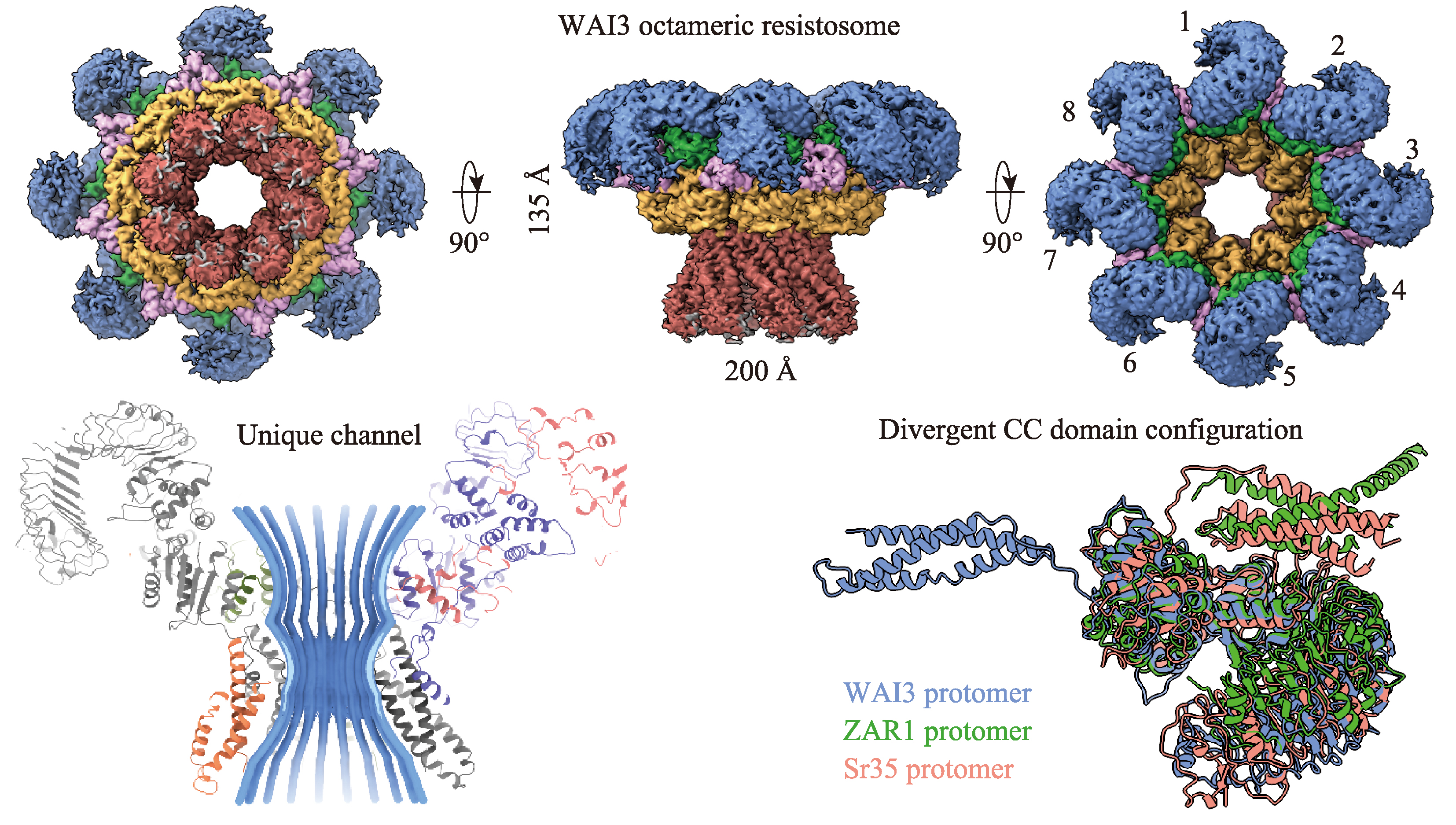
Plants rely on nucleotide-binding, leucine-rich repeat (NLR) receptors to recognize effector proteins, activating immune responses. In recent years, researchers have elucidated the structures of various plant NLR resistosomes. However, the activation mechanism of the evolutionarily ancient and widely distributed CCG10-NLR phylogenetic clade has remained elusive. To investigate this scientific question, the research group led by Zhiyong Liu from Institute of Genetics and Developmental Biology, Chinese Academy of Sciences, in collaboration with multiple research groups, identified the wheat spontaneous immunity gene wheat autoimmunity 3 (WAI3), which encodes a CCG10-NLR protein. Cryo-electron microscopy (cryo-EM) analysis reveals that that activated WAI3 assembles into a distinctive octameric resistosome, which triggers sustained calcium influx. The homologous CCG10-NLR protein RPS2 in Arabidopsis was also shown to form an octamer and induce calcium influx, indicating that this mechanism is conserved in both monocot and dicot plants. Furthermore, the WAI3 resistosome exhibits a unique conformation of the coiled-coil (CC) domain, which may be associated with the absence of the EDVID (Glu-Asp-Val-Ile-Asp) motif in the CC domain of CCG10-NLRs. This study reveals a novel mechanism of resistosome assembly and immune signal transduction in plant CCG10-NLR proteins, broadening the understanding of the diversity and plasticity of plant immune receptors.
Key words: plant immunity; CCG10-NLR; WAI3; octameric resistosome; wheat autoimmunity
Guanghao Guo, Zhiyong Liu . Activation mechanism of the wheat CCG10-NLR immune receptor[J]. Hereditas(Beijing), 2026 , 48(5) : 447 -450 . DOI: 10.16288/j.yczz.26-082
| [1] | Jones JDG, Dangl JL.The plant immune system. Nature, 2006, 444(7117): 323-329. |
| [2] | Jones JDG, Staskawicz BJ, Dangl JL. The plant immune system: from discovery to deployment. Cell, 2024, 187(9): 2095-2116. |
| [3] | Wang JZ, Hu MJ, Wang J, Qi JF, Han ZF, Wang GX, Qi YJ, Wang HW, Zhou JM, Chai JJ. Reconstitution and structure of a plant NLR resistosome conferring immunity. Science, 2019, 364(6435): eaav5870. |
| [4] | Ma SC, Lapin D, Liu L, Sun Y, Song W, Zhang XX, Logemann E, Yu DL, Wang J, Jirschitzka J, Han ZF, Schulze-Lefert P, Parker JE, Chai JJ. Direct pathogen- induced assembly of an NLR immune receptor complex to form a holoenzyme. Science, 2020, 370(6521): eabe3069. |
| [5] | Martin R, Qi TC, Zhang HB, Liu FR, King M, Toth C, Nogales E, Staskawicz BJ. Structure of the activated ROQ1 resistosome directly recognizing the pathogen effector XopQ. Science, 2020, 370(6521): eabd9993. |
| [6] | Maruta N, Gu WX, Lim BYJ, Sorbello M, Ngu DHY, Jobichen C, Nanson JD, Li Y, Chen J, Outram MA, Bernoux M, Rahman M, Vu TD, Xu HY, Wang L, Kwah K, Burdett H, Mobli M, Ve T, Ellis JG, Anderson PA, Williams SJ, Dodds PN, Kobe B. Structural basis of canonical TIR-NLR activation in plant innate immunity. bioRxiv, 2026, doi: 10.64898/2026.02.03.703613. |
| [7] | Zhao H, Szymansky CM, Lyu X, Huang JH, Derbyshire P, Menke FLH, Webster MW, Kamoun S, Selvaraj M, Jones JDG. Structural basis for the broad recognition specificity of an Arabidopsis immune receptor. bioRxiv, 2026, doi: 10.64898/2026.02.04.703898. |
| [8] | Förderer A, Li ET, Lawson AW, Deng YN, Sun Y, Logemann E, Zhang XX, Wen J, Han ZF, Chang JB, Chen YH, Schulze-Lefert P, Chai JJ. A wheat resistosome defines common principles of immune receptor channels. Nature, 2022, 610(7932): 532-539. |
| [9] | Zhao YB, Liu MX, Chen TT, Ma XM, Li ZK, Zheng ZC, Zheng SR, Chen LF, Li YZ, Tang LR, Chen Q, Wang PY, Ouyang SY. Pathogen effector AvrSr35 triggers Sr35 resistosome assembly via a direct recognition mechanism. Sci Adv, 2022, 8(36): eabq5108. |
| [10] | Liu FR, Yang ZL, Wang C, You Z, Martin R, Qiao WJ, Huang J, Jacob P, Dangl JL, Carette JE, Luan S, Nogales E, Staskawicz BJ. Activation of the helper NRC4 immune receptor forms a hexameric resistosome. Cell, 2024, 187(18): 4877-4889.e15. |
| [11] | Madhuprakash J, Toghani A, Contreras MP, Posbeyikian A, Richardson J, Kourelis J, Bozkurt TO, Webster MW, Kamoun S. A disease resistance protein triggers oligomerization of its NLR helper into a hexameric resistosome to mediate innate immunity. Sci Adv, 2024, 10(45): eadr2594. |
| [12] | Bi GZ, Su M, Li N, Liang Y, Dang S, Xu JC, Hu MJ, Wang JZ, Zou MX, Deng YN, Li QY, Huang SJ, Li JJ, Chai JJ, He KM, Chen YH, Zhou JM. The ZAR1 resistosome is a calcium-permeable channel triggering plant immune signaling. Cell, 2021, 184(13): 3528-3541. e12. |
| [13] | Seo E, Kim S, Yeom SI, Choi D. Genome-wide comparative analyses reveal the dynamic evolution of nucleotide-binding leucine-rich repeat gene family among Solanaceae plants. Front Plant Sci, 2016, 7: 1205. |
| [14] | Sulkowski O, Ovodova A, Leisse A, Gögelein K, Förderer A. Diversification of the “EDVID” packing motif underpins structural and functional variation in plant NLR coiled-coil domains. bioRxiv, 2025, doi: 10.1101/2025.06.01.657260. |
| [15] | Wróblewski T, Spiridon L, Martin EC, Petrescu AJ, Cavanaugh K, Truco MJ, Xu HQ, Gozdowski D, Pawłowski K, Michelmore RW, Takken FLW. Genome- wide functional analyses of plant coiled-coil NLR-type pathogen receptors reveal essential roles of their N-terminal domain in oligomerization, networking, and immunity. PLoS Biol, 2018, 16(12): e2005821. |
| [16] | Guo GH, Zhao H, Bai KH, Lu J, Wu QH, Lu L, Zhang Y, Dong LL, Li GW, Chen YX, Hou YK, Lu P, Li MM, Zhang HZ, Wang GJ, Zhu KY, Huang BG, Cui XJ, Fu HK, Hu CC, Chu ZY, Lyu X, Kamoun S, Wang C, Liu ZY, Selvaraj M, Jones JDG. An activated wheat CCG10-NLR immune receptor forms an octameric resistosome. Cell, 2026, doi: 10.1016/j.cell.2026.02.024. |
| [17] | Lu P, Zhang GH, Li J, Gong Z, Wang GJ, Dong LL, Zhang HZ, Guo GH, Su M, Wang K, Wang YM, Zhu KY, Wu QH, Chen YX, Li MM, Huang BG, Li BB, Li WL, Dong L, Hou YK, Cui XJ, Fu HK, Qiu D, Yuan CG, Li HJ, Zhou JM, Han GZ, Chen YH, Liu ZY. A wheat tandem kinase and NLR pair confers resistance to multiple fungal pathogens. Science, 2025, 387(6741): 1418-1424. |
/
| 〈 |
|
〉 |

www.chinagene.cn
备案号:京ICP备09063187号
