Hereditas(Beijing) ›› 2026, Vol. 48 ›› Issue (6): 570-588.doi: 10.16288/j.yczz.25-287
• Research Article • Previous Articles Next Articles
SNP density impact on kinship inference and IBS-machine learning optimization
Lv Dai1,2( ), Zichen Tang3, Zhen Jia1,2, Li Jiang2, Chuantong Zhao1,2, Zhiyuan Zhao1,2, Wenting Zhao2(), Caixia Li1,2()
- 1
School of Criminal Investigation ,People’s Public Security University of China Beijing 100038, China
2Beijing Engineering Research Center of Crime Scene Evidence Examination ,National Engineering Laboratory for Forensic Science, Institute of Forensic Science Beijing 100038, China
3School of Life Sciences ,Jiangsu Normal University Xuzhou 221116, China
-
Received:2025-12-08Revised:2026-02-05Online:2026-06-20Published:2026-02-12 -
Contact:Wenting Zhao, Caixia Li E-mail:1130039162@qq.com;wtzhao@sibs.ac.cn;licaixia@tsinghua.org.cn -
Supported by:Fundamental Research Funds for Institute of Forensic Science(2024JB043);Fundamental Research Funds for Institute of Forensic Science(2024JB026);National Natural Science Foundation of China(82171870);Beijing Nova Program of Science and Technology(20220484149)

Cite this article
Lv Dai, Zichen Tang, Zhen Jia, Li Jiang, Chuantong Zhao, Zhiyuan Zhao, Wenting Zhao, Caixia Li. SNP density impact on kinship inference and IBS-machine learning optimization[J]. Hereditas(Beijing), 2026, 48(6): 570-588.
share this article
Add to citation manager EndNote|Reference Manager|ProCite|BibTeX|RefWorks
Table 1
IBS kinship inference criteria"
| 亲缘关系 | 亲缘关系系数 | 推断标准 | 零IBD共享统计量 | 推断标准 |
|---|---|---|---|---|
| MZ | > | 0 | <0.1 | |
| PO | ( | 0 | <0.1 | |
| FS | ( | (0.1, 0.365) | ||
| 2nd | ( | (0.365, 1 | ||
| 3rd | ( | (1 | ||
| 4th | ( | (1 | ||
| 5th | ( | (1 | ||
| 6th | ( | (1 | ||
| 7th | ( | (1 | ||
| UN | 0 | ≤0 | 1 | 1 |
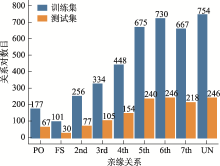
Fig. 1
Sample distribution of machine learning training and test sets"
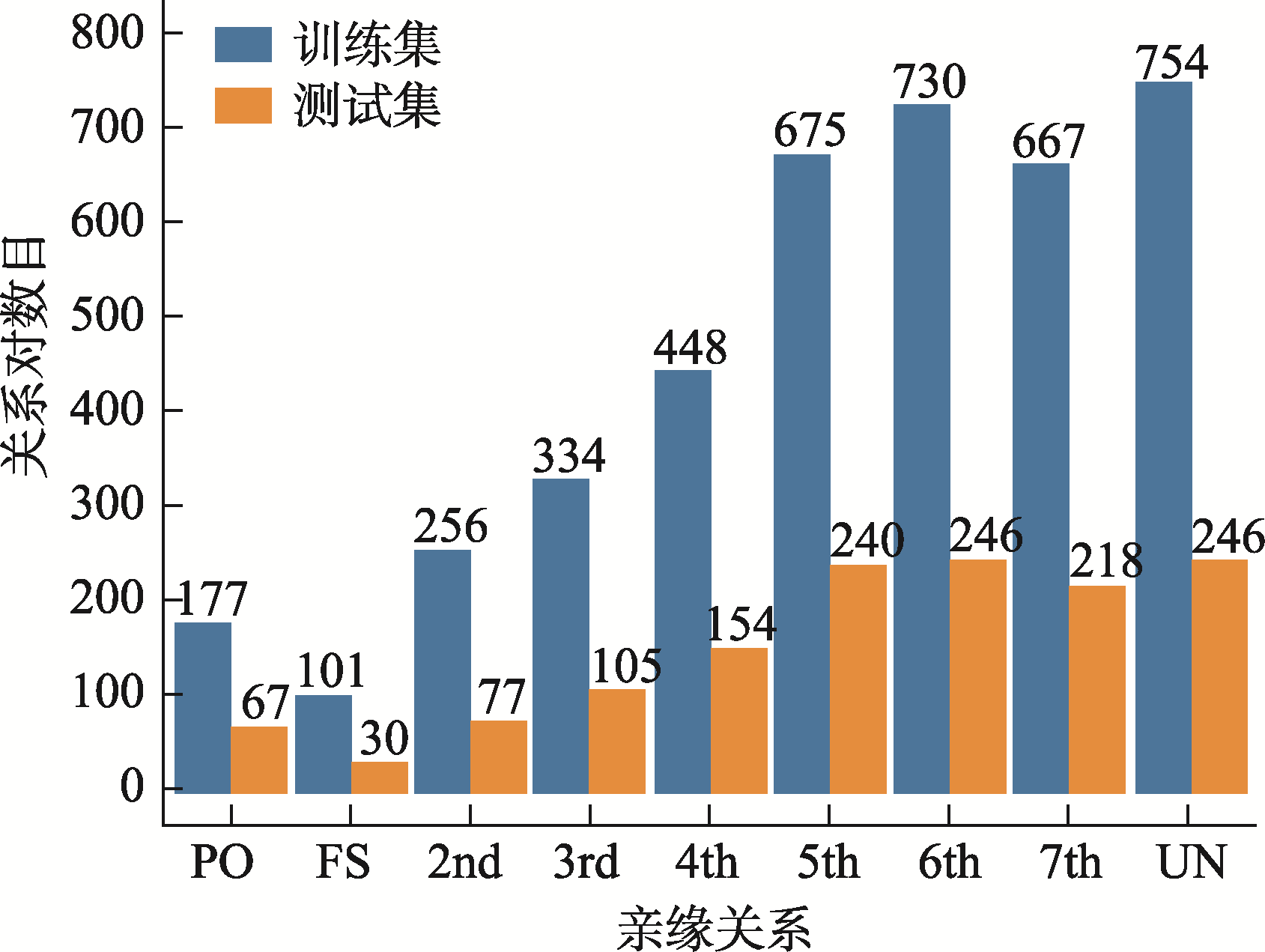
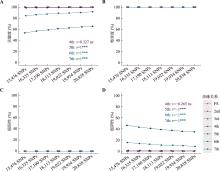
Fig. 2
Correlation analysis of LR method inference efficiency and SNP number"
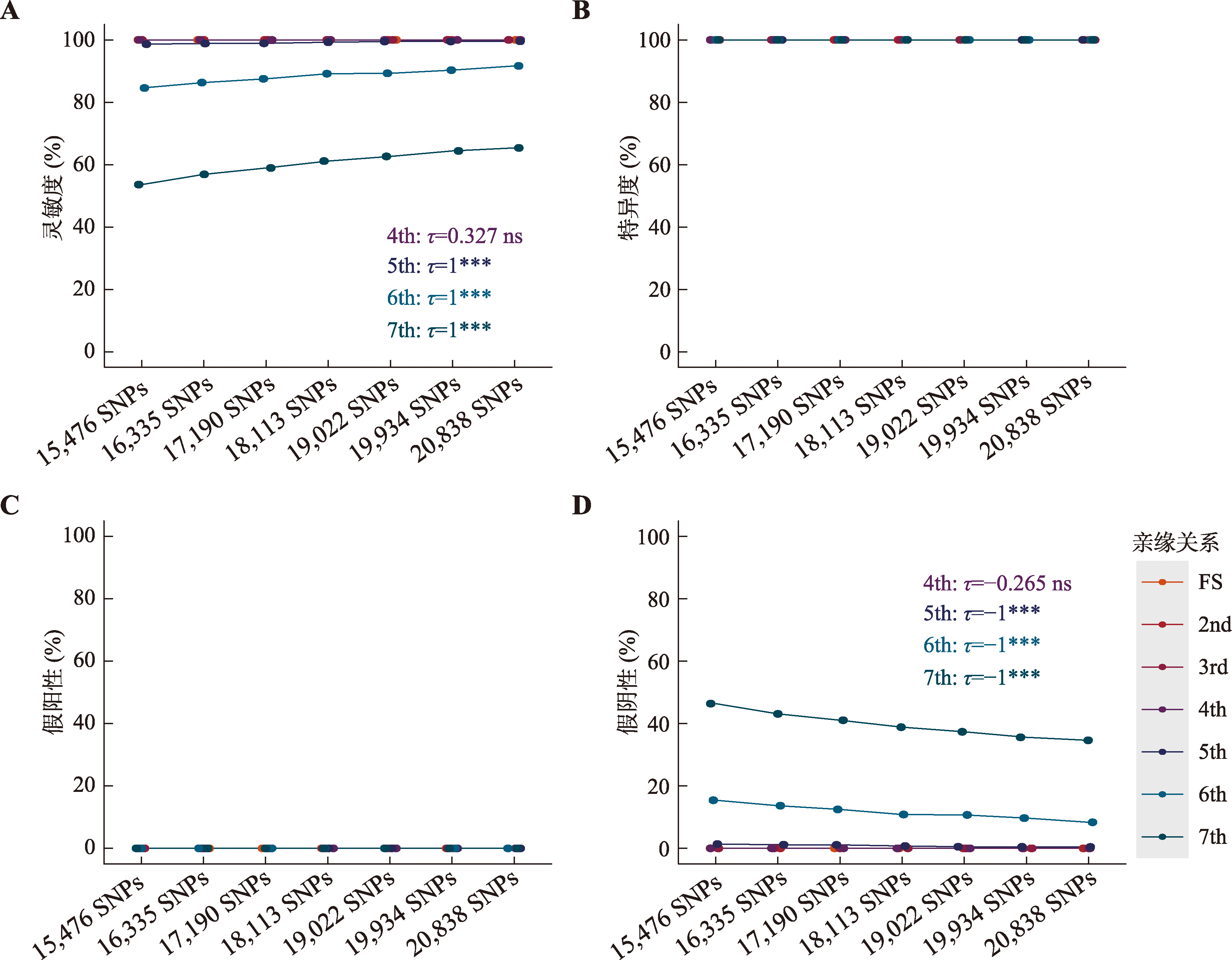
Fig. 3
Distribution of log10LR values across different kinship degrees in simulated pedigrees A:FS;B:2nd;C:3rd;D:4th;E:5th;F:6th;G:7th。"
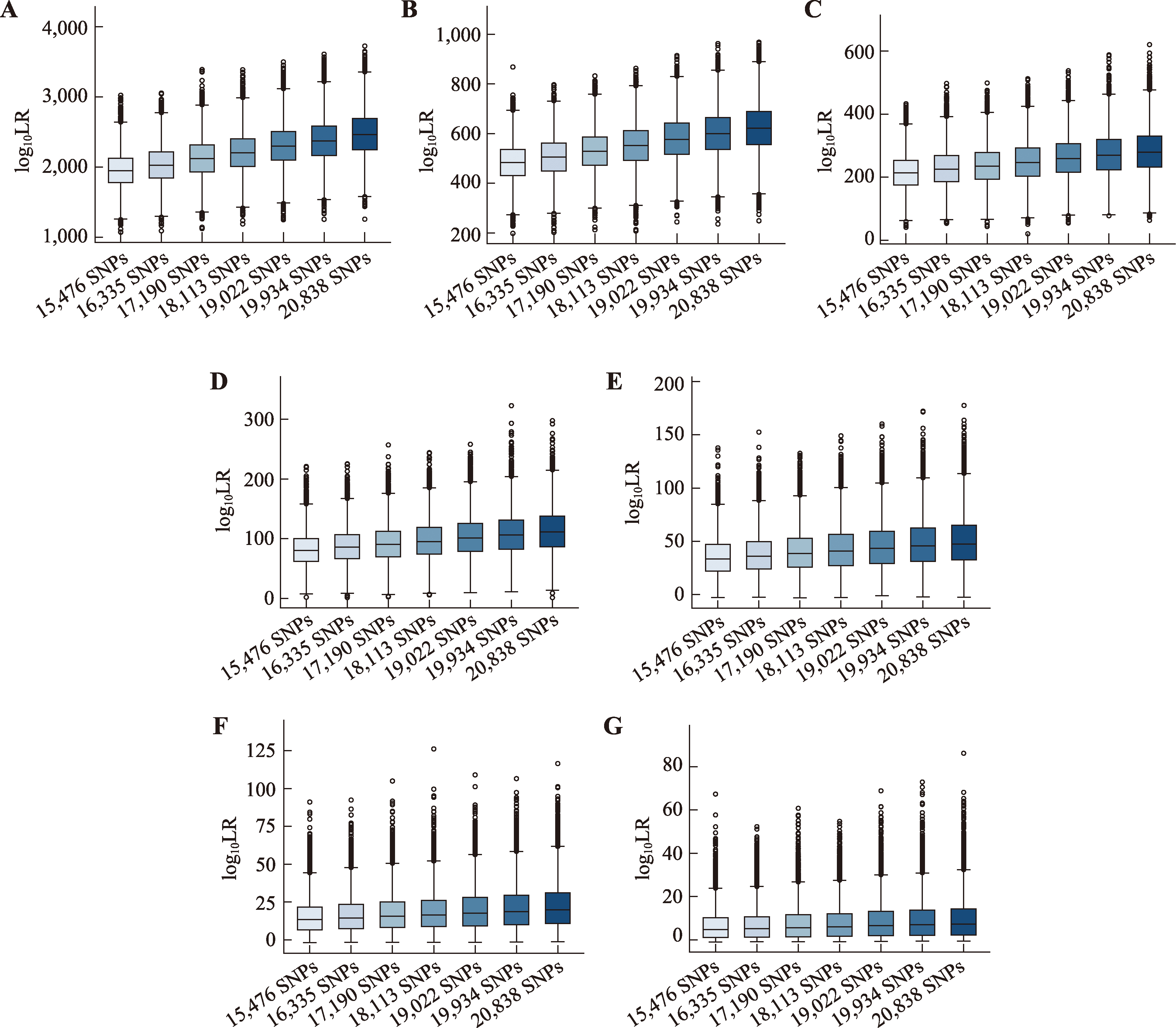
Table 2
Statistic of log10LR values distribution across seven SNP panels in different kinship degrees"
| SNP panel | 亲缘关系 | 最小值 | 最大值 | 中位数 | 四分位差 |
|---|---|---|---|---|---|
| 15,476 SNPs | FS | 1,072.95 | 3,024.46 | 1,947.54 | 345.67 |
| 2nd | 198.14 | 868.27 | 483.15 | 105.27 | |
| 3rd | 41.03 | 432.76 | 214.26 | 77.44 | |
| 4th | 2.14 | 221.04 | 80.55 | 38.53 | |
| 5th | -2.73 | 137.78 | 33.42 | 25.07 | |
| 6th | -1.89 | 91.12 | 13.44 | 15.10 | |
| 7th | -1.01 | 67.31 | 4.65 | 9.13 | |
| 16,335 SNPs | FS | 1,092.61 | 3,055.49 | 2,029.01 | 372.75 |
| 2nd | 202.07 | 796.77 | 505.16 | 112.90 | |
| 3rd | 53.98 | 497.24 | 225.83 | 82.32 | |
| 4th | 1.54 | 225.36 | 85.95 | 40.29 | |
| 5th | -2.53 | 152.54 | 36.09 | 25.72 | |
| 6th | -1.71 | 92.45 | 14.37 | 16.23 | |
| 7th | -0.96 | 52.27 | 5.10 | 9.34 | |
| 17,190 SNPs | FS | 1,124.99 | 3,391.81 | 2,123.87 | 382.52 |
| 2nd | 212.60 | 832.31 | 528.93 | 114.69 | |
| 3rd | 43.67 | 498.70 | 235.10 | 84.76 | |
| 4th | 2.72 | 257.00 | 90.38 | 42.63 | |
| 5th | -3.13 | 132.66 | 38.51 | 27.04 | |
| 6th | -1.65 | 104.99 | 15.60 | 17.00 | |
| 7th | -0.97 | 60.74 | 5.58 | 10.12 | |
| 18,113 SNPs | FS | 1,190.91 | 3,388.22 | 2,203.48 | 393.76 |
| 2nd | 208.09 | 862.78 | 551.54 | 120.46 | |
| 3rd | 20.75 | 512.22 | 246.60 | 88.67 | |
| 4th | 5.86 | 244.06 | 95.36 | 44.32 | |
| 5th | -2.74 | 149.03 | 41.03 | 29.33 | |
| 6th | -1.52 | 126.21 | 16.50 | 17.35 | |
| 7th | -0.86 | 54.70 | 6.02 | 10.36 | |
| 19,022 SNPs | FS | 1,251.28 | 3,499.48 | 2,302.01 | 407.16 |
| 2nd | 244.14 | 914.15 | 577.05 | 125.82 | |
| 3rd | 55.03 | 537.41 | 259.37 | 91.19 | |
| 4th | 9.56 | 258.09 | 101.22 | 46.68 | |
| 5th | -0.97 | 160.18 | 43.36 | 30.33 | |
| 6th | -1.57 | 109.03 | 17.75 | 18.81 | |
| 7th | -0.77 | 68.84 | 6.60 | 11.27 | |
| 19,934 SNPs | FS | 1,257.21 | 3,610.17 | 2,371.70 | 421.40 |
| 2nd | 235.84 | 962.51 | 600.05 | 127.67 | |
| 3rd | 78.03 | 587.94 | 269.73 | 95.92 | |
| 4th | 11.21 | 322.68 | 106.23 | 48.72 | |
| 5th | -2.28 | 172.12 | 45.85 | 31.39 | |
| 6th | -1.46 | 106.58 | 18.58 | 19.38 | |
| 7th | -0.66 | 72.88 | 6.90 | 11.54 | |
| 20,838 SNPs | FS | 1,259.09 | 3,726.38 | 2,466.37 | 445.04 |
| 2nd | 248.86 | 967.85 | 622.00 | 133.54 | |
| 3rd | 63.64 | 620.12 | 279.62 | 97.89 | |
| 4th | 1.51 | 297.68 | 111.32 | 51.26 | |
| 5th | -2.49 | 177.54 | 47.33 | 32.46 | |
| 6th | -1.26 | 116.53 | 19.80 | 20.38 | |
| 7th | -0.62 | 86.17 | 7.24 | 12.06 |
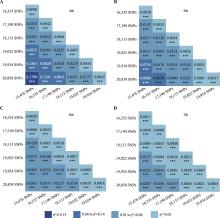
Fig. 4
Effect size analysis using η2 among SNP panels for each kinship degree in simulated pedigrees"
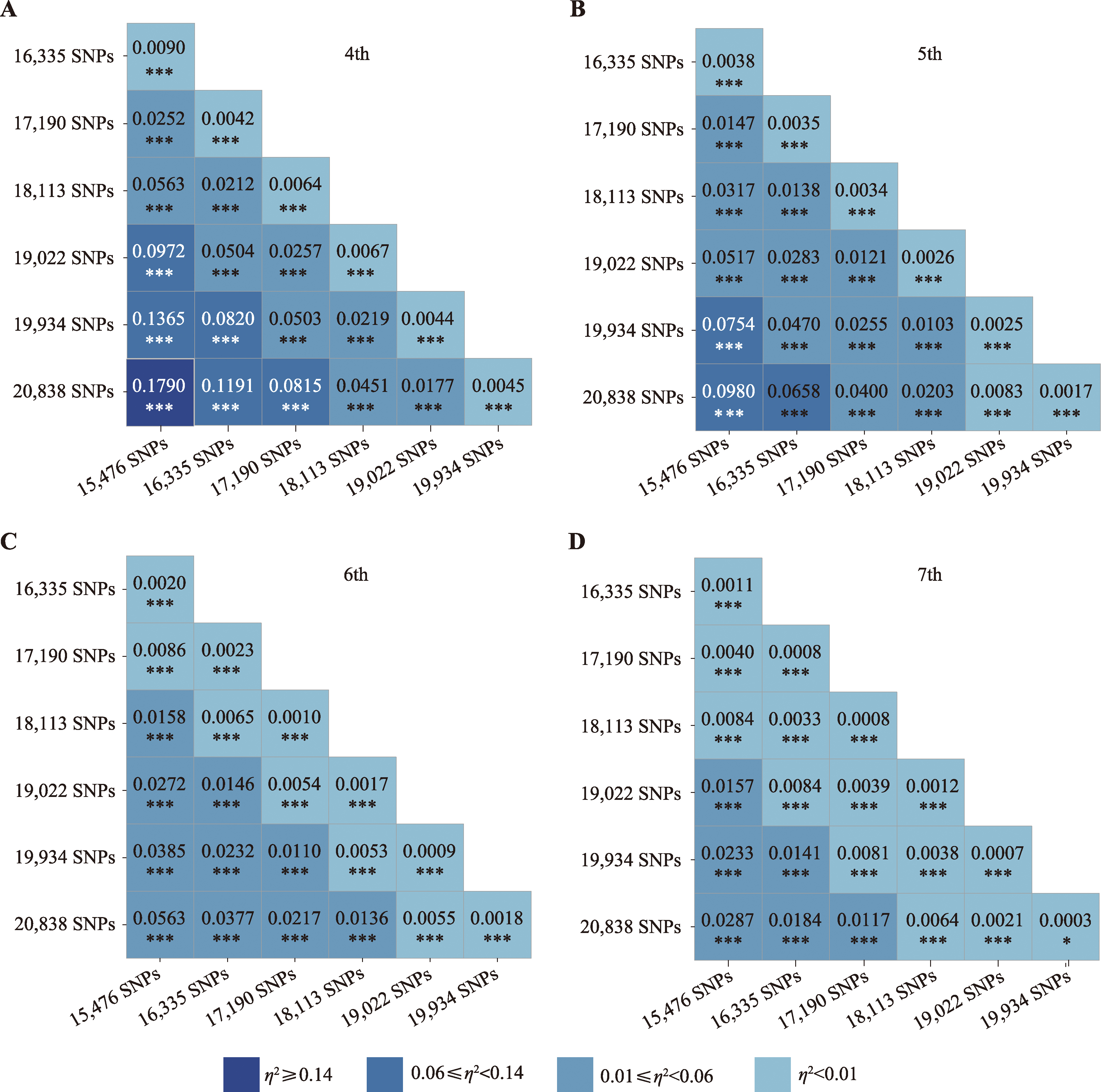
Fig. 5
Correlation analysis of IBS inference efficiency and SNP number"
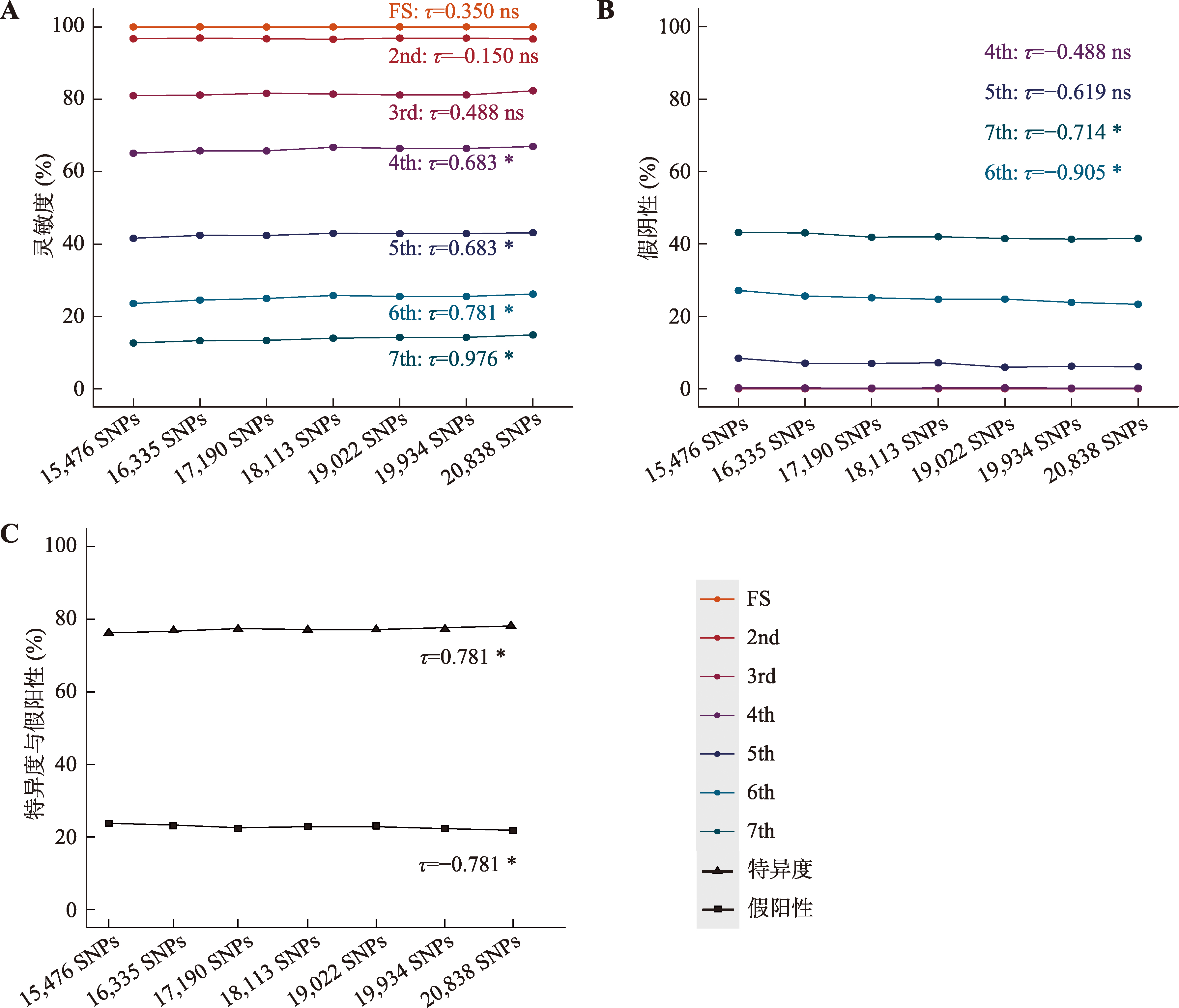
Table 3
Threshold-LR method performance metrics using 21K panel on real pedigrees"
| 亲缘关系 | t | 灵敏度(%) | 假阴性(%) | 特异度(%) | 假阳性(%) |
|---|---|---|---|---|---|
| FS/unrelated | 4 | 100.00 | 0.00 | 100.00 | 0.00 |
| 2nd/unrelated | 4 | 100.00 | 0.00 | 100.00 | 0.00 |
| 3rd/unrelated | 4 | 100.00 | 0.00 | 99.90 | 0.10 |
| 4th/unrelated | 4 | 100.00 | 0.00 | 99.80 | 0.20 |
| 5th/unrelated | 4 | 99.56 | 0.44 | 99.50 | 0.50 |
| 6th/unrelated | 4 | 93.65 | 6.35 | 99.30 | 0.70 |
| 3 | 95.49 | 4.51 | 99.20 | 0.80 | |
| 2 | 96.72 | 3.28 | 98.30 | 1.70 | |
| 1 | 97.85 | 2.15 | 95.40 | 4.60 | |
| 7th/unrelated | 4 | 68.70 | 31.30 | 99.30 | 0.70 |
| 3 | 74.24 | 25.76 | 98.90 | 1.10 | |
| 2 | 79.32 | 20.68 | 98.10 | 1.90 | |
| 1 | 86.21 | 13.79 | 93.60 | 6.40 |
Table 4
Maximum-LR method inference performance metrics using 21K panel on real pedigrees"
| 真实亲缘关系 | 推断亲缘关系 | 灵敏度(%) | 假阴性(%) | 特异度(%) | 假阳性(%) | ||||||||
|---|---|---|---|---|---|---|---|---|---|---|---|---|---|
| PO | FS | 2nd | 3rd | 4th | 5th | 6th | 7th | UN | |||||
| PO | 76 | 3 | 165 | 31.00 | 0.00 | ||||||||
| FS | 131 | 100.00 | 0.00 | ||||||||||
| 2nd | 7 | 316 | 9 | 1 | 94.89 | 0.00 | |||||||
| 3rd | 3 | 300 | 136 | 68.34 | 0.00 | ||||||||
| 4th | 46 | 549 | 7 | 91.20 | 0.00 | ||||||||
| 5th | 3 | 413 | 469 | 28 | 1 | 1 | 51.54 | 0.11 | |||||
| 6th | 16 | 566 | 312 | 58 | 24 | 31.97 | 2.46 | ||||||
| 7th | 5 | 126 | 407 | 226 | 121 | 35.70 | 13.67 | ||||||
| UN | 1 | 22 | 139 | 838 | 83.80 | 16.20 | |||||||
Table 5
IBS method performance metrics using 21K panel on real pedigrees"
| 真实亲缘关系 | 推断亲缘关系 | 灵敏度(%) | 假阴性(%) | 特异度(%) | 假阳性(%) | |||||||||
|---|---|---|---|---|---|---|---|---|---|---|---|---|---|---|
| PO | FS | 2nd | 3rd | 4th | 5th | 6th | 7th | >7th | UN | |||||
| PO | 244 | 100.00 | 0.00 | |||||||||||
| FS | 131 | 100.00 | 0.00 | |||||||||||
| 2nd | 323 | 10 | 97.00 | 0.00 | ||||||||||
| 3rd | 6 | 381 | 51 | 1 | 86.79 | 0.00 | ||||||||
| 4th | 36 | 416 | 123 | 13 | 7 | 2 | 5 | 69.10 | 0.83 | |||||
| 5th | 116 | 348 | 232 | 76 | 59 | 84 | 38.03 | 9.18 | ||||||
| 6th | 13 | 148 | 209 | 142 | 159 | 305 | 21.41 | 31.25 | ||||||
| 7th | 1 | 44 | 95 | 113 | 136 | 496 | 12.77 | 56.05 | ||||||
| UN | 17 | 64 | 97 | 133 | 689 | 68.90 | 31.10 | |||||||
Table 6
Performance of IBS-ML models for kinship inference in 5-fold cross-validation (mean±standard deviation)"
| IBS-ML | 评估参数 | PO (%) | FS (%) | 2nd (%) | 3rd (%) | 4th (%) | 5th (%) | 6th (%) | 7th (%) | UN (%) |
|---|---|---|---|---|---|---|---|---|---|---|
| IBS-XGBoost | 灵敏度 | 100.0±0.0 | 100.0±0.0 | 97.0±2.7 | 83.2±7.3 | 81.2±5.2 | 47.6±11.7 | 35.7±13.0 | 14.0±9.0 | |
| 假阴性 | 0.0±0.0 | 0.0±0.0 | 0.0±0.0 | 0.0±0.0 | 0.0±0.0 | 5.5±2.7 | 33.9±11.2 | 44.9±9.9 | ||
| 特异度 | 77.3±10.5 | |||||||||
| 假阳性 | 22.7±10.5 | |||||||||
| IBS-LightGBM | 灵敏度 | 100.0±0.0 | 99.8±0.6 | 97.5±2.4 | 85.2±5.0 | 76.3±7.9 | 46.8±8.6 | 25.3±8.7 | 15.1±6.8 | |
| 假阴性 | 0.0±0.0 | 0.0±0.0 | 0.0±0.0 | 0.0±0.0 | 0.0±0.0 | 7.5±5.0 | 32.0±8.1 | 47.7±2.6 | ||
| 特异度 | 74.6±16.2 | |||||||||
| 假阳性 | 25.4±16.2 | |||||||||
| IBS-RF | 灵敏度 | 100.0±0.0 | 100.0±0.0 | 97.5±2.4 | 83.3±4.6 | 80.5±9.9 | 48.8±10.9 | 39.3±10.8 | 9.6±6.7 | |
| 假阴性 | 0.0±0.0 | 0.0±0.0 | 0.0±0.0 | 0.0±0.0 | 0.0±0.0 | 5.4±5.2 | 30.8±8.0 | 46.5±6.6 | ||
| 特异度 | 76.3±11.7 | |||||||||
| 假阳性 | 23.7±11.7 | |||||||||
| IBS-DT | 灵敏度 | 100.0±0.0 | 100.0±0.0 | 93.1±1.2 | 82.1±4.8 | 73.2±9.8 | 55.2±10.4 | 45.0±5.9 | 1.8±1.8 | |
| 假阴性 | 0.0±0.0 | 0.0±0.0 | 0.0±0.0 | 0.0±0.0 | 0.3±0.3 | 7.1±5.4 | 28.5±4.3 | 52.2±2.6 | ||
| 特异度 | 72.3±13.5 | |||||||||
| 假阳性 | 27.7±13.5 | |||||||||
| IBS-KNN | 灵敏度 | 100.0±0.0 | 100.0±0.0 | 97.2±2.6 | 85.2±7.3 | 74.3±8.1 | 44.1±5.5 | 25.0±6.3 | 24.5±3.4 | |
| 假阴性 | 0.0±0.0 | 0.0±0.0 | 0.0±0.0 | 0.0±0.0 | 0.3±0.3 | 9.0±2.3 | 20.7±6.8 | 33.3±13.0 | ||
| 特异度 | 46.5±14.8 | |||||||||
| 假阳性 | 53.5±14.8 | |||||||||
| IBS-SVM | 灵敏度 | 100.0±0.0 | 99.4±1.5 | 97.3±2.5 | 87.6±4.8 | 61.7±7.8 | 49.4±11.0 | 44.3±10.4 | 40.1±22.4 | |
| 假阴性 | 0.0±0.0 | 0.0±0.0 | 0.0±0.0 | 0.0±0.0 | 0.0±0.0 | 2.2±2.0 | 8.7±7.2 | 15.0±12.9 | ||
| 特异度 | 26.5±22.3 | |||||||||
| 假阳性 | 73.5±22.3 |
Table 7
Performance of IBS-ML models for kinship inference on test set"
| IBS-ML | 评估参数 | PO (%) | FS (%) | 2nd (%) | 3rd (%) | 4th (%) | 5th (%) | 6th (%) | 7th (%) | UN (%) |
|---|---|---|---|---|---|---|---|---|---|---|
| IBS-XGBoost | 灵敏度 | 100.00 | 100.00 | 96.10 | 90.48 | 77.92 | 48.75 | 21.95 | 11.93 | |
| 假阴性 | 0.00 | 0.00 | 0.00 | 0.00 | 0.65 | 6.67 | 34.15 | 61.93 | ||
| 特异度 | 80.49 | |||||||||
| 假阳性 | 19.51 | |||||||||
| IBS-LightGBM | 灵敏度 | 98.51 | 100.00 | 94.81 | 92.38 | 87.66 | 38.33 | 22.36 | 11.47 | |
| 假阴性 | 0.00 | 0.00 | 0.00 | 0.00 | 0.65 | 6.67 | 35.37 | 62.39 | ||
| 特异度 | 81.30 | |||||||||
| 假阳性 | 18.70 | |||||||||
| IBS-RF | 灵敏度 | 100.00 | 100.00 | 96.10 | 90.48 | 87.10 | 40.66 | 37.80 | 4.59 | |
| 假阴性 | 0.00 | 0.00 | 0.00 | 0.00 | 0.65 | 5.42 | 27.64 | 55.96 | ||
| 特异度 | 75.61 | |||||||||
| 假阳性 | 24.39 | |||||||||
| IBS-DT | 灵敏度 | 100.00 | 100.00 | 96.10 | 91.43 | 83.23 | 44.58 | 49.59 | 0.00 | |
| 假阴性 | 0.00 | 0.00 | 0.00 | 0.00 | 0.65 | 4.17 | 22.36 | 50.00 | ||
| 特异度 | 65.61 | |||||||||
| 假阳性 | 34.39 | |||||||||
| IBS-KNN | 灵敏度 | 100.00 | 100.00 | 96.10 | 91.43 | 81.29 | 44.58 | 28.86 | 25.69 | |
| 假阴性 | 0.00 | 0.00 | 0.00 | 0.00 | 0.65 | 7.50 | 21.54 | 38.07 | ||
| 特异度 | 47.97 | |||||||||
| 假阳性 | 52.03 | |||||||||
| IBS-SVM | 灵敏度 | 100.00 | 100.00 | 93.51 | 36.19 | 29.22 | 31.25 | 13.41 | 79.36 | |
| 假阴性 | 0.00 | 0.00 | 0.00 | 0.00 | 0.00 | 0.83 | 6.50 | 17.43 | ||
| 特异度 | 33.33 | |||||||||
| 假阳性 | 66.67 |
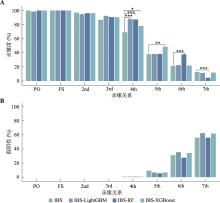
Fig. 6
Comparative analysis of IBS and IBS-ML methods with statistical significance tests"
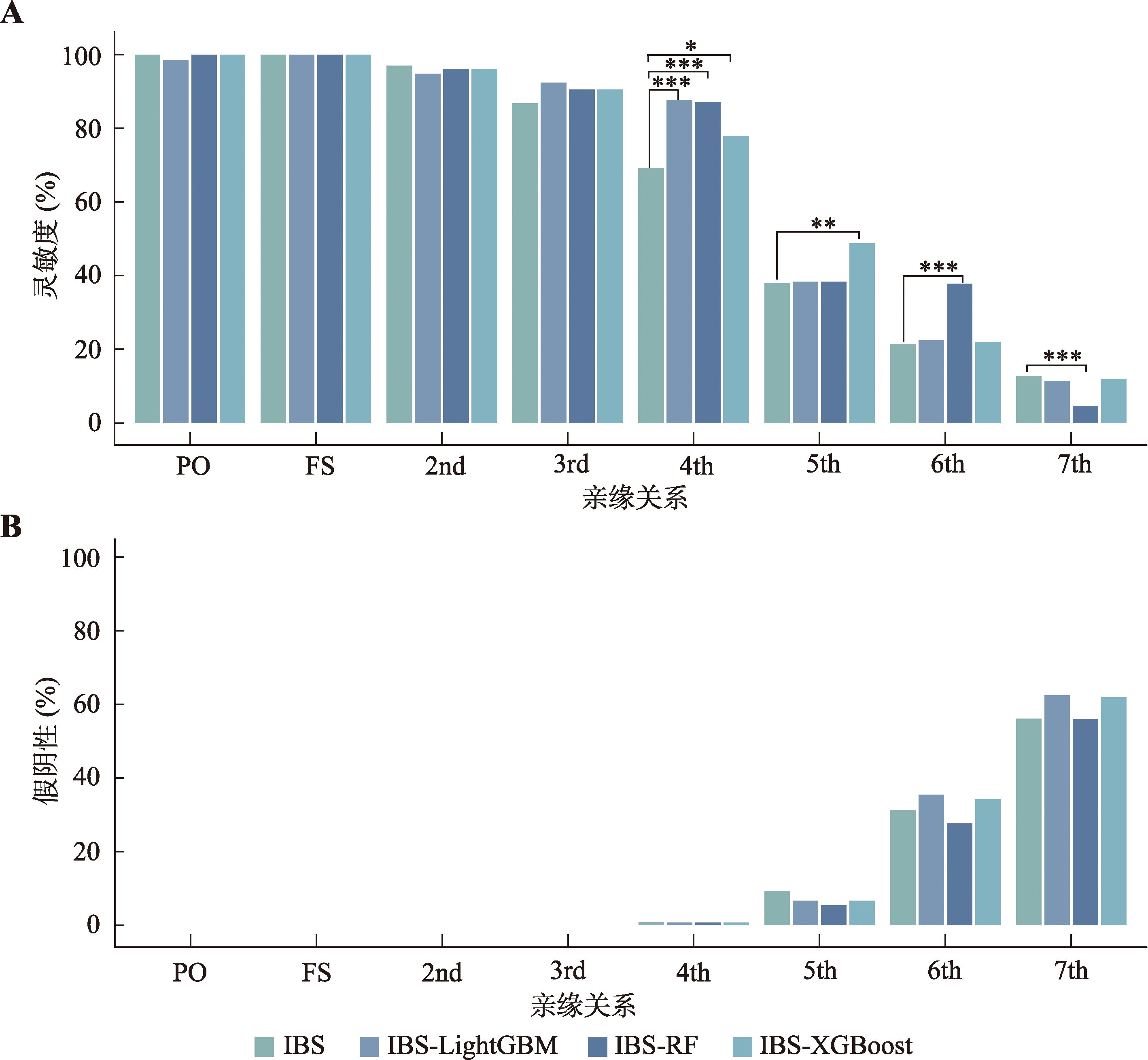
Fig. 7
MAF value distribution of seven SNP panels based on East Asian population"
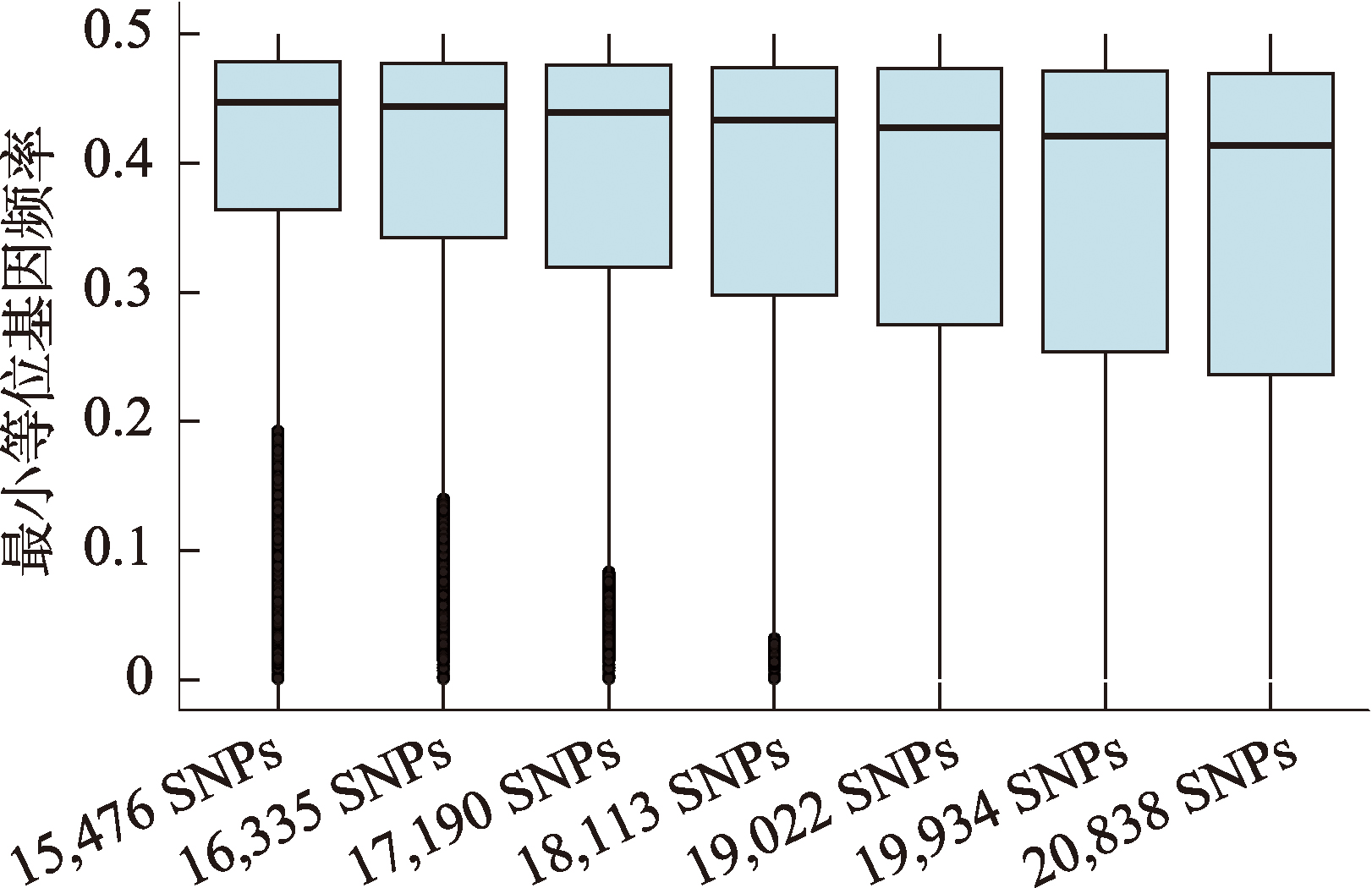
Table 8
Threshold-LR method performance metrics using FORCE panel on real pedigrees"
| 亲缘关系 | t | 灵敏度 (%) | 假阴性 (%) | 特异度 (%) | 假阳性 (%) |
|---|---|---|---|---|---|
| FS/unrelated | 4 | 100.00 | 0.00 | 100.00 | 0.00 |
| 2nd/unrelated | 4 | 100.00 | 0.00 | 100.00 | 0.00 |
| 3rd/unrelated | 4 | 99.54 | 0.00 | 100.00 | 0.10 |
| 4th/unrelated | 4 | 94.35 | 0.00 | 100.00 | 0.20 |
| 5th/unrelated | 4 | 40.87 | 0.44 | 100.00 | 0.50 |
| 6th/unrelated | 4 | 6.45 | 93.55 | 100.00 | 0.00 |
| 3 | 13.32 | 86.68 | 100.00 | 0.00 | |
| 2 | 25.51 | 74.49 | 99.60 | 0.40 | |
| 1 | 48.67 | 51.33 | 98.10 | 1.90 | |
| 7th/unrelated | 4 | 0.79 | 99.21 | 100.00 | 0.00 |
| 3 | 2.60 | 97.40 | 100.00 | 0.00 | |
| 2 | 5.99 | 94.01 | 99.90 | 0.10 | |
| 1 | 18.31 | 81.69 | 98.90 | 1.10 |
| [1] |
Phillips C. The golden state killer investigation and the nascent field of forensic genealogy. Forensic Sci Int Genet, 2018, 36: 186-188.
pmid: 30041097 |
| [2] |
Tillmar A, Kling D. Comparative study of statistical approaches and SNP panels to infer distant relationships in forensic genetics. Genes, 2025, 16(2): 114.
pmid: 40004443 |
| [3] |
Jäger AC, Alvarez ML, Davis CP, Guzmán E, Han Y, Way L, Walichiewicz P, Silva D, Pham N, Caves G, Bruand J, Schlesinger F, Pond SJK, Varlaro J, Stephens KM, Holt CL. Developmental validation of the MiSeq FGx forensic genomics system for targeted next generation sequencing in forensic DNA casework and database laboratories. Forensic Sci Int Genet, 2017, 28: 52-70.
pmid: 28171784 |
| [4] |
Gorden EM, Greytak EM, Sturk-Andreaggi K, Cady J, McMahon TP, Armentrout S, Marshall C. Extended kinship analysis of historical remains using SNP capture. Forensic Sci Int Genet, 2022, 57: 102636.
pmid: 34896972 |
| [5] |
De Vries JH, Kling D, Vidaki A, Arp P, Kalamara V, Verbiest MMPJ, Piniewska-Róg D, Parsons TJ, Uitterlinden AG, Kayser M. Impact of SNP microarray analysis of compromised DNA on kinship classification success in the context of investigative genetic genealogy. Forensic Sci Int Genet, 2022, 56: 102625.
pmid: 34753062 |
| [6] |
Tillmar A, Sturk-Andreaggi K, Daniels-Higginbotham J, Thomas JT, Marshall C. The FORCE panel: an all-in-one SNP marker set for confirming investigative genetic genealogy leads and for general forensic applications. Genes (Basel), 2021, 12(12): 1968.
pmid: 34946917 |
| [7] |
Kling D, Tillmar A. Forensic genealogy—a comparison of methods to infer distant relationships based on dense SNP data. Forensic Sci Int Genet, 2019, 42: 113-124.
pmid: 31302460 |
| [8] |
Kling D, Phillips C, Kennett D, Tillmar A. Investigative genetic genealogy: current methods, knowledge and practice. Forensic Sci Int Genet, 2021, 52: 102474.
pmid: 33592389 |
| [9] |
Zhou Y, Browning SR, Browning BL. A fast and simple method for detecting identity-by-descent segments in large-scale data. Am J Hum Genet, 2020, 106(4): 426-437.
pmid: 32169169 |
| [10] |
Seidman DN, Shenoy SA, Kim M, Babu R, Woods IG, Dyer TD, Lehman DM, Curran JE, Duggirala R, Blangero J, Williams AL. Rapid, phase-free detection of long identity- by-descent segments enables effective relationship classification. Am J Hum Genet, 2020, 106(4): 453-466.
pmid: 32197076 |
| [11] |
Dou JZ, Sun BL, Sim XL, Hughes JD, Reilly DF, Tai ES, Liu JJ, Wang CL. Estimation of kinship coefficient in structured and admixed populations using sparse sequencing data. PLoS Genet, 2017, 13(9): e1007021.
pmid: 28961250 |
| [12] |
Morling N, Allen RW, Carracedo A, Geada H, Guidet F, Hallenberg C, Martin W, Mayr WR, Olaisen B, Pascali VL, Schneider PM, Paternity Testing Commission of the International Society of Forensic Genetics. Paternity testing commission of the international society of forensic genetics: recommendations on genetic investigations in paternity cases. Forensic Sci Int, 2002, 129(3): 148-157.
pmid: 12372685 |
| [13] |
Abecasis GR, Wigginton JE. Handling marker-marker linkage disequilibrium: pedigree analysis with clustered markers. Am J Hum Genet, 2005, 77(5): 754-767.
pmid: 16252236 |
| [14] |
Purcell S, Neale B, Todd-Brown K, Thomas L, Ferreira MAR, Bender D, Maller J, Sklar P, De Bakker PIW, Daly MJ, Sham PC. PLINK: a tool set for whole-genome association and population-based linkage analyses. Am J Hum Genet, 2007, 81(3): 559-575.
pmid: 17701901 |
| [15] |
Zeng K, Zhao WT, Fang ZX, Li J, Liu J, Zhao D, Zhu BF, Li CX. Development and validation of a capture sequencing panel containing 9000 SNPs for inferring distant relatives in East Asian populations. Forensic Sci Int Genet, 2026, 81: 103341.
pmid: 40845711 |
| [16] |
Abecasis GR, Cherny SS, Cookson WO, Cardon LR. Merlin—rapid analysis of dense genetic maps using sparse gene flow trees. Nat Genet, 2002, 30(1): 97-101.
pmid: 11731797 |
| [17] |
Wu RG, Chen H, Li R, Zang Y, Shen XF, Hao B, Wang QW, Sun HY. Pairwise kinship testing with microhaplotypes: can advancements be made in kinship inference with these markers? Forensic Sci Int, 2021, 325: 110875.
pmid: 34166816 |
| [18] |
Cui W, Chen M, Yang Y, Cai MM, Lan Q, Xie T, Zhu BF. Applications of 1993 single nucleotide polymorphism loci in forensic pairwise kinship identifications and inferences. Forensic Sci Int Genet, 2023, 65: 102889.
pmid: 37247510 |
| [19] |
Manichaikul A, Mychaleckyj JC, Rich SS, Daly K, Sale M, Chen WM.Robust relationship inference in genome-wide association studies. Bioinformatics, 2010, 26(22): 2867-2873.
pmid: 20926424 |
| [20] |
Liu J, Wei YL, Yang L, Jiang L, Zhao WT, Li CX. Testing of two SNP array-based genealogy algorithms using extended Han Chinese pedigrees and recommendations for improved performances in forensic practice. Electrophoresis, 2023, 44(17-18): 1435-1445.
pmid: 37501329 |
| [21] | Chawla NV, Bowyer KW, Hall LO, Kegelmeyer WP. SMOTE: synthetic minority over-sampling technique. J Artif Intell Res, 2002, 16(1): 321-357. |
| [22] | Van Den Heuvel E, Zhan ZZ. Myths about linear and monotonic associations: Pearson’s r, Spearman’s ρ, and Kendall’s τ. Am Stat, 2022, 76(1): 44-52. |
| [23] | Benjamini Y, Hochberg Y. Controlling the false discovery rate: a practical and powerful approach to multiple testing. J R Stat Soc B, 1995, 57(1): 289-300. |
| [24] | Tomczak M, Tomczak E. The need to report effect size estimates revisited. An overview of some recommended measures of effect size. Trends Sport Sci, 2014, 1(21): 19-25. |
| [25] |
Lakens D. Calculating and reporting effect sizes to facilitate cumulative science: a practical primer for t-tests and ANOVAs. Front Psychol, 2013, 4: 863.
pmid: 24324449 |
| [26] |
Hill WG, Weir BS. Variation in actual relationship as a consequence of Mendelian sampling and linkage. Genet Res, 2011, 93(1): 47-64.
pmid: 21226974 |
| [27] |
Huff CD, Witherspoon DJ, Simonson TS, Xing JC, Watkins WS, Zhang YH, Tuohy TM, Neklason DW, Burt RW, Guthery SL, Woodward SR, Jorde LB. Maximum- likelihood estimation of recent shared ancestry (ERSA). Genome Res, 2011, 21(5): 768-774.
pmid: 21324875 |
| [28] |
Speed D, Balding DJ. Relatedness in the post-genomic era: is it still useful? Nat Rev Genet, 2015, 16(1): 33-44.
pmid: 25404112 |
| [29] |
Wei YF, Zhu Q, Wang HY, Cao YY, Li X, Zhang XK, Wang YF, Zhang J. Pairwise kinship inference and pedigree reconstruction using 91 microhaplotypes. Forensic Sci Int Genet, 2024, 72: 103090.
pmid: 38968912 |
| [30] |
Tabangin ME, Woo JG, Martin LJ. The effect of minor allele frequency on the likelihood of obtaining false positives. BMC Proc, 2009, 3(Suppl 7): S41.
pmid: 20018033 |
| [31] |
Thompson EA. Identity by descent: variation in meiosis, across genomes, and in populations. Genetics, 2013, 194(2): 301-326.
pmid: 23733848 |
| [1] | Zhihong Li, Miaoqi Chen, Xiaojun Yuan, Huajun Huang, Wanting Huang, Piaoyan Zhou, Chen Zeng, Xunuo Feng, Luoyao Yang, Shuqiang Huang, Cuiyu Tan, Cairong Chen, Qiuxia Yan. Identification of biomarkers for non-obstructive azoospermia based on microRNA and bioinformatics screening [J]. Hereditas(Beijing), 2026, 48(3): 301-312. |
| [2] | Hui Liang, Xue Wang, Jingfang Si, Yi Zhang. Classification accuracy of machine learning algorithms for Chinese local cattle breeds using genomic markers [J]. Hereditas(Beijing), 2024, 46(7): 530-539. |
| [3] | Ziyi Zhang, Qilin Wang, Junyou Zhang, Yingying Duan, Jiaxin Liu, Zhaoshuo Liu, Chunyan Li. Machine learning applications in breast cancer survival and therapeutic outcome prediction based on multi-omic analysis [J]. Hereditas(Beijing), 2024, 46(10): 820-832. |
| [4] | Huiyi Zheng, Huaxuan Wu, Zhiqiang Du. Gut metagenome-derived image augmentation and deep learning improve prediction accuracy of metabolic disease classification [J]. Hereditas(Beijing), 2024, 46(10): 886-896. |
| [5] | Dong Chen, Shujie Wang, Zhenjian Zhao, Xiang Ji, Qi Shen, Yang Yu, Shengdi Cui, Junge Wang, Ziyang Chen, Jinyong Wang, Zongyi Guo, Pingxian Wu, Guoqing Tang. Genomic prediction of pig growth traits based on machine learning [J]. Hereditas(Beijing), 2023, 45(10): 922-932. |
| [6] | Yongqiang Kong, Jinkai Liu, Jiaqi Gu, Jingyi Xu, Yunuo Zheng, Yiliang Wei, Shaoyuan Wu. Optimization scheme of machine learning model for genetic division between northern Han, southern Han, Korean and Japanese [J]. Hereditas(Beijing), 2022, 44(11): 1028-1043. |
| [7] | Yali Hu, Rui Dai, Yongxin Liu, Jingying Zhang, Bin Hu, Chengcai Chu, Huaibo Yuan, Yang Bai. Analysis of rice root bacterial microbiota of Nipponbare and IR24 [J]. Hereditas(Beijing), 2020, 42(5): 506-518. |
| [8] | Zhao Xuetong, Yang Yadong, Qu Hongzhu, Fang Xiangdong. Applications of machine learning in clinical decision support in the omic era [J]. Hereditas(Beijing), 2018, 40(9): 693-703. |
| [9] | Zhang Guishan, Yang Yong, Zhang Lingmin, Dai Xianhua. Application of machine learning in the CRISPR/Cas9 system [J]. Hereditas(Beijing), 2018, 40(9): 704-723. |
| [10] | Zhe-ye Peng,Zi-jun Tang,Min-zhu Xie. Research progress in machine learning methods for gene-gene interaction detection [J]. Hereditas(Beijing), 2018, 40(3): 218-226. |
| [11] | HOU Yan-Yan, YING Xiao-Min, LI Wu-Ju . Computational approaches to microRNA discovery [J]. HEREDITAS, 2008, 30(6): 687-696. |
| Viewed | ||||||
|
Full text |
|
|||||
|
Abstract |
|
|||||

