| [1] |
Welker F, Ramos-Madrigal J, Gutenbrunner P, Mackie M, Tiwary S, Rakownikow Jersie-Christensen R, Chiva C, Dickinson MR, Kuhlwilm M, de Manuel M, Gelabert P, Martinón-Torres M, Margvelashvili A, Arsuaga JL, Carbonell E, Marques-Bonet T, Penkman K, Sabidó E, Cox J, Olsen JV, Lordkipanidze D, Racimo F, Lalueza-Fox C, Bermúdez de Castro JM, Willerslev E, Cappellini E. The dental proteome of Homo antecessor. Nature, 2020, 580(7802): 235-238.
pmid: 32269345
|
| [2] |
Zhu ZY, Dennell R, Huang WW, Wu Y, Qiu SF, Yang SX, Rao ZG, Hou YM, Xie JB, Han JW, Ouyang TP. Hominin occupation of the Chinese Loess Plateau since about 2.1 million years ago. Nature, 2018, 559(7715): 608-612.
pmid: 29995848
|
| [3] |
Liu W, Wu XJ, Xing S. The morphological evidence for the regional continuity and diversity of Middle Pleistocene human evolution in China. Acta Anthropologica Sinica, 2019, 38(4): 473-490.
|
|
刘武, 吴秀杰, 邢松. 更新世中期中国古人类演化区域连续性与多样性的化石证据. 人类学学报, 2019, 38(4): 473-490.
|
| [4] |
Shen GJ, Gao X, Gao B, Granger DE. Age of Zhoukoudian Homo erectus determined with (26)Al/(10)Be burial dating. Nature, 2009, 458(7235): 198-200.
pmid: 19279636
|
| [5] |
Grün R, Huang PH, Wu X, Stringer CB, Thorne AG, McCulloch M. ESR analysis of teeth from the palaeoanthropological site of Zhoukoudian, China. J Human Evol, 1997, 32(1): 83-91.
pmid: 9034955
|
| [6] |
Antón SC. Evolutionary significance of cranial variation in Asian Homo erectus. Am J Phys Anthropol, 2002, 118(4): 301-323.
pmid: 12124912
|
| [7] |
Zhao JX, Hu K, Collerson KD, Xu HK. Thermal ionization mass spectrometry U-series dating of a hominid site near Nanjing, China. Geology, 2001, 29(1): 27-30.
|
| [8] |
Zhang L, Zhang SQ, Gu XJ, Li X. A study on the perforated bone from Sunjiadong site in Henan Province. Acta Anthropological Sinica, 2017, 36(4): 457-464.
|
|
张乐, 张双权, 顾雪军, 李璇. 河南栾川孙家洞遗址出土的穿孔标本. 人类学学报, 2017, 36(4): 457-464.
|
| [9] |
Grün R, Huang PH, Huang W, McDermott F, Thorne A, Stringer CB, Yan G. ESR and U-series analyses of teeth from the palaeoanthropological site of Hexian, Anhui Province, China. J Human Evol, 1998, 34(6): 555-564.
pmid: 9650100
|
| [10] |
Zhao LX, Li X, Gu XJ, Du BP, Shi JZ, Gao X. Middle Pleistocene hominins from the Sunjiadong site, Luanchuan county, Henan Province, Central China. Acta Anthropologica Sinica, 2018, 37(2): 192-205.
|
|
赵凌霞, 李璇, 顾雪军, 杜抱朴, 史家珍, 高星. 河南栾川发现直立人化石及其演化意义. 人类学学报, 2018, 37(2): 192-205.
|
| [11] |
Liu W, Martinón-Torres M, Kaifu Y, Wu XJ, Kono RT, Chang CH, Wei PP, Xing S, Huang WB, Bermúdez de Castro JM. A mandible from the Middle Pleistocene Hexian site and its significance in relation to the variability of Asian Homo erectus. Am J Phys Anthropol, 2017, 162(4): 715-731.
pmid: 28109118
|
| [12] |
Kaifu Y. Archaic hominin populations in Asia before the arrival of modern humans. Current Anthropology, 2017, 58(S17): S418-S433.
|
| [13] |
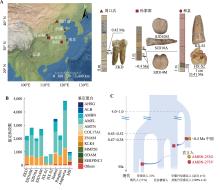
Fu QM, Wu ZY, Bennett EA, Xing S, Ji Q, Dong Z, Rao HY, Gu XJ, Dang YZ, Xing J, Zhou K, Feng XT. Enamel proteins from six Homo erectus specimens across China. Nature, 2026. doi: 10.1038/s41586-026-10478-8.
|
| [14] |
Huang PH, Jin SZ, Liang RY, Lu ZJ, Zheng LZ, Yuan ZX, Cai BX, Fang CM. Study of ESR dating for burying age of the first skull of Peking Man and chronological scale of the cave deposit in Zhoukoudian site Loc. 1. Acta Anthropologica Sinica, 1991, 10(2): 107-115.
|
|
黄培华, 金嗣炤, 梁任义, 陆仲家, 郑丽珍, 袁振新, 蔡炳溪, 方朝萌. 北京猿人第一个头盖骨及其遗址堆积层年代的电子自旋共振测年研究. 人类学学报, 1991, 10(2): 107-115.
|
| [15] |
Woo JK, Chia L. New discoveries of Sinanthropus pekinensis in Choukoutien. Acta Palaeontologica Sinica, 1954(3): 267-288.
|
|
吴汝康, 贾兰坡. 周口店新发现的中国猿人化石. 古生物学报, 1954(3): 267-288.
|
| [16] |
Huang WB, Fang DS, Ye YX. Preliminary study on the fossil hominid skull and fauna of Hexian, Anhui. Vertebr Palasiat, 1982, (3): 248-256.
|
|
黄万波, 方笃生, 叶永相. 安徽和县猿人化石及有关问题的初步研究. 古脊椎动物与古人类, 1982, (3): 248-256.
|
| [17] |
Ni XJ, Ji Q, Wu WS, Shao QF, Ji YN, Zhang C, Liang L, Ge JY, Guo Z, Li JH, Li Q, Grün R, Stringer C. Massive cranium from Harbin in northeastern China establishes a new Middle Pleistocene human lineage. Innovation (Camb), 2021, 2(3): 100130.
pmid: 34557770
|
| [18] |
Tsutaya T, Sawafuji R, Taurozzi AJ, Fagernäs Z, Patramanis I, Troché G, Mackie M, Gakuhari T, Oota H, Tsai CH, Olsen JV, Kaifu Y, Chang CH, Cappellini E, Welker F. A male Denisovan mandible from Pleistocene Taiwan. Science, 2025, 388(6743): 176-180.
pmid: 40208980
|
| [19] |
GenomeAsia100K Consortium. The GenomeAsia 100K Project enables genetic discoveries across Asia. Nature, 2019, 576(7785): 106-111.
pmid: 31802016
|
| [20] |
Peyrégne S, Massilani D, Swiel Y, Boyle MJ, Iasi LNM, Sümer AP, Mesa AB, de Filippo C, Viola B, Essel E, Nagel S, Richter J, Weihmann A, Schellbach B, Zeberg H, Visagie J, Kozlikin MB, Shunkov MV, Derevianko AP, Prüfer K, Peter BM, Meyer M, Pääbo S, Kelso J. A high-coverage genome from a 200,000-year-old Denisovan. bioRxiv, 2025. doi: 10.1101/2025.10.20.683404.
|
| [21] |
Prüfer K, Racimo F, Patterson N, Jay F, Sankararaman S, Sawyer S, Heinze A, Renaud G, Sudmant PH, de Filippo C, Li H, Mallick S, Dannemann M, Fu QM, Kircher M, Kuhlwilm M, Lachmann M, Meyer M, Ongyerth M, Siebauer M, Theunert C, Tandon A, Moorjani P, Pickrell J, Mullikin JC, Vohr SH, Green RE, Hellmann I, Johnson PLF, Blanche H, Cann H, Kitzman JO, Shendure J, Eichler EE, Lein ES, Bakken TE, Golovanova LV, Doronichev VB, Shunkov MV, Derevianko AP, Viola B, Slatkin M, Reich D, Kelso J, Pääbo S. The complete genome sequence of a Neanderthal from the Altai Mountains. Nature, 2014, 505(7481): 43-49.
pmid: 24352235
|
 ), Huiyun Rao1(