Hereditas(Beijing) ›› 2026, Vol. 48 ›› Issue (9): 921-930.doi: 10.16288/j.yczz.25-345
• Research Article • Previous Articles Next Articles
Transmission history of major China-prevalent Mycobacterium tuberculosis sub-lineages in East Asia
Wei Wu1( ), Bin Yang1, Zhiwei Zhou1, Haibing Yuan2, Qun Sun1()
- 1
Key Laboratory of Bio-resources and Eco-environment of the Ministry of Education ,College of Life Sciences, Sichuan University Chengdu 610064, China
2Center for Archaeological Science ,Sichuan University Chengdu 610064, China
-
Received:2025-12-29Revised:2026-03-25Online:2026-09-20Published:2026-04-07 -
Contact:Qun Sun E-mail:wu_wei@stu.scu.edu.cn;qunsun@scu.edu.cn -
Supported by:National Natural Science Foundation of China(32470009);National Key Science and Technology Special Project for Deep Earth Research(2024ZD1000602);National Key Science and Technology Special Project for Deep Earth Research(2024ZD1000603);Open Research Fund of Center for Archaeological Science, Sichuan University(24SASB01);Open Research Fund of Center for Archaeological Science, Sichuan University(24SASB05)

Cite this article
Wei Wu, Bin Yang, Zhiwei Zhou, Haibing Yuan, Qun Sun. Transmission history of major China-prevalent Mycobacterium tuberculosis sub-lineages in East Asia[J]. Hereditas(Beijing), 2026, 48(9): 921-930.
share this article
Add to citation manager EndNote|Reference Manager|ProCite|BibTeX|RefWorks
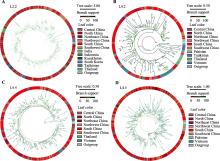
Fig. 1
Maximum-likelihood phylogenies and regional composition of four sub-lineages"

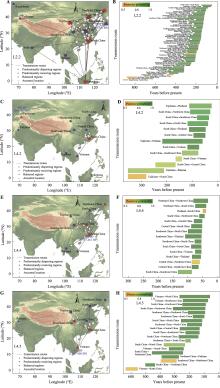
Fig. 2
Discrete phylogeographic transmission networks of four sub-lineages"

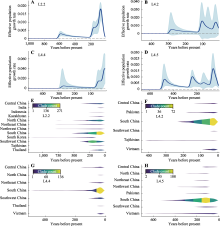
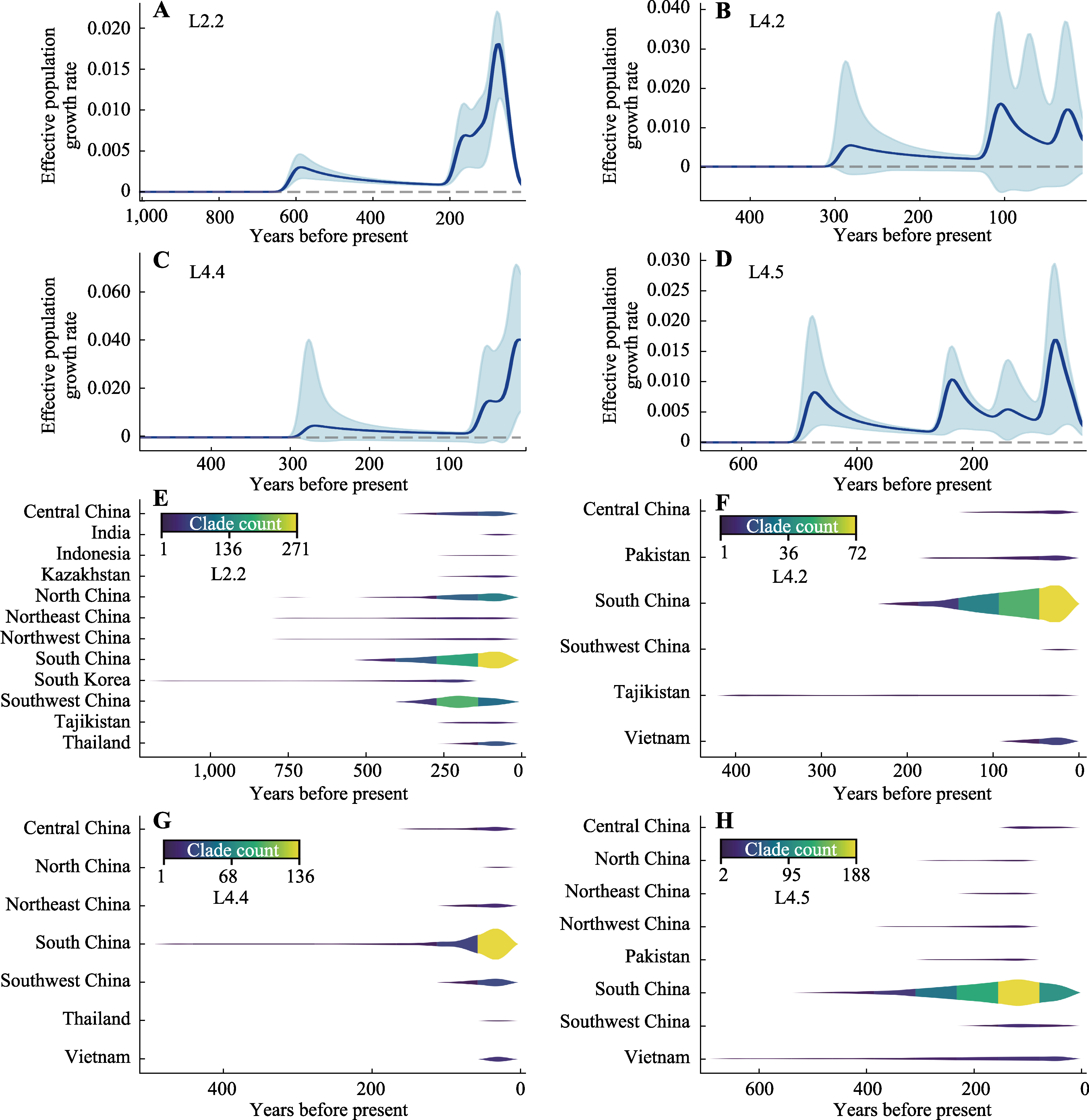
Fig. 3
The effective population growth rates and monophyletic branch formation time distributions of the four sub-lineages"
| [1] | World Health Organization. Global tuberculosis report 2025. Geneva: World Health Organization, 2025. |
| [2] |
Liu QY, Ma AJ, Wei LH, Pang Y, Wu BB, Luo T, Zhou Y, Zheng HX, Jiang Q, Gan MY, Zuo TY, Liu M, Yang CG, Jin L, Comas I, Gagneux S, Zhao YL, Pepperell CS, Gao Q. China’s tuberculosis epidemic stems from historical expansion of four strains of Mycobacterium tuberculosis. Nat Ecol Evol, 2018, 2(12): 1982-1992.
pmid: 30397300 |
| [3] | Liu Y, Wang BX, Liu ZY, Han Y, Tan YJ, Li XJ, Liu JX, Tan SY, Zhang TY. Progress in resistance mechanisms and diagnosis of non-first line anti-TB drugs. Hereditas (Beijing), 2016, 38(10): 928-939. |
| 刘洋, 王邦兴, 刘志永, 韩轶, 谭耀驹, 李昕洁, 刘健雄, 谭守勇, 张天宇. 非一线抗结核药物耐药机制及耐药性诊断研究进展. 遗传, 2016, 38(10): 928-939. | |
| [4] |
Wu W, Liu ZC, Chen HQ, Tang YH, Jiang ZZ, Zhang YY, Zhang AD, Zhou ZW, Marks RS, Zhang F, Yuan HB, Yu Y, Mao KS, Dinnyés A, Rastogi N, Xie JP, Sun Q. Cross-continental transmission and host adaptation of Mycobacterium tuberculosis in China unveiled by population history reconstruction and adaptive evolution signal detection. IMetaOmics, 2025, 2(4): e70052.
pmid: 41676452 |
| [5] |
Wu BB, Zhu WL, Wang Y, Wang Q, Zhou L, Liu ZW, Bi LJ, Barun M, Kreiswirth BN, Chen L, Chen SH, Wang XM, Wang WB. Genetic composition and evolution of the prevalent Mycobacterium tuberculosis lineages 2 and 4 in the Chinese and Zhejiang Province populations. Cell Biosci, 2021, 11(1): 162.
pmid: 34419157 |
| [6] |
Zhu CD, Yang TT, Yin JF, Jiang H, Takiff HE, Gao Q, Liu QY, Li WM. The global success of Mycobacterium tuberculosis modern Beijing family is driven by a few recently emerged strains. Microbiol Spectr, 2023, 11(4): e0333922.
pmid: 37272796 |
| [7] |
Li YF, Yang Y, Kong XL, Song WM, Li YM, Li YY, Fang WW, Yang JY, Men D, Yu CB, Yang GR, Han WG, Liu WY, Yan K, Li HC, Liu Y. Transmission dynamics and phylogeography of Mycobacterium tuberculosis in China based on whole-genome phylogenetic analysis. Int J Infect Dis, 2024, 140: 124-131.
pmid: 37863309 |
| [8] |
Ashton PM, Cha J, Anscombe C, Thuong NTT, Thwaites GE, Walker TM. Distribution and origins of Mycobacterium tuberculosis L 4 in Southeast Asia. Microb Genom, 2023, 9(2): mgen000955.
pmid: 36729036 |
| [9] |
Chen SF, Zhou YQ, Chen YR, Gu J. Fastp: an ultra-fast all-in-one FASTQ preprocessor. Bioinformatics, 2018, 34(17): i884-i890.
pmid: 30423086 |
| [10] |
McKenna A, Hanna M, Banks E, Sivachenko A, Cibulskis K, Kernytsky A, Garimella K, Altshuler D, Gabriel S, Daly M, DePristo MA. The genome analysis toolkit: a MapReduce framework for analyzing next-generation DNA sequencing data. Genome Res, 2010, 20(9): 1297-1303.
pmid: 20644199 |
| [11] |
Nguyen LT, Schmidt HA, von Haeseler A, Minh BQ. IQ-TREE: a fast and effective stochastic algorithm for estimating maximum-likelihood phylogenies. Mol Biol Evol, 2015, 32(1): 268-274.
pmid: 25371430 |
| [12] |
Kalyaanamoorthy S, Minh BQ, Wong TKF, von Haeseler A, Jermiin LS. ModelFinder: fast model selection for accurate phylogenetic estimates. Nat Methods, 2017, 14(6): 587-589.
pmid: 28481363 |
| [13] |
Bouckaert R, Heled J, Kühnert D, Vaughan T, Wu CH, Xie D, Suchard MA, Rambaut A, Drummond AJ. BEAST 2: a software platform for Bayesian evolutionary analysis. PLoS Comput Biol, 2014, 10(4): e1003537.
pmid: 24722319 |
| [14] |
Bielejec F, Baele G, Vrancken B, Suchard MA, Rambaut A, Lemey P. SpreaD3: interactive visualization of spatiotemporal history and trait evolutionary processes. Mol Biol Evol, 2016, 33(8): 2167-2169.
pmid: 27189542 |
| [15] |
Stucki D, Brites D, Jeljeli L, Coscolla M, Liu QY, Trauner A, Fenner L, Rutaihwa L, Borrell S, Luo T, Gao Q, Kato-Maeda M, Ballif M, Egger M, Macedo R, Mardassi H, Moreno M, Tudo Vilanova G, Fyfe J, Globan M, Thomas J, Jamieson F, Guthrie JL, Asante-Poku A, Yeboah-Manu D, Wampande E, Ssengooba W, Joloba M, Henry Boom W, Basu I, Bower J, Saraiva M, Vaconcellos SEG, Suffys P, Koch A, Wilkinson R, Gail-Bekker L, Malla B, Ley SD, Beck HP, de Jong BC, Toit K, Sanchez-Padilla E, Bonnet M, Gil-Brusola A, Frank M, Penlap Beng VN, Eisenach K, Alani I, Revathi G, Gehre F, Akter S, Ntoumi F, Stewart- Isherwood L, Ntinginya NE, Rachow A, Hoelscher M, Cirillo DM, Skenders G, Hoffner S, Bakonyte D, Stakenas P, Diel R, Crudu V, Moldovan O, Al-Hajoj S, Otero L, Barletta F, Jane Carter E, Diero L, Supply P, Comas I, Niemann S, Gagneux S. Mycobacterium tuberculosis lineage 4 comprises globally distributed and geographically restricted sublineages. Nat Genet, 2016, 48(12): 1535-1543.
pmid: 27798628 |
| [16] |
Luo T, Comas I, Luo D, Lu B, Wu J, Wei LH, Yang CG, Liu QY, Gan MY, Sun G, Shen X, Liu FY, Gagneux S, Mei J, Lan RS, Wan KL, Gao Q. Southern East Asian origin and coexpansion of Mycobacterium tuberculosis Beijing family with Han Chinese. Proc Natl Acad Sci USA, 2015, 112(26): 8136-8141.
pmid: 26080405 |
| [17] |
Merker M, Blin C, Mona S, Duforet-Frebourg N, Lecher S, Willery E, Blum MGB, Rüsch-Gerdes S, Mokrousov I, Aleksic E, Allix-Béguec C, Antierens A, Augustynowicz- Kopeć E, Ballif M, Barletta F, Beck HP, Barry CE 3rd, Bonnet M, Borroni E, Campos-Herrero I, Cirillo D, Cox H, Crowe S, Crudu V, Diel R, Drobniewski F, Fauville- Dufaux M, Gagneux S, Ghebremichael S, Hanekom M, Hoffner S, Jiao WW, Kalon S, Kohl TA, Kontsevaya I, Lillebæk T, Maeda S, Nikolayevskyy V, Rasmussen M, Rastogi N, Samper S, Sanchez-Padilla E, Savic B, Shamputa IC, Shen A, Sng LH, Stakenas P, Toit K, Varaine F, Vukovic D, Wahl C, Warren R, Supply P, Niemann S, Wirth T. Evolutionary history and global spread of the Mycobacterium tuberculosis Beijing lineage. Nat Genet, 2015, 47(3): 242-249.
pmid: 25599400 |
| [18] |
Casali N, Nikolayevskyy V, Balabanova Y, Harris SR, Ignatyeva O, Kontsevaya I, Corander J, Bryant J, Parkhill J, Nejentsev S, Horstmann RD, Brown T, Drobniewski F. Evolution and transmission of drug-resistant tuberculosis in a Russian population. Nat Genet, 2014, 46(3): 279-286.
pmid: 24464101 |
| [19] | Zhang LY, Huang FJ, Xu JQ, Gong Z, Xie JP. Acid-resistant genes in Mycobacterium tuberculosis and the underlying regulatory network. Hereditas (Beijing), 2018, 40(7): 546-560. |
| 张沥元, 黄芙静, 许峻旗, 龚真, 谢建平. 结核分枝杆菌酸抗性基因及其调控网络. 遗传, 2018, 40(7): 546-560. | |
| [20] | Ke H, Fan L. Annual progress of immunotherapy for tuberculosis in 2023. Chinese Journal of Tuberculosis and Respiratory Diseases, 2024, 47(4): 371-375. |
| 柯荟, 范琳. 结核病免疫治疗年度进展2023. 中华结核和呼吸杂志, 2024, 47(4): 371-375. | |
| [21] |
Brites D, Gagneux S. Co-evolution of Mycobacterium tuberculosis and Homo sapiens. Immunol Rev, 2015, 264(1): 6-24.
pmid: 25703549 |
| [1] | Chengxi Liu, Wenwen Deng, Mei Long, Shengzhi Yang, Xinfeng Han, Caiwu Li, Ke Zhao, Likou Zou. Analysis of resistance and virulence genes in anaerobic Escherichia coli from giant pandas based on whole genome sequencing [J]. Hereditas(Beijing), 2026, 48(2): 213-226. |
| [2] | Jieyu Shen, Tianhan Su, Daqi Yu, Shengjun Tan, Yong E. Zhang. Evolution by gene duplication: in the era of genomics [J]. Hereditas(Beijing), 2025, 47(2): 147-171. |
| [3] | Xin Zhu, Xin Jin, Jun Liu, Lan Yang, Lixin Zou, Caixia Li, Jiang Huang, Li Jiang. Paternal genetic structure analysis of the modern Han populations based on Y-SNP and Y-STR [J]. Hereditas(Beijing), 2024, 46(2): 149-167. |
| [4] | Dantong Xu, Yifei Wang, Jiali Cai, Wentao Gong, Xiangchun Pan, Yuhan Tian, Qingpeng Shen, Jiaqi Li, Xiaolong Yuan. Study on detection of CNVs using human whole genome bisulfite sequencing data [J]. Hereditas(Beijing), 2023, 45(4): 324-340. |
| [5] | Fei Wang, Meng Wang, Xinghua Zhang, Keli Yu, Lianbin Zheng, Yajun Yang. Genetic substructure analysis of three isolated populations in southwest China [J]. Hereditas(Beijing), 2022, 44(5): 424-431. |
| [6] | Hongyuan Zheng, Lin Yan, Chao Yang, Yarong Wu, Jingliang Qin, Tongyu Hao, Dajin Yang, Yunchang Guo, Xiaoyan Pei, Tongyan Zhao, Yujun Cui. Population genomics study of Vibrio alginolyticus [J]. Hereditas(Beijing), 2021, 43(4): 350-361. |
| [7] | Zilong Wen, Yiqiang Zhao. Progress on animal domestication under population genetics [J]. Hereditas(Beijing), 2021, 43(3): 226-239. |
| [8] |
Zhuo Wang, Xiaohan Shen, Qihui Shi.
|
| [9] | Qiang Wei, Yan Ao, Manman Yang, Tao Chen, Hu Han, Xingju Zhang, Ran Wang, Qiuju Xia, Fangfang Jiang, Yong Li. Identification of genomic insertion of dominant-negative GHR mutation transgenes in Wuzhishan pig using whole genome sequencing method [J]. Hereditas(Beijing), 2021, 43(12): 1149-1158. |
| [10] | Xiaojuan Wang, Enfang Qian, Yue Li, Zhengyang Song, Hui Zhao, Hexin Xie, Caixia Li, Jiang Huang, Li Jiang. A genetic sub-structure study of the Tibetan population in Southwest China [J]. Hereditas(Beijing), 2020, 42(6): 565-576. |
| [11] | Wenwen Deng, Caiwu Li, Siyue Zhao, Rengui Li, Yongguo He, Daifu Wu, Shengzhi Yang, Yan Huang, Hemin Zhang, Likou Zou. Whole genome sequencing reveals the distribution of resistance and virulence genes of pathogenic Escherichia coli CCHTP from giant panda [J]. Hereditas(Beijing), 2019, 41(12): 1138-1147. |
| [12] | Yaxin Yao,Yongfu La,Ran Di,Qiuyue Liu,Wenping Hu,Xiangyu Wang,Mingxing Chu. Comparison of different single cell whole genome amplification methods and MALBAC applications in assisted reproduction [J]. Hereditas(Beijing), 2018, 40(8): 620-631. |
| [13] | Wenwen Deng,Mei Long,Shengzhi Yang,Likou Zou. Evolution and the flanking sequences of β-lactamase resistance gene blaOKP [J]. Hereditas(Beijing), 2018, 40(7): 585-592. |
| [14] | Liyuan Zhang, Fujing Huang, Junqi Xu, Zhen Gong, Jianping Xie. Acid-resistant genes in Mycobacterium tuberculosis and the underlying regulatory network [J]. Hereditas(Beijing), 2018, 40(7): 546-560. |
| [15] | Chao Yang, Ruifu Yang, Yujun Cui. Bacterial genome-wide association study: methodologies and applications [J]. Hereditas(Beijing), 2018, 40(1): 57-65. |
| Viewed | ||||||
|
Full text |
|
|||||
|
Abstract |
|
|||||

