Hereditas(Beijing) ›› 2026, Vol. 48 ›› Issue (4): 421-431.doi: 10.16288/j.yczz.25-131
• Research Article • Previous Articles Next Articles
An evolutionary perspective on the nucleocytoplasmic shuttling mechanism of duck plague virus UL54 protein
Mingfei Xu( ), Yanhong Yang, Qianqian Li, Hong Zhu, Chaoyue Liu()
Institute of Basic Medicine ,North Sichuan Medical College Nanchong 637000, China
-
Received:2025-07-03Revised:2025-08-21Online:2026-04-20Published:2025-09-18 -
Contact:Chaoyue Liu E-mail:289112406@qq.com;liuchaoyue@nsmc.edu.cn -
Supported by:Natural Science Foundation of Sichuan Province(2024NSFSC1277)

Cite this article
Mingfei Xu, Yanhong Yang, Qianqian Li, Hong Zhu, Chaoyue Liu. An evolutionary perspective on the nucleocytoplasmic shuttling mechanism of duck plague virus UL54 protein[J]. Hereditas(Beijing), 2026, 48(4): 421-431.
share this article
Add to citation manager EndNote|Reference Manager|ProCite|BibTeX|RefWorks
Table 1
Overlap PCR-related primers"
| 扩增片段名称 | 左片段引物序列(5′→3′) | 右片段引物序列(5′→3′) |
|---|---|---|
| UL54 | A: AAGCTTATGGCCTGCAGTGCTAAACC | B:GC GGATCCCAATAAAAGTACTTCCCGTGC |
| UL54(m269) | A1:CCGCCTCAACTTCGCCCGAT ATGTTTGAGATTAGACAATTG | B1:ATCGGGCGATGTTCAGGCGG ATGTTTGAGATTAGACAATTG |
| UL54(m348) | A2:GCGGCATGTGAAAATGGGGC GAGATGAAAACGCGCAGATCA | B2:GCCCCATTTTCACATGCCGC GAGATGAAAACGCGCAGATCA |
| UL54(m373) | A3:GTGTGTCGACTATATCGCC CGAGCTTTCTTTTCATTACC | B3:GGCGATATAGTCGACACAC CGAGCTTTCTTTTCATTACC |
| UL54(m377) | A4:AGGGTAATGAAAAGACGTCTCG CGTTAAGTTGTCCAGGGCT | B4:CGAGACGTCTTTTCATTACCCT CGTTAAGTTGTCCAGGGCT |
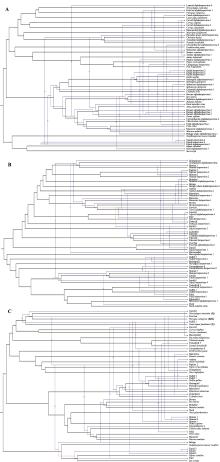
Fig. 1
Co-evolutionary analysis of DPV UL54 gene with host species and the viral whole genome"
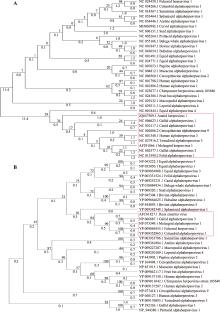
Fig. 2
Phylogenetic analysis of DPV UL54 gene and its encoded protein"
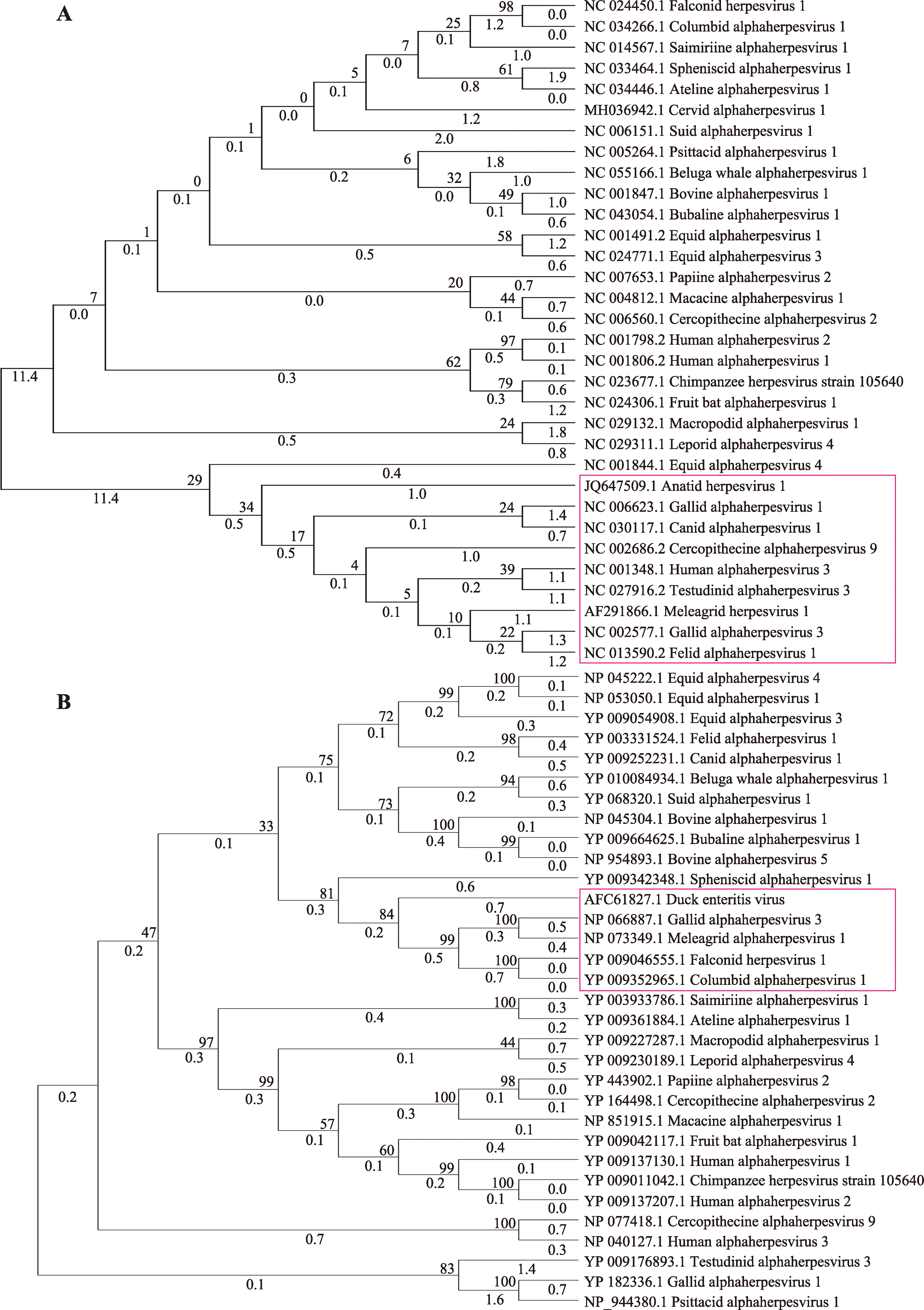
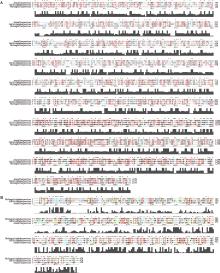
Fig. 3
Mutation analysis of the UL54 gene and its encoded protein"

Fig. 4
Predictions of NLS and NES of UL54 in GaHV-3 and MeHV-1"
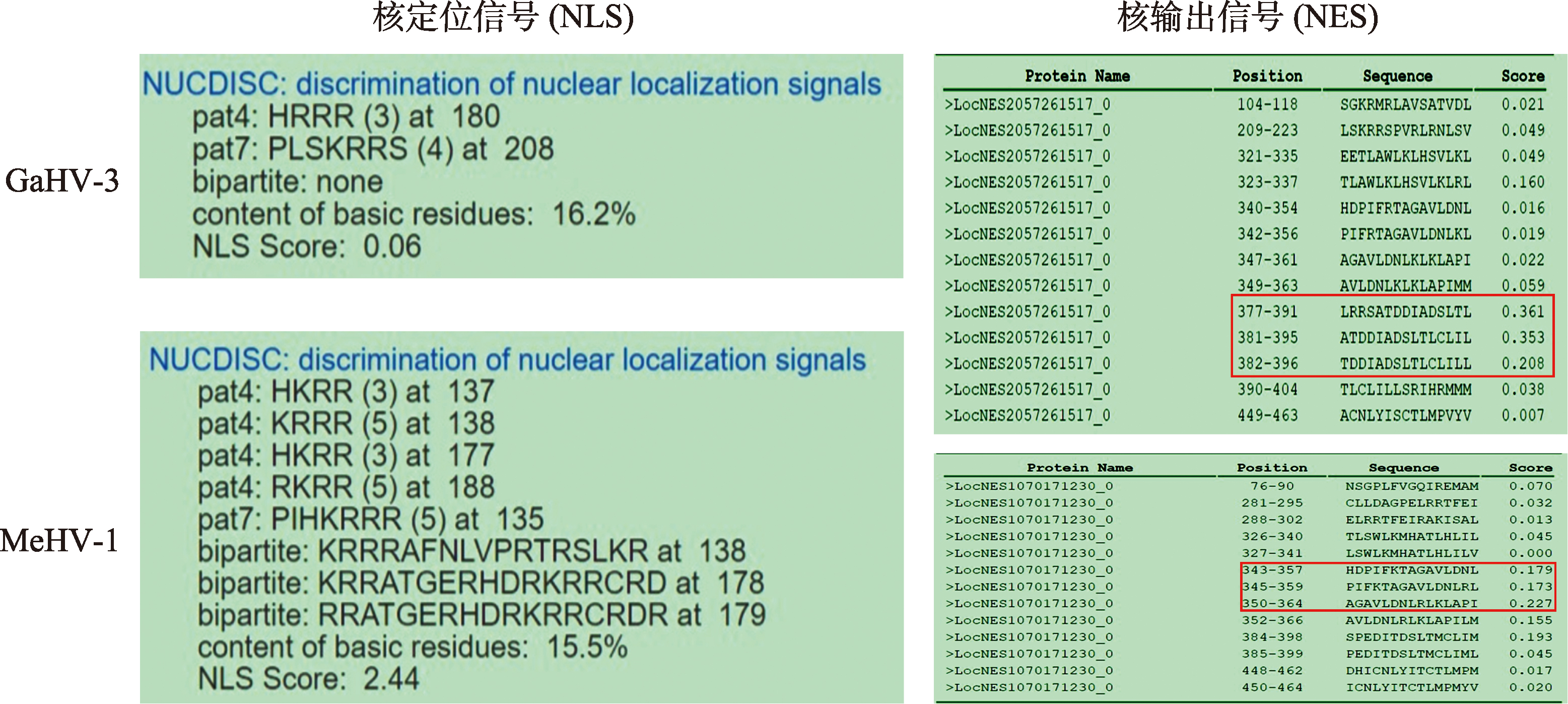
Fig. 5
Analysis of specific amino acid mutations in the nucleocytoplasmic shuttling-related regions of the DPV UL54-encoded protein"
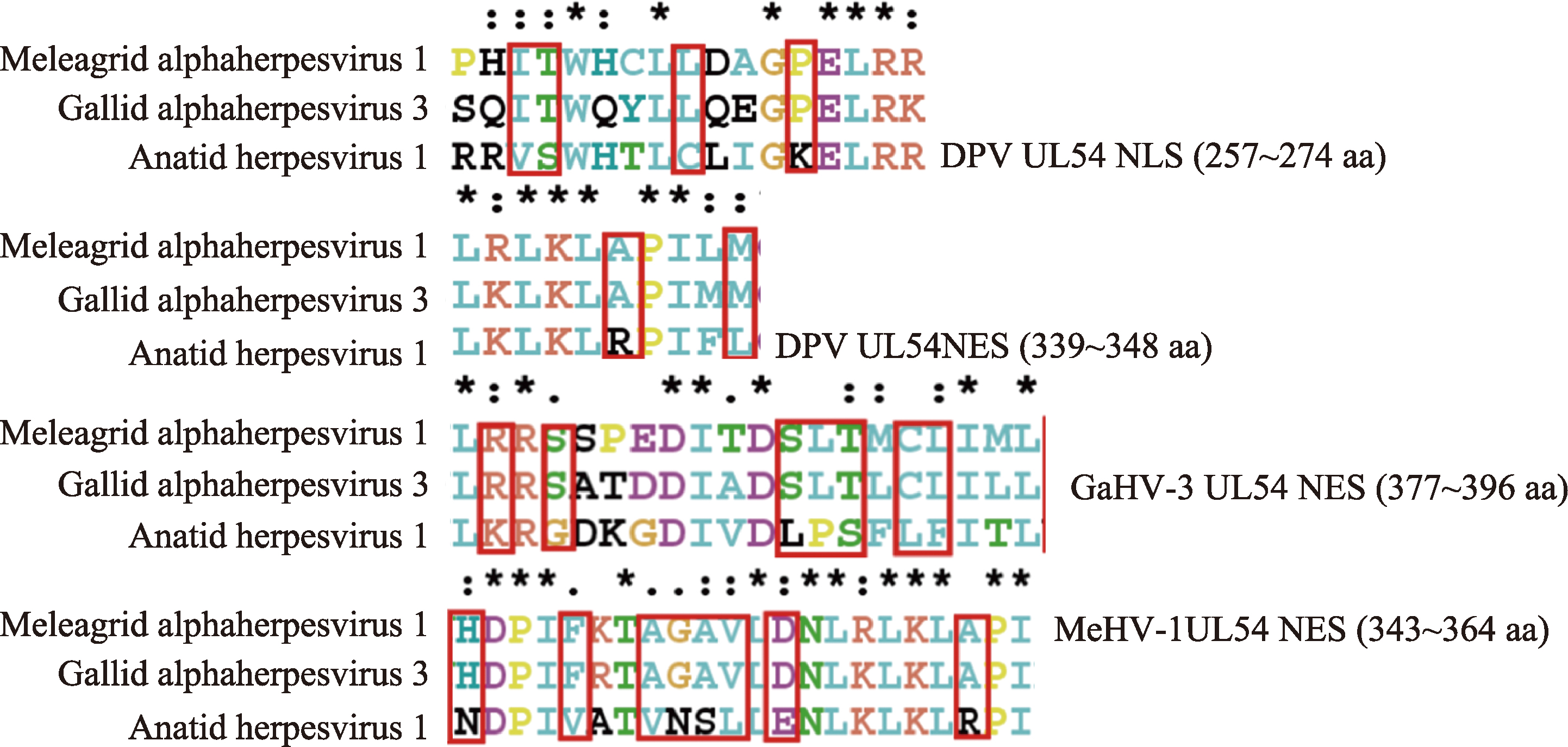
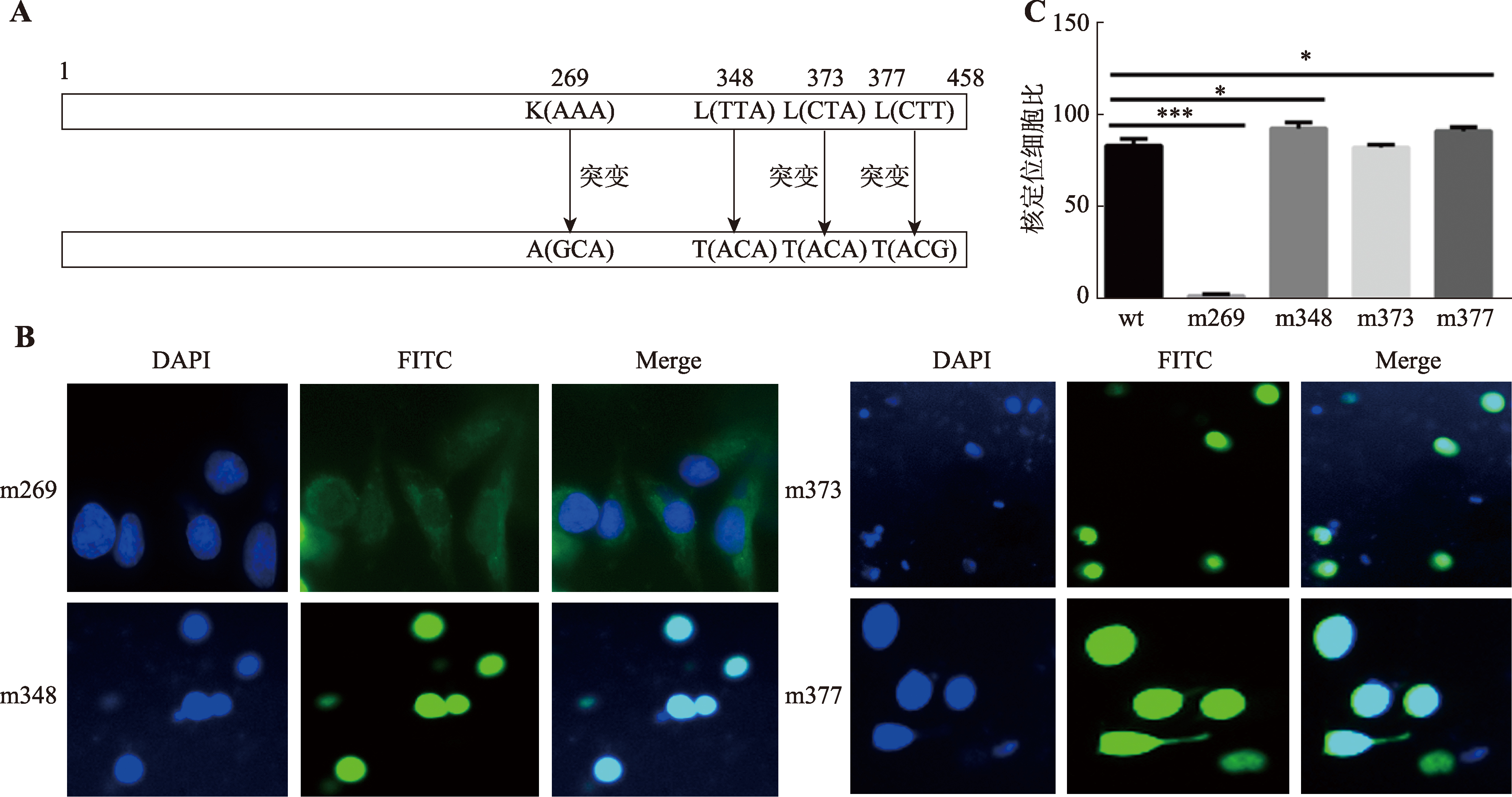
Fig. 6
Verification of evolution-related sites of nucleocytoplasmic shuttling of DPV UL54-encoded protein"
| [1] |
Kong J, Feng KY, Zhao QQ, Chen YZ, Wang JF, Chen S, Shao GM, Liao LQ, Li YJ, Xie Z, Zhang XH, Xie QM. Pathogenicity and transmissibility studies on live attenuated duck enteritis virus vaccine in non-target species. Front Microbiol, 2022, 13: 979368.
pmid: 36439841 |
| [2] |
Dhama K, Kumar N, Saminathan M, Tiwari R, Karthik K, Kumar MA, Palanivelu M, Shabbir MZ, Malik YS, Singh RK. Duck virus enteritis (duck plague)—a comprehensive update. Vet Q, 2017, 37(1): 57-80.
pmid: 28320263 |
| [3] |
Tian B, Cai DJ, He TQ, Deng LY, Wu LP, Wang MS, Jia RY, Zhu DK, Liu MF, Yang Q, Wu Y, Zhao XX, Chen S, Zhang SQ, Huang J, Ou XM, Mao S, Yu YL, Zhang L, Liu YY, Cheng AC. Isolation and selection of duck primary cells as pathogenic and innate immunologic cell models for duck plague virus. Front Immunol, 2019, 10: 3131.
pmid: 32063900 |
| [4] |
Lauring AS. Within-host viral diversity: a window into viral evolution. Annu Rev Virol, 2020, 7(1): 63-81.
pmid: 32511081 |
| [5] |
Koonin EV, Dolja VV, Krupovic M. The logic of virus evolution. Cell Host Microbe, 2022, 30(7): 917-929.
pmid: 35834963 |
| [6] |
LaTourrette K, Garcia-Ruiz H. Determinants of virus variation, evolution, and host adaptation. Pathogens, 2022, 11(9): 1039.
pmid: 36145471 |
| [7] |
Xing N, Höfler T, Hearn CJ, Nascimento M, Camps Paradell G, McMahon DP, Kunec D, Osterrieder N, Cheng HH, Trimpert J. Fast-forwarding evolution-accelerated adaptation in a proofreading-deficient hypermutator herpesvirus. Virus Evol, 2022, 8(2): veac099.
pmid: 36405341 |
| [8] |
Adamson CS, Nevels MM. Bright and early: inhibiting human cytomegalovirus by targeting major immediate- early gene expression or protein function. Viruses, 2020, 12(1): 110.
pmid: 31963209 |
| [9] |
Zarrouk K, Zhu XJ, Pham VD, Goyette N, Piret J, Shi R, Boivin G. Impact of amino acid substitutions in region II and helix K of herpes simplex Virus 1 and human cytomegalovirus DNA polymerases on resistance to foscarnet. Antimicrob Agents Chemother, 2021, 65(7): e0039021.
pmid: 33875432 |
| [10] |
Wang XY, Hennig T, Whisnant AW, Erhard F, Prusty BK, Friedel CC, Forouzmand E, Hu W, Erber L, Chen Y, Sandri-Goldin RM, Dölken L, Shi YS. Herpes simplex virus blocks host transcription termination via the bimodal activities of ICP27. Nat Commun, 2020, 11(1): 293.
pmid: 31941886 |
| [11] |
Tunnicliffe RB, Levy C, Ruiz Nivia HD, Sandri-Goldin RM, Golovanov AP. Structural identification of conserved RNA binding sites in herpesvirus ORF 57 homologs: implications for PAN RNA recognition. Nucleic Acids Res, 2019, 47(4): 1987-2001.
pmid: 30462297 |
| [12] |
Tunnicliffe RB, Hu WK, Wu MY, Levy C, Mould AP, McKenzie EA, Sandri-Goldin RM, Golovanov AP. Molecular mechanism of SR protein kinase 1 inhibition by the herpesvirus protein ICP27. mBio, 2019, 10(5): e02551-19.
pmid: 31641093 |
| [13] |
Tang S, Patel A, Krause PR. Hidden regulation of herpes simplex virus 1 pre-mRNA splicing and polyadenylation by virally encoded immediate early gene ICP27. PLoS Pathog, 2019, 15(6): e1007884.
pmid: 31206552 |
| [14] |
Guan XM, Zhang MD, Fu M, Luo SK, Hu QX. Herpes simplex virus type 2 immediate early protein ICP27 inhibits IFN-β production in mucosal epithelial cells by antagonizing IRF3 activation. Front Immunol, 2019, 10: 290.
pmid: 30863402 |
| [15] |
Chou SW, Ercolani RJ, Lanier ER. Novel cytomegalovirus UL54 DNA polymerase gene mutations selected in vitro that confer brincidofovir resistance. Antimicrob Agents Chemother, 2016, 60(6): 3845-3848.
pmid: 27044553 |
| [16] |
James SH, Price NB, Hartline CB, Lanier ER, Prichard MN. Selection and recombinant phenotyping of a novel CMX001 and cidofovir resistance mutation in human cytomegalovirus. Antimicrob Agents Chemother, 2013, 57(7): 3321-3325.
pmid: 23650158 |
| [17] |
Liu CY, Cheng AC, Wang MS, Chen S, Jia RY, Zhu DK, Liu MF, Sun KF, Yang Q, Chen XY. Duck enteritis virus UL54 is an IE protein primarily located in the nucleus. Virol J, 2015, 12: 198.
pmid: 26606920 |
| [18] |
Liu CY, Cheng AC, Wang MS, Chen S, Jia RY, Zhu DK, Liu MF, Sun KF, Yang Q, Chen XY. Characterization of nucleocytoplasmic shuttling and intracellular localization signals in duck enteritis virus UL54. Biochimie, 2016, 127: 86-94.
pmid: 27157269 |
| [19] |
Liu CY, Cheng AC, Wang MS, Chen S, Jia RY, Zhu DK, Liu MF, Sun KF, Yang Q, Wu Y, Zhao XX, Chen XY. Regulation of viral gene expression by duck enteritis virus UL54. Sci Rep, 2017, 7(1): 1076.
pmid: 28432334 |
| [20] |
Conow C, Fielder D, Ovadia Y, Libeskind-Hadas R. Jane: a new tool for the cophylogeny reconstruction problem. Algorithms Mol Biol, 2010, 5(1): 16.
pmid: 20181081 |
| [21] |
Kumar S, Stecher G, Tamura K. MEGA7: molecular evolutionary genetics analysis version 7.0 for bigger datasets. Mol Biol Evol, 2016, 33(7): 1870-1874.
pmid: 27004904 |
| [22] |
Wu XK, Shan KJ, Zan FW, Tang XL, Qian ZH, Lu J. Optimization and deoptimization of codons in SARS-CoV-2 and related implications for vaccine development. Adv Sci (Weinh), 2023, 10(23): e2205445.
pmid: 37267926 |
| [23] |
Yang Z. Maximum-likelihood models for combined analyses of multiple sequence data. J Mol Evol, 1996, 42(5): 587-596.
pmid: 8662011 |
| [1] | Dongwei Yuan, Sheng Li. Mechanisms of social evolution from cockroaches to termites [J]. Hereditas(Beijing), 2026, 48(3): 239-243. |
| [2] | Shitian He, Xinyi Zhu, Sihuan Li, Shaomin Tao, Cheng Pan, Chuanlin Yin. Research progress on insect codon usage bias [J]. Hereditas(Beijing), 2026, 48(2): 158-176. |
| [3] | Zuming Zhang, Hao Zhou, Xuezhi Huang, Duoyue Zhang, Jiayi Zhang, Yu Lin, Liwei Fang, Xiuchang Zhang, Yujun Cui, Yarong Wu, Yanjun Li. Study on population genomics of Bacillus anthracis based on multiple types of genetic variations [J]. Hereditas(Beijing), 2025, 47(6): 681-693. |
| [4] | Jiaxin Ni, Wei Zhang. Progress and prospects on evolutionary developmental biology of butterfly wing patterns [J]. Hereditas(Beijing), 2025, 47(2): 258-270. |
| [5] | Li Zhang, Chuanyun Li. Theoretical thinking from gene evolution to cell type evolution [J]. Hereditas(Beijing), 2025, 47(2): 172-182. |
| [6] | Lin Zhang, Zhuocheng Yao, Jian Lu, Xiaolu Tang. Current understanding of the adaptive evolution of the SARS-CoV-2 genome [J]. Hereditas(Beijing), 2025, 47(2): 211-227. |
| [7] | Can Liu, Weiwei Zhai, Xuemei Lu. Evolutionary ecology in tumor evolution: concept, application and innovation [J]. Hereditas(Beijing), 2025, 47(2): 228-236. |
| [8] | Dalang Yu, Jianing Yang, Jianwei Zhang, Wanyu Zhang, Haipeng Li. A new era of evolutionary analysis based on a personal computer: the future of multifunctional software such as eGPS [J]. Hereditas(Beijing), 2025, 47(2): 271-285. |
| [9] | Run Li, Hong Shi. Function of Bcl-2 gene and its mechanism on body size adaptive evolution in primates [J]. Hereditas(Beijing), 2025, 47(11): 1231-1243. |
| [10] | Guilian Sheng, Mingmin Zheng, Bo Xiao, Junxia Yuan. Progress on ancient DNA investigation of Late Quaternary mammals in China [J]. Hereditas(Beijing), 2025, 47(1): 46-57. |
| [11] | Daxuan Zhang, Shenru Dai, Yinqiu Cui. The migration and evolutionary mechanisms of northern Asian populations from the perspective of ancient genomics [J]. Hereditas(Beijing), 2025, 47(1): 34-45. |
| [12] | Cong Liu, Yangqing Luo, Yujing Yan, Yangheshan Yang, Di Zeng, Yuhao Zhao, Xingfeng Si. The formation, maintenance, and loss of island biodiversity [J]. Hereditas(Beijing), 2025, 47(1): 101-132. |
| [13] | Zhongyi Sun, Guojie Zhang. Why should we stop translating “evolution” to “进化” and turn to use “演化” in Chinese [J]. Hereditas(Beijing), 2025, 47(1): 5-17. |
| [14] | Mingjie Sun, Jiali Lu, Yue Pang. Lamprey——an excellent model for iron metabolism [J]. Hereditas(Beijing), 2024, 46(5): 387-397. |
| [15] | Yucheng Liu, Yanting Shen, Zhixi Tian. Frontiers of soybean pan-genome studies [J]. Hereditas(Beijing), 2024, 46(3): 183-198. |
| Viewed | ||||||
|
Full text |
|
|||||
|
Abstract |
|
|||||

