Hereditas(Beijing) ›› 2026, Vol. 48 ›› Issue (7): 726-740.doi: 10.16288/j.yczz.25-261
• Technique and Method • Previous Articles Next Articles
Machine learning-based geographical ancestry inference model for the Han Chinese population
Shuaiqi Wang1,2( ), Chunnian Wang1,2, Deqin Zhang2,3, Linlin Lou2,4, Yiting Ban2, Li Jiang2(), Caixia Li1,2()
- 1
School of Investigation ,People’s Public Security University of China Beijing 100038, China
2Institute of Forensic Science ,Ministry of Public Security & Beijing Engineering Research Center of Crime Scene Evidence Examination & National Engineering Laboratory for Forensic Science Beijing 100038, China
3Department of Forensic Medicine ,Guizhou Medical University Guiyang 550004, China
4School of Forensic Medicine ,Shanxi Medical University Jinzhong 030600, China
-
Received:2025-12-23Revised:2026-02-18Online:2026-07-20Published:2026-03-06 -
Contact:Li Jiang, Caixia Li E-mail:qwert0019155@gmail.com;jl@mail.bnu.edu.cn;licaixia@tsinghua.org.cn -
Supported by:National Key R&D Program of China(2022YFC3341004);National Natural Science Foundation of China(82171870);Science and Technology Program of the Ministry of Public Security(2023JSZ02);Beijing Nova Program of Science and Technology(20220484149)

Cite this article
Shuaiqi Wang, Chunnian Wang, Deqin Zhang, Linlin Lou, Yiting Ban, Li Jiang, Caixia Li. Machine learning-based geographical ancestry inference model for the Han Chinese population[J]. Hereditas(Beijing), 2026, 48(7): 726-740.
share this article
Add to citation manager EndNote|Reference Manager|ProCite|BibTeX|RefWorks
Table 1
Sample information"
| 群体信息 | 人群缩写 | 样本量 | 地理分区 | ChinaMAP遗传分区c) | WBBC遗传分区d) | |
|---|---|---|---|---|---|---|
| 参考集 | 测试集 | |||||
| 黑龙江汉族a) | HLJ | 123 | 30 | 东北 | 北方汉族 | 北方汉族 |
| 河北汉族a) | HEB | 123 | 30 | 华北 | ||
| 辽宁汉族b) | LN | / | 30 | 东北 | ||
| 山西汉族b) | SX | / | 30 | 华北 | ||
| 甘肃汉族a) | GS | 124 | 30 | 西北 | 西北汉族 | |
| 青海汉族b) | QH | / | 30 | 西北 | ||
| 江苏汉族a) | JS | 123 | 30 | 华东 | 东部汉族 | 中部汉族 |
| 上海汉族b) | SH | / | 30 | 华东 | ||
| 湖北汉族a) | HUB | 125 | 30 | 华中 | 中部汉族 | 南方汉族 |
| 云南汉族a) | YN | 124 | 30 | 西南 | 南方汉族 | |
| 贵州汉族b) | GZ | / | 30 | 西南 | ||
| 福建汉族a) | FJ | 123 | 30 | 华东 | 东南汉族 | |
| 广西汉族a) | GX | 124 | 30 | 华南 | 岭南汉族 | 岭南汉族 |
| 广东汉族b) | GD | / | 30 | 华南 | ||
Supplementary Table 1
Sequencing methods and basic information of samples"
| 遗传分区 | 群体信息 | 人群缩写 | 样本量 | 来源参考集 | 测序方法 | ||||
|---|---|---|---|---|---|---|---|---|---|
| 参考集 | 测试集 | GSA | CGA | sequencing (5×) | sequencing (15×) | ||||
| 北方汉族 | 黑龙江汉族a) | HLJ | 123 | 30 | 本实验室 | 125 | 27 | 1 | / |
| 河北汉族a) | HEB | 123 | 30 | 本实验室 | 136 | 3 | 14 | / | |
| 辽宁汉族b) | LN | / | 30 | 本实验室 | 26 | 3 | / | 1 | |
| 山西汉族b) | SX | / | 30 | 本实验室 | 29 | 1 | / | / | |
| 西北汉族 | 甘肃汉族a) | GS | 124 | 30 | 本实验室 | 151 | 2 | / | 1 |
| 青海汉族b) | QH | / | 30 | 本实验室 | 11 | / | / | 19 | |
| 中部汉族 | 湖北汉族a) | HUB | 125 | 30 | 本实验室 | 116 | 39 | / | / |
| 东部汉族 | 江苏汉族a) | JS | 123 | 30 | 本实验室 | 149 | / | / | 4 |
| 上海汉族b) | SH | / | 30 | 本实验室 | 24 | 6 | / | / | |
| 西南汉族 | 云南汉族a) | YN | 124 | 30 | 本实验室 | 98 | 55 | 1 | / |
| 贵州汉族b) | GZ | / | 30 | 本实验室 | 20 | 9 | / | 1 | |
| 东南汉族 | 福建汉族a) | FJ | 123 | 30 | 本实验室 | 151 | / | 1 | 1 |
| 岭南汉族 | 广西汉族a) | GX | 124 | 30 | 本实验室 | 99 | 42 | 13 | |
| 广东汉族b) | GD | / | 30 | 本实验室 | 30 | / | / | / | |
Supplementary Table 2
Hyperparameter tuning ranges and optimal parameters of XGBoost classifier"
| 分类器 | 参数 | 参数范围 | 最优参数 |
|---|---|---|---|
| XGBoost | learning_rate | range(0.1,1) | 0.1406 |
| gamma | range(0.01,1) | 0.8593 | |
| lambda | range(1,10) | 5.4916 | |
| max_depth | range(1,10) | 10 | |
| min_child_weight | range(1,5) | 1 | |
| num_boost_round | range(10,500) | 170 | |
| early_stopping_rounds | range(10,100) | 18 |
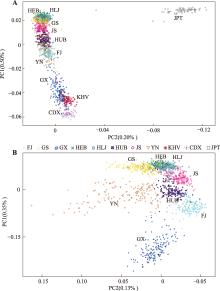
Fig. 1
Principal component analysis results of East Asian and Han Chinese populations"

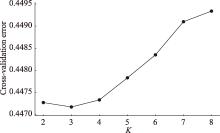
Supplementary Fig. 1
Cross-validation errors for different K values in the genetic ancestry analysis of East Asian populations"
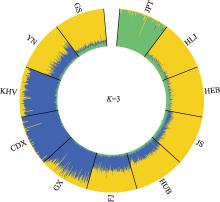
Fig. 2
ADMIXTURE results of 205,041 SNPs in East Asians"
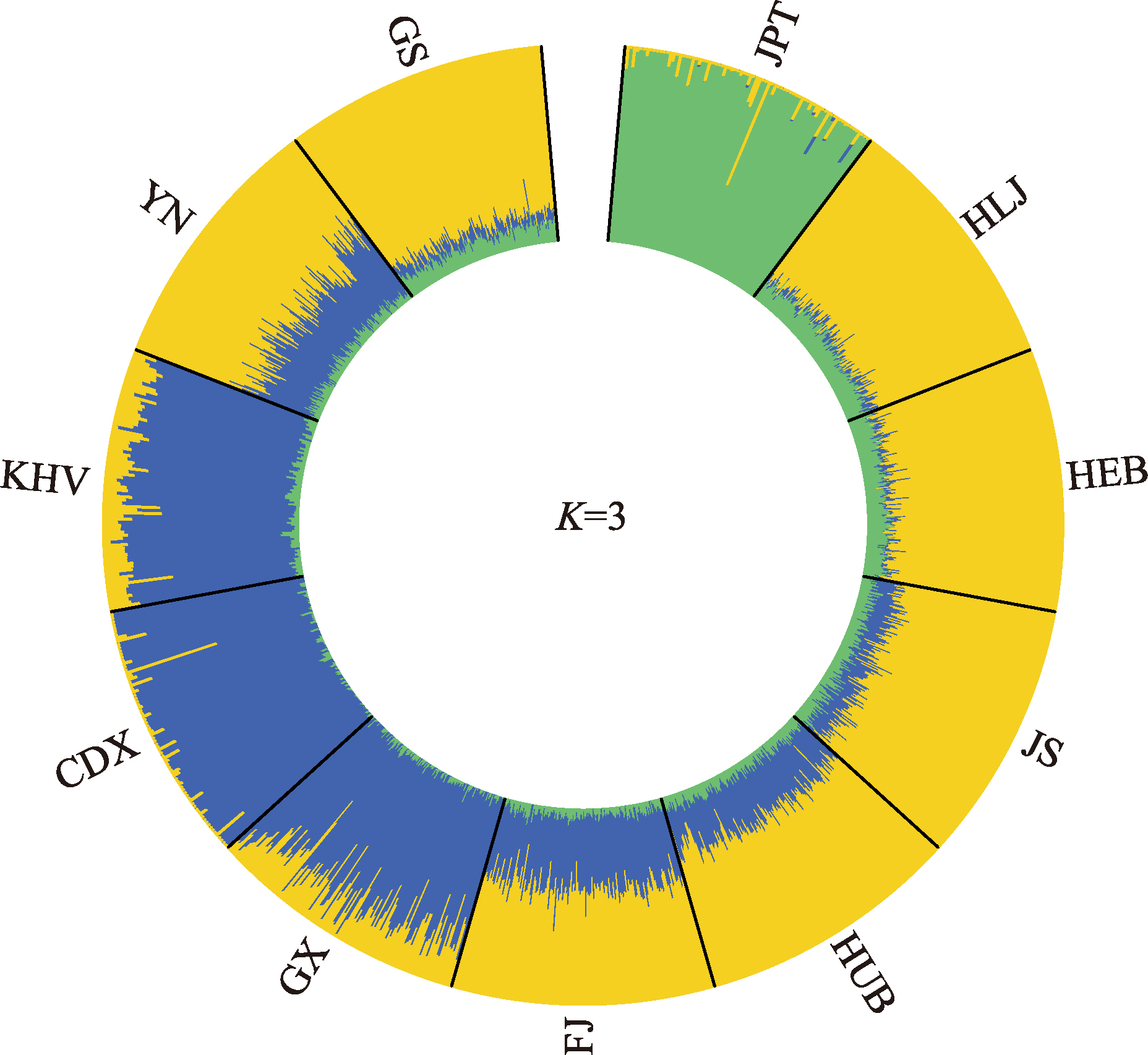
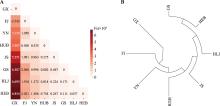
Fig. 3
Genetic relationships between Han Chinese populations in different provinces of China"
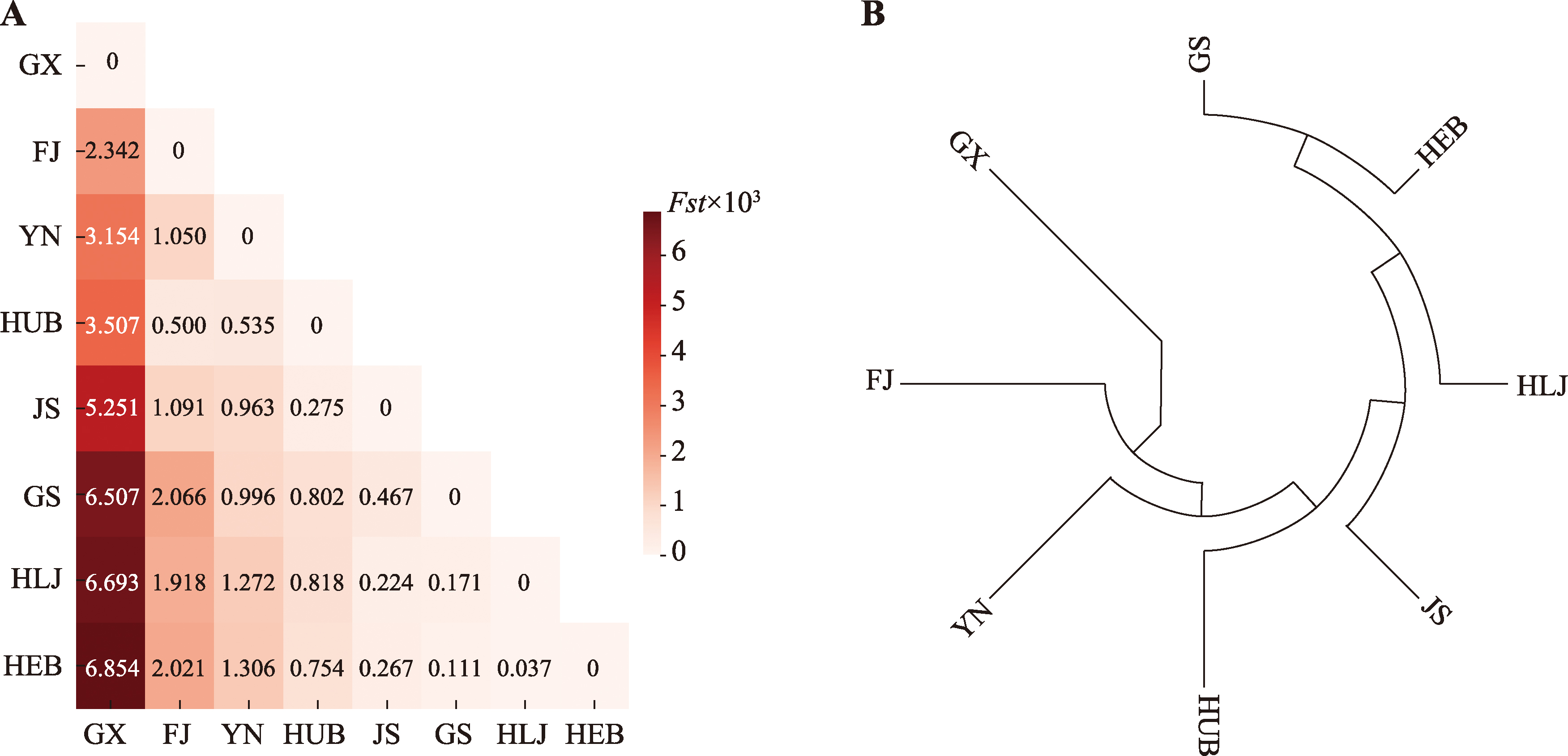
Table 2
Comparative analysis of accuracy rates for XGBoost, Random Forest and KNN algorithms"
| 方法 | 1stAcc | AccLR | ErrLR | ConsLR | InccLR |
|---|---|---|---|---|---|
| XGBoost | 87.06% | 96.66% | 3.34% | 59.96% | 36.70% |
| 随机森林 | 85.54% | 95.55% | 4.45% | 58.44% | 37.11% |
| K近邻 | 71.08% | 94.03% | 5.97% | 16.78% | 77.25% |
Table 3
Prediction results based on the PCA-XGBoost model in the reference dataset"
| 真实/预测 | 北方汉族 | 西北汉族 | 中部汉族 | 东部汉族 | 东南汉族 | 西南汉族 | 岭南汉族 | 总计 | 1stAcc | AccLR | ConsLR |
|---|---|---|---|---|---|---|---|---|---|---|---|
| 北方汉族 | 215(73) | 16(13) | 2(2) | 13(13) | 246 | 87.40% | 98.78% | 57.72% | |||
| 西北汉族 | 18(10) | 103(59) | 1(1) | 2(2) | 124 | 83.06% | 93.55% | 35.48% | |||
| 中部汉族 | 2(1) | 106(51) | 9(7) | 5(3) | 3(2) | 125 | 84.80% | 95.20% | 44.00% | ||
| 东部汉族 | 19(13) | 1(0) | 10(9) | 93(42) | 123 | 75.61% | 93.50% | 41.46% | |||
| 东南汉族 | 8(5) | 2(1) | 109(16) | 3(3) | 1(1) | 123 | 88.62% | 96.75% | 75.61% | ||
| 西南汉族 | 7(4) | 2(2) | 114(17) | 1(1) | 124 | 91.94% | 97.58% | 78.23% | |||
| 岭南汉族 | 1(1) | 2(1) | 121(10) | 124 | 97.58% | 99.19% | 89.52% | ||||
| 总计 | 989 | 87.06% | 96.66% | 59.96% |
Supplementary Table 3
Prediction results based on the PCA-KNN model in the reference dataset"
| 真实/预测 | 北方汉族 | 西北汉族 | 中部汉族 | 东部汉族 | 东南汉族 | 西南汉族 | 岭南汉族 | 总计 | 1stAcc | AccLR | ConsLR |
|---|---|---|---|---|---|---|---|---|---|---|---|
| 北方汉族 | 220(203) | 9(8) | 1(1) | 15(12) | 1(1) | 246 | 89.43% | 98.37% | 6.91% | ||
| 西北汉族 | 69(53) | 50(48) | 5(4) | 124 | 40.32% | 86.29% | 1.61% | ||||
| 中部汉族 | 23(20) | 2(1) | 59(59) | 29(25) | 6(5) | 6(5) | 125 | 42.70% | 92.00% | 0.00% | |
| 东部汉族 | 32(22) | 21(19) | 66(65) | 3(3) | 1(1) | 123 | 53.66% | 90.24% | 0.81% | ||
| 东南汉族 | 1(0) | 17(14) | 7(6) | 98(56) | 123 | 79.67% | 95.93% | 34.15% | |||
| 西南汉族 | 5(4) | 7(6) | 16(10) | 4(1) | 1(1) | 90(60) | 1(1) | 124 | 72.58% | 91.13% | 24.19% |
| 岭南汉族 | 1(1) | 1(1) | 1(1) | 1(1) | 120(46) | 124 | 96.77% | 100.00% | 59.58% | ||
| 总计 | 989 | 71.08% | 94.03% | 16.78% |
Supplementary Table 4
Prediction results based on the PCA-RF model in the reference dataset"
| 真实/预测 | 北方汉族 | 西北汉族 | 中部汉族 | 东部汉族 | 东南汉族 | 西南汉族 | 岭南汉族 | 总计 | 1stAcc | AccLR | ConsLR |
|---|---|---|---|---|---|---|---|---|---|---|---|
| 北方汉族 | 213(56) | 13(7) | 20(18) | 246 | 86.59% | 96.75% | 63.82% | ||||
| 西北汉族 | 24(11) | 100(25) | 124 | 80.65% | 89.52% | 60.48% | |||||
| 中部汉族 | 1(0) | 1(0) | 101(81) | 11(11) | 4(2) | 7(6) | 125 | 80.80% | 96.00% | 16.00% | |
| 东部汉族 | 19(11) | 1(1) | 9(8) | 98(78) | 123 | 76.42% | 92.68% | 13.01% | |||
| 东南汉族 | 16(15) | 1(0) | 102(6) | 2(2) | 2(1) | 123 | 82.93% | 97.56% | 78.05% | ||
| 西南汉族 | 1(1) | 5(2) | 4(3) | 114(15) | 124 | 91.94% | 96.77% | 79.84% | |||
| 岭南汉族 | 1(0) | 1(0) | 122(7) | 124 | 98.39% | 98.39% | 92.74% | ||||
| 总计 | 989 | 85.54% | 95.55% | 58.44% |
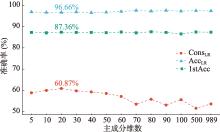
Fig. 4
The accuracy of the model based on different numbers of PCs"
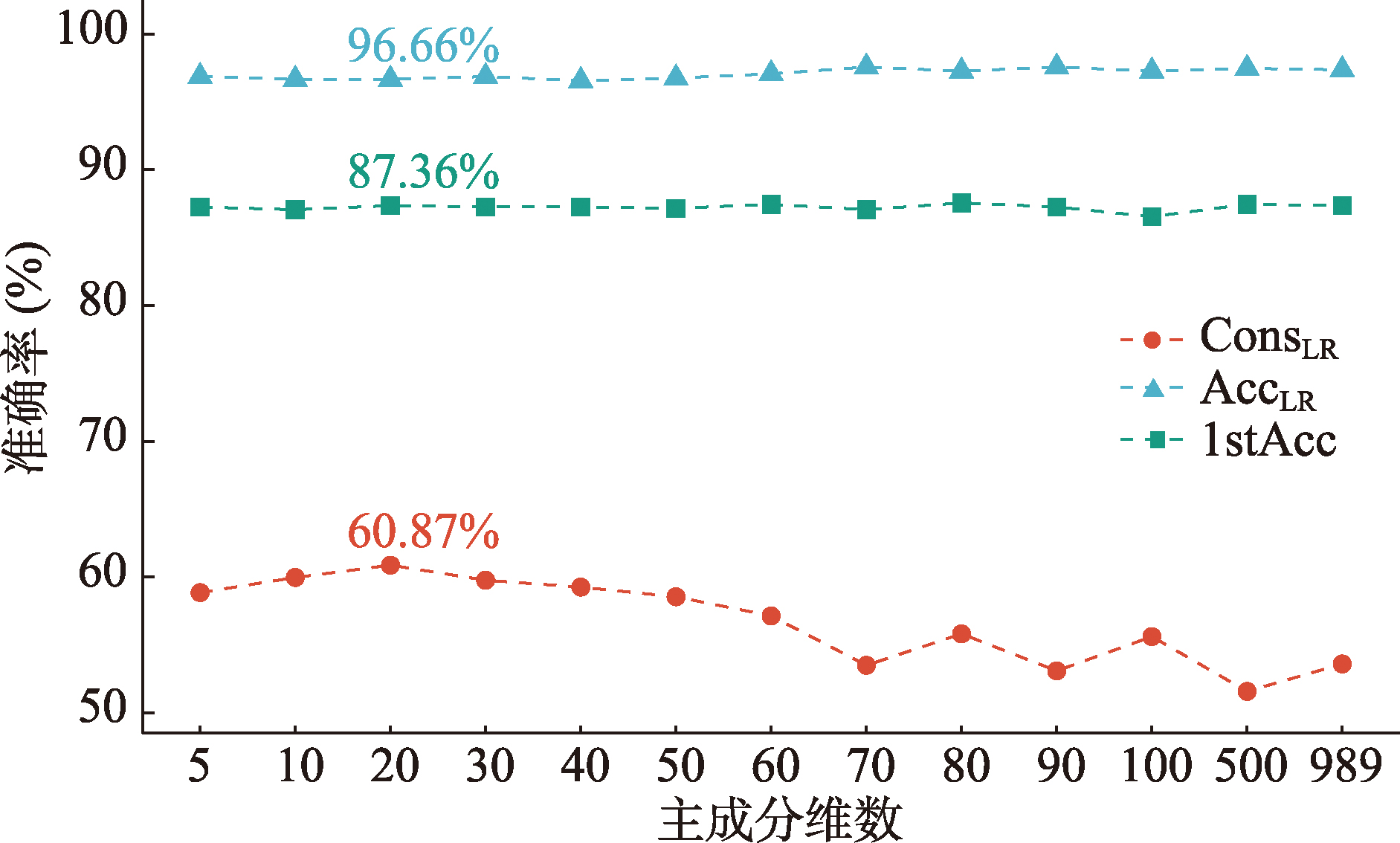
Table 4
Prediction results based on the optimized PCA-XGBoost model in the reference dataset"
| 真实/预测 | 北方汉族 | 西北汉族 | 中部汉族 | 东部汉族 | 东南汉族 | 西南汉族 | 岭南汉族 | 总计 | 1stAcc | AccLR | ConsLR |
|---|---|---|---|---|---|---|---|---|---|---|---|
| 北方汉族 | 212(73) | 18(16) | 1(1) | 15(12) | 246 | 86.18% | 97.97% | 59.50% | |||
| 西北汉族 | 16(11) | 106(53) | 1(1) | 1(0) | 124 | 85.48% | 95.16% | 42.74% | |||
| 中部汉族 | 2(1) | 103(40) | 10(8) | 6(4) | 4(4) | 125 | 82.40% | 96.00% | 50.40% | ||
| 东部汉族 | 18(12) | 6(6) | 99(46) | 123 | 80.49% | 95.12% | 43.09% | ||||
| 东南汉族 | 7(3) | 3(2) | 110(14) | 2(2) | 1(1) | 123 | 89.43% | 95.93% | 78.04% | ||
| 西南汉族 | 6(4) | 3(2) | 115(21) | 124 | 92.74% | 97.58% | 78.81% | ||||
| 岭南汉族 | 2(1) | 122(3) | 124 | 98.39% | 99.19% | 95.97% | |||||
| 总计 | 989 | 87.66% | 96.87% | 62.39% |
Table 5
Prediction results of the PCA-XGBoost model on the type A test dataset"
| 真实/预测 | 北方汉族 | 西北汉族 | 中部汉族 | 东部汉族 | 东南汉族 | 西南汉族 | 岭南汉族 | 总计 | 1stAcc | AccLR | ConsLR |
|---|---|---|---|---|---|---|---|---|---|---|---|
| 北方汉族 | 49(17) | 7(7) | 4(4) | 60 | 81.67% | 100.00% | 53.33% | ||||
| 西北汉族 | 4(2) | 25(12) | 1(0) | 30 | 83.33% | 93.33% | 43.33% | ||||
| 中部汉族 | 1(0) | 23(11) | 3(2) | 3(3) | 30 | 76.67% | 93.33% | 40.00% | |||
| 东部汉族 | 4(0) | 26(12) | 30 | 86.67% | 86.67% | 46.67% | |||||
| 东南汉族 | 2(0) | 27(5) | 1(1) | 30 | 90.00% | 93.33% | 73.33% | ||||
| 西南汉族 | 2(1) | 28(4) | 30 | 93.33% | 96.67% | 80.00% | |||||
| 岭南汉族 | 1(1) | 29(1) | 30 | 96.67% | 100.00% | 93.33% | |||||
| 总计 | 240 | 86.25% | 95.42% | 60.41% |
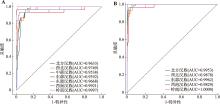
Fig. 5
Classification performance of the PCA-XGBoost model on different test sets"
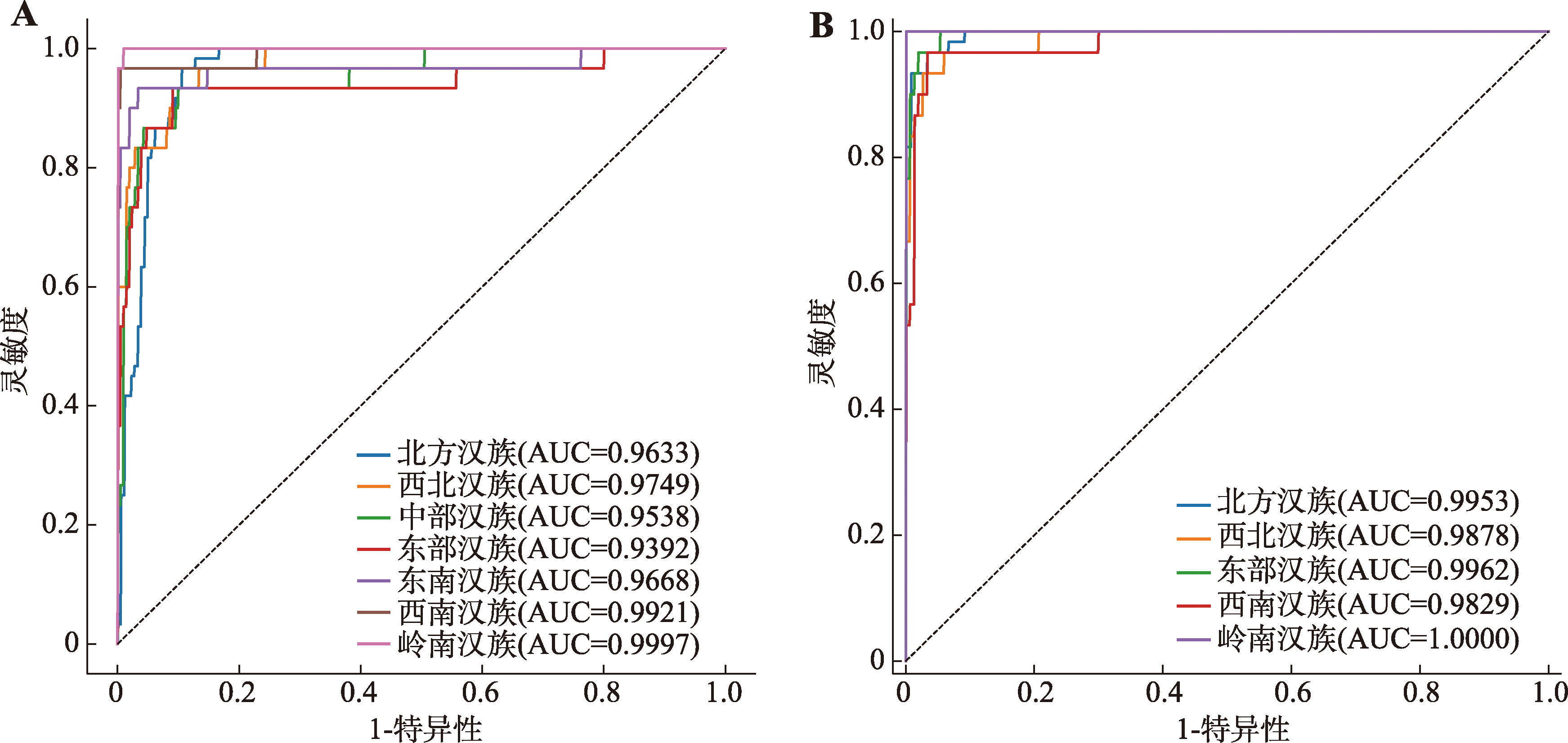
Table 6
Prediction results of the PCA-XGBoost model on the type B test dataset"
| 真实/预测 | 北方汉族 | 西北汉族 | 中部汉族 | 东部汉族 | 东南汉族 | 西南汉族 | 岭南汉族 | 总计 | 1stAcc | AccLR | ConsLR |
|---|---|---|---|---|---|---|---|---|---|---|---|
| 北方汉族 | 53(23) | 5(5) | 1(1) | 1(1) | 60 | 88.33% | 100.00% | 50.00% | |||
| 西北汉族 | 1(1) | 28(8) | 1(1) | 30 | 93.33% | 100.00% | 66.67% | ||||
| 东部汉族 | 5(5) | 25(9) | 30 | 83.33% | 100.00% | 53.33% | |||||
| 西南汉族 | 10(7) | 3(3) | 17(6) | 30 | 56.67% | 90.00% | 36.67% | ||||
| 岭南汉族 | 30(1) | 30 | 100.00% | 100.00% | 96.67% | ||||||
| 总计 | 180 | 85.00% | 98.33% | 58.89% |
| [1] |
Alladio E, Poggiali B, Cosenza G, Pilli E, Palamenghi A, Marino A, Staiti N. Multivariate statistical approach and machine learning for the evaluation of biogeographical ancestry inference in the forensic field. Sci Rep, 2022, 12(1): 8974.
pmid: 35643723 |
| [2] |
Salvo NM, Olsen GH, Berg T, Janssen K. Biogeographical ancestry analyses using the ForenSeqTM DNA signature prep kit and multiple prediction tools. Genes, 2024, 15(4): 510.
pmid: 38674444 |
| [3] |
Kidd KK, Speed WC, Pakstis AJ, Furtado MR, Fang RX, Madbouly A, Maiers M, Middha M, Friedlaender FR, Kidd JR. Progress toward an efficient panel of SNPs for ancestry inference. Forensic Sci Int Genet, 2014, 10: 23-32.
pmid: 24508742 |
| [4] |
Wei YL, Wei L, Zhao L, Sun QF, Jiang L, Zhang T, Liu HB, Chen JG, Ye J, Hu L, Li CX. A single-tube 27-plex SNP assay for estimating individual ancestry and admixture from three continents. Int J Legal Med, 2016, 130(1): 27-37.
pmid: 25833170 |
| [5] |
Pakstis AJ, Kang LL, Liu LJ, Zhang ZY, Jin TB, Grigorenko EL, Wendt FR, Budowle B, Hadi S, Al Qahtani MS, Morling N, Mogensen HS, Themudo GE, Soundararajan U, Rajeevan H, Kidd JR, Kidd KK. Increasing the reference populations for the 55 AISNP panel: the need and benefits. Int J Legal Med, 2017, 131(4): 913-917.
pmid: 28070634 |
| [6] |
Zhou YS, Jin XY, Wu BL, Zhu BF. Development and performance evaluation of a novel ancestry informative DIP panel for continental origin inference. Front Genet, 2022, 12: 801275.
pmid: 35251118 |
| [7] |
Li CX, Pakstis AJ, Jiang L, Wei YL, Sun QF, Wu H, Bulbul O, Wang P, Kang LL, Kidd JR, Kidd KK. A panel of 74 AISNPs: improved ancestry inference within eastern Asia. Forensic Sci Int Genet, 2016, 23: 101-110.
pmid: 27077960 |
| [8] |
Paschou P, Ziv E, Burchard EG, Choudhry S, Rodriguez- Cintron W, Mahoney MW, Drineas P. PCA-correlated SNPs for structure identification in worldwide human populations. PLoS Genet, 2007, 3(9): e160.
pmid: 17892327 |
| [9] |
Pritchard JK, Stephens M, Donnelly P. Inference of population structure using multilocus genotype data. Genetics, 2000, 155(2): 945-959.
pmid: 10835412 |
| [10] |
Bianco SD, Parca L, Petrizzelli F, Biagini T, Giovannetti A, Liorni N, Napoli A, Carella M, Procaccio V, Lott MT, Zhang SP, Vescovi AL, Wallace DC, Caputo V, Mazza T. APOGEE 2: multi-layer machine-learning model for the interpretable prediction of mitochondrial missense variants. Nat Commun, 2023, 14(1): 5058.
pmid: 37598215 |
| [11] |
Yang QX, Luo L, Lin ZP, Wen W, Zeng WB, Deng H. A machine learning-based predictive model of causality in orthopaedic medical malpractice cases in China. PLoS One, 2024, 19(4): e0300662.
pmid: 38630758 |
| [12] |
Yesilyaprak A, Kumar AK, Agrawal A, Furqan MM, Verma BR, Syed AB, Majid M, Akyuz K, Rayes DL, Chen D, Wang TKM, Cremer PC, Klein AL. Predicting long-term clinical outcomes of patients with recurrent pericarditis. J Am Coll Cardiol, 2024, 84(13): 1193-1204.
pmid: 39217549 |
| [13] |
Cai MM, Lei FZ, Chen M, Lan Q, Wu XL, Mao C, Shi MS, Zhu BF. Systematic analyses of AISNPs screening and classification algorithms based on genome-wide data for forensic biogeographic ancestry inference. Forensic Sci Int, 2024, 357: 111975.
pmid: 38547686 |
| [14] |
Wang CN, Wang SQ, Zhao YR, Liu J, Zhang DQ, Wang FY, Fan H, Li CX, Jiang L. A biogeographical ancestry inference pipeline using PCA-XGBoost model and its application in Asian populations. Forensic Sci Int Genet, 2025, 77: 103239.
pmid: 40037006 |
| [15] | Yang QX, Chen J, Nie SJ, Liu C, Deng H, He GL. Fine-scale biogeographical ancestry inference in Southeast and East Asians via high-efficiency markers and machine learning approaches. Front Ecol Evol, 2025, 13: 1572596. |
| [16] |
Wang MG, Yuan DD, Zou X, Wang Z, Yeh HY, Liu J, Wei LH, Wang CC, Zhu BF, Liu C, He GL. Fine-scale genetic structure and natural selection signatures of southwestern Hans inferred from patterns of genome-wide allele, haplotype, and haplogroup lineages. Front Genet, 2021, 12: 727821.
pmid: 34504517 |
| [17] |
He GL, Wang Z, Guo JX, Wang MG, Zou X, Tang RK, Liu J, Zhang H, Li YX, Hu R, Wei LH, Chen G, Wang CC, Hou YP. Inferring the population history of Tai-Kadai- speaking people and southernmost Han Chinese on Hainan Island by genome-wide array genotyping. Eur J Hum Genet, 2020, 28(8): 1111-1123.
pmid: 32123326 |
| [18] |
Yao HB, Wang MG, Zou X, Li YX, Yang XM, Li AL, Yeh HY, Wang PX, Wang Z, Bai JY, Guo JX, Chen JW, Ding X, Zhang Y, Lin BQ, Wang CC, He GL. New insights into the fine-scale history of western-eastern admixture of the northwestern Chinese population in the Hexi Corridor via genome-wide genetic legacy. Mol Genet Genomics, 2021, 296(3): 631-651.
pmid: 33650010 |
| [19] |
Cong PK, Bai WY, Li JC, Yang MY, Khederzadeh S, Gai SR, Li N, Liu YH, Yu SH, Zhao WW, Liu JQ, Sun Y, Zhu XW, Zhao PP, Xia JW, Guan PL, Qian Y, Tao JG, Xu L, Tian G, Wang PY, Xie SY, Qiu MC, Liu KQ, Tang BS, Zheng HF. Genomic analyses of 10,376 individuals in the Westlake BioBank for Chinese (WBBC) pilot project. Nat Commun, 2022, 13(1): 2939.
pmid: 35618720 |
| [20] |
Cao YN, Li L, Xu M, Feng ZM, Sun XH, Lu JL, Xu Y, Du PN, Wang TG, Hu RY, Ye Z, Shi LX, Tang XL, Yan L, Gao ZN, Chen G, Zhang YF, Chen LL, Ning G, Bi YF, Wang WQ, The ChinaMAP Consortium. The ChinaMAP analytics of deep whole genome sequences in 10,588 individuals. Cell Res, 2020, 30(9): 717-731.
pmid: 32355288 |
| [21] | Gu JQ, Jiang L, Xu JY, Wang H, Wei YL, Li CX. Genetic structure of East Asians based on high-density SNP data. Prog Biochem Biophys, 2023, 50(11): 2739-2752. |
| 顾佳琪, 江丽, 徐景怡, 王寒, 魏以梁, 李彩霞. 基于高密度SNP数据的东亚人群遗传结构研究. 生物化学与生物物理进展, 2023, 50(11): 2739-2752. | |
| [22] |
Li CP, Tian DM, Tang BX, Liu XN, Teng XF, Zhao WM, Zhang Z, Song SH. Genome Variation Map: a worldwide collection of genome variations across multiple species. Nucleic Acids Res, 2021, 49(D1): D1186-D1191.
pmid: 33170268 |
| [23] |
Purcell S, Neale B, Todd-Brown K, Thomas L, Ferreira MAR, Bender D, Maller J, Sklar P, de Bakker PIW, Daly MJ, Sham PC. PLINK: a tool set for whole-genome association and population-based linkage analyses. Am J Hum Genet, 2007, 81(3): 559-575.
pmid: 17701901 |
| [24] |
1000 Genomes Project Consortium, Auton A, Brooks LD, Durbin RM, Garrison EP, Kang HM, Korbel JO, Marchini JL, McCarthy S, McVean GA, Abecasis GR. A global reference for human genetic variation. Nature, 2015, 526(7571): 68-74.
pmid: 26432245 |
| [25] |
Yang J, Lee SH, Goddard ME, Visscher PM. GCTA: a tool for genome-wide complex trait analysis. Am J Hum Genet, 2011, 88(1): 76-82.
pmid: 21167468 |
| [26] |
Alexander DH, Novembre J, Lange K. Fast model-based estimation of ancestry in unrelated individuals. Genome Res, 2009, 19(9): 1655-1664.
pmid: 19648217 |
| [27] |
Ito K, Murphy D. Application of ggplot2 to pharmacometric graphics. CPT Pharmacometrics Syst Pharmacol, 2013, 2(10): e79.
pmid: 24132163 |
| [28] |
Danecek P, Auton A, Abecasis G, Albers CA, Banks E, DePristo MA, Handsaker RE, Lunter G, Marth GT, Sherry ST, McVean G, Durbin R, 1000 Genomes Project Analysis Group. The variant call format and VCFtools. Bioinformatics, 2011, 27(15): 2156-2158.
pmid: 21653522 |
| [29] |
Kumar S, Stecher G, Li M, Knyaz C, Tamura K. MEGA X: molecular evolutionary genetics analysis across computing platforms. Mol Biol Evol, 2018, 35(6): 1547-1549.
pmid: 29722887 |
| [30] | Yao HT, Jiang L, Wang CN, Fan H, Li CX. Research on the intercontinental population biogeographic ancestral inference model based on PCA-XGBoost method. Prog Biochem Biophys, 2024, 51(12): 3292-3309. |
| 姚昊天, 江丽, 王春年, 范虹, 李彩霞. 基于PCA- XGBoost方法的洲际人群生物地理祖源推断模型研究. 生物化学与生物物理进展, 2024, 51(12): 3292-3309. | |
| [31] | Chen TQ, Guestrin C. XGBoost: a scalable tree boosting system. In: Proceedings of the 22nd ACM SIGKDD International Conference on Knowledge Discovery and Data Mining (KDD'16). Association for Computing Machinery, New York, NY, USA, 2016, 785-794. |
| [32] |
Rigatti SJ. Random forest. J Insur Med, 2017, 47(1): 31-39.
pmid: 28836909 |
| [33] | Hastie T, Tibshirani R. Discriminant adaptive nearest neighbor classification and regression. In: Proceedings of the 9th International Conference on Neural Information Processing Systems (NIPS'95). MIT Press, Cambridge, MA, USA, 1995, 409-415. |
| [34] | He GL, Li YX, Zou X, Yeh HY, Tang RK, Wang PX, Bai JY, Yang XM, Wang Z, Guo JX, Chen JW, Chen J, Yang MQ, Zhao J, Sun J, Zhu KY, Ma H, Wang R, Yang WJ, Hu R, Wei LH, Hou YP, Wang MG, Chen G, Wang CC. Northern gene flow into southeastern East Asians inferred from genome-wide array genotyping. J Syst Evol, 2023, 61(1): 179-197. |
| [35] |
Wen B, Li H, Lu DR, Song XF, Zhang F, He YG, Li F, Gao Y, Mao XY, Zhang L, Qian J, Tan JZ, Jin JZ, Huang W, Deka RJ, Su B, Chakraborty R, Jin L. Genetic evidence supports demic diffusion of Han culture. Nature, 2004, 431(7006): 302-305.
pmid: 15372031 |
| [36] |
Zhang P, Luo HX, Li YY, Wang Y, Wang JJ, Zheng Y, Niu YW, Shi YR, Zhou HH, Song TR, Kang Q, Han100K Initiative, Xu T, He SM. NyuWa Genome resource: a deep whole-genome sequencing-based variation profile and reference panel for the Chinese population. Cell Rep, 2021, 37(7): 110017.
pmid: 34788621 |
| [37] |
Chen PY, Wu J, Luo L, Gao HY, Wang MG, Zou X, Li YX, Chen G, Luo HB, Yu LM, Han YY, Jia FQ, He GL. Population genetic analysis of modern and ancient DNA variations yields new insights into the formation, genetic structure, and phylogenetic relationship of Northern Han Chinese. Front Genet, 2019, 10: 1045.
pmid: 31737039 |
| [38] |
Liu SY, Huang SJ, Chen F, Zhao LJ, Yuan YY, Francis SS, Fang L, Li ZL, Lin L, Liu R, Zhang Y, Xu HX, Li SK, Zhou YW, Davies RW, Liu Q, Walters RG, Lin K, Ju J, Korneliussen T, Yang MA, Fu QM, Wang J, Zhou LJ, Krogh A, Zhang HY, Wang W, Chen ZM, Cai ZM, Yin Y, Yang HM, Mao M, Shendure J, Wang J, Albrechtsen A, Jin X, Nielsen R, Xu X. Genomic analyses from non-invasive prenatal testing reveal genetic associations, patterns of viral infections, and Chinese population history. Cell, 2018, 175(2): 347-359.e14.
pmid: 30290141 |
| [39] | Zhou JB, Zhang XP, Li X, Sui J, Zhang S, Zhong H, Zhang QX, Zhang XM, Huang H, Wen YF. Genetic structure and demographic history of Northern Han people in Liaoning Province inferred from genome-wide array data. Front Ecol Evol, 2022, 10: 1014024. |
| [40] |
Chiang CWK, Mangul S, Robles C, Sankararaman S. A comprehensive map of genetic variation in the world’s largest ethnic group—Han Chinese. Mol Biol Evol, 2018, 35(11): 2736-2750.
pmid: 30169787 |
| [41] |
Chen JM, Zheng HF, Bei JX, Sun LD, Jia WH, Li T, Zhang FR, Seielstad M, Zeng YX, Zhang XJ, Liu JJ. Genetic structure of the Han Chinese population revealed by genome-wide SNP variation. Am J Hum Genet, 2009, 85(6): 775-785.
pmid: 19944401 |
| [42] |
Li W, Yin YB, Quan XW, Zhang H. Gene expression value prediction based on XGBoost algorithm. Front Genet, 2019, 10: 1077.
pmid: 31781160 |
| [43] |
Deng XS, Li M, Deng SB, Wang L. Hybrid gene selection approach using XGBoost and multi-objective genetic algorithm for cancer classification. Med Biol Eng Comput, 2022, 60(3): 663-681.
pmid: 35028863 |
| [44] |
Watson DS. Interpretable machine learning for genomics. Hum Genet, 2022, 141(9): 1499-1513.
pmid: 34669035 |
| [45] |
Musolf AM, Holzinger ER, Malley JD, Bailey-Wilson JE. What makes a good prediction? Feature importance and beginning to open the black box of machine learning in genetics. Hum Genet, 2022, 141(9): 1515-1528.
pmid: 34862561 |
| [46] |
Gaspar HA, Breen G. Probabilistic ancestry maps: a method to assess and visualize population substructures in genetics. BMC Bioinform, 2019, 20(1): 116.
pmid: 30845922 |
| [47] |
Ausmees K, Nettelblad C. A deep learning framework for characterization of genotype data. G3 (Bethesda), 2022, 12(3): jkac020.
pmid: 35078229 |
| [48] | Montserrat DM, Bustamante C, Ioannidis A. Lai-net: local-ancestry inference with neural networks. ICASSP 2020-2020 IEEE International Conference on Acoustics, Speech and Signal Processing (ICASSP). IEEE, 2020, 1314-1318. |
| [49] |
Karim MR, Cochez M, Zappa A, Sahay R, Rebholz- Schuhmann D, Beyan O, Decker S. Convolutional embedded networks for population scale clustering and bio-ancestry inferencing. IEEE/ACM Trans Comput Biol Bioinform, 2020, 19(1): 369-382.
pmid: 32750845 |
| [50] |
Battey CJ, Ralph PL, Kern AD. Predicting geographic location from genetic variation with deep neural networks. eLife, 2020, 9: e54507.
pmid: 32511092 |
| [51] |
Soumare H, Rezgui S, Gmati N, Benkahla A. New neural network classification method for individuals ancestry prediction from SNPs data. BioData Min, 2021, 14(1): 30.
pmid: 34183066 |
| [52] |
Prugnolle F, Manica A, Balloux F. Geography predicts neutral genetic diversity of human populations. Curr Biol, 2005, 15(5): R159-R160.
pmid: 15753023 |
| [53] |
Battey CJ, Ralph PL, Kern AD. Space is the place: effects of continuous spatial structure on analysis of population genetic data. Genetics, 2020, 215(1): 193-214.
pmid: 32209569 |
| [54] |
Li YC, Ye WJ, Jiang CG, Zeng Z, Tian JY, Yang LQ, Liu KJ, Kong QP. River valleys shaped the maternal genetic landscape of Han Chinese. Mol Biol Evol, 2019, 36(8): 1643-1652.
pmid: 31112995 |
| [55] |
Gao Y, Zhang C, Yuan LY, Ling YC, Wang XJ, Liu C, Pan YW, Zhang XX, Ma XX, Wang YC, Lu Y, Yuan K, Ye W, Qian JQ, Chang HD, Cao RF, Yang X, Ma L, Ju YH, Dai L, Tang YY, The Han100K Initiative, Zhang GQ, Xu SH. PGG. Han: the Han Chinese genome database and analysis platform. Nucleic Acids Res, 2020, 48(D1): D971-D976.
pmid: 31584086 |
| [56] |
Li ZC, Jiang XS, Fang MY, Bai Y, Liu SY, Huang SJ, Jin X. CMDB: the comprehensive population genome variation database of China. Nucleic Acids Res, 2023, 51(D1): D890-D895.
pmid: 35871305 |
| [57] |
Wang CC, Li H. Inferring human history in East Asia from Y chromosomes. Investig Genet, 2013, 4(1): 11.
pmid: 23731529 |
| [58] |
Moutsouri I, Manoli P, Christofi V, Bashiardes E, Keravnou A, Xenophontos S, Cariolou MA. Deciphering the maternal ancestral lineage of Greek Cypriots, Armenian Cypriots and Maronite Cypriots. PLoS One, 2024, 19(2): e0292790.
pmid: 38315645 |
| [59] | Yu HX, Zhang XP, Wei LH. The 30-100 patrilineal nomenclature system for eastern Eurasian populations. Hereditas(Beijing), 2025, 47(6): 660-671. |
| 于会新, 张咸鹏, 韦兰海. 欧亚大陆东部人群父系30-100分类体系. 遗传, 2025, 47(6): 660-671. | |
| [60] |
Yang T, Liu YH, Zou S, Li XP, Wang ZY, Luo LT, Tang RK, Liu C, Hu LP, He GL, Nie SJ, Wang MG. Patrilineages of ethnolinguistically diverse populations reveal multifactorial influences on Chinese paternal population stratification. BMC Biol, 2025, 23(1): 341.
pmid: 41250068 |
| [61] |
Lee J, Yang S, Baik JY, Liu XX, Tan Z, Li DW, Wen ZX, Hou BJ, Duong-Tran D, Chen TL, Shen L. Knowledge- driven feature selection and engineering for genotype data with large language models. AMIA Jt Summits Transl Sci Proc, 2025, 2025: 250-259.
pmid: 40502214 |
| [62] |
Ali S, Qadri YA, Ahmad K, Lin ZZ, Leung MF, Kim SW, Vasilakos AV, Zhou T. Large language models in genomics—a perspective on personalized medicine. Bioengineering (Basel), 2025, 12(5): 440.
pmid: 40428059 |
| [1] | Lv Dai, Zichen Tang, Zhen Jia, Li Jiang, Chuantong Zhao, Zhiyuan Zhao, Wenting Zhao, Caixia Li. SNP density impact on kinship inference and IBS-machine learning optimization [J]. Hereditas(Beijing), 2026, 48(6): 570-588. |
| [2] | Zhihong Li, Miaoqi Chen, Xiaojun Yuan, Huajun Huang, Wanting Huang, Piaoyan Zhou, Chen Zeng, Xunuo Feng, Luoyao Yang, Shuqiang Huang, Cuiyu Tan, Cairong Chen, Qiuxia Yan. Identification of biomarkers for non-obstructive azoospermia based on microRNA and bioinformatics screening [J]. Hereditas(Beijing), 2026, 48(3): 301-312. |
| [3] | Hui Liang, Xue Wang, Jingfang Si, Yi Zhang. Classification accuracy of machine learning algorithms for Chinese local cattle breeds using genomic markers [J]. Hereditas(Beijing), 2024, 46(7): 530-539. |
| [4] | Ziyi Zhang, Qilin Wang, Junyou Zhang, Yingying Duan, Jiaxin Liu, Zhaoshuo Liu, Chunyan Li. Machine learning applications in breast cancer survival and therapeutic outcome prediction based on multi-omic analysis [J]. Hereditas(Beijing), 2024, 46(10): 820-832. |
| [5] | Huiyi Zheng, Huaxuan Wu, Zhiqiang Du. Gut metagenome-derived image augmentation and deep learning improve prediction accuracy of metabolic disease classification [J]. Hereditas(Beijing), 2024, 46(10): 886-896. |
| [6] | Dong Chen, Shujie Wang, Zhenjian Zhao, Xiang Ji, Qi Shen, Yang Yu, Shengdi Cui, Junge Wang, Ziyang Chen, Jinyong Wang, Zongyi Guo, Pingxian Wu, Guoqing Tang. Genomic prediction of pig growth traits based on machine learning [J]. Hereditas(Beijing), 2023, 45(10): 922-932. |
| [7] | Yongqiang Kong, Jinkai Liu, Jiaqi Gu, Jingyi Xu, Yunuo Zheng, Yiliang Wei, Shaoyuan Wu. Optimization scheme of machine learning model for genetic division between northern Han, southern Han, Korean and Japanese [J]. Hereditas(Beijing), 2022, 44(11): 1028-1043. |
| [8] | Xi Li, Haoyu Wang, Yueyan Cao, Qiang Zhu, Panyin Shu, Tingyun Hou, Yuting Wang, Ji Zhang. Forensic genomics research on microhaplotypes [J]. Hereditas(Beijing), 2021, 43(10): 962-971. |
| [9] | Yali Hu, Rui Dai, Yongxin Liu, Jingying Zhang, Bin Hu, Chengcai Chu, Huaibo Yuan, Yang Bai. Analysis of rice root bacterial microbiota of Nipponbare and IR24 [J]. Hereditas(Beijing), 2020, 42(5): 506-518. |
| [10] | Zhao Xuetong, Yang Yadong, Qu Hongzhu, Fang Xiangdong. Applications of machine learning in clinical decision support in the omic era [J]. Hereditas(Beijing), 2018, 40(9): 693-703. |
| [11] | Zhang Guishan, Yang Yong, Zhang Lingmin, Dai Xianhua. Application of machine learning in the CRISPR/Cas9 system [J]. Hereditas(Beijing), 2018, 40(9): 704-723. |
| [12] | Zhe-ye Peng,Zi-jun Tang,Min-zhu Xie. Research progress in machine learning methods for gene-gene interaction detection [J]. Hereditas(Beijing), 2018, 40(3): 218-226. |
| [13] | CHEN Min-Zhi, CHENG An-Hui, MA Long, WANG Hui, QIU Rong-Fang, XUE Fu-Zhong, LIU Ai-Ji. Association study between TNFSF4 and coronary heart disease [J]. HEREDITAS, 2011, 33(3): 239-245. |
| [14] | HOU Yan-Yan, YING Xiao-Min, LI Wu-Ju . Computational approaches to microRNA discovery [J]. HEREDITAS, 2008, 30(6): 687-696. |
| [15] | GUI Hong-Sheng, YANG Li, LI Sheng-Bin. The application of statistical approaches in studying population genetics with STR data [J]. HEREDITAS, 2007, 29(12): 1443-1148. |
| Viewed | ||||||
|
Full text |
|
|||||
|
Abstract |
|
|||||

