Hereditas(Beijing) ›› 2026, Vol. 48 ›› Issue (8): 796-806.doi: 10.16288/j.yczz.25-340
• Research Article • Previous Articles Next Articles
PIK3CA in-frame deletion-activated PI3K/AKT signaling pathway drives macrodactyly
Jingheng Wu( ), Shanlin Chen, Yunhao Xue, Pengcheng Li, Mengmeng Tian
Department of Hand Surgery ,Beijing Jishuitan Hospital, Capital Medical University Beijing 100035, China
-
Received:2026-01-29Revised:2026-04-25Online:2026-05-08Published:2026-05-08 -
Contact:Jingheng Wu E-mail:wujingheng1@gmail.com -
Supported by:Beijing Natural Science Foundation(7222089)

Cite this article
Jingheng Wu, Shanlin Chen, Yunhao Xue, Pengcheng Li, Mengmeng Tian. PIK3CA in-frame deletion-activated PI3K/AKT signaling pathway drives macrodactyly[J]. Hereditas(Beijing), 2026, 48(8): 796-806.
share this article
Add to citation manager EndNote|Reference Manager|ProCite|BibTeX|RefWorks

Table 1
Primers used in this study"
| 用途 | 引物名称 | 引物序列 |
|---|---|---|
| 载体构建 | p3×FLAG-CMV-7.1-PIK3CA-NotI-F | gcttgcggccgcAATGCCTCCACGACCATCA |
| p3×FLAG-CMV-7.1-PIK3CA-KpnI-R | gactggtaccTCAGTTCAATGCATGCTGTT | |
| PIK3CA-m1-F | TTTTTAAAAGTAATTGTAGGCAACCGTGAA | |
| PIK3CA-m1-R | TTCACGGTTGCCTACAATTACTTTTAAAAA | |
| PIK3CA-m2-F | TCAATCGAGAAATTGATTTTGCTATCGGCAT | |
| PIK3CA-m2-R | ATGCCGATAGCAAAATCAATTTCTCGATTGA | |
| pcDNA3.1(+)-myc-PIK3R1-EcoRI-F | cgaggaattcATGAGTGCTGAGGGGTACCA | |
| pcDNA3.1(+)-myc-PIK3R1-BamHI-R | GTTCggatccTCGCCTCTGCTGTGCATATA | |
| qPCR | PIK3CA-qPCR-F | CCTATTGTCGTGCATGTGGG |
| PIK3CA-qPCR-R | AATCTGGTCGCCTCATTTGC | |
| H ACTIN-F | TGACGTGGACATCCGCAAAG | |
| H ACTIN-R | CTGGAAGGTGGACAGCGAGG |
Table 2
Variants of PIK3CA detected in 13 patients"
| 患者 | 外显子 | 核苷酸变化 | 氨基酸变化 | 变异率 |
|---|---|---|---|---|
| 1 | exon3 | c.353G>A | p.Gly118Asp | 0.3 |
| 2 | exon2 | c.325_327del | p.Glu110del | 0.12 |
| 3 | exon2 | c.325_327del | p.Glu110del | 0.37 |
| 4 | exon2 | c.325_327del | p.Glu110del | 0.17 |
| 5 | exon21 | c.3145G>C | p.Gly1049Arg | 0.27 |
| 6 | exon21 | c.3145G>C | p.Gly1049Arg | 0.24 |
| 7 | exon21 | c.3145G>C | p.Gly1049Arg | 0.25 |
| 8 | exon21 | c.3139C>T | p.His1047Tyr | 0.19 |
| 9 | exon2 | c.307_312del | p.Glu103_Pro104del | 0.23 |
| 10 | exon10 | c.1636C>A | p.Gln546Lys | 0.36 |
| 11 | exon8 | c.1258T>C | p.Cys420Arg | 0.13 |
| 12 | exon8 | c.1258T>C | p.Cys420Arg | 0.22 |
| 13 | exon5 | c.1035T>A | p.Asn345Lys | 0.35 |
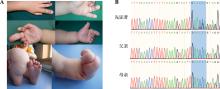
Fig. 1
Clinical phenotype and Sanger sequencing validation of proband and parents"

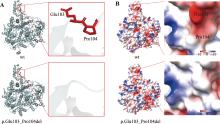
Fig. 2
The impact of mutation (p.Glu103_Pro104del) on 3D structure and surface electrostatic potential of PIK3CA protein"

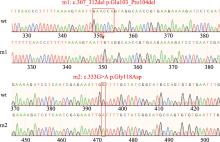
Fig. 3
Sequencing results of the PIK3CA-wt/m1/m2 vector construction"

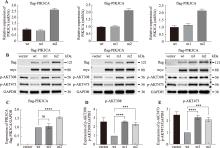
Fig. 4
The impact of mutation on PIK3CA expression and PI3K/AKT signaling"

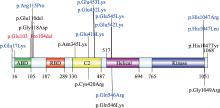
Fig. 5
Schematic diagram of PIK3CA protein and the reported mutation spectrum of the PIK3CA gene in PROS syndrome"

| [1] |
Shen XF, Gasteratos K, Spyropoulou GA, Yin F, Rui YJ. Congenital difference of the hand and foot: pediatric macrodactyly. J Plast Reconstr Aesthet Surg, 2022, 75(11): 4054-4062.
pmid: 36175329 |
| [2] |
Orloff MS, He X, Peterson C, Chen FS, Chen JL, Mester JL, Eng C. Germline PIK3CA and AKT1 mutations in cowden and cowden-like syndromes. Am J Hum Genet, 2013, 92(1): 76-80.
pmid: 23246288 |
| [3] |
Giżewska-Kacprzak K, Śliwiński M, Nicieja K, Babiak- Choroszczak L, Walaszek I. Macrodactyly. Children (Basel), 2024, 11(7): 753.
pmid: 39062202 |
| [4] |
Hardwicke J, Khan MAA, Richards H, Warner RM, Lester R. Macrodactyly - options and outcomes. J Hand Surg Eur Vol, 2013, 38(3): 297-303.
pmid: 22736742 |
| [5] |
Liu Y, Yang ZY, Pang CJ, Fan XB, Zhao CY, Wei ZK. A visual analysis of research hotspots and trends on macrodactyly between 2005 and 2024. Orphanet J Rare Dis, 2005, 20(1): 489.
pmid: 40993711 |
| [6] |
Aytenfisu TY, Campbell HM, Chakrabarti M, Amzel LM, Gabelli SB. Class I PI3K biology. Curr Top Microbiol Immunol, 2022, 436: 3-49.
pmid: 36243838 |
| [7] |
Vadas O, Burke JE, Zhang XX, Berndt A, Williams RL. Structural basis for activation and inhibition of class I phosphoinositide 3-kinases. Sci Signal, 2011, 4(195): re2.
pmid: 22009150 |
| [8] |
Hennessy BT, Smith DL, Ram PT, Lu YL, Mills GB. Exploiting the PI3K/AKT pathway for cancer drug discovery. Nat Rev Drug Discov, 2005, 4(12): 988-1004.
pmid: 16341064 |
| [9] | Tang XW, Chu D, Yan SN, Yin YF, Bian Q, Weng B, Chen B, Ran ML. MiR-191 promotes the porcine immature Sertoli cell proliferation by targeting the BDNF gene through activating the PI3K/AKT signaling pathway. Hereditas(Beijing), 2021, 43(7): 680-693. |
| 唐湘薇, 楚丹, 颜赛娜, 尹艳飞, 卞桥, 翁波, 陈斌, 冉茂良. MiR-191靶向BDNF基因通过激活PI3K/AKT信号通路促进猪未成熟支持细胞增殖. 遗传, 2021, 43(7): 680-693. | |
| [10] |
Fruman DA, Chiu HY, Hopkins BD, Bagrodia S, Cantley LC, Abraham RT. The PI3K pathway in human disease. Cell, 2017, 170(4): 605-635.
pmid: 28802037 |
| [11] |
Lindhurst MJ, Parker VER, Payne F, Sapp JC, Rudge S, Harris J, Witkowski AM, Zhang QF, Groeneveld MP, Scott CE, Daly A, Huson SM, Tosi LL, Cunningham ML, Darling TN, Geer J, Gucev Z, Sutton VR, Tziotzios C, Dixon AK, Helliwell T, O'Rahilly S, Savage DB, Wakelam MJO, Barroso I, Biesecker LG, Semple RK. Mosaic overgrowth with fibroadipose hyperplasia is caused by somatic activating mutations in PIK3CA. Nat Genet, 2012, 44(8): 928-933.
pmid: 22729222 |
| [12] |
Iriarte Fuster A, Cerdà Serra P, Riera-Mestre A. PIK3CA- related overgrowth spectrum (PROS): new insight in known diseases. Med Clin (Barc), 2021, 157(10): 483-488.
pmid: 34281706 |
| [13] |
Vahidnezhad H, Youssefian L, Baghdadi T, Sotoudeh S, Tavassoli A, Zeinali S, Afsharaalam S, Uitto J. Phenotypic heterogeneity in PIK3CA-related overgrowth spectrum. Br J Dermatol, 2016, 175(4): 810-814.
pmid: 27037860 |
| [14] |
Tian W, Huang YZ, Sun LY, Guo Y, Zhao S, Lin M, Dong XY, Zhong WY, Yin YH, Chen ZF, Zhang N, Zhang YQ, Wang LL, Lin JC, Yan ZH, Yang XZ, Zhao JH, Qiu GX, Zhang JG, Wu ZH, Wu N, (Deciphering Disorders Involving Scoliosis, Comorbidities) study group. Phenotypic and genetic spectrum of isolated macrodactyly:somatic mosaicism of PIK3CA and AKT 1 oncogenic variants. Orphanet J Rare Dis, 2020, 15(1): 288.
pmid: 33054853 |
| [15] | Wu JH, Tian W, Tian GL, Tian MM, Chen SL, Tian W. PIK3CA mutation analysis in isolated macrodactyly. Chin J Surg, 2018, 56(7): 538-542. |
| 武竞衡, 田伟, 田光磊, 田萌萌, 陈山林, 田文. 单纯性巨指(趾)症PIK3CA基因突变位点研究. 中华外科杂志, 2018, 56(7): 538-542. | |
| [16] |
Tripolszki K, Knox R, Parker V, Semple R, Farkas K, Sulák A, Horváth E, Széll M, Nagy N. Somatic mosaicism of the PIK3CA gene identified in a Hungarian girl with macrodactyly and syndactyly. Eur J Med Genet, 2016, 59(4): 223-226.
pmid: 26851524 |
| [17] | National Cancer Institute. Macrodactyly (NCI Thesaurus Code C48900)[EB/OL]. ( 2020-02-07). https://evsexplore.semantics.cancer.gov/evsexplore/concept/ncit/C48900. |
| [18] | Wu JH, Tian GL, Tian MM, Chen SL. Clinical characteristics of 170 cases of macrodactyly. J Peking Univ (Health Sciences), 2021, 53(3): 590-593. |
| 武竞衡, 田光磊, 田萌萌, 陈山林. 170例巨指(趾)患者临床特点分析. 北京大学学报(医学版), 2021, 53(3): 590-593. | |
| [19] |
Huang CH, Mandelker D, Schmidt-Kittler O, Samuels Y, Velculescu VE, Kinzler KW, Vogelstein B, Gabelli SB, Amzel LM. The structure of a human p110alpha/ p85alpha complex elucidates the effects of oncogenic PI3Kalpha mutations. Science, 2007, 318(5857): 1744-1748.
pmid: 18079394 |
| [20] |
Mora A, Komander D, van Aalten DMF, Alessi DR. PDK1, the master regulator of AGC kinase signal transduction. Semin Cell Dev Biol, 2004, 15(2): 161-170.
pmid: 15209375 |
| [21] |
Sarbassov DD, Guertin DA, Ali SM, Sabatini DM. Phosphorylation and regulation of Akt/PKB by the rictor- mTOR complex. Science, 2005, 307(5712): 1098-1101.
pmid: 15718470 |
| [22] |
Wu XY, Renuse S, Sahasrabuddhe NA, Zahari MS, Chaerkady R, Kim MS, Nirujogi RS, Mohseni M, Kumar P, Raju R, Zhong J, Yang J, Neiswinger J, Jeong JS, Newman R, Powers MA, Somani BL, Gabrielson E, Sukumar S, Stearns V, Qian J, Zhu H, Vogelstein B, Park BH, Pandey A. Activation of diverse signalling pathways by oncogenic PIK3CA mutations. Nat Commun, 2014, 5: 4961.
pmid: 25247763 |
| [23] |
Yan W, Zhang B, Wang HJ, Mo R, Jiang XY, Qin W, Ma L, Lin ZM. Somatic frameshift mutation in PIK3CA causes CLOVES syndrome by provoking PI3K/AKT/mTOR pathway. Hereditas, 2021, 158(1): 18.
pmid: 34074347 |
| [24] |
Burke JE, Williams RL. Synergy in activating class I PI3Ks. Trends Biochem Sci, 2015, 40(2): 88-100.
pmid: 25573003 |
| [25] |
Burke JE, Perisic O, Masson GR, Vadas O, Williams RL. Oncogenic mutations mimic and enhance dynamic events in the natural activation of phosphoinositide 3-kinase p110α (PIK3CA). Proc Natl Acad Sci USA, 2012, 109(38): 15259-15264.
pmid: 22949682 |
| [26] |
Miled N, Yan Y, Hon WC, Perisic O, Zvelebil M, Inbar Y, Schneidman-Duhovny D, Wolfson HJ, Backer JM, Williams RL. Mechanism of two classes of cancer mutations in the phosphoinositide 3-kinase catalytic subunit. Science, 2007, 317(5835): 239-242.
pmid: 17626883 |
| [27] |
Gymnopoulos M, Elsliger MA, Vogt PK. Rare cancer- specific mutations in PIK3CA show gain of function. Proc Natl Acad Sci USA, 2007, 104(13): 5569-5574.
pmid: 17376864 |
| [28] |
Berndt A, Miller S, Williams O, Le DD, Houseman BT, Pacold JI, Gorrec F, Hon WC, Liu Y, Rommel C, Gaillard P, Rückle T, Schwarz MK, Shokat KM, Shaw JP, Williams RL. The p110 delta structure: mechanisms for selectivity and potency of new PI(3)K inhibitors. Nat Chem Biol, 2010, 6(2): 117-124.
pmid: 20081827 |
| [29] | McCarthy N. Structural survey. Nat Rev Cancer, 2008, 8: 76-77. |
| [30] |
Blesinger H, Kaulfuß S, Aung T, Schwoch S, Prantl L, Rößler J, Wilting J, Becker J. PIK3CA mutations are specifically localized to lymphatic endothelial cells of lymphatic malformations. PLoS One, 2018, 13(7): e0200343.
pmid: 29985963 |
| [1] | Zihan Ni, Yu Min, Lingling Ma, Yoshinori Watanabe. The effect of centromere protein Fta2 phosphorylation during meiosis [J]. Hereditas(Beijing), 2024, 46(7): 552-559. |
| [2] | Qi Li, Zhicheng Dong, Min Liu. The carboxy-terminal domain of RNA polymerase II large subunit: simple repeats are not simple [J]. Hereditas(Beijing), 2024, 46(12): 1028-1041. |
| [3] | Hao Zhang, Zhipeng Zhang, Xiaodong Guo, Min Ma, Yue Ao, Xu Liu, Xiaoyan Ma, Hao Liang, Xudong Guo. The effect of cgVEGF164 on the growth of murine hair follicles [J]. Hereditas(Beijing), 2019, 41(1): 76-84. |
| [4] | Xinyan Ji, Guoxuan Zhong, Bin Zhao. Molecular mechanisms of the mammalian Hippo signaling pathway [J]. Hereditas(Beijing), 2017, 39(7): 546-567. |
| [5] | Zexian Liu, Yudong Cai, Xuejiang Guo, Ao Li, Tingting Li, Jianding Qiu, Jian Ren, Shaoping Shi, Jiangning Song, Minghui Wang, Lu Xie, Yu Xue, Ziding Zhang, Xingming Zhao. Post-translational modification (PTM) bioinformatics in China: progresses and perspectives [J]. HEREDITAS(Beijing), 2015, 37(7): 621-634. |
| [6] | Jinwei Suo, Shaojun Dai. Regulation of pollen tube growth by reversible protein phosphorylation [J]. HEREDITAS(Beijing), 2014, 36(8): 766-778. |
| [7] | Zhaohui Zhang, Xianjiang Kang, Shumei Mu. Histone phosphorylation and spermatogenesis [J]. HEREDITAS, 2014, 36(3): 220-227. |
| Viewed | ||||||
|
Full text |
|
|||||
|
Abstract |
|
|||||

