Hereditas(Beijing) ›› 2026, Vol. 48 ›› Issue (8): 807-816.doi: 10.16288/j.yczz.26-112
• Research Article • Previous Articles Next Articles
Analysis of genetic structure and genetic diversity in Diannan small-ear pig
Zhang Li1,2( ), Qun Lan1,2, Ming Li1,2, Shengju Lian1,2, Jiawen Liu1,2, Heng Zhao3, Haiming Ma1,2, Hongjiang Wei3, Yulong Yin2,4, Mei Liu1,2()
- 1
College of Animal Science and Technology ,Hunan Agricultural University Changsha 410128, China
2Livestock and Poultry Breed Innovation Center ,Yuelu Mountain Laboratory Changsha 410128, China
3College of Veterinary Medicine ,Yunnan Agricultural University Kunming 650201, China
4Institute of Subtropical Agriculture ,Chinese Academy of Sciences Changsha 410125, China
-
Received:2026-04-27Revised:2026-06-20Online:2026-07-14Published:2026-07-14 -
Contact:Mei Liu E-mail:15993148878@163.com;Mei.Liu@hunau.edu.cn -
Supported by:National Natural Science Foundation of China(U23A20229);Yunnan Provincial Science and Technology Talent and Platform Program(202505AT350004);Hunan Provincial Major Scientific Research Project(2025QK2003);Hunan Provincial Natural Science Foundation Outstanding Young Researcher Project(2025JJ40017)

Cite this article
Zhang Li, Qun Lan, Ming Li, Shengju Lian, Jiawen Liu, Heng Zhao, Haiming Ma, Hongjiang Wei, Yulong Yin, Mei Liu. Analysis of genetic structure and genetic diversity in Diannan small-ear pig[J]. Hereditas(Beijing), 2026, 48(8): 807-816.
share this article
Add to citation manager EndNote|Reference Manager|ProCite|BibTeX|RefWorks
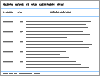
Table 1
Statistical results of SNP quality control"
| 质量控制标准 | SNP标记数目 |
|---|---|
| SNP标记总数 | 30,648 |
| 最小等位基因频率<0.01的SNP标记 | 235 |
| 哈代-温伯格平衡检验P<10-6的SNP标记 | 68 |
| SNP检出率<0.90 | 211 |
| X染色体上的SNP标记 | 588 |
| 通过质量控制的SNP总数 | 29,468 |
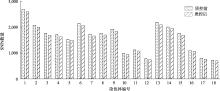
Fig. 1
Distribution of whole genomic SNPs on each autosome of the Diannan small-ear pigs"
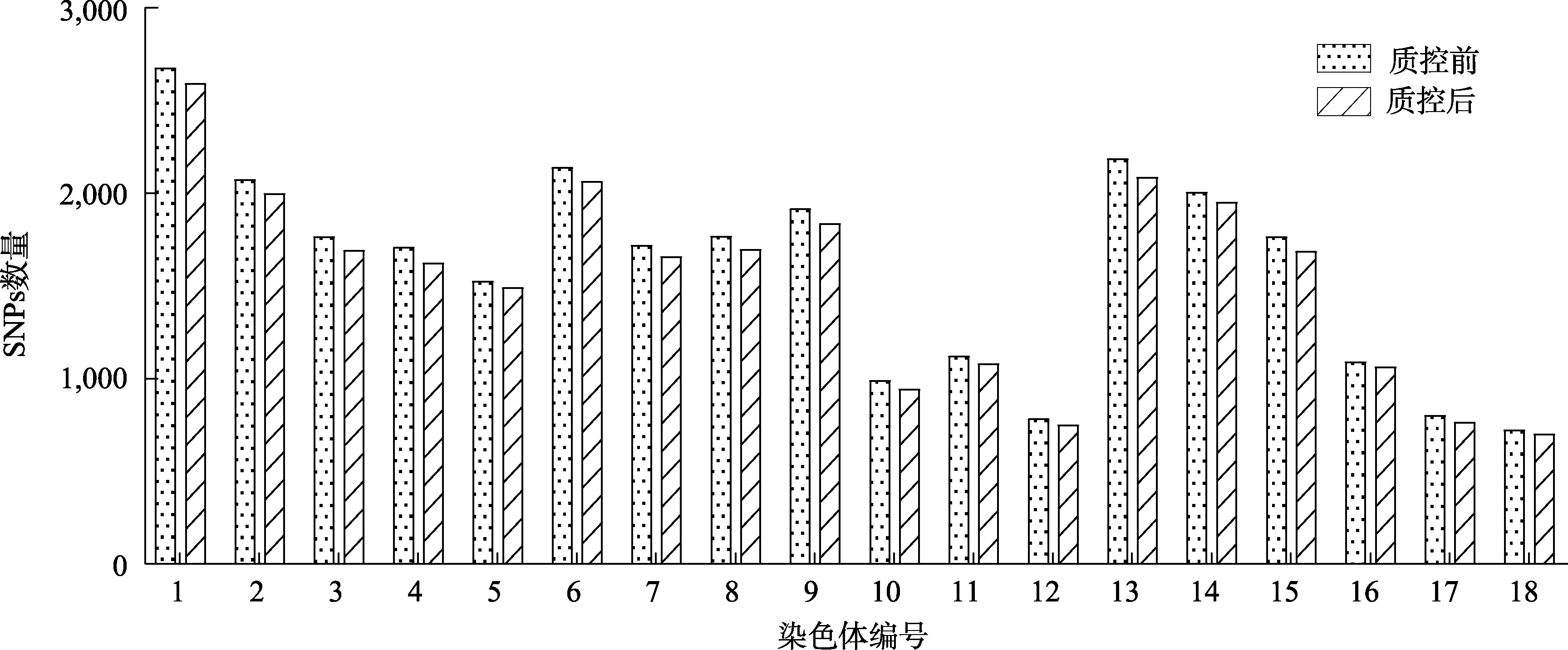
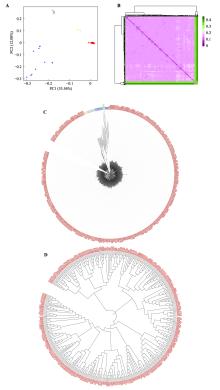
Fig. 2
Analysis for population genetic structure and genetic relationship of the test pigs"

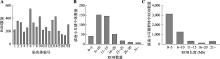
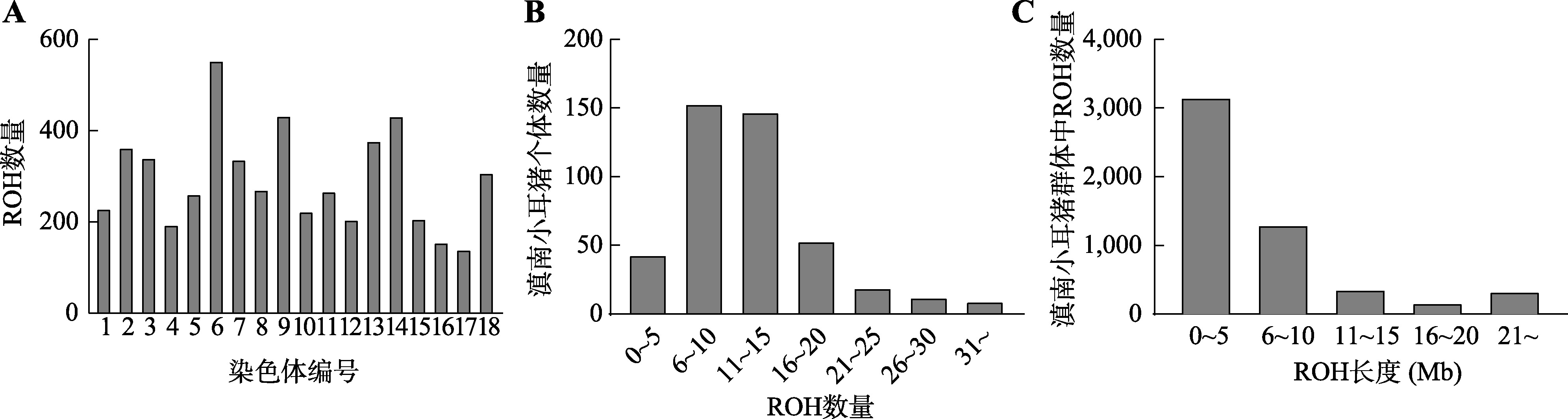
Fig. 3
Analysis of ROH in the Diannan small-ear pig polulation"
| [1] | 宋修春, 王磊, 李玉春. 小型猪种质资源引进培育及生物学特性研究进展. 中国畜禽种业, 2021, 17(5): 89-90. |
| [2] |
Wang ZX, Li QG, Chamba Y, Zhang B, Shang P, Zhang H, Wu CX. Identification of genes related to growth and lipid deposition from transcriptome profiles of pig muscle tissue. PLoS One, 2015, 10(10): e0141138.
pmid: 26505482 |
| [3] |
Shi RM, Wang G, Chen ZA, Yuan LB, Zhou TH, Tan HB. Dual-tissue transplantation versus osteochondral autograft transplantation in the treatment of osteochondral defects: a porcine model study. J Orthop Surg Res, 2023, 18(1): 481.
pmid: 37403163 |
| [4] | Xiong BH. Comparative study of autograft of achilles tendon and extensor digitorum longus tendon for reconstruction of anterior cruciate ligament in Diannan small-ear pigs[Dissertation]. Kunming Medical University, 2024. |
| 熊波涵. 滇南小耳猪自体跟腱与趾长伸肌腱移植重建前交叉韧带的对比研究[学位论文]. 昆明医科大学, 2024. | |
| [5] | Luo QL, Lian SJ, Wang J, Long CM, Liu M. Application of pig kidney in biomedicine. China Swine Ind, 2025, 20(2): 51-62. |
| 骆庆龙, 练胜举, 王婧, 龙次民, 刘梅. 猪肾在生物医学中的应用. 中国猪业, 2025, 20(2): 51-62. | |
| [6] |
Liu W, Bai XF, Yuan WL, Wang CY, Hu YJ, Yu JH, Zhang Y, Shi JJ. Bilateral pseudo-disc changes in a minipig model for unilateral anterior disc displacement of the temporomandibular joint. Oral Maxillofac Surg, 2026, 30(1): 44.
pmid: 41781582 |
| [7] | Lian YJ, Zhang ZY, Liao XB, Wei HJ, Yin YL, Liu M. Breeding methods and application progress of medical miniature pigs. Acta Vet Zootech Sin, 2023, 54(7): 2667-2682. |
| 连玉举, 张致远, 廖晓波, 魏红江, 印遇龙, 刘梅. 医用小型猪选育方法和应用进展. 畜牧兽医学报, 2023, 54(7): 2667-2682. | |
| [8] | Luo QL, Yuan ZS, Zhang ZY, Liao XB, Yin YL, Liu M. Research progress of coronary heart disease model pigs. Acta Vet Zootech Sin, 2024, 55(12): 5349-5367. |
| 骆庆龙, 袁昭顺, 张致远, 廖晓波, 印遇龙, 刘梅. 冠心病模式猪的研究进展. 畜牧兽医学报, 2024, 55(12): 5349-5367. | |
| [9] |
Jia D, Zhang RX, He YH, Cai GF, Zheng JL, Yang YY, Li YL. Comparative effectiveness of two methods for inducing osteoarthritis in a novel animal model, the Diannan small-ear pig. J Orthop Surg Res, 2021, 16(1): 594.
pmid: 34649596 |
| [10] |
Yuan ZA, Huang L, Hu ZG, Deng JH, Duan YH, Jiang Q, Tan BE, Ma XK, Zhang C, Tang XZ. Lactobacillus fermentum ZC529 protects intestinal epithelial barrier integrity by activating the Keap1-Nrf2 signaling pathway and inhibiting the NF-κB signaling pathway. Antioxidants (Basel), 2025, 14(6): 732.
pmid: 40563364 |
| [11] | Yang HJ, Peng H, Wang LY. Future prospects for the development of chinese in digenous pig breeds with perspective of pork consumption trends. Chin J Anim Sci, 2014, 50(16): 6-10. |
| 杨红杰, 彭华, 王林云. 从我国猪肉消费趋势展望地方猪种发展前景. 中国畜牧杂志, 2014, 50(16): 6-10. | |
| [12] | Lu SX, Li ML, Yan DW, Ge CR. Germplasm characteristics, conservation and various utilization of Yunnan local pig breeds. J Yunnan Agric Univ: Nat Sci, 2020, 35(6): 1096-1105. |
| 鲁绍雄, 李明丽, 严达伟, 葛长荣. 云南地方猪种质特性及其保种与多样化利用. 云南农业大学学报(自然科学), 2020, 35(6): 1096-1105. | |
| [13] | 孙利民, 邓俊, 许文坤, 刘艺端. 云南省地方猪遗传资源介绍. 云南农业, 2020(10): 90-91. |
| [14] | 杨朝元, 陈惠仙, 高新. 澜沧县南岭乡滇南小耳猪养殖现状与发展建议. 云南畜牧兽医, 2018, (4): 13-14. |
| [15] | Ni SH, Wang ZY, Xie XF, Zhong ZQ, Xiao Q. Advances in the application of genomic selection technology in livestock breeding. Chin J Anim Sci, 2024, 60(6): 95-101. |
| 倪世恒, 王子轶, 谢鑫峰, 钟梓奇, 肖倩. 基因组选择技术在畜禽育种中的应用研究进展. 中国畜牧杂志, 2024, 60(6): 95-101. | |
| [16] |
Sato S, Uemoto Y, Kikuchi T, Egawa S, Kohira K, Saito T, Sakuma H, Miyashita S, Arata S, Kojima T, Suzuki K. SNP- and haplotype-based genome-wide association studies for growth, carcass, and meat quality traits in a Duroc multigenerational population. BMC Genet, 2016, 17(4): 60.
pmid: 27094516 |
| [17] |
Zhang J, Yang JJ, Zhang LK, Luo J, Zhao H, Zhang JN, Wen CL. A new SNP genotyping technology target SNP-seq and its application in genetic analysis of cucumber varieties. Sci Rep, 2020, 10(1): 5623.
pmid: 32221398 |
| [18] | Xiao J, Li ZY, Zhao JN, Liu YC, Yang LF, Liu XH, Chen YS, Zeng JH. Population genetic structure analysis of rural black pigs based on SNP chips. Chin J Anim Sci, 2025, 61(11): 213-219. |
| 肖俊, 李镇养, 赵继念, 刘永超, 阳林芳, 刘小红, 陈瑶生, 曾检华. 基于SNP芯片的乡下黑猪群体遗传结构分析. 中国畜牧杂志, 2025, 61(11): 213-219. | |
| [19] | LV XF, Xing WT, Zheng WX, XIEERMAOLA Y, SAIMAITI S, Wang L. Analysis of genetic diversity and genetic structure of Bogda cashmere goat population using SNP chip. Heilongjiang Anim Husb Vet Med, 2025, (10): 46-52. |
| 吕雪峰, 邢巍婷, 郑文新, 叶尔兰·谢尔毛拉, 赛迪古丽·赛买提, 王乐. 采用SNP芯片分析博格达绒山羊群体遗传结构和遗传多样性. 黑龙江畜牧兽医, 2025, (10): 46-52. | |
| [20] |
Alemu A, Åstrand J, Montesinos-López OA, Isidro Y Sánchez J, Fernández-Gónzalez J, Tadesse W, Vetukuri RR, Carlsson AS, Ceplitis A, Crossa J, Ortiz R, Chawade A. Genomic selection in plant breeding: Key factors shaping two decades of progress. Mol Plant, 2024, 17(4): 552-578.
pmid: 38475993 |
| [21] |
Marina H, Pelayo R, Gutiérrez-Gil B, Suárez-Vega A, Esteban-Blanco C, Reverter A, Arranz JJ. Low-density SNP panel for efficient imputation and genomic selection of milk production and technological traits in dairy sheep. J Dairy Sci, 2022, 105(10): 8199-8217.
pmid: 36028350 |
| [22] | Wang J, Yang F, Yang X, Zhao ZY, Xin AG, Sun Q. Preliminary investigation and suggestions for the development of autochthonous pig industry in Yunnan. Swine Prod, 2022, (2): 63-66. |
| 王娟, 杨繁, 杨馨, 赵智勇, 信爱国, 孙强. 云南地方猪产业发展现状初步调查与建议. 养猪, 2022, (2): 63-66. | |
| [23] | Zhao ZH, Jia Q, Mo FT, Xi JZ, Kang F, Ning LN. Analysis of genetic polymorphism in Duroc, Landrace and Yorkshire Pigs using microsatellite markers. Jiangsu J Agric Sci, 2007, 23(2): 103-108. |
| 赵振华, 贾青, 墨锋涛, 锡建中, 康峰, 宁立娜. 杜洛克、长白和大约克夏纯种猪微卫星多态性分析. 江苏农业学报, 2007, 23(2): 103-108. | |
| [24] | Tao X, Yang XM, Liang Y, Liu YH, Wang Y, Kong FJ, Lei YF, Yang YK, Wang Y, An R, Yang K, Lü XB, He ZP, Gu YR. Analysis of genetic structure of conservation population in Yacha pig based on SNP Chip. Acta Vet Zootech Sin, 2023, 54(6): 2308-2319. |
| 陶璇, 杨雪梅, 梁艳, 刘一辉, 汪勇, 孔繁晶, 雷云峰, 杨跃奎, 王言, 安瑞, 杨坤, 吕学斌, 何志平, 顾以韧. 基于SNP芯片的丫杈猪保种群体遗传结构研究. 畜牧兽医学报, 2023, 54(6): 2308-2319. | |
| [25] | 王昊, 刘晓明, 王源, 宋英姿, 于光辉. 烟台黑猪群体遗传多样性与遗传结构研究. 中国畜牧杂志, 2026, 62(1): 181-186. |
| [26] |
Liu B, Shen LY, Guo ZX, Gan ML, Chen Y, Yang RL, Niu LL, Jiang DM, Zhong ZJ, Li XW, Zhang SH, Zhu L. Single nucleotide polymorphism-based analysis of the genetic structure of Liangshan pig population. Anim Biosci, 2021, 34(7): 1105-1115.
pmid: 32777894 |
| [27] | Shen Y, Gaxi PC, Luo G, Gerong ZM, Luorong LM, Liu PL, Gu YR. Analysis of genetic structure of Daocheng Tibetan pigs conservation population based on SNP chip. China Swine Ind, 2025, 20(5): 3-13. |
| 沈瑶, 呷西彭错, 罗淦, 格茸卓玛, 洛茸拉姆, 刘鹏亮, 顾以韧. 基于SNP芯片的稻城藏猪保种群体遗传结构分析. 中国猪业, 2025, 20 (5): 3-13. | |
| [28] |
Wang X, Wang C, Huang M, Tang J, Fan Y, Li Y, Li X, Ji H, Ren J, Ding N. Genetic diversity, population structure and phylogenetic relationships of three indigenous pig breeds from Jiangxi Province, China, in a worldwide panel of pigs. Anim Genet, 2018, 49(4): 275-283.
pmid: 29993136 |
| [29] |
Ji HY, Wang YN, Zhou QY, Wan MC, Ding NS, Zhou HH, Tan MF, Zou ZH, Chen H, Liu CL. Genomic insights into population structure, genetic diversity, and key traits of Jiangxi indigenous pigs. BMC Genomics, 2025, 27(1): 93.
pmid: 41422149 |
| [30] |
Wu F, Sun H, Lu SX, Gou X, Yan DW, Xu Z, Zhang ZY, Qadri QR, Zhang Z, Wang Z, Chen Q, Li ML, Wang XY, Dong XX, Wang QS, Pan YC. Genetic diversity and selection signatures within Diannan small-ear pigs revealed by next-generation sequencing. Front Genet, 2020, 11(7): 733.
pmid: 32849777 |
| [31] |
Gonzales PR, Andersen EF, Brown TR, Horner VL, Horwitz J, Rehder CW, Rudy NL, Robin NH, Thorland EC, On Behalf of the Acmg Laboratory Quality Assurance Committee. Interpretation and reporting of large regions of homozygosity and suspected consanguinity/uniparental disomy, 2021 revision: a technical standard of the American College of Medical Genetics and Genomics (ACMG). Genet Med, 2022, 24(2): 255-261.
pmid: 34906464 |
| [32] | Liu G, Sun FZ, Zhu FX, Feng HY, Han X. Runs of homozygosity and its application on livestock genome study. Hereditas(Beijing), 2019, 41(4): 304-317. |
| 刘刚, 孙飞舟, 朱芳贤, 冯海永, 韩旭. 连续性纯合片段在畜禽基因组研究中的应用. 遗传, 2019, 41(4): 304-317. | |
| [33] | Tian M, Wang WQ, Cheng SZ, He XM, Wang WT, Wu SH, Wang K, Li HS, Wang WJ, Zhang LC, Liu D. Genetic structure analysis of Hetao big-ear pig population based on genomic SNP and ROH. Acta Vet Zootech Sin, 2026, 57(2): 659-667. |
| 田明, 王文清, 程士哲, 何鑫淼, 王文涛, 吴赛辉, 王坤, 李虎山, 王玮婕, 张龙超, 刘娣. 基于基因组的SNP和ROH的河套大耳猪群体遗传结构解析. 畜牧兽医学报, 2026, 57(2): 659-667. | |
| [34] | Hu ZP, Wang LG, Zong WC, Hou RD, Su YF, Niu NQ, Wang LX, Wang Y, Zhang LC. Genetic structure analysis of Jianbai Xiang pig population based on genomic SNP and ROH. Acta Vet Zootech Sin, 2023, 54(10): 4117-4125. |
| 胡紫平, 王立刚, 宗文成, 侯任达, 苏艳芳, 牛乃琪, 王立贤, 王源, 张龙超. 基于基因组SNP和ROH的剑白香猪群体遗传结构解析. 畜牧兽医学报, 2023, 54(10): 4117-4125. | |
| [35] | 安飘, 罗淦, 余梦迪, 巩泽莹, 顾以韧, 刘鹏亮. 基于SNP芯片的巴马香猪保种群体遗传结构分析. 猪业科学, 2025, 42(11): 120-123+6. |
| [36] |
Zhang ZY, Zhao W, Wang Z, Pan YC, Wang QS, Zhang Z. Integration of ssGWAS and ROH analyses for uncovering genetic variants associated with reproduction traits in Large White pigs. Anim Genet, 2024, 55(5): 714-724.
pmid: 39129705 |
| [37] | Bao YX. A preliminary study of allogeneic liver transplantation in miniature pigs[Dissertation]. Yunnan Agricultural University, 2024. |
| 保岳霄. 小型猪同种异体肝移植的初探[学位论文]. 云南农业大学, 2024. | |
| [38] | Lian SJ, Li M, Liu JW, Li Y, Luo QL, Lian YJ, Xi RS, Pei Y, Jiang WM, Yang L, Zhao H, Zhang ZY, Liao XB, Wei HJ, Yin YL, Liu M. Construction, phenotypic identification and analysis of hyperlipidemia model in Diannan small ear pigs. Acta Vet Zootech Sin, 2026, .https://link.cnki.net/urlid/11.1985.S.20260527.1555.010 |
| 练胜举, 李铭, 刘佳雯, 李杨, 骆庆龙, 连玉举, 席镕圣, 裴昱, 蒋雯梦, 杨龙, 赵恒, 张致远, 廖晓波, 魏红江, 印遇龙, 刘梅. 滇南小耳猪高脂血症模型构建与表型鉴定分析. 畜牧兽医学报, 2026, https://link.cnki.net/urlid/11.1985.S.20260527.1555.010. |
| [1] | Gang Song, Yanhua Qu. Environmental changes and uplift of the Qinghai-Tibet Plateau drive genetic diversification and speciation of the birds [J]. Hereditas(Beijing), 2025, 47(1): 133-145. |
| [2] | Mengyu Wang, Chenghao Zhou, Qian Xue, Jianmei Yin, Yixiu Jiang, Huiyong Zhang, Guohui Li, Wei Han. Application effectiveness of “Youxin-1” in genetic diversity and structure analysis of local chickens [J]. Hereditas(Beijing), 2024, 46(8): 640-648. |
| [3] | Jun Ma, Anping Fan, Wusheng Wang, Jinchuan Zhang, Xiaojun Jiang, Ruijun Ma, Sheqiang Jia, Fei Liu, Chuchao Lei, Yongzhen Huang. Analysis of genetic diversity and genetic structure of Qinchuan cattle conservation population using whole-genome resequencing [J]. Hereditas(Beijing), 2023, 45(7): 602-616. |
| [4] | Jie Kou, Yan Li, Peng Wang, Hong Liu, Jiawen Liu, Juan Wang, Ye Wang, Liang Zhang, Fujun Shen. Optimization of microsatellite genotyping system used for genetic diversity evaluation of Ailuropoda melanoleuca [J]. Hereditas(Beijing), 2022, 44(3): 253-266. |
| [5] | Zhiwei Xu, Yunlin Wei, Xiuling Ji. Progress on phage genomics of Pseudomonas spp. [J]. Hereditas(Beijing), 2020, 42(8): 752-759. |
| [6] | Zhi Li,Jun He,Jun Jiang,Richard G. Tait Jr.,Stewart Bauck,Wei Guo,Xiao-Lin Wu. Impacts of SNP genotyping call rate and SNP genotyping error rate on imputation accuracy inHolsteincattle [J]. Hereditas(Beijing), 2019, 41(7): 644-652. |
| [7] | Jianmin Zheng,Jiangtao Luo,Hongshen Wan,Shizhao Li,Manyu Yang,Jun Li,Ennian Yang,Yun Jiang,Yubin Liu,Xiangquan Wang,Zongjun Pu. Pedigree and development of wheat varieties in Sichuan Province [J]. Hereditas(Beijing), 2019, 41(7): 599-610. |
| [8] | Jun He,Changsong Qian,Richard G. Tait Jr.,Stewart Bauck,Xiaolin Wu. Estimating genomic breed composition of individual animals using selected SNPs [J]. Hereditas(Beijing), 2018, 40(4): 305-314. |
| [9] | Zhao Yongxin, Li Menghua. Research advances on the origin, evolution and genetic diversity of Chinese native sheep breeds [J]. Hereditas(Beijing), 2017, 39(11): 958-973. |
| [10] | Xian Gong, Chao Zhang, Aisa Yiliyasi, Ying Shi, Xuewei Yang, Aosiman Nuersimanguli, Yaqun Guan, Shuhua Xu. A comparative analysis of genetic diversity of candidate genes associated with type 2 diabetes in worldwide populations [J]. Hereditas(Beijing), 2016, 38(6): 543-559. |
| [11] | HUANG Yi-Min XIA Meng-Ying HUANG Shi. Evolutionary process unveiled by the maximum genetic diversity hypothesis [J]. HEREDITAS, 2013, 35(5): 599-606. |
| [12] | WEN Ying LU Xiao-Ping REN Rui MI Fu-Gui HAN Ping-An XUE Chun-Lei. Development of EST-SSR marker and genetic diversity analysis in Sorghum bicolor×Sorghum sudanenes [J]. HEREDITAS, 2013, 35(2): 225-232. |
| [13] | LI Duo CHAI Zhi-Xin JI Qiu-Mei ZHANG Cheng-Fu XIN Jin-Wei ZHONG Jin-Cheng. Genetic diversity of DNA microsatellite for Tibetan Yak [J]. HEREDITAS, 2013, 35(2): 175-184. |
| [14] | MA Zhi-Jie ZHONG Jin-Cheng HAN Jian-Lin XU Jing-Tao LIU Zhong-Na BAI Wen-Lin. Research progress on molecular genetic diversity of the yak (Bos grunniens) [J]. HEREDITAS, 2013, 35(2): 151-160. |
| [15] | FU Jian-Jun LI Jia-Le SHEN Yu-Bang WANG Rong-Quan XUAN Yun-Feng XU Xiao-Yan CHEN Yong. Genetic variation analysis of wild populations of grass carp (Ctenopharyngodon idella) using microsatellite markers [J]. HEREDITAS, 2013, 35(2): 192-201. |
| Viewed | ||||||
|
Full text |
|
|||||
|
Abstract |
|
|||||

