
pnr cooperate with fred to regulate SOP cell fate both positively and negatively in the medial notum of Drosophila
Received date: 2025-03-24
Revised date: 2025-05-07
Online published: 2025-05-30
Supported by
National Natural Science Foundation of China(32270528);Hunan Provincial Graduate Research Innovation Project(CX20231055)
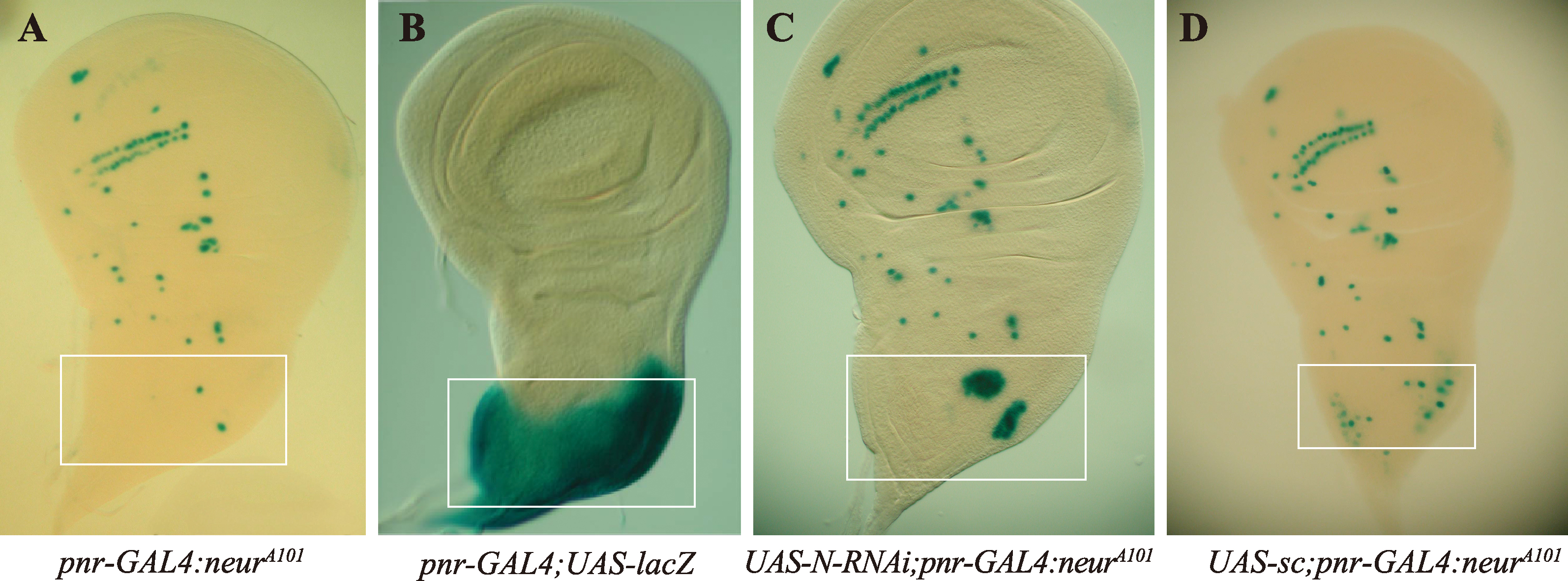
According to the “Prepattern Hypothesis”, the development of dorsal sensory organ precursors (SOP) in Drosophila melanogaster depends on the sequential regulation of prepattern genes, proneural genes, and neurogenic genes. In most cases, ectopic SOP formation caused by dysfunction of a single regulatory gene either exhibits spatial discontinuity or is restricted to proneural clusters. However, knockdown of the fred gene induces a novel phenotype of ectopic SOP that are spatially continuous and not confined to proneural cluster regions. This study reveals that fred knockdown-induced ectopic SOP formation is independent of proneural clusters, suggesting that nearly all wing imaginal disc cells possess neurogenic potential. Furthermore, we demonstrate that the prepattern gene pannier (pnr) cooperates with fred to regulate SOP cell fate through two distinct mechanisms: (1) pnr and fred are essential for endogenous SOP formation in the medial notum, while (2) they synergistically suppress SOP initiation outside proneural clusters. These findings challenge the canonical assertion in the “Prepattern Hypothesis” that SOP formation strictly relies on proneural cluster formation, thereby providing a critical extension to the hypothesis.
Key words: fred; neurogenic potential; sense organ precursors; pnr; cell fate determination
Kaiyue Song, Yifei Zhang, Yao Zhang, Shuting Long, Jianjun Peng, Yuandong Sun, Xiaojuan Cui, Benshan Pan, Yuxin Chai, Xiaoxia Wang, Jiahui Chen . pnr cooperate with fred to regulate SOP cell fate both positively and negatively in the medial notum of Drosophila[J]. Hereditas(Beijing), 2026 , 48(1) : 87 -101 . DOI: 10.16288/j.yczz.25-080
| [1] | Koto A, Kuranaga E, Miura M. Apoptosis ensures spacing pattern formation of Drosophila sensory organs. Curr Biol, 2011, 21(4): 278-287. |
| [2] | Marcellini S, Simpson P. Two or four bristles: functional evolution of an enhancer of scute in Drosophilidae. PLoS Biol, 2006, 4(12): e386. |
| [3] | Emery G, Hutterer A, Berdnik D, Mayer B, Wirtz-Peitz F, Gaitan MG, Knoblich JA. Asymmetric Rab 11 endosomes regulate delta recycling and specify cell fate in the Drosophila nervous system. Cell, 2005, 122(5): 763-773. |
| [4] | Troost T, Binshtok U, Sprinzak D, Klein T. Cis-inhibition suppresses basal Notch signalling during sensory organ precursor selection. bioRxiv, 2022, doi: 10.1101/2022.07.19.500683. |
| [5] | Ghysen A, Dambly-Chaudière C. From DNA to form: the achaete-scute complex. Genes Dev, 1988, 2(5): 495-501. |
| [6] | Gómez-Skarmeta JL, Campuzano S, Modolell J. Half a century of neural prepatterning: the story of a few bristles and many genes. Nat Rev Neurosci, 2003, 4(7): 587-598. |
| [7] | Ruiz-Gómez M, Modolell J. Deletion analysis of the achaete-scute locus of Drosophila melanogaster. Genes Dev, 1987, 1(10): 1238-1246. |
| [8] | Usui K, Goldstone C, Gibert JM, Simpson P. Redundant mechanisms mediate bristle patterning on the Drosophila thorax. Proc Natl Acad Sci USA, 2008, 105(51): 20112-20117. |
| [9] | Campuzano S, Modolell J. Patterning of the Drosophila nervous system: the achaete-scute gene complex. Trends Genet, 1992, 8(6): 202-208. |
| [10] | Garrell J, Campuzano S. The helix-loop-helix domain: a common motif for bristles, muscles and sex. Bioessays, 1991, 13(10): 493-498. |
| [11] | Jan YN, Jan LY. HLH proteins, fly neurogenesis, and vertebrate myogenesis. Cell, 1993, 75(5): 827-830. |
| [12] | He QY, Hou TL, Fan CX, Wang SC, Wang YH, Chen SS. Juvenile hormone suppresses sensory organ precursor determination to block Drosophila adult abdomen morphogenesis. Insect Biochem Mol Biol, 2023, 157: 103957. |
| [13] | Dutriaux A, Godart A, Brachet A, Silber J. The insulin receptor is required for the development of the Drosophila peripheral nervous system. Plos One, 2013, 8(9): e71857. |
| [14] | Marcellini S, Gibert JM, Simpson P. achaete, but not scute, is dispensable for the peripheral nervous system of Drosophila. Dev Biol, 2005, 285(2): 545-553. |
| [15] | Artavanis-Tsakonas S, Rand MD, Lake RJ. Notch signaling: cell fate control and signal integration in development. Science, 1999, 284(5415): 770-776. |
| [16] | Culí J, Modolell J. Proneural gene self-stimulation in neural precursors: an essential mechanism for sense organ development that is regulated by Notch signaling. Genes Dev, 1998, 12(13): 2036-2047. |
| [17] | Huppert SS, Jacobsen TL, Muskavitch MA. Feedback regulation is central to Delta-Notch signalling required for Drosophila wing vein morphogenesis. Development, 1997, 124(17): 3283-3291. |
| [18] | Francis C, Lydie C, Hervé R, Khalil M, François S. Self-organized Notch dynamics generate stereotyped sensory organ patterns in Drosophila. Science, 2017, 356(6337): eaai7407. |
| [19] | Campos-Ortega JA. Mechanisms of early neurogenesis in Drosophila melanogaster. J Neurobiol, 1993, 24(10): 1305-1327. |
| [20] | Miller SW, Posakony JW. Lateral inhibition: two modes of non-autonomous negative autoregulation by neuralized. PLoS Genet, 2018, 14(7): e1007528. |
| [21] | Troost T, Binshtok U, Sprinzak D, Klein T. Cis-inhibition suppresses basal Notch signaling during sensory organ precursor selection. Proc Natl Acad Sci USA, 2023, 120(23): e2214535120. |
| [22] | Cubas P, Modolell J. The extramacrochaetae gene provides information for sensory organ patterning. EMBO J, 1992, 11(9): 3385-3393. |
| [23] | del Corral RD, Aroca P, Gómez-Skarmeta JL, Cavodeassi F, Modolell J. The Iroquois homeodomain proteins are required to specify body wall identity in Drosophila. Genes Dev, 1999, 13(13): 1754-1761. |
| [24] | Heitzler P, Haenlin M, Ramain P, Calleja M, Simpson P. A genetic analysis of pannier, a gene necessary for viability of dorsal tissues and bristle positioning in Drosophila. Genetics, 1996, 143(3): 1271-1286. |
| [25] | Tobias T, Markus S, Thomas K. A re-examination of the selection of the sensory organ precursor of the bristle sensilla of Drosophila melanogaster. PLoS Genet, 2015, 11(1): e1004911. |
| [26] | Chandra S, Ahmed A, Vaessin H. The Drosophila IgC2 domain protein Friend-of-Echinoid, a paralogue of Echinoid, limits the number of sensory organ precursors in the wing disc and interacts with the Notch signaling pathway. Dev Biol, 2003, 256(2): 302-316. |
| [27] | Fetting JL, Spencer SA, Wolff T. The cell adhesion molecules Echinoid and Friend of Echinoid coordinate cell adhesion and cell signaling to regulate the fidelity of ommatidial rotation in the Drosophila eye. Development, 2009, 136(19): 3323-3333. |
| [28] | Heitzler P, Bourouis M, Ruel L, Carteret C, Simpson P. Genes of the enhancer of split and achaete-scute complexes are required for a regulatory loop between Notch and Delta during lateral signalling in Drosophila. Development, 1996, 122(1): 161-171. |
| [29] | Calleja M, Moreno E, Pelaz S, Morata G. Visualization of gene expression in living adult Drosophila. Science, 1996, 274(5285): 252-255. |
| [30] | Huang F, Dambly-Chaudière C, Ghysen A. The emergence of sense organs in the wing disc of Drosophila. Development, 1991, 111(4): 1087-1095. |
| [31] | Ramain P, Heitzler P, Haenlin M, Simpson P. Pannier, a negative regulator of achaete and scute in Drosophila, encodes a zinc finger protein with homology to the vertebrate transcription factor GATA-1. Development, 1993, 119(4): 1277-1291. |
| [32] | Volk T, VijayRaghavan K. A central role for epidermal segment border cells in the induction of muscle patterning in the Drosophila embryo. Development, 1994, 120(1): 59-70. |
| [33] | Ellis MC, Weber U, Wiersdorff V, Mlodzik M. Confrontation of scabrous expressing and non-expressing cells is essential for normal ommatidial spacing in the Drosophila eye. Development, 1994, 120(7): 1959-1969. |
| [34] | Haenlin M, Cubadda Y, Blondeau F, Heitzler P, Lutz Y, Simpson P, Ramain P. Transcriptional activity of pannier is regulated negatively by heterodimerization of the GATA DNA-binding domain with a cofactor encoded by the u-shaped gene of Drosophila. Genes Dev, 1997, 11(22): 3096-3108. |
| [35] | Cubadda Y, Heitzler P, Ray R P, Bourouis M, Ramain P, Gelbart W, Simpson P, Haenlin M. u-shaped encodes a zinc finger protein that regulates the proneural genes achaete and scute during the formation of bristles in Drosophila. Genes Dev, 1997, 11(22): 3083-3095. |
| [36] | Xu T, Rubin GM. Analysis of genetic mosaics in developing and adult Drosophila tissues. Development, 1993, 117(4): 1223-1237. |
| [37] | Kaspar M, Schneider M, Chia W, Klein T. Klumpfuss is involved in the determination of sensory organ precursors in Drosophila. Dev Biol, 2008, 324(2): 177-191. |
| [38] | Mlodzik M, Baker NE, Rubin GM. Isolation and expression of scabrous, a gene regulating neurogenesis in Drosophila. Genes Dev, 1990, 4(11): 1848-1861. |
| [39] | Furman DP, Bukharina TA. Morphogenesis of Drosophila melanogaster macrochaetes: cell fate determination for bristle organ. J Stem Cells, 2012, 7(1): 19-41. |
| [40] | Bruelle C, Pinot M, Daniel E, Daudé M, Mathieu J, Le Borgne R. Cell-intrinsic and -extrinsic roles of the ESCRT-III subunit Shrub in abscission of Drosophila sensory organ precursors. Development, 2023, 150(10): dev201409. |
| [41] | Hainaut M, Sagnier T, Be?renger H, Pradel J, Graba Y, Miotto B. The MYST-containing protein Chameau is required for proper sensory organ specification during Drosophila thorax morphogenesis. PLoS One, 2012, 7(3): e32882. |
| [42] | Asmar J, Biryukova I, Heitzler P. Drosophila dLMO-PA isoform acts as an early activator of achaete/scute proneural expression. Dev Biol, 2008, 316(2): 487-497. |
| [43] | Tian RB, Chen X, Wu MM, Xu QX, Wang S, Zang LS, Xiao D. The molecular properties and roles of pannier in Harmonia axyridis’s metamorphosis and melanin synthesis. Front Physiol, 2022, 13: 909258. |
| [44] | Liang Q, Peng TT, Sun BY, Tu JB, Cheng XY, Tian YLZ, Fan XL, Yang DY, Gaur U, Yang MY. Gene expression patterns determine the differential numbers of dorsocentral macrochaetes between Musca domestica and Drosophila melanogaster. Genesis, 2018, 56(11-12): e23258. |
| [45] | García-García MJ, Ramain P, Simpson P, Modolell J. Different contributions of pannier and wingless to the patterning of the dorsal mesothorax of Drosophila. Development, 1999, 126(16): 3523-3532. |
| [46] | Fromental-Ramain C, Taquet N, Ramain P. Transcriptional interactions between the pannier isoforms and the cofactor U-shaped during neural development in Drosophila. Mech Dev, 2010, 127(9-12): 442-457. |
| [47] | Fromental-Ramain C, Vanolst L, Delaporte C, Ramain P. pannier encodes two structurally related isoforms that are differentially expressed during Drosophila development and display distinct functions during thorax patterning. Mech Dev, 2008, 125(1-2): 43-57. |
| [48] | Svetlana M, William T, Ruth S. JAK/STAT and the GATA factor Pannier control hemocyte maturation and differentiation in Drosophila. Dev Biol, 2011, 352(2): 308-316. |
| [49] | Frommer G, Vorbrüggen G, Pasca G, Jäckle H, Volk T. Epidermal egr-like zinc finger protein of Drosophila participates in myotube guidance. EMBO J, 1996, 15(7): 1642-1649. |
| [50] | Lee JC, VijayRaghavan K, Celniker SE, Tanouye MA. Identification of a Drosophila muscle development gene with structural homology to mammalian early growth response transcription factors. Proc Natl Acad Sci USA, 1995, 92(22): 10344-10348. |
| [51] | Ghazi A, Paul L, VijayRaghavan K. Prepattern genes and signaling molecules regulate stripe expression to specify Drosophila flight muscle attachment sites. Mech Dev, 2003, 120(5): 519-528. |
| [52] | Usui K, Pistillo D, Simpson P. Mutual exclusion of sensory bristles and tendons on the notum of dipteran flies. Curr Biol, 2004, 14(12): 1047-1055. |
| [53] | Amit S, Meghana T, Oorvashi Roy P, Madhuri KS. A glimpse into dorso-ventral patterning of the Drosophila eye. Dev Dyn, 2012, 241(1): 69-84. |
| [54] | Gómez-Skarmeta JL, del Corral RD, de la Calle-Mustienes E, Ferrés-Marcó D, Modolell J. araucan and caupolican, two members of the novel iroquois complex, encode homeoproteins that control proneural and vein-forming genes. Cell, 1996, 85(1): 95-105. |
| [55] | Kehl BT, Cho KO, Choi KW. mirror, a Drosophila homeobox gene in the iroquois complex, is required for sensory organ and alula formation. Development, 1998, 125(7): 1217-1227. |
/
| 〈 |
|
〉 |

www.chinagene.cn
备案号:京ICP备09063187号
