Mechanistic study on the role of lamprey NATTERIN in ameliorating hyperlipidemia by regulating cardiac lipid transport and metabolism
Received date: 2026-06-16
Revised date: 2026-10-13
Online published: 2026-10-23
Supported by
National Natural Science Foundation of China(32070518);National Natural Science Foundation of China(32470558);Applied Basic Research Project of the Science and Technology Department of Liaoning Province(XLYC2002093);Project of the Educational Department of Liaoning Province(JTYQN2023268);Project of the Educational Department of Liaoning Province(JYTMS20231060);Dalian Youth Science and Technology Star Fund Project(2022RQ041)
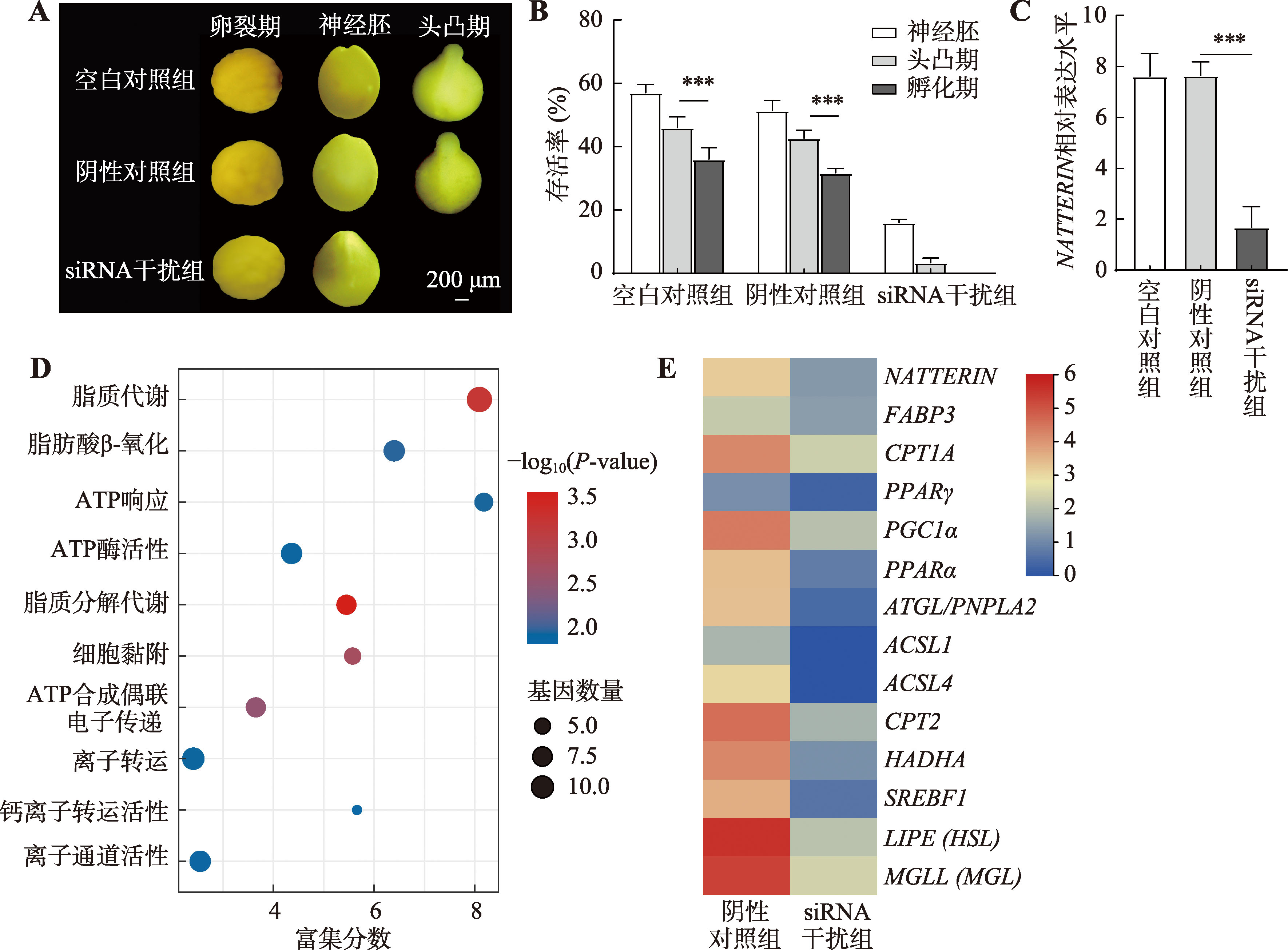
Hyperlipidemia is a major risk factor for cardiovascular diseases. As an extant jawless vertebrate, lampreys possess a unique physiological system that reflects the ancestral features of lipid metabolism in vertebrates. To explore whether this system harbors novel lipid-lowering bioactive molecules applicable to the treatment of hyperlipidemia, we first performed a multi-tissue comparative transcriptomic analysis and identified a set of heart-specific genes in the lamprey, among which NATTERIN was found to be upregulated in response to adrenaline. Using a transgenic zebrafish model overexpressing NATTERIN, we observed that NATTERIN promoted cardiac lipid enrichment and reduced lipid accumulation in peripheral blood vessels. Transcriptomic analysis further revealed significant upregulation of lipid transport- and metabolism-related genes, including the cardiac-type fatty acid-binding protein FABP3, as well as PPARα and PGC1α. Conversely, in lamprey embryos in which NATTERIN was silenced by siRNA, the fatty acid metabolic pathway was markedly suppressed, with reduced expression of PPARα and PGC1α. Furthermore, an acute hyperlipidemia model was established in Lethenteron reissneri using Tyloxapol. Following treatment with recombinant NATTERIN protein, plasma levels of triglycerides, total cholesterol, and low-density lipoprotein cholesterol were significantly decreased, while those of high-density lipoprotein cholesterol were elevated. Concurrently, the expression of PPARα, PGC1α, and other fatty acid metabolism-related genes was upregulated in the heart, with free fatty acid content returning to normal levels. Collectively, these findings demonstrate that NATTERIN activates the expression of cardiac lipid transport and metabolism genes, including FABP3, PGC1α, and PPARα, thereby enhancing fatty acid catabolism and promoting the clearance of lipids from peripheral blood vessels by the heart, and provide an evolutionary perspective for the development of new therapeutic strategies against hyperlipidemia.
Key words: lamprey; NATTERIN; heart; fatty acid metabolism; hyperlipidemia
Zeyu Du , Shixi Sun , Yujie Qiu , Yue Pang . Mechanistic study on the role of lamprey NATTERIN in ameliorating hyperlipidemia by regulating cardiac lipid transport and metabolism[J]. Hereditas(Beijing), 2026 , 48(11) : 1085 -1097 . DOI: 10.16288/j.yczz.26-145
| [1] | Zhu YG, Li J, Pang Y, Li QW. Lamprey: an important animal model of evolution and disease research. Hereditas(Beijing), 2020, 42(9): 847-857. |
| 朱医高, 李军, 逄越, 李庆伟. 七鳃鳗:生物进化和疾病研究的重要模式动物. 遗传, 2020, 42(9): 847-857. | |
| [2] | Chang MM, Zhang JY, Miao DS. A lamprey from the Cretaceous Jehol biota of China. Nature, 2006, 441(7096): 972-974. |
| [3] | Xu XL, Ma AQ, Li TS, Cui WX, Wang XF, Li J, Li QW, Pang Y. Genetic and functional characterization of novel brown-like adipocytes around the lamprey brain. Front Cell Dev Biol, 2021, 9: 674939. |
| [4] | Pang Y, Qin YT, Du ZY, Liu Q, Zhang J, Han K, Lu JL, Yuan ZB, Li J, Pan SS, Dong XR, Xu MY, Wang DT, Li S, Li Z, Chen YD, Zhao ZS, Zhang Z, Chuan SQ, Song Y, Sun MJ, Jia XD, Xia ZY, Zhan LP, Yue Z, Cui W, Wang J, Gu Y, Ni M, Yang HM, Xu X, Liu X, Li QW, Fan GY. Single-cell transcriptome atlas of lamprey exploring Natterin- induced white adipose tissue browning. Nat Commun, 2025, 16(1): 752. |
| [5] | 杜泽宇, 卢佳丽, 李庆伟, 逄越. 七鳃鳗全组织单细胞转录组图谱揭示原始脊椎动物细胞功能演化及脂肪代谢调控. 遗传, 2025, 47(4): 395-398. |
| [6] | Yang H, Pang Y, Li QW. Research progress of bile acids tolerance mechanism in lamprey biliary atresia. Hereditas(Beijing), 2022, 44(1): 59-67. |
| 杨恒, 逄越, 李庆伟. 七鳃鳗胆道闭锁过程中胆汁酸耐受机制研究进展. 遗传, 2022, 44(1): 59-67. | |
| [7] | Chi XY, Su P, Bi D, Tai Z, Li YY, Pang Y, Li QW. Lamprey immune protein-1 (LIP-1) from Lampetra japonica induces cell cycle arrest and cell death in HeLa cells. Fish Shellfish Immunol, 2018, 75: 295-300. |
| [8] | Teng HM, Li QW, Gou M, Liu G, Cao X, Lu JL, Han YL, Yu Y, Gao ZF, Song XP, Dong WJ, Pang Y. Lamprey immunity protein enables early detection and recurrence monitoring for bladder cancer through recognizing Neu5Gc-modified uromodulin glycoprotein in urine. Biochim Biophys Acta Mol Basis Dis, 2022, 1868(12): 166493. |
| [9] | Song XP, Xu XT, Lu JL, Chi XY, Pang Y, Li QW. Lamprey immune protein mediates apoptosis of lung cancer cells via the endoplasmic reticulum stress signaling pathway. Front Oncol, 2021, 11: 663600. |
| [10] | Pang Y, Li CZ, Wang SY, Ba W, Yu T, Pei GY, Bi D, Liang HF, Pan X, Zhu T, Gou M, Han YL, Li QW. A novel protein derived from lamprey supraneural body tissue with efficient cytocidal actions against tumor cells. Cell Commun Signal, 2017, 15(1): 42. |
| [11] | Du ZY, Zhang D, Li J, Li QW, Pang Y. Lamprey immune protein triggers the ferroptosis pathway during zebrafish embryonic development. Cell Commun Signal, 2022, 20(1): 124. |
| [12] | Lan PX, Lan TW. Association of triglyceride-glucose index and obesity metrics with cardiovascular disease among U.S. adults with hyperlipidemia: findings from the NHANES 2007-2016. Metab Syndr Relat Disord, 2026, 24(4): 139-147. |
| [13] | Chen J, Wei ZX, Song ZX, Meng ST, An JQ, Zhang ZQ, Biao YN, Zhang MQ, Zhang YX. Atractylodin ameliorates obesity-associated hepatic steatosis by regulating the PLIN2-ATGL/CPT1A axis-mediated lipid droplet-mitochondria interactions. Phytomedicine, 2026, 155: 158134. |
| [14] | Haemmerle G, Moustafa T, Woelkart G, Büttner S, Schmidt A, van de Weijer T, Hesselink M, Jaeger D, Kienesberger PC, Zierler K, Schreiber R, Eichmann T, Kolb D, Kotzbeck P, Schweiger M, Kumari M, Eder S, Schoiswohl G, Wongsiriroj N, Pollak NM, Radner FPW, Preiss-Landl K, Kolbe T, Rülicke T, Pieske B, Trauner M, Lass A, Zimmermann R, Hoefler G, Cinti S, Kershaw EE, Schrauwen P, Madeo F, Mayer B, Zechner R. ATGL- mediated fat catabolism regulates cardiac mitochondrial function via PPAR-α and PGC-1. Nat Med, 2011, 17(9): 1076-1085. |
| [15] | Hirota T, Fujita Y, Ieiri I. An updated review of pharmacokinetic drug interactions and pharmacogenetics of statins. Expert Opin Drug Metab Toxicol, 2020, 16(9): 809-822. |
| [16] | Couldwell M, Tidwell AJ, Taylor AE. Effect of GLP 1 agonists on reproduction. J Clin Endocrinol Metab, 2025, 110(11): 3009-3024. |
| [17] | Da Dalt L, Cabodevilla AG, Goldberg IJ, Norata GD. Cardiac lipid metabolism, mitochondrial function, and heart failure. Cardiovasc Res, 2023, 119(10): 1905-1914. |
| [18] | Ma L, Gou M, Du ZY, Zhu T, Li J, Li QW, Pang Y. MicroRNA expression profile in Lampetra morii upon Vibrio anguillarum infection and miR-4561 characterization targeting lip. Commun Biol, 2021, 4(1): 995. |
| [19] | Zhu T, Li YX, Pang Y, Han YL, Li J, Wang ZK, Liu X, Li HR, Hua YS, Jiang H, Teng HM, Quan J, Liu Y, Geng M, Li MA, Hui F, Liu JZ, Qiu Q, Li QW, Ren YD. Chromosome-level genome assembly of Lethenteron reissneri provides insights into lamprey evolution. Mol Ecol Resour, 2021, 21(2): 448-463. |
| [20] | Huang DL, de Mello PLH, Liu T, Liu Y, Kapadia EH, Liang YP, Lu JG, Corbo JC, Parichy DM. Graded BMP signals modulate yellow and red color in fishes, impacting adult pigment patterns and conspecific shoaling behavior. Curr Biol, 2026, 36(8): 2127-2136.e5. |
| [21] | Arshad U, Santos JEP. Characterization of a model to induce hyperlipidemia in feed-restricted dairy cows. JDS Commun, 2023, 5(1): 77-82. |
| [22] | Feng Y, Peng YB, Hou JC, Wang ZH, Lai JL, Xiong TXS, Shi JW, Wang YX, Yim WY, Chen YQ, Dong NG. FABP3 and FABP4 promote lipid peroxidation injury during static cold storage of donor heart:Insights from multi-omics and therapeutic targeting. J Mol Cell Cardiol Plus, 2025, 14: 100497. |
| [23] | Montaigne D, Butruille L, Staels B. PPAR control of metabolism and cardiovascular functions. Nat Rev Cardiol, 2021, 18(12): 809-823. |
| [24] | Yang Y, Qiu W, Xiao JY, Sun J, Ren X, Jiang LX. Dihydromyricetin ameliorates hepatic steatosis and insulin resistance via AMPK/PGC-1α and PPARα-mediated autophagy pathway. J Transl Med, 2024, 22(1): 309. |
| [25] | Jiang HY, Fang TT, Cheng ZY. Mechanism of heart failure after myocardial infarction. J Int Med Res, 2023, 51(10): 3000605231202573. |
| [26] | Guo A, Li K, Tian HC, Fan Z, Chen QN, Yang YF, Yu J, Wu YX, Xiao Q. FGF19 protects skeletal muscle against obesity-induced muscle atrophy, metabolic derangement and abnormal irisin levels via the AMPK/SIRT-1/PGC-α pathway. J Cell Mol Med, 2021, 25(7): 3585-3600. |
| [27] | Liu Y, Wang F, Xu HY, Wang HX, Lu ML, Cheng L. Ginkgolide B attenuates hyperlipidemia by restoring sphingolipid homeostasis and activating PPARα and Nrf2 pathways. Sci Rep, 2025, 15(1): 28774. |
| [28] | Liu YK, Chen BJ, Li HQ, Zhang WH, Lian B, Huang Z, Qin QH, Tan QX, Wei CY. CPT1A exacerbates trastuzumab- induced cardiotoxicity via promotion of mitochondrial dysfunction. Int J Biol Macromol, 2026, 338(Pt 1): 149581. |
| [29] | Hammoud R, Drucker DJ. Beyond the pancreas: contrasting cardiometabolic actions of GIP and GLP1. Nat Rev Endocrinol, 2023, 19(4): 201-216. |
| [30] | Bachmann CM, Janitschke D, Lauer AA, Erhardt T, Hartmann T, Grimm MOW, Grimm HS. Gemfibrozil- induced intracellular triglyceride increase in SH-SY5Y, HEK and Calu-3 Cells. Int J Mol Sci, 2023, 24(3): 2972. |
| [31] | Hernandez-Anzaldo S, Berry E, Brglez V, Leung D, Yun TJ, Lee JS, Filep JG, Kassiri Z, Cheong C, Lambeau G, Lehner R, Fernandez-Patron C. Identification of a novel heart-liver axis: matrix metalloproteinase-2 negatively regulates cardiac secreted phospholipase A 2 to modulate lipid metabolism and inflammation in the liver. J Am Heart Assoc, 2015, 4(11): e002553. |
/
| 〈 |
|
〉 |

www.chinagene.cn
备案号:京ICP备09063187号