
遗传 ›› 2026, Vol. 48 ›› Issue (1): 3-25.doi: 10.16288/j.yczz.25-146
翁炳焕1( ), 傅松滨2, 蒋宇林3, 王和4, 蔡光伟5, 朱宝生6, 郝娜3, 黄荷凤1(), 贺林7()
收稿日期:2025-07-29
修回日期:2025-10-09
出版日期:2026-01-20
发布日期:2025-10-29
通讯作者:
翁炳焕,博士,主任技师,研究方向:细胞遗传学。E-mail: 5503006@zju.edu.cn;基金资助:
Binghuan Weng1(), Songbin Fu2, Yulin Jiang3, He Wang4, Kwongwai Choy5, Baosheng Zhu6, Na Hao3, Hefeng Huang1(), Lin He7()
Received:2025-07-29
Revised:2025-10-09
Published:2026-01-20
Online:2025-10-29
Supported by:摘要:
核型分析作为产前诊断常规项目应用于遗传学诊断和遗传咨询。染色体多态性在核型分析中很常见,但因缺乏以图示为参照的多态性判断标准,使各实验室对同一染色体变异是否应判断为多态性以及用什么符号表达多态性存在差异,从而影响核型分析报告的互认及多态性的临床解读。本共识通过采集已确诊的各种多态性核型图,研究其在不同显带技术中的形态特征,比较各种多态性的G带、C带和N带的特征异同,确认多态性G带特征,并参照《人类细胞基因组学国际命名体系(ISCN 2024)》(An International System for Human Cytogenomic Nomenclature,ISCN 2024)进行多态性归类,提出判断标准、鉴别流程、知情告知和临床解读模式,以规范多态性判别,促进核型分析报告互认,确保遗传咨询结果一致,解决本行业长期困扰的多态性判断标准缺乏和同一多态性被不同解读的遗传咨询问题。
翁炳焕, 傅松滨, 蒋宇林, 王和, 蔡光伟, 朱宝生, 郝娜, 黄荷凤, 贺林. 人类染色体多态性的形态特征与判断标准及遗传咨询专家共识[J]. 遗传, 2026, 48(1): 3-25.
Binghuan Weng, Songbin Fu, Yulin Jiang, He Wang, Kwongwai Choy, Baosheng Zhu, Na Hao, Hefeng Huang, Lin He. Expert consensus on the morphological characteristics diagnostic criteria and genetic counseling of human chromosomal polymorphisms[J]. Hereditas(Beijing), 2026, 48(1): 3-25.
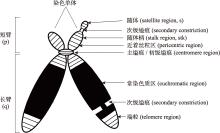
图1
D/G组染色单体结构示意图 黑色部分表示常染色质区;其余非黑色部分表示异染色质区,包括随体(p13)、次级缢痕、随体柄(p12)、近着丝粒区(p11.2)、主缢痕(初级缢痕)及端粒。图片由浙江大学医学院附属妇产科医院楼钰函博士、香港中文大学蔡光伟教授、树兰医院应俊博士绘制。"
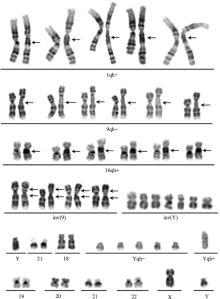
图2
染色体多态性常规G带核型图 在每对同源染色体中,排在左侧者为非多态性染色体,排在右侧者为所标示的染色体多态性核型(G显带,约300~400条带;放大倍数为1,000×),箭头指向多态性所在区带。其中第1~3行分别为1号、9号和16号染色体qh+多态性;第4行的inv(9)为9号染色体异染色质区臂间倒位多态性即inv(9)(p12q13);第4行的inv(Y)为来自同一例羊水细胞的不同形态特征的Y多态性(该Y多态性的G带和C带验证结果均与父亲Y多态性一致);第5行为所标示的Yqh-、Yqh+与正常Y、正常21号、正常18号的大小对比,其中Yqh-只显示1条比21q21更浅、更窄的G带(需进一步做AZF微缺失等验证);第6行所标示的Y的大小似21号,在常规G带核型分析中这种形态特征的Y可以告知Y≤21(图示为常规G带多态性核型图,供仅开展常规G带核型分析者参考)。图片由浙江大学医学院附属妇产科医院细胞遗传室团队及楼钰函博士提供、树兰医院应俊博士编辑。"
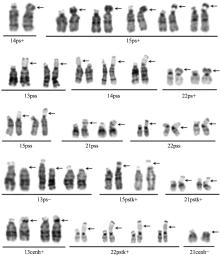
图3
D/G组染色体多态性常规G带核型图 在每对同源染色体中,排在右侧者为所标示多态性,箭头指向多态性所在区带,可见在各类多态性中,同类多态性有不同形态特征,而不同类多态性又有相同形态特征(G显带,约300~400条带;放大倍数约为1,200×)。14/15/22ps+:这类染色体随体增大(似罗氏易位)表现为所增大的随体大小不一或伴有长度不一的随体柄,如第1~4对的14/15ps+的随体增大像21号,第5~6对15ps+的随体增大相对不明显,但伴有随体柄长度增加,类似于图中15pstk+,22ps+也可见随体柄有所延长;13/14/15/21/22pss:这类染色体为双随体(pss),也可称双随体柄(pstkstk),因双随体通常伴有双随体柄,可表示为pss/pstkstk。在pss/pstkstk中可见1条深浅或宽窄不一的G带(箭头指向),如21/22pss尤其是21pss的G带较明显(根据该G带可区别于图中随体柄长度增加但G带呈均匀浅带的15/21pstk+);15/21/22pstk+:同类pstk+的随体柄增加长度或区带着色也不一致,如22pstk+就不同于15/21pstk+,根据C带或N带验证(图5、图6和图7),这两类虽同为pstk+,但22pstk+的N带还可见双随体柄(同图5的14pstk+);13ps-:13号染色体随体缺失但仍可见着丝粒;13cenh+:13号染色体着丝粒区异染色质长度增加;21cenh-:21号染色体着丝粒缺失(图示为常规G带多态性核型图,供仅开展常规G带核型分析者参考)。图片由浙江大学医学院附属妇产科医院细胞遗传室团队及王雨博士提供、树兰医院应俊博士编辑。"
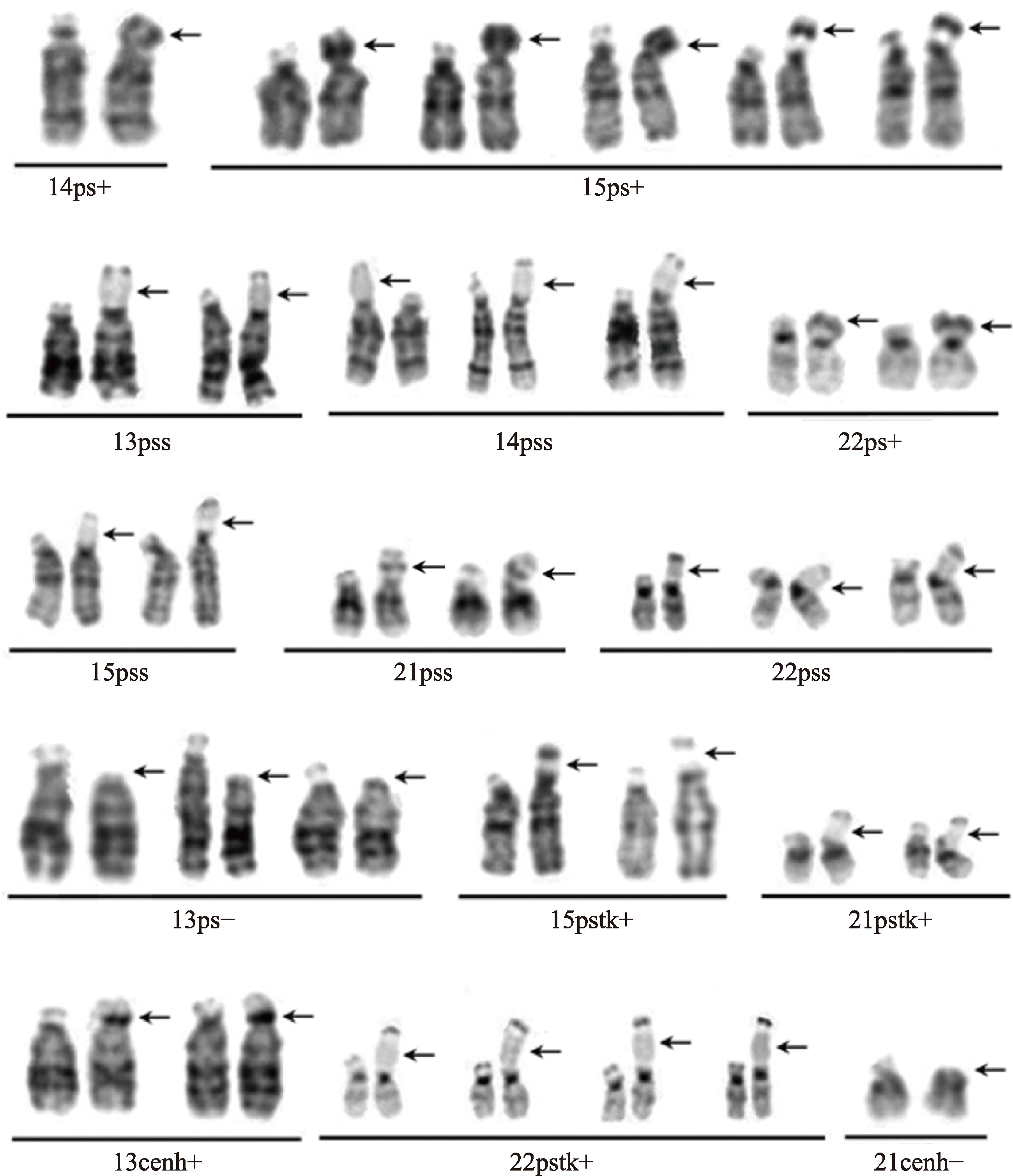
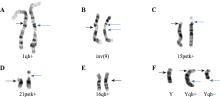
图4
染色体多态性高分辨G带核型图 在每对同源染色体中,排在左侧者为非多态性染色体,黑色箭头指向着丝粒;排在右侧者为多态性染色体,蓝色箭头指向多态性区域(G显带,约550条带;放大倍数为1,000×)。A:1号qh多态性,高分辨为2条G带(多了1条G带),表示为1qh+;B:9号染色体异染色质区臂间倒位多态性,表示为inv(9)(p12q13);C:15号染色体近着丝粒区域(p11.2)随体柄多态性,表示为15pstk+;D:21号染色体随体柄多态性,表示为21pstk+;E:16号qh多态性,表示为16qh+;F:分别为正常Y、Yqh+和Yqh-多态性。图片由香港中文大学蔡光伟教授提供。"
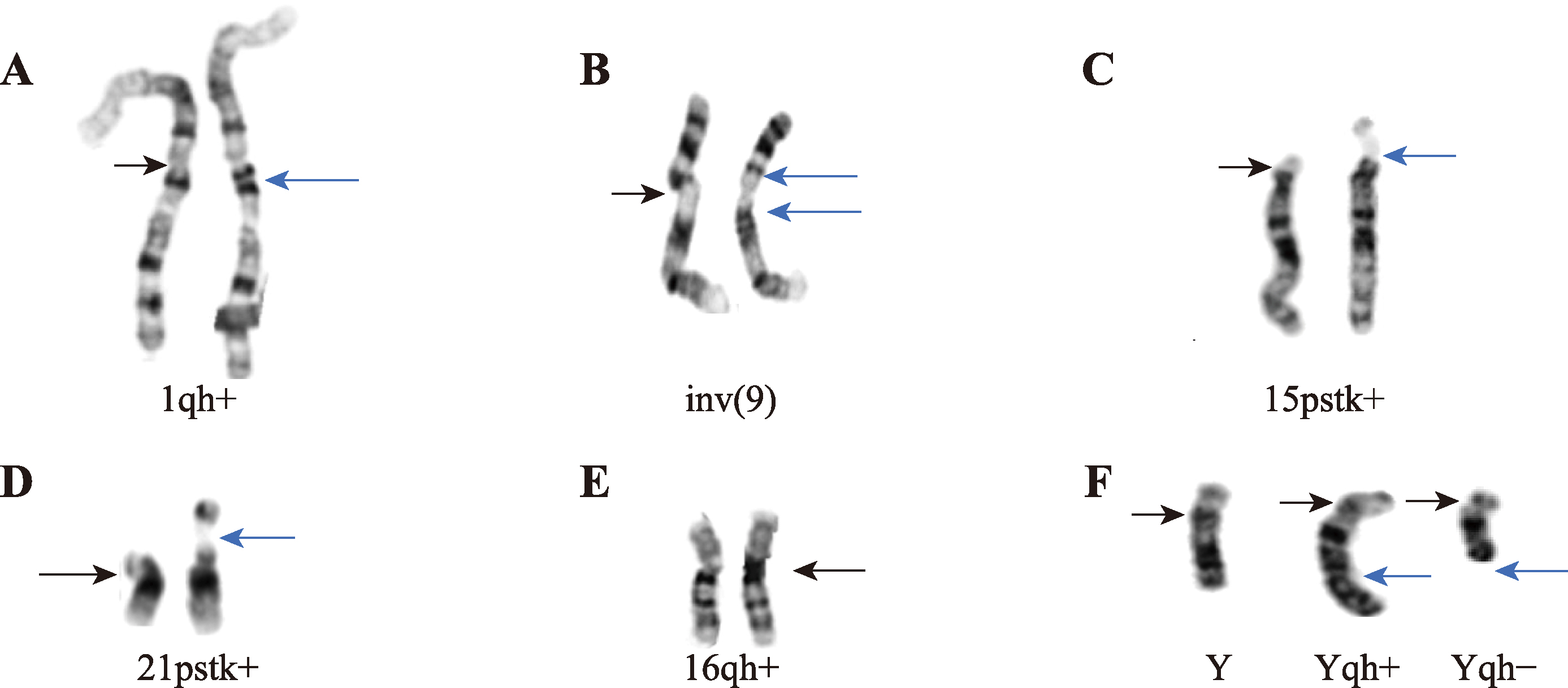
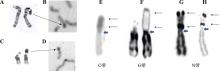
图5
D/G组染色体ps+和pstk+的G带、C带和N带图 宽箭头指向着丝粒,细箭头指向多态性区域。A和B:分别为G带和C带的15号染色体ps+图示,G带显示排在右侧的15号短臂随体深染、增大,进而以C带验证,结果也为深染,初步判断为异染色质增加,即为15ps+;C和D:分别为G带和C带的21号染色体ps+图示,G 带显示排在右侧的21号短臂随体深染、增大,进一步以C带验证,结果也为深染,初步判断为异染色质增加,即为21ps+;E~H:为C带、G带、N带的14号染色体pstk多态性图示,G带显示14pstk增大、增长,以C带验证,C带显示深染,初步判断为异染色质增加,经N带进一步验证,如G和H所示的细箭头指向,染色体具有转录活性的核仁形成区(NOR)被特异性地染成黑色,可见其随体柄明显延长(对应于细箭头之间,即14pstk+,同时又是双随体柄,即14pstkstk或称双NORs)。A~D的放大倍数约为1,000×,E~H的放大倍数约为1,200×。图片由香港中文大学蔡光伟教授提供。"
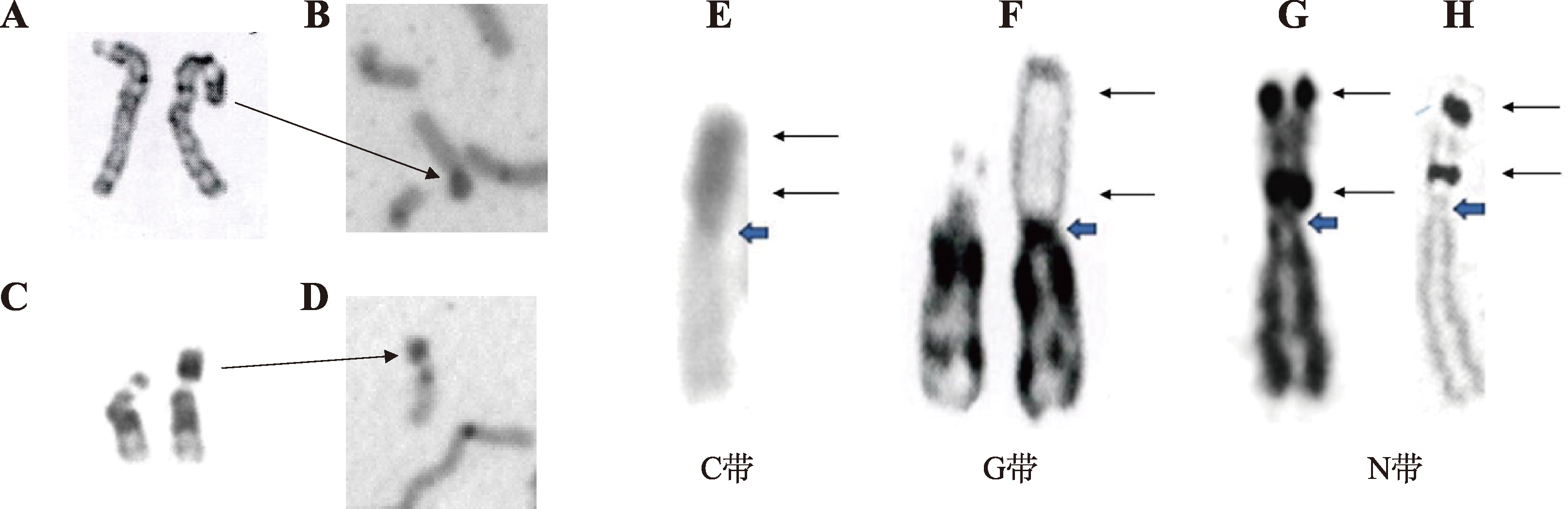
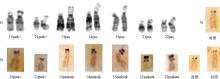
图6
D/G组染色体pstkstk/pss的G带和N带图 G带初判的多态性可以用N带进一步验证。如图中第一行为G带核型图(放大倍数为1,000×),每对同源染色体排在右侧者为经G带初判的多态性(排在左侧者可作为G带的非多态性对照,排在最后这条及第二行的最后两条均为N带的非多态性对照)。其中第1~2对染色体G带可见排在右侧的染色体随体柄长度增加(第2条的随体增大不明显),经N带验证,与对照相比,可见被染成黑色的银染颗粒(NOR)明显远离着丝粒区,为随体柄长度增加,可分别判断为15pstk+和21pstk+;第3~7对排在右侧的染色体G带显示随体区长度明显增加,在随体区中间可见相对较深的G带(特别是第6对21号染色体的该G带更明显,需与罗氏易位区别),初判为pss/pstkstk(双随体通常伴有双随体柄),经N带进一步验证,与对照相比,未见随体柄长度增加,但可见2对黑色银染颗粒或两条黑色条带(为具有转录活性的NOR被银染,表示双随体柄),如图所示,可分别判断为13/14/15/21/22pstkstk/pss。非pstkstk多态性的N带对照,仅显示两颗靠近着丝粒的黑色银染颗粒,明显不同于pstkstk/pss。图片由哈尔滨医科大学医学遗传学实验室赛凤英老师和北京协和医院赫娜老师提供、浙江大学医学院附属妇产科医院生殖遗传科石君玲博士编辑。"
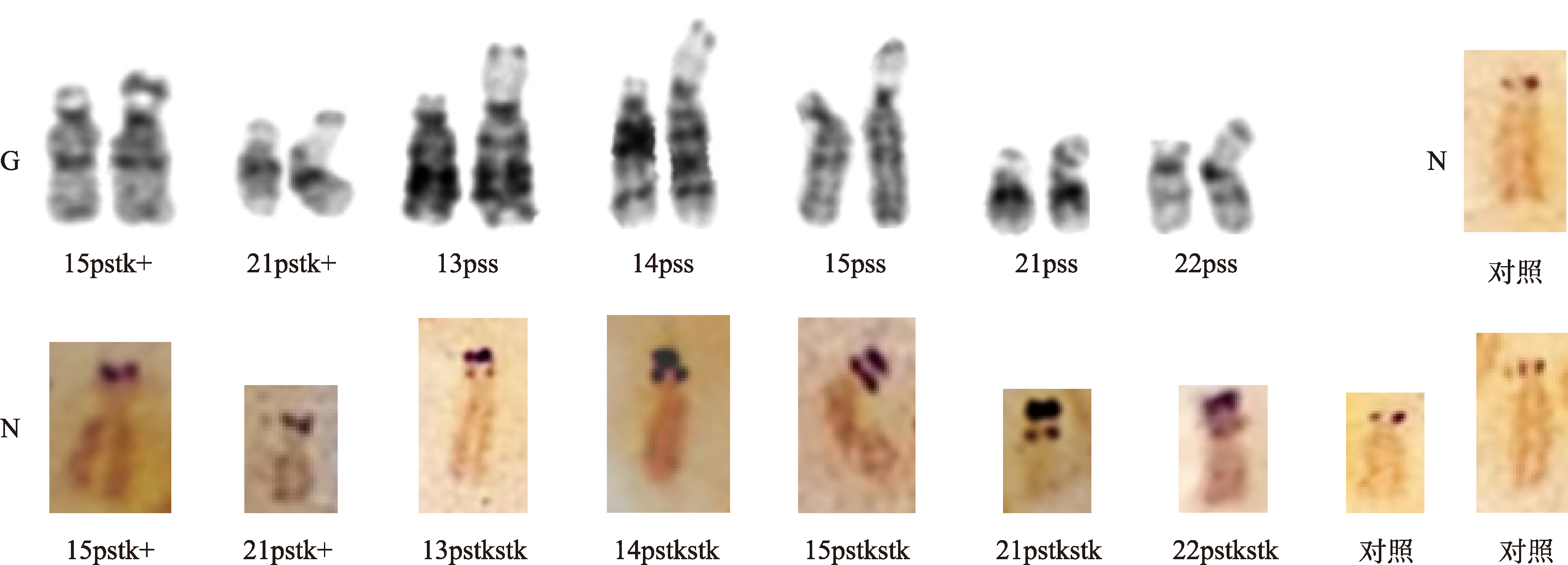
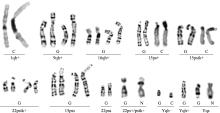
图7
染色体多态性常规或高分辨的G带、C带和N带核型图 在每对同源染色体中,排在左侧者为非多态性(对照),排在右侧者为所标示的多态性(G显带,约400~550条带;放大倍数为1,000×)。其中15ps+经C带验证,其短臂深染而长臂常染色质浅染,证明深染的短臂为异染色质增加即ps+(否则就有可能不是多态性);15pstk+经C带验证,证明为随体柄异染色质增加(通常可用N带验证随体柄是否延长);22pstk+、15pss、22pss为约550条带的G显带的多态性(pss即pstkstk);22ps+/pstk+为G显带可见同时伴有这两种多态性,经N带验证,其随体柄延长不明显但随体柄上的NOR被染成黑色,而随体染浅色(通常可用C带验证ps+,随体的异染色质为深染);Y多态性,其中Yqs的G带显示Y大小正常,但可见Y长臂末端浅带,即Yqs,经N带验证,其“qs”被染成黑色(“s”其实为易位而来的近端着丝粒染色体的短臂“p”,所指“qs”被N带染成黑色,其本质是近端着丝粒染色体短臂随体柄“stk”上的NOR被染成黑色而不是随体“s”被染成黑色,所以“qs”实质为含有“stk”和“s”的短臂“p”)。图片由云南省第一人民医院遗传科朱宝生教授提供、树兰医院应俊博士编辑。"
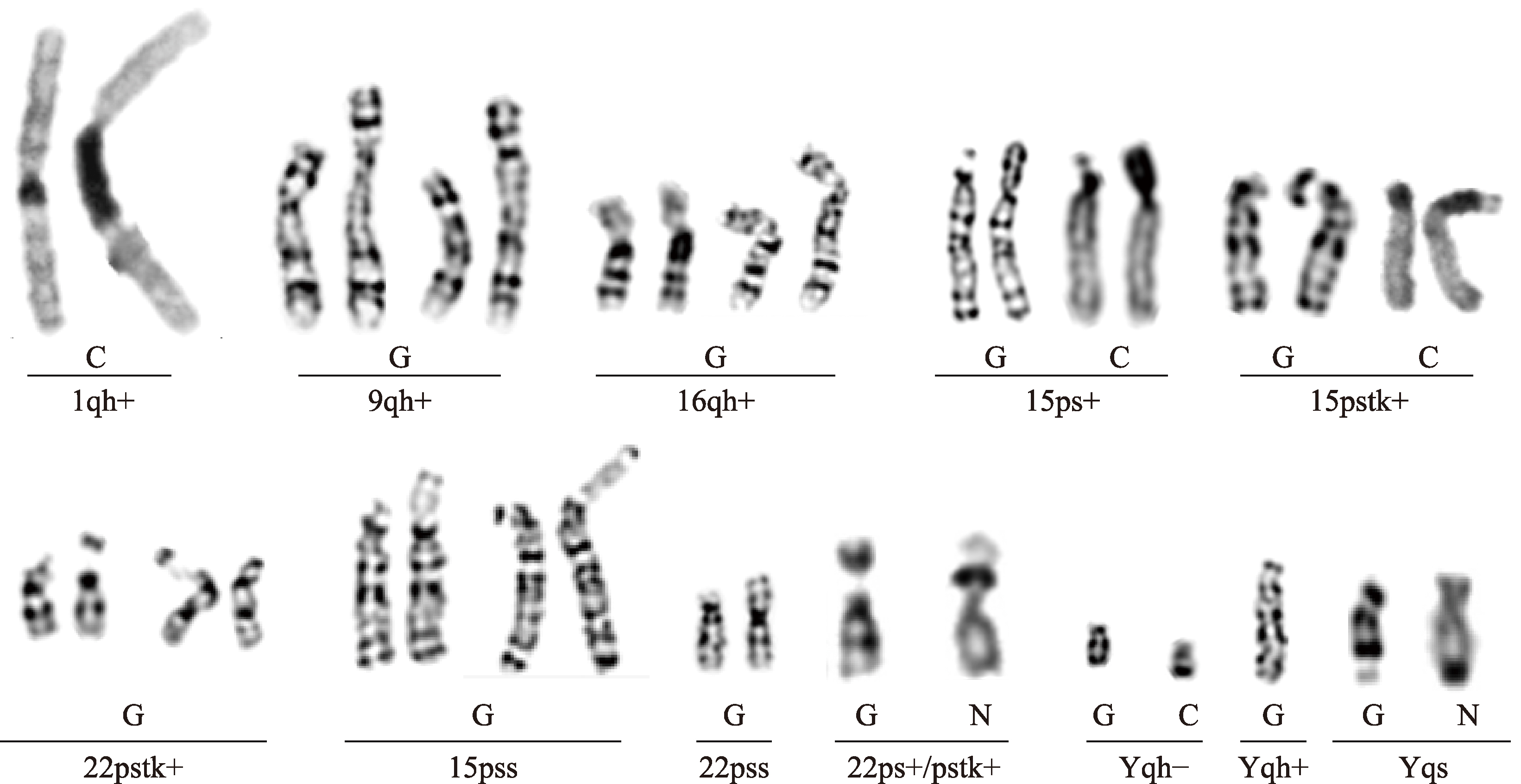
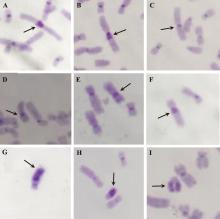
图8
染色体多态性的C带图 A和B:箭头所指染色体为在G带判断为1qh+时所做的C带;C:非1qh+对照;D和E:箭头所指染色体为在G带判断为inv(9)(p12q13)时所做的C带,可见本来位于长臂异染色质区的深带倒位到短臂异染色质区;F:非inv(9)(p12q13)的对照,未见长臂异染色质区深带倒位;G~I:箭头所指染色体分别为在G带判断为Yqh+、Yqh-及正常Y时所做的C带。放大倍数为1,000×。图片由哈尔滨医科大学医学遗传学实验室赛凤英老师提供、树兰医院应俊博士编辑。"
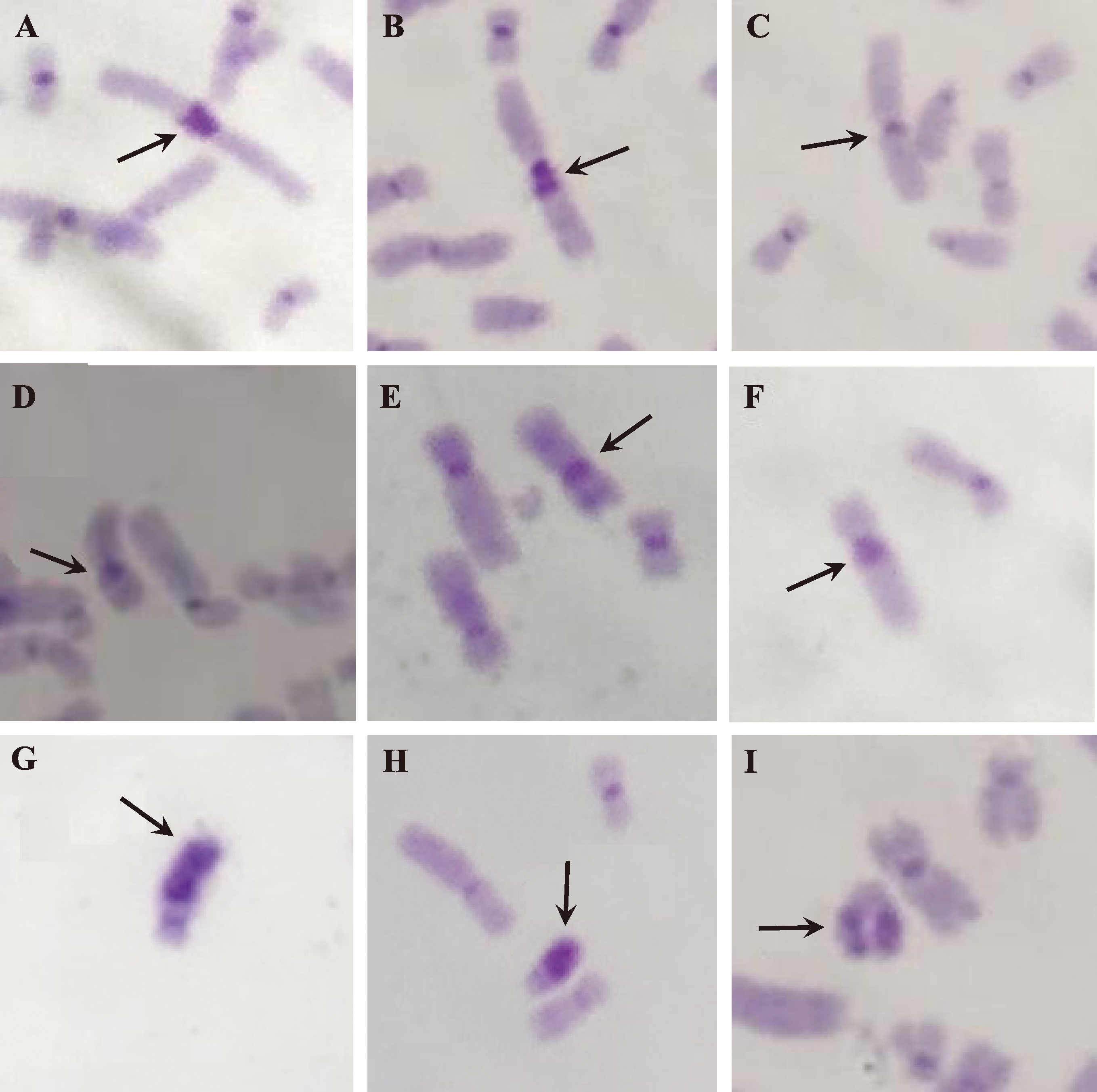
图9
D/G组染色体随体柄和随体多态性的N带图 A、B、C、E、F、H、I、J、K:当G带发现pss(pstkstk)时,进一步做N带验证,N带染色可见2对黑色银染颗粒(NOR),其中顶端这对黑色银染颗粒易融合为1条深带,分别判断为13、15、14、21、22pstkstk/pss;D、G:当G带发现随体柄长度明显增加(pstk+)时,进一步做N带验证,可见随体柄明显增长,表示为14pstk+/15pstk+;L:正常随体或随体柄的N带对照。箭头指向N带的多态性随体、随体柄及非多态性对照。放大倍数为1,000×。图片由哈尔滨医科大学医学遗传学实验室赛凤英老师提供。"
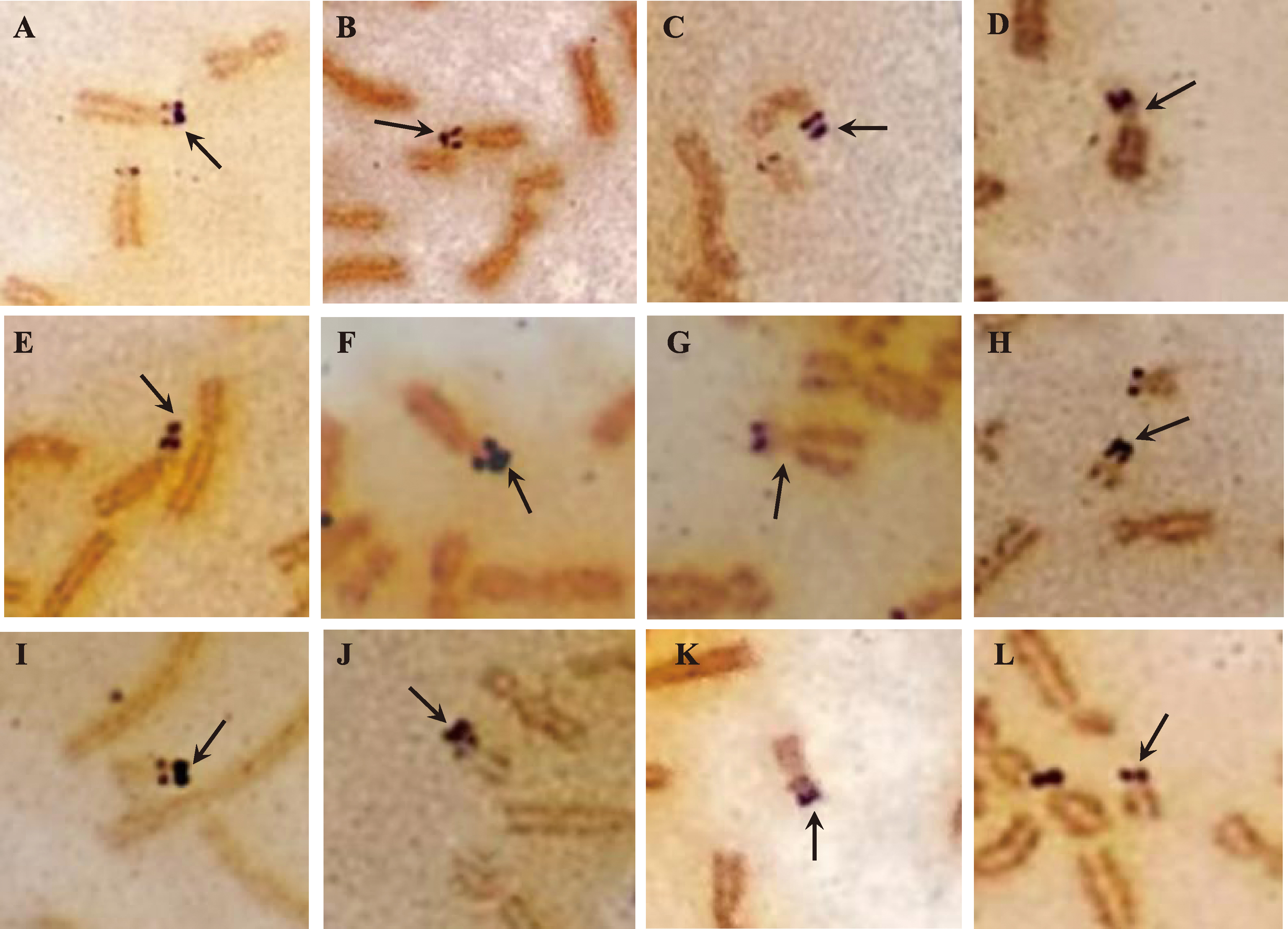
图10
C带和N带的染色体分裂相图 A:C带的染色体分裂相。a1:Y染色体(Y≥18);a2:18号染色体(可作为判别是否为Y≥18的对照);a3和a4:D组染色体着丝粒对比,可见a3的着丝粒区异染色质比a4有较明显的增加(15cenh+);a5:21号染色体(可作为判别是否为Y≤21的对照);a6:没有臂间倒位的9号染色体,可见不同于图8中的inv(9)(p12q13)。B:N带的染色体分裂相。b1:当G带发现双随体pss/pstkstk时,进一步做N带验证,N带可见2对黑色银染颗粒(NOR),其中顶端的两个黑色银染颗粒呈融合状的1条深带,可判断为双随体柄或双随体即pstkstk/pss;b2~b5:在同一分裂相中不同D/G组染色体的正常随体/随体柄(非pss)的N带对照。放大倍数为1,000×。图片由哈尔滨医科大学医学遗传学实验室赛凤英老师提供、树兰医院应俊博士编辑。"
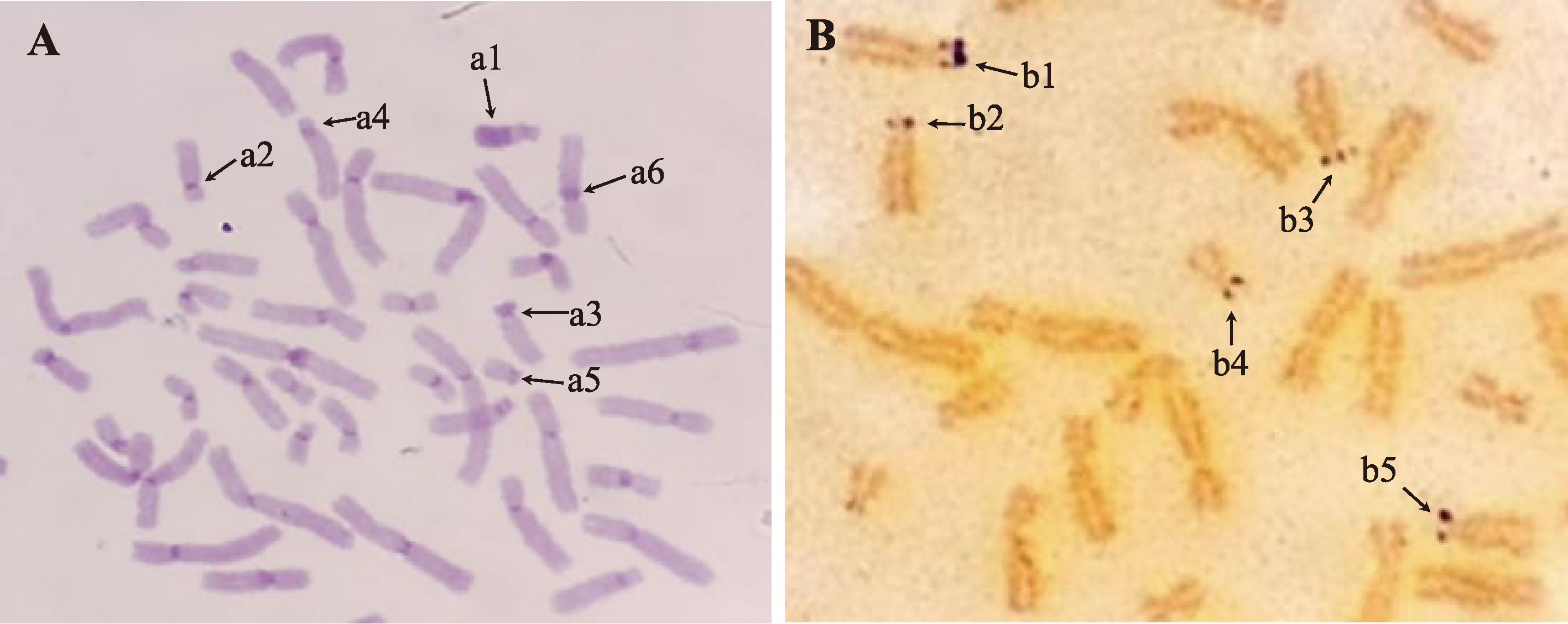
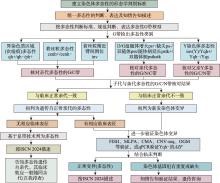
图11
染色体变异或多态性的判别、验证流程图 流程图包括多态性的G带初判、C带和N带验证、变异来源鉴别、新发变异或有临床表征多态性的分子检测。分子检测包括荧光原位杂交(fluorescence in situ hybridization, FISH)、多重连接探针扩增(multiplex ligation-dependent probe amplification, MLPA)、染色体微阵列分析(chromosomal microarray analysis, CMA)、低深度全基因组拷贝数变异测序(copy number variation sequencing, CNV-seq)、基因组光学图谱技术(optical genome mapping, OGM)、实时荧光定量聚合酶链反应(quantitative real time-polymerase chain reaction, qPCR)。由浙江大学医学院附属妇产科医院产前诊断专家组及翁炳焕设计提供。"

图12
基于G-带和CMA判别染色体多态性与异常核型 A~H:分别为多态性22pss、22pstk+、22ps+、21pss、inv(Y)、inv(Y)、Yqh-(Y<21)和15ps+的CMA检测结果,CMA表明相应多态性染色体未检出被检基因组的拷贝数异常;I和J:分别为der(14;21)和der(13;22)的CMA检测结果,CMA也表明为罗氏易位;K:der(21),核型中同时存在罗氏易位[t(21;21)]和21号部分缺失[del(21)],CMA显示21号有部分嵌合重复。图片由浙江大学医学院附属妇产科医院分子检测平台及楼钰函博士提供、树兰医院应俊博士编辑。"

| [1] | Wyandt HE, Tonk VS. Atlas of Human Chromosome Heteromorphisms. Boston: Kluwer Academic, 2004. |
| [2] |
ISCN 2024-An International System for Human Cytogenomic Nomenclature (2024). Cytogenet Genome Res, 2024, 164(Suppl 1): 1-224.
pmid: 39571546 |
| [3] | Weng BH, Cai JP, Wang XM, You JF, Jin Y, Wang XH. Establishment of lymphocyte cell lines with abnormal chromosome karyotypes and its application in external quality assesment for chromosome karyotype analysis. Chin J Med Genet, 2007, 24(6): 689-691. |
|
翁炳焕, 蔡剑平, 王绪敏, 尤建飞, 金昱, 王晓华. 染色体异常核型淋巴细胞建系及其在染色体分析室间质评中的应用. 中华医学遗传学杂志, 2007, 24(6): 689-691.
pmid: 18067085 |
|
| [4] | 翁炳焕, 任宇珂, 吕时铝, 金昱, 卢欢明. 产前诊断中染色体核型分析的质量控制. 中华医院管理杂志, 2008, 24(3): 216-217. |
| [5] |
Weng BH, Li X. An external quality assessment scheme for prenatal detection of rare chromosomal abnormalities. Clin Chim Acta, 2012, 413(21-22): 1721-1724.
pmid: 22789962 |
| [6] | Wang W, Chen YY, Chen X, Zhong K, He FL, Zhang Y, Bao LM, Zou L, Wang ZG. Result survey analysis of prenatal chromosome karyotyping in an external quality assessment program. Chin J Med Genet, 2014, 31(4): 483-486. |
| 王薇, 陈园园, 陈希, 钟堃, 何法霖, 张妍, 包黎明, 邹琳, 王治国. 我国产前染色体核型分析的室间质评调查结果分析. 中华医学遗传学杂志, 2014, 31(4): 483-486. | |
| [7] |
Lu YJ, Tian T, Chen LX, Yan LY, Chang L, Qiao J. Diverse impacts of female chromosomal polymorphismson assisted reproduction outcomes: aretrospective cohort study. BMC Pregnancy Childbirth, 2024, 24(1): 331.
pmid: 38678230 |
| [8] |
Lu YG, Tian T, Chen LX, Yan LY, Chang L, Qiao J. Impacts of male chromosomal polymorphisms on semen quality and IVF/ICSI outcomes: a retrospective cohort study. Int J Gynaecol Obstet, 2024, 166(3): 1247-1262.
pmid: 38576264 |
| [9] | Bao X, Shi H, Sun YP. Chromosome polymorphism: thenew indication of PGT-A? Chin J Reprod Contracept, 2019, 42(11): 1107-1113. |
| 鲍晓, 史昊, 孙莹璞. 染色体多态性:PGT-A新指征? 中华生殖与避孕杂志, 2022, 42(11): 1107-1113. | |
| [10] | Jiang YH, Kong W, Huan Q, Wen J. Pregnancy outcome of 105 patients with chromosomal polymorphism after assisted reproductive technology. J Reprod Med, 2016, 25(4): 320-324. |
| 姜永辉, 孔伟, 宦晴, 闻姬. 105例染色体多态性患者辅助生殖妊娠结局分析. 生殖医学杂志, 2016, 25(4): 320-324. | |
| [11] | Long Y, Xu JC, Hu B, Dong YL, Hu HM, Zhang R, Yao H. The relationship between amniotic fluid chromosomal polymorphism and pregnancy outcome. J Pract Obstet Gynecol, 2016, 32(8): 615-617. |
| 龙洋, 徐聚春, 胡斌, 董艳玲, 胡华梅, 章容, 姚宏. 羊水染色体多态性与妊娠结局的关系分析. 实用妇产科杂志, 2016, 32(8): 615-617. | |
| [12] |
Dong Y, Jiang YT, Du RC, Zhang HG, Li LL, Liu RZ. Impact of chromosomal heteromorphisms on reproductive failure and analysis of 38 heteromorphicpedigreesin Northeast China. J Assist ReprodGenet, 2013, 30(2): 275-281.
pmid: 23274509 |
| [13] | Fu J, Chen L, Pan H, Ma JM, Yu L, Yang HX. Association between chromosome heteromorphisms and abnormal pregnancy. Chin J Sex, 2016, 25(5): 112-115. |
| 付杰, 陈亮, 潘虹, 马京梅, 于丽, 杨慧霞. 染色体多态性与不良孕产史关系的探讨. 中国性科学, 2016, 25(5): 112-115. | |
| [14] |
Elkarhat Z, Kindil Z, Zarouf L, Razoki L, Aboulfaraj J, Elbakay C, Nassereddine S, Nasser B, Barakat A, Rouba H. Chromosomal abnormalities in couples with recurrent spontaneous miscarriage: a 21-year retrospective study, areport of a novel insertion, and a literature review. J Assist Reprod Genet, 2019, 36(3): 499-507.
pmid: 30470960 |
| [15] | Zhang YF, Li Y, Shi R, Zhang YJ, Luo HN, Ma JF, Zhang YS. Clinical effects of chromosomal polymorphisms in reproductive abnormalities. J Reprod Med, 2020, 29(4): 560-564. |
| 张印峰, 李莹, 史蕊, 张瑶佳, 罗海宁, 马俊芳, 张云山. 染色体多态性在生殖异常方面的临床效应. 生殖医学杂志, 2020, 29(4): 560-564. | |
| [16] |
Verdaasdonk JS, Bloom K. Centromeres: unique chromatin structures that drive chromosome segregation. Nat Rev Mol Cell Biol, 2011, 12(5): 320-332.
pmid: 21508988 |
| [17] |
Minocherhomji S, Athalye AS, Madon PF, Kulkarni D, Uttamchandani SA, Parikh FR. A case-control study identifying chromosomal polymorphic variations as forms of epigenetic alterations associated with the infertility phenotype. Fertil Steril, 2009, 92(1): 88-95.
pmid: 18692838 |
| [18] | 王桂玲, 任春娥, 姜爱芳. 染色体多态性qh+与复发性流产关系的探讨. 中华医学遗传学杂志, 2015, 32(4): 591-592. |
| [19] |
Sarrate Z, Solé M, Vidal F, Anton E, Blanco J. Chromosome positioning and male infertility: it comes with the territory. J Assist Reprod Genet, 2018, 35(11): 1929-1938.
pmid: 30229502 |
| [20] | Wang XR, Deng JX, Li JJ. The relationship between clinical outcomes of reproducetive abnormalities and chromosome polymorphism. Hereditas (Beijing), 2007, 29(11): 1362-1366. |
| 王小荣, 邓剑霞, 李津津. 染色体多态性与临床效应及生殖关系的探究. 遗传, 2007, 29(11): 1362-1366. | |
| [21] | 何瑶, 刘东云, 裴莉. Y染色体AZFc区缺失患者行体外受精-胚胎移植结局分析. 中华医学遗传学杂志, 2018, 35(5): 762-764. |
| [22] |
Xie PY, Hu L, Tan YQ, Gong F, Zhang SP, Xiong B, Peng YQ, Lu GX, Lin G. Retrospective analysis of meiotic segregation pattern and interchromosomal effects in blastocysts from inversion preimplantation genetic testing cycles. Fertil Steril, 2019, 112(2): 336-342.
pmid: 31103288 |
| [23] | Chen H, Shen JD, Xie JZ, Sun XP, Cui YG, Liu JY, Wu W. Influence of chromosome 9 inversion on embryo chromosome and pregnancy outcome. Reprod Med J, 2019, 28(5): 509-514. |
| 陈欢, 沈鉴东, 谢佳孜, 孙雪萍, 崔毓桂, 刘嘉茵, 吴畏. 9号染色体倒位携带对于胚胎染色体及妊娠结局的影响. 生殖医学杂志, 2019, 28(5): 509-514. | |
| [24] |
Mohsen-Pour N, Talebi T, Naderi N, Moghadam MH, Maleki M, Kalayinia S. Chromosome 9 inversion: pathogenic or benign? a comprehensive systematic review of all clinical reports. Curr Mol Med, 2022, 22(5): 385-400.
pmid: 34365947 |
| [25] |
Muthuvel A, Ravindran M, Chander A, Subbian C. Pericentric inversion of chromosome9 causing infertility and subsequent successful in vitro fertilization. Niger Med J, 2016, 57(2): 142-144.
pmid: 27226692 |
| [26] | Zhao BQ, Gao X, Liu M, Chen H, Li JX. Retrospective study on chromosomal polymorphisms based on assisted reproductive population. Int J Lab Med, 2019, 44(12): 1430-1434. |
| 赵冰清, 高选, 刘敏, 陈虹, 李江夏. 基于辅助生殖人群的染色体多态性回顾性研究. 国际检验医学杂志, 2023, 44(12): 1430-1434. | |
| [27] |
Alves JM, Chikhi L, Amorim A, Lopes AM. The 8p23 inversion polymorphism determines local recombination heterogeneity across human populations. Genome Biol Evol, 2014, 6(4): 921-930.
pmid: 24682157 |
| [28] |
Puig M, Casilas S, Vilatoro S, Marta P. Human inversions and their functional consequences. Brief Funct Genomics, 2015, 14(5): 369-379.
pmid: 25998059 |
| [29] |
Moghbelinejad S, Mozdarani H, Ghoraeian P, Asadi R. Basic and clinical genetic studies on male infertility in Iran during 2000-2016: a review. Int J Reprod Biomed, 2018, 16(3): 131-148.
pmid: 29766145 |
| [30] |
Wang Y, Li G, Zuo MZ, Fang JH, Li HR, Quan DD, Huang L, Peng PP. Y chromosome polymorphisms may contribute to an increased risk of male-induced unexplained recurrent miscarriage. Biosci Rep, 2017, 37(2): BSR20160528.
pmid: 28183871 |
| [31] | Zhou DN, Li SJ, Yang J, Sun LP. Effects of male chromosomal polymorphism on spermatozoa quality and the outcome of in vitro fertilization/intracytoplasmic sperm injection treatment. Chin J Reprod Contracept, 2017, 37(10): 797-802. |
| 周丹妮, 李赛姣, 杨菁, 孙丽萍. 男性染色体多态性对精子质量及体外受精/卵胞质内单精子显微注射结局的影响. 中华生殖与避孕杂志, 2017, 37(10): 797-802. | |
| [32] | Wang XB, Chen XF, Ping P, Liu Y, Zhu ZJ, Gong YH, Li P, Liu Q, Li Z. The research of chromosomal polymorphisms on male spermatogenesis and reproductive outcomes. Chin J Reprod Contracept, 2018, 38(5): 380-385. |
| 汪小波, 陈向锋, 平萍, 刘勇, 朱子珏, 公跃华, 李朋, 刘强, 李铮. 染色体多态性对男性生精能力及生育结局的研究. 中华生殖与避孕杂志, 2018, 38(5): 380-385. | |
| [33] |
Knebel S, Pasantes JJ, Thi DAD, Schaller F, Schempp W. Heterogeneity of pericentric inversions of the human Y chromosome. Cytogenet Genome Res, 2011, 132(4): 219-226.
pmid: 21307635 |
| [34] |
Tempest HG, Simpson JL. Why are we still talking about chromosomal heteromorphisms? Reprod Biomed Online, 2017, 35(1): 1-2.
pmid: 28676188 |
| [35] |
Morales R, Lledó B, Ortiz JA, Ten J, Llácer J, Bernabeu R. Chromosomal polymorphic variants increase aneuploidies in male gametes and embryos. Syst Biol Reprod Med, 2016, 62(5): 317-324.
pmid: 27560353 |
| [36] |
Sun L, Chen ZH, Yang L, Yi CX, Liu J, Ou CQ. Chromosomal polymorphisms are independently associated with multinucleated embryo formation. J Assist Reprod Genet, 2018, 35(1): 149-156.
pmid: 28900749 |
| [37] |
Regina LB, Rupak P. G-banding and molecular cytogenetics detect novel translocations and cryptic aberrations in human immortal endothelial cells. Int J Mol Sci, 2024, 25(14): 7941.
pmid: 39063182 |
| [38] |
Wang RH, Wu K, Hu XL. Prenatal diagnosis of dicentric chromosome X mosaicism: a case report and review. Front Genet, 2024, 18(15): 1436469.
pmid: 39092432 |
| [39] |
Cheung SW, Sun L, Featherstone T. Visualization of NORs in relation to the precise chromosomal localization of ribosomal RNA genes. Cytogenet Cell Genet, 1989, 50(2-3): 93-97.
pmid: 2476278 |
| [40] |
He Q, Zhang YL, Song MY, Zhou Y, Lin D, Ma YL, Sun F, Li Q. Detection of AZF microdeletions and analysis of reproductive hormonal profiles in Hainan men undergoing assisted reproductive technology. BMC Urol, 2024, 24(1): 123.
pmid: 38867229 |
| [41] | Zhang YY, Du Q, Liu XL, Cui WT, He R, Zhao YY. Screening of azoospermia factor microdeletions on Y chromosome in infertile men by QF-PCR. Hereditas(Beijing), 2014, 36(6): 552-557. |
| 张媛媛, 杜强, 刘晓亮, 崔婉婷, 何蓉, 赵彦艳. QF-PCR筛查男性不育患者Y染色体无精子症因子微缺失. 遗传, 2014, 36(6): 552-557. | |
| [42] | 张思仲. 染色体诊断与遗传咨询中的多态性问题和困惑. 中华医学遗传学杂志, 2010, 27(6): 707-709. |
| [43] | Liao YP, Wang CJ, Liang M, Hu XM, Wu Q. Analysis of genetic characteristics and reproductive risks of balanced complex chromosome rearrangement carriers in China. Hereditas(Beijing), 2017, 39(5): 396-412. |
| 廖亚平, 王春景, 梁猛, 胡小梅, 吴琦. 平衡复杂染色体重排携带者的遗传与生育情况分析. 遗传, 2017, 39(5): 396-412. | |
| [44] | Zhu YY, Zhou W, Dai MJ. The impact of Y chromosome inversion on male reproduction. Chin J Med Genet, 2013, 26(3): 379-380. |
| 朱燕英, 周武, 戴美杰. Y染色体倒位对男性生殖的影响. 中华医学遗传学杂志, 2013, 30(3): 379-380. | |
| [45] |
Li JP, Zhang FB, Li LJ, Chen WK, Wu JG, Tian YH, Liang ZY, Chen C, Jin F. Y chromosome polymorphisms contribute to an increased risk of non-obstructive azoospermia: a retrospective study of 32,055 Chinese men. J Assist Reprod Genet, 2024, 41(3): 757-765.
pmid: 38270748 |
| [46] |
Fu MM, Chen MH, GuoN, Lin M, Li Y, Huang HL, Cai MY, Xu LP. Molecular genetic analysis of 1,980 cases of male infertility. Exp Ther Med, 2023, 26(1): 345.
pmid: 37383371 |
| [47] |
Sukenik-Halevy R, Mevorach N, Basel-Salmon L, Matar RT, Kahana S, Klein K, Agmon-Fishman I, Levy M, Maya I. Chromosomal microarray testing yield in 829 cases of microcephaly: a clinical characteristics-based analysis for prenatal and postnatal cases. Arch Gynecol Obstet, 2024, 310(3): 1547-1554.
pmid: 38494511 |
| [48] |
Duan HL, Wang WJ, Zhang Y, Chen XM, Jiang ZH, Li J. Accuracy of expanded noninvasive prenatal testing for maternal copy number variations: acomparative study with CNV-seq of maternal lymphocyte DNA. Taiwan J Obstet Gynecol, 2024, 63(4): 536-539.
pmid: 39004482 |
| [49] |
Levy B, Liu J, Iqbal MA, DuPont B, Sahajpal N, Ho M, Yu JW, Brody SJ, Ganapathi M, Rajkovic A, Smolarek TA, Boyar F, Bui P, Dubuc AM, Kolhe R, Stevenson RE. Multisite evaluation and validation of optical genome mapping for prenatal genetic testing. J Mol Diagn, 2024, 26(10): 906-916.
pmid: 39032820 |
| [50] | 邬玲仟, 张学. 医学遗传学. 北京: 人民卫生出版社, 2016, 47-91. |
| [51] | 贺林. 今日遗传咨询. 北京: 人民卫生出版社, 2019, 3-779. |
| [52] | Zhang XY, Zhu TY, Zhang QR, Guo XJ, Wang C, Jin GF, Hu ZB. Progress in the genetic studies of spermatogenesis abnormalities. Hereditas(Beijing), 2021, 43(5): 473-486. |
| 张星雨, 祝天喻, 张清荣, 郭雪江, 王铖, 靳光付, 胡志斌. 精子发生障碍的遗传学研究进展. 遗传, 2021, 43(5): 473-486. | |
| [53] | Guan J, Wu XN, Li J, Chen GH, Wang HY, Wang QJ. Interpretation of de novo mutations (DNM) and genetic counseling for sporadic hearing loss based on family trio-based sequencing. Hereditas(Beijing), 2025, 47(3): 329-341. |
| 关静, 吴萧男, 李进, 谌国会, 王洪阳, 王秋菊. 基于散发耳聋核心家系的基因新发突变(DNM)特征分析及遗传咨询策略. 遗传, 2025, 47(3): 329-341. | |
| [54] | Sun LY, Xing QH, He L. Retrospect and prospect of the genetic research on birth defects in China. Hereditas(Beijing), 2018, 40(10): 800-813. |
| 孙丽雅, 邢清和, 贺林. 中国出生缺陷遗传学研究的回顾与展望. 遗传, 2018, 40(10): 800-813. | |
| [55] | 陆国辉, 徐湘民. 临床遗传咨询. 北京: 北京大学医学出版社, 2007, 181-515. |
| [56] | 贺林. 常见出生缺陷产前诊断的行业规范与指南. 北京: 人民卫生出版社, 2013, 49-296. |
| [57] | Zhu CY, Li CX, Xu PP, Liu L. Prenatal diagnosis analysis of three cases of Turner syndrome fetuses with complex mosaic small supernumerary marker chromosomes. Chin J Med Genet, 2024, 41(11): 1363-1370. |
| 朱重阳, 李春旭, 许培培, 刘灵. 携带复杂嵌合型额外小标记染色体的特纳综合征3例胎儿的产前诊断分析. 中华医学遗传学杂志, 2024, 41(11): 1363-1370. | |
| [58] | Quan J, Xiao YQ, Lu DR, Bao Y. Application and research of genomic optical mapping technology in disease diagnosis. Hereditas(Beijing), 2025, 47(4): 428-436. |
| 权静, 肖艳群, 卢大儒, 鲍芸. 基因组光学图谱技术在疾病诊断中的应用与研究. 遗传, 2025, 47(4): 428-436. | |
| [59] |
Chia NL, Moore S, Hastings RJ. ISCN 2024: summary of revisions and new nomenclature. Cytogenet Genome Res, 2025, 165(1): 1-8.
pmid: 40159394 |
| [1] | 关静, 吴萧男, 李进, 谌国会, 王洪阳, 王秋菊. 基于散发耳聋核心家系的基因新发突变(DNM)特征分析及遗传咨询策略[J]. 遗传, 2025, 47(3): 329-341. |
| [2] | 胡浩, 杨晓文, 程德华, 李秀蓉, 何文斌, 胡晓, 高伯笛, 赵晓蒙, 张前军, 杜娟, 刘激扬, 卢光琇, 林戈, 李汶. 一例X染色体结构重排导致DMD疾病[J]. 遗传, 2023, 45(1): 88-95. |
| [3] | 张秀泉,王建,熊符,吕伟标,周远青,杨少民,张玉婷,田小燕,连蔚,徐湘民. 染色体10q24.31片段重复导致先天性缺指/缺趾畸形的一个家系致病机理分析[J]. 遗传, 2019, 41(8): 716-724. |
| [4] | 孙丽雅, 邢清和, 贺林. 中国出生缺陷遗传学研究的回顾与展望[J]. 遗传, 2018, 40(10): 800-813. |
| [5] | 廖亚平,王春景,梁猛,胡小梅,吴琦. 平衡复杂染色体重排携带者的遗传与生育情况分析[J]. 遗传, 2017, 39(5): 396-412. |
| [6] | 张喆,李巍. 遗传咨询问答(27)[J]. 遗传, 2010, 32(9): 0-0. |
| [7] | 张喆,李巍. 遗传咨询问答(26)[J]. 遗传, 2010, 32(3): 0-0. |
| [8] | 郑陈光,秦靖,杜娟,陈科,陈赤,田晓先,相蕾,孙亮,杨泽. 南宁地区唐氏综合征患者的细胞遗传学研究[J]. 遗传, 2009, 31(3): 261-264. |
| [9] | 贺敏,李巍. 中国遗传咨询网——我国首个在线遗传咨询与遗传教育网站的开发[J]. 遗传, 2007, 29(3): 381-381―384. |
| [10] | 王小荣,邓剑霞,李津津. 染色体多态性与临床效应及生殖关系的探究[J]. 遗传, 2007, 29(11): 1362-1362―1366. |
| [11] | 章远志,Nanbert Zhong. 心理治疗模式遗传咨询的工作重点及基本程序[J]. 遗传, 2006, 28(11): 1440-1444. |
| [12] | 王树玉,王素桂,任国庆,贾婵维,马延敏,薛虹. 优生与遗传咨询的临床研究[J]. 遗传, 2002, 24(6): 631-635. |
| [13] | 符生苗,符惠群,钟文玲,程在玉. 335例遗传咨询病理的染色体分析[J]. 遗传, 1990, 12(5): 33-35. |
| [14] | 张晓珍,余继英,霍晓春,饶兆英,柳丽瑰. 826例遗传咨询病人的染色体分析[J]. 遗传, 1990, 12(1): 24-26. |
| 阅读次数 | ||||||
|
全文 |
|
|||||
|
摘要 |
|
|||||

www.chinagene.cn
备案号:京ICP备09063187号-4
总访问:,今日访问:,当前在线:

