

进化视角下鸭瘟病毒UL54蛋白核质穿梭机制解析
收稿日期: 2025-07-03
修回日期: 2025-08-21
网络出版日期: 2025-09-18
基金资助
四川省自然科学基金项目(2024NSFSC1277)
An evolutionary perspective on the nucleocytoplasmic shuttling mechanism of duck plague virus UL54 protein
Received date: 2025-07-03
Revised date: 2025-08-21
Online published: 2025-09-18
Supported by
Natural Science Foundation of Sichuan Province(2024NSFSC1277)
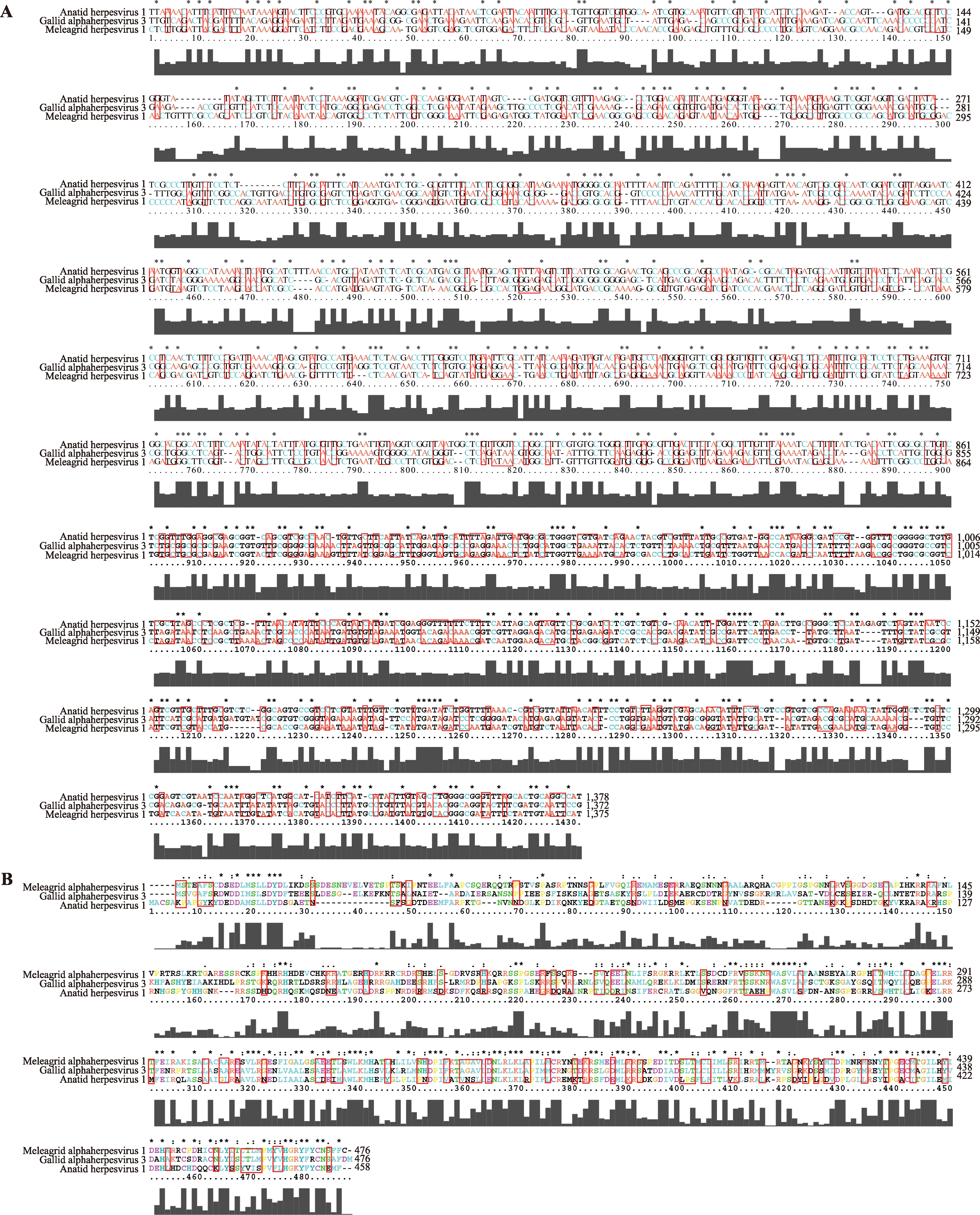
鸭瘟病毒(duck plague virus,DPV)是α-疱疹病毒的重要成员,可引发鸭瘟(duck plague,DP),严重威胁水禽业。DPV UL54基因编码蛋白具有核质穿梭特性,影响病毒复制过程,但是其在进化过程中的作用尚不明确。本研究从进化角度出发,探究DPV UL54基因编码蛋白的核质穿梭特性。首先采用分子进化学方法对DPV全基因组及UL54基因进行共进化分析;接着,构建来自不同病毒源头的UL54基因的核苷酸和氨基酸系统进化树;然后,选取与DPV距离较近的病毒毒株和DPV进行UL54基因序列比对,发现DPV UL54基因具有特异性的突变位点;最后,构建UL54基因突变重组质粒,检测这些突变位点对其编码蛋白核质穿梭特性的影响。研究结果显示,在进化过程中DPV展现出与宿主共同进化以及跨越宿主传播的双重模式,同时源自不同病毒毒株的UL54基因呈现出显著的进化差异。进一步研究发现,UL54的氨基酸位点中具有与DPV进化关联的特定突变位点,即269位的赖氨酸(Lys)、348位的亮氨酸(Leu)和377位的亮氨酸(Leu),这些位点的变异对UL54基因编码蛋白的核质穿梭特性具有显著影响。本研究结果为理解DPV的进化机制和开发新的治疗策略提供了重要理论依据。
徐明飞, 杨艳红, 李倩倩, 朱红, 刘超越 . 进化视角下鸭瘟病毒UL54蛋白核质穿梭机制解析[J]. 遗传, 2026 , 48(4) : 421 -431 . DOI: 10.16288/j.yczz.25-131
Duck plague virus (DPV), a member of the alpha-herpesvirus, causes duck plague (DP), thereby posing a serious threat to the waterfowl industry. The DPV UL54-encoded protein shuttles between the nucleus and cytoplasm to modulate viral replication. However, the role of the UL54 protein in the evolutionary process remains unknown. This study is conducted from an evolutionary perspective to explore the nuclear-cytoplasmic shuttling characteristic of UL54 protein. First, we analyzed the co-evolution on DPV whole genome and its UL54 gene using molecular evolutionary methods. Next, we constructed phylogenetic trees based on UL54 nucleotide sequences and the corresponding amino-acid sequences from different alpha-herpesvirus stains. Based on these phylogenetic trees, we selected strains that are genetically close to DPV, and performed UL54 gene sequence alignment between DPV and those phylogenetically related strains. Then, we discovered there were specific mutation sites in UL54 gene of DPV. Finally, we constructed recombinant plasmids with genetic mutations to detect the influence of mutation sites on the nuclear-cytoplasmic shuttling property of the UL54-encoded proteins. The results showed that DPV exhibited dual modes comprising co-evolution with its natural hosts and cross-species transmission, meanwhile UL54 genes from different viral strains exhibited marked evolutionary divergence. Further investigation revealed there were three specific mutation sites (Lys269, Leu348 and Leu377) in UL54 amino acid sites, which were correlated with evolution of DPV. Mutation at these sites significantly impacted the nuclear-cytoplasmic shuttling property of the UL54-encoded protein. Our study provides a rationale for understanding the evolutionary mechanism of DPV and exploring new therapeutic strategy.
| [1] | Kong J, Feng KY, Zhao QQ, Chen YZ, Wang JF, Chen S, Shao GM, Liao LQ, Li YJ, Xie Z, Zhang XH, Xie QM. Pathogenicity and transmissibility studies on live attenuated duck enteritis virus vaccine in non-target species. Front Microbiol, 2022, 13: 979368. |
| [2] | Dhama K, Kumar N, Saminathan M, Tiwari R, Karthik K, Kumar MA, Palanivelu M, Shabbir MZ, Malik YS, Singh RK. Duck virus enteritis (duck plague)—a comprehensive update. Vet Q, 2017, 37(1): 57-80. |
| [3] | Tian B, Cai DJ, He TQ, Deng LY, Wu LP, Wang MS, Jia RY, Zhu DK, Liu MF, Yang Q, Wu Y, Zhao XX, Chen S, Zhang SQ, Huang J, Ou XM, Mao S, Yu YL, Zhang L, Liu YY, Cheng AC. Isolation and selection of duck primary cells as pathogenic and innate immunologic cell models for duck plague virus. Front Immunol, 2019, 10: 3131. |
| [4] | Lauring AS. Within-host viral diversity: a window into viral evolution. Annu Rev Virol, 2020, 7(1): 63-81. |
| [5] | Koonin EV, Dolja VV, Krupovic M. The logic of virus evolution. Cell Host Microbe, 2022, 30(7): 917-929. |
| [6] | LaTourrette K, Garcia-Ruiz H. Determinants of virus variation, evolution, and host adaptation. Pathogens, 2022, 11(9): 1039. |
| [7] | Xing N, Höfler T, Hearn CJ, Nascimento M, Camps Paradell G, McMahon DP, Kunec D, Osterrieder N, Cheng HH, Trimpert J. Fast-forwarding evolution-accelerated adaptation in a proofreading-deficient hypermutator herpesvirus. Virus Evol, 2022, 8(2): veac099. |
| [8] | Adamson CS, Nevels MM. Bright and early: inhibiting human cytomegalovirus by targeting major immediate- early gene expression or protein function. Viruses, 2020, 12(1): 110. |
| [9] | Zarrouk K, Zhu XJ, Pham VD, Goyette N, Piret J, Shi R, Boivin G. Impact of amino acid substitutions in region II and helix K of herpes simplex Virus 1 and human cytomegalovirus DNA polymerases on resistance to foscarnet. Antimicrob Agents Chemother, 2021, 65(7): e0039021. |
| [10] | Wang XY, Hennig T, Whisnant AW, Erhard F, Prusty BK, Friedel CC, Forouzmand E, Hu W, Erber L, Chen Y, Sandri-Goldin RM, Dölken L, Shi YS. Herpes simplex virus blocks host transcription termination via the bimodal activities of ICP27. Nat Commun, 2020, 11(1): 293. |
| [11] | Tunnicliffe RB, Levy C, Ruiz Nivia HD, Sandri-Goldin RM, Golovanov AP. Structural identification of conserved RNA binding sites in herpesvirus ORF 57 homologs: implications for PAN RNA recognition. Nucleic Acids Res, 2019, 47(4): 1987-2001. |
| [12] | Tunnicliffe RB, Hu WK, Wu MY, Levy C, Mould AP, McKenzie EA, Sandri-Goldin RM, Golovanov AP. Molecular mechanism of SR protein kinase 1 inhibition by the herpesvirus protein ICP27. mBio, 2019, 10(5): e02551-19. |
| [13] | Tang S, Patel A, Krause PR. Hidden regulation of herpes simplex virus 1 pre-mRNA splicing and polyadenylation by virally encoded immediate early gene ICP27. PLoS Pathog, 2019, 15(6): e1007884. |
| [14] | Guan XM, Zhang MD, Fu M, Luo SK, Hu QX. Herpes simplex virus type 2 immediate early protein ICP27 inhibits IFN-β production in mucosal epithelial cells by antagonizing IRF3 activation. Front Immunol, 2019, 10: 290. |
| [15] | Chou SW, Ercolani RJ, Lanier ER. Novel cytomegalovirus UL54 DNA polymerase gene mutations selected in vitro that confer brincidofovir resistance. Antimicrob Agents Chemother, 2016, 60(6): 3845-3848. |
| [16] | James SH, Price NB, Hartline CB, Lanier ER, Prichard MN. Selection and recombinant phenotyping of a novel CMX001 and cidofovir resistance mutation in human cytomegalovirus. Antimicrob Agents Chemother, 2013, 57(7): 3321-3325. |
| [17] | Liu CY, Cheng AC, Wang MS, Chen S, Jia RY, Zhu DK, Liu MF, Sun KF, Yang Q, Chen XY. Duck enteritis virus UL54 is an IE protein primarily located in the nucleus. Virol J, 2015, 12: 198. |
| [18] | Liu CY, Cheng AC, Wang MS, Chen S, Jia RY, Zhu DK, Liu MF, Sun KF, Yang Q, Chen XY. Characterization of nucleocytoplasmic shuttling and intracellular localization signals in duck enteritis virus UL54. Biochimie, 2016, 127: 86-94. |
| [19] | Liu CY, Cheng AC, Wang MS, Chen S, Jia RY, Zhu DK, Liu MF, Sun KF, Yang Q, Wu Y, Zhao XX, Chen XY. Regulation of viral gene expression by duck enteritis virus UL54. Sci Rep, 2017, 7(1): 1076. |
| [20] | Conow C, Fielder D, Ovadia Y, Libeskind-Hadas R. Jane: a new tool for the cophylogeny reconstruction problem. Algorithms Mol Biol, 2010, 5(1): 16. |
| [21] | Kumar S, Stecher G, Tamura K. MEGA7: molecular evolutionary genetics analysis version 7.0 for bigger datasets. Mol Biol Evol, 2016, 33(7): 1870-1874. |
| [22] | Wu XK, Shan KJ, Zan FW, Tang XL, Qian ZH, Lu J. Optimization and deoptimization of codons in SARS-CoV-2 and related implications for vaccine development. Adv Sci (Weinh), 2023, 10(23): e2205445. |
| [23] | Yang Z. Maximum-likelihood models for combined analyses of multiple sequence data. J Mol Evol, 1996, 42(5): 587-596. |
/
| 〈 |
|
〉 |

www.chinagene.cn
备案号:京ICP备09063187号-4
总访问:,今日访问:,当前在线:
