

GPX8抑制猪骨骼肌卫星细胞成肌分化并促进慢肌纤维形成
收稿日期: 2025-06-11
修回日期: 2025-09-18
网络出版日期: 2025-10-14
基金资助
农业生物育种国家科技重大专项(2023ZD0404702);陕西省创新能力支撑计划项目(2023-CX-TD-57);国家生猪产业技术体系(CARS-35-PIG)
GPX8 inhibits myogenic differentiation and promotes slow myofiber formation of porcine skeletal muscle satellite cells
Received date: 2025-06-11
Revised date: 2025-09-18
Online published: 2025-10-14
Supported by
Biological Breeding-National Science and Technology Major Project(2023ZD0404702);Program for Shaanxi Science & Technology(2023-CX-TD-57);Earmarked Fund for(CARS-35-PIG)
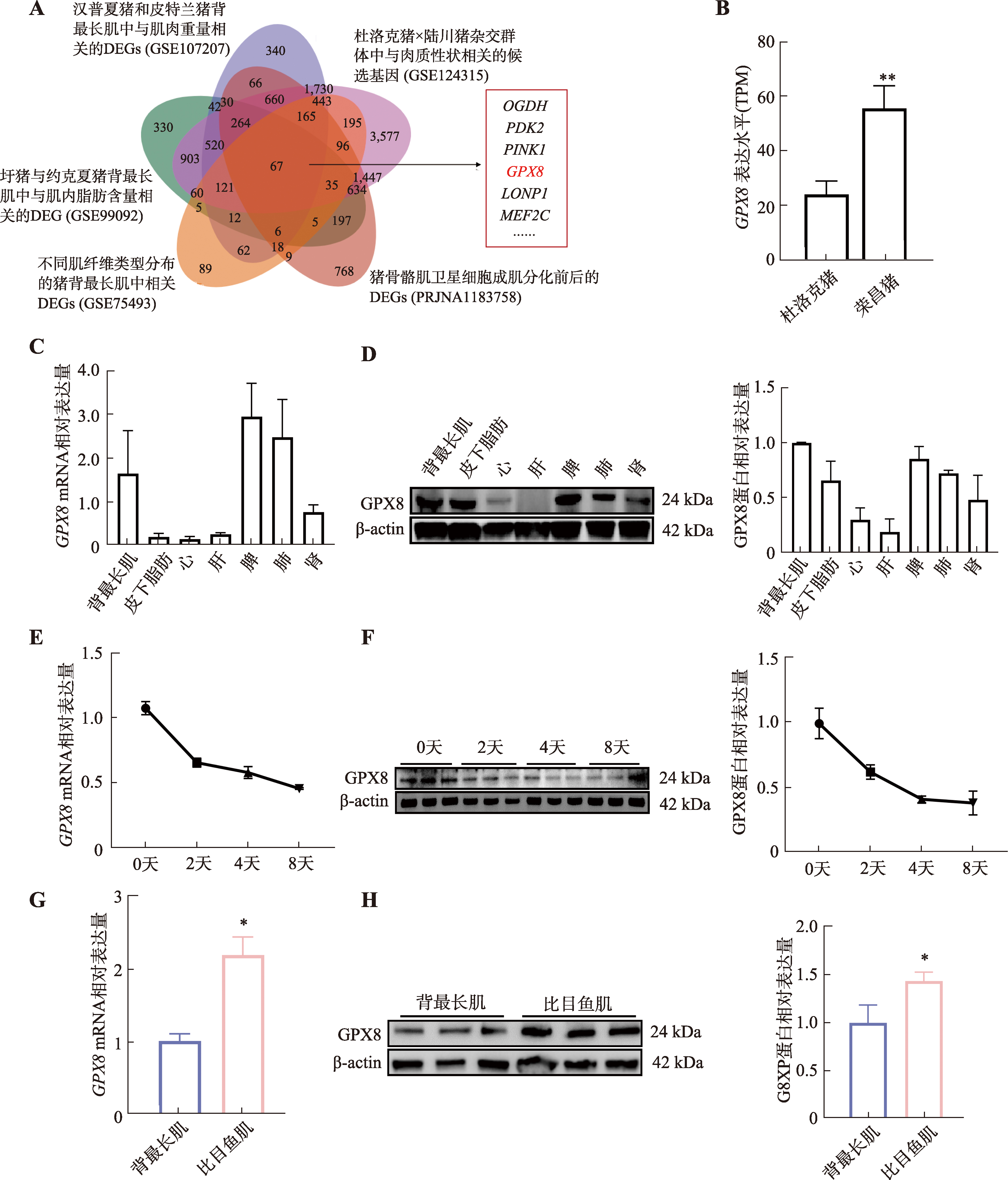
谷胱甘肽过氧化物酶8 (glutathione peroxidase 8,GPX8)是谷胱甘肽过氧化物酶家族的重要成员。全基因组关联分析(genome-wide association analysis,GWAS)表明,GPX8与猪生长发育及胴体性状高度相关。本研究以猪骨骼肌卫星细胞为研究对象,分别干扰和过表达GPX8,利用免疫荧光染色、qRT-PCR和Western blotting等方法探究GPX8对成肌分化和肌纤维类型转化的影响。结果显示,干扰GPX8显著提高成肌分化指数(P<0.01),促进分化标志基因MyHC、MyoG mRNA和蛋白的表达(P<0.05),过表达GPX8得到相反的结果。干扰GPX8显著降低MYH7 mRNA(P<0.01)和慢肌纤维蛋白(slow-twitch MyHC,slow-MyHC)的表达(P<0.05),抑制线粒体生物发生,过表达GPX8得到相反的结果。整合GWAS等多组学数据筛选出调控GPX8表达的顺式eQTLs (expression quantitative trait locus),并通过双荧光素酶报告分析检测候选SNPs对GPX8启动子活性的影响,鉴定出GPX8启动子区5个候选SNPs (rs335618489、rs325233940、rs32989756、rs322106839和rs701033890),其中rs335618489-T、rs325233940-G、rs32989756-T和rs322106839-G通过改变启动子活性显著上调GPX8表达水平(P<0.01),进而影响猪产肉性状。总之,本研究表明GPX8抑制猪骨骼肌卫星细胞成肌分化并促进快肌纤维向慢肌纤维类型转化,GPX8启动子区功能性SNPs通过调控GPX8表达影响猪肌肉发育,为进一步提高猪肉产量提供了育种靶点。
郑腾飞, 梁歆悦, 孟迎迎, 安亚龙, 王育禾, 史新娥, 李晓 . GPX8抑制猪骨骼肌卫星细胞成肌分化并促进慢肌纤维形成[J]. 遗传, 2026 , 48(1) : 102 -115 . DOI: 10.16288/j.yczz.25-173
Glutathione peroxidase 8(GPX8) is a key member of the glutathione peroxidase family. Genome-wide association studies (GWAS) have indicated that GPX8 is highly associated with growth and carcass traits of pigs. Using porcine skeletal muscle satellite cells, this study explored the effects of GPX8 on myogenic differentiation and myofiber type switching through GPX8 knockdown and overexpression, combined with analyses involving immunofluorescence staining, qRT-PCR, and Western blotting. The results demonstrated that GPX8 knockdown significantly increased the myogenic differentiation index (P<0.01) and promoted both mRNA and protein levels of the myogenic marker genes MyHC and MyoG (P<0.05). Conversely, GPX8 overexpression exhibited the opposite effects. GPX8 knockdown significantly reduced the mRNA level of MYH7 (P<0.01) and protein level of slow-twitch MyHC (slow-MyHC)(P<0.05), while suppressing mitochondrial biogenesis. In contrast, GPX8 overexpression exhibited opposing results. Integrated multi-omics data from GWAS analyses were employed to identify expression quantitative trait locus (eQTLs) regulating GPX8 expression. The effects of candidate SNPs on GPX8 promoter activity were further validated using dual-luciferase reporter assays. Five candidate SNPs (rs335618489, rs325233940, rs32989756, rs322106839, and rs701033890) were identified within the GPX8 promoter region. Among these, rs335618489-T, rs325233940-G, rs32989756-T, and rs322106839-G significantly upregulated GPX8 expression level by altering promoter activity (P<0.01), thereby influencing porcine muscle development traits. In summary, this study demonstrates that GPX8 inhibits the myogenic differentiation of porcine skeletal muscle satellite cells and promotes the transition from fast-twitch to slow-twitch myofibers. Functional SNPs in the GPX8 promoter region influence porcine muscle development by modulating GPX8 expression, thereby providing valuable breeding targets for improving pork production.
| [1] | Matarneh SK, Silva SL, Gerrard DE. New insights in muscle biology that alter meat quality. Annu Rev Anim Biosci, 2021, 9: 355-377. |
| [2] | Schiaffino S, Reggiani C. Fiber types in mammalian skeletal muscles. Physiol Rev, 2011, 91(4): 1447-1531. |
| [3] | Wigmore PM, Stickland NC. Muscle development in large and small pig fetuses. J Anat, 1983, 137(Pt 2): 235-245. |
| [4] | Schiaffino S, Dyar KA, Ciciliot S, Blaauw B, Sandri M. Mechanisms regulating skeletal muscle growth and atrophy. FEBS J, 2013, 280(17): 4294-4314. |
| [5] | Yang YL, Yan JY, Fan XH, Chen JX, Wang ZS, Liu XQ, Yi GQ, Liu YW, Niu YC, Zhang LC, Wang LX, Li SC, Li K, Tang ZL. The genome variation and developmental transcriptome maps reveal genetic differentiation of skeletal muscle in pigs. PLoS Genet, 2021, 17(11): e1009910. |
| [6] | Wang M, Yu H, Kim YS, Bidwell CA, Kuang S. Myostatin facilitates slow and inhibits fast myosin heavy chain expression during myogenic differentiation. BBRC, 2012, 426(1): 83-88. |
| [7] | Reisman EG, Caruana NJ, Bishop DJ. Exercise training and changes in skeletal muscle mitochondrial proteins: from blots to “omics”. Crit Rev Biochem Mol Biol, 2024, 59(3-4): 221-243. |
| [8] | Sousa-Victor P, García-Prat L, Muñoz-Cánoves P. Control of satellite cell function in muscle regeneration and its disruption in ageing. Nat Rev Mol Cell Biol, 2022, 23(3): 204-226. |
| [9] | Choi S, Ferrari G, Tedesco FS. Cellular dynamics of myogenic cell migration: molecular mechanisms and implications for skeletal muscle cell therapies. EMBO Mol Med, 2020, 12(12): e12357. |
| [10] | Hernández-Hernández JM, García-González EG, Brun CE, Rudnicki MA. The myogenic regulatory factors, determinants of muscle development, cell identity and regeneration. Semin Cell Dev Biol, 2017, 72: 10-18. |
| [11] | Yartseva V, Goldstein LD, Rodman J, Kates L, Chen MZ, Chen YJJ, Foreman O, Siebel CW, Modrusan Z, Peterson AS, Jovičić A. Heterogeneity of satellite cells implicates DELTA1/NOTCH2 signaling in self-renewal. Cell Rep, 2020, 30(5): 1491-1503.e6. |
| [12] | Scarpulla RC. Metabolic control of mitochondrial biogenesis through the PGC-1 family regulatory network. Biochim Biophys Acta, 2011, 1813(7): 1269-1278. |
| [13] | Zhuang ZW, Li SY, Ding RR, Yang M, Zheng EQ, Yang HQ, Gu T, Xu Z, Cai GY, Wu ZF, Yang J. Meta-analysis of genome-wide association studies for loin muscle area and loin muscle depth in two Duroc pig populations. PLoS One, 2019, 14(6): e0218263. |
| [14] | Pei J, Pan XY, Wei GH, Hua Y. Research progress of glutathione peroxidase family(GPX) in redoxidation. Front Pharmacol, 2023, 14: 1147414. |
| [15] | Kanemura S, Sofia EF, Hirai N, Okumura M, Kadokura H, Inaba K. Characterization of the endoplasmic reticulum- resident peroxidases GPx7 and GPx8 shows the higher oxidative activity of GPx7 and its linkage to oxidative protein folding. J Biol Chem, 2020, 295(36): 12772-12785. |
| [16] | Yoboue ED, Rimessi A, Anelli T, Pinton P, Sitia R. Regulation of calcium fluxes by GPX8, a Type-II transmembrane peroxidase enriched at the mitochondria- associated endoplasmic reticulum membrane. Antioxid Redox Signal, 2017, 27(9): 583-595. |
| [17] | Yin X, Zhang P, Xia N, Wu SQ, Liu BY, Weng L, Shang MY. GPx8 regulates apoptosis and autophagy in esophageal squamous cell carcinoma through the IRE1/JNK pathway. Cell Signal, 2022, 93: 110307. |
| [18] | Zhang J, Liu Y, Guo Y, Zhao Q. GPX8 promotes migration and invasion by regulating epithelial characteristics in non-small cell lung cancer. Thorac Cancer, 2020, 11(11): 3299-3308. |
| [19] | Nguyen TTM, Nguyen TH, Kim HS, Dao TTP, Moon Y, Seo M, Kang SM, Mai VH, An YJ, Jung CR, Kim JM, Park S. GPX8 regulates clear cell renal cell carcinoma tumorigenesis through promoting lipogenesis by NNMT. J Exp Clin Cancer Res, 2023, 42(1): 42. |
| [20] | Chen H, Xu L, Shan ZL, Chen S, Hu H. GPX8 is transcriptionally regulated by FOXC1 and promotes the growth of gastric cancer cells through activating the Wnt signaling pathway. Cancer Cell Int, 2020, 20(1): 596. |
| [21] | Steibel JP, Bates RO, Rosa GJM, Tempelman RJ, Rilington VD, Ragavendran A, Raney NE, Ramos AM, Cardoso FF, Edwards DB, Ernst CW. Genome-wide linkage analysis of global gene expression in loin muscle tissue identifies candidate genes in pigs. PLoS One, 2011, 6(2): e16766. |
| [22] | Wang ZZ, Ma HR, Xu L, Zhu B, Liu Y, Bordbar F, Chen Y, Zhang LP, Gao X, Gao HJ, Zhang SL, Xu LY, Li JY. Genome-wide scan identifies selection signatures in Chinese Wagyu cattle using a high-density SNP array. Animals (Basel), 2019, 9(6): 296. |
| [23] | Dou ML, Yao Y, Ma L, Wang XY, Shi XE, Yang GS, Li X. The long noncoding RNA MyHC IIA/X-AS contributes to skeletal muscle myogenesis and maintains the fast fiber phenotype. J Biol Chem, 2020, 295(15): 4937-4949. |
| [24] | Xu JG, Wang CL, Jin EH, Gu YF, Li SH, Li QG. Identification of differentially expressed genes in longissimus dorsi muscle between Wei and Yorkshire pigs using RNA sequencing. Genes Genomics, 2018, 40(4): 413-421. |
| [25] | Ropka-Molik K, Pawlina-Tyszko K, Żukowski K, Piórkowska K, Żak G, Gurgul A, Derebecka N, Wesoły J. Examining the genetic background of porcine muscle growth and development based on transcriptome and mirnaome data. Int J Mol Sci, 2018, 19(4): 1208. |
| [26] | Liu Y, Liu XL, Zheng ZW, Ma TT, Liu Y, Long H, Cheng HJ, Fang M, Gong J, Li XY, Zhao SH, Xu XW. Genome- wide analysis of expression QTL (eQTL) and allele- specific expression (ASE) in pig muscle identifies candidate genes for meat quality traits. Genet Sel Evol, 2020, 52(1): 59. |
| [27] | Ropka-Molik K, Bereta A, Żukowski K, Piórkowska K, Gurgul A, Żak G. Transcriptomic gene profiling of porcine muscle tissue depending on histological properties. Anim Sci J, 2017, 88(8): 1178-1188. |
| [28] | An YL, Zhang C, Ge ZH, Li Y, Wen CL, Ding RR, Han PY, Yue YQ, Wu JW, Jin JJ, Li X. The atlas of promoter- enhancer interactions during myogenic differentiation offers novel insights into genetic variants related to meat traits in pigs. J Integr Agric, 2025, doi: 10.1016/j.jia.2025.05.009. |
| [29] | Fu YH, Liu H, Dou JW, Wang Y, Liao Y, Huang X, Tang ZS, Xu JY, Yin D, Zhu SL, Liu YF, Shen X, Liu HY, Liu JQ, Yang X, Zhang Y, Xiang Y, Li JJ, Zheng ZQ, Zhao YX, Ma YL, Wang HY, Du XY, Xie SS, Xu XW, Zhang HH, Yin LL, Zhu MJ, Yu M, Li XY, Liu XL, Zhao SH. IAnimal: a cross-species omics knowledgebase for animals. Nucleic Acids Res, 2023, 51(D1): D1312-D1324. |
| [30] | Dong SS, He WM, Ji JJ, Zhang C, Guo Y, Yang TL. LDBlockShow: a fast and convenient tool for visualizing linkage disequilibrium and haplotype blocks based on variant call format files. Brief Bioinform, 2021, 22(4): bbaa227. |
| [31] | Pan ZY, Yao YL, Yin HW, Cai ZX, Wang Y, Bai LJ, Kern C, Halstead M, Chanthavixay G, Trakooljul N, Wimmers K, Sahana G, Su GS, Lund MS, Fredholm M, Karlskov- Mortensen P, Ernst CW, Ross P, Tuggle CK, Fang LZ, Zhou HJ. Pig genome functional annotation enhances the biological interpretation of complex traits and human disease. Nat Commun, 2021, 12(1): 5848. |
| [32] | González Morales N, Marescal O, Szikora S, Katzemich A, Correia-Mesquita T, Bíró P, Erdelyi M, Mihály J, Schöck F. The oxoglutarate dehydrogenase complex is involved in myofibril growth and Z-disc assembly in Drosophila. J Cell Sci, 2023, 136(13): jcs260717. |
| [33] | Rahimi Y, Camporez JPG, Petersen MC, Pesta D, Perry RJ, Jurczak MJ, Cline GW, Shulman GI. Genetic activation of pyruvate dehydrogenase alters oxidative substrate selection to induce skeletal muscle insulin resistance. Proc Natl Acad Sci USA, 2014, 111(46): 16508-16513. |
| [34] | Cairns G, Thumiah-Mootoo M, Abbasi MR, Gourlay M, Racine J, Larionov N, Prola A, Khacho M, Burelle Y. PINK1 deficiency alters muscle stem cell fate decision and muscle regenerative capacity. Stem Cell Reports, 2024, 19(5): 673-688. |
| [35] | Li HZ, Yang WW, Cao WY, Yu ZK, Zhang GY, Long LZ, Guo H, Qu H, Fu CG, Chen KJ. Effects and mechanism of Kedaling tablets for atherosclerosis treatment based on network pharmacology, molecular docking and experimental study. J Ethnopharmacol, 2024, 319(Pt 1): 117108. |
| [36] | Huang Y. Genome-wide association analysis and genetic parameter estimation of carcass traits in Large White pigs[Dissertation]. Guangxi University, 2020. |
| 黄叶. 大白猪胴体性状全基因组关联分析及遗传参数估计[学位论文]. 广西大学, 2020. | |
| [37] | Essén-Gustavsson B, Karlström K, Lundström K. Muscle fibre characteristics and metabolic response at slaughter in pigs of different halothane genotypes and their relation to meat quality. Meat Sci, 1992, 31(1): 1-11. |
| [38] | Park J, Moon SS, Song SM, Cheng HL, Im C, Du LX, Kim GD. Comparative review of muscle fiber characteristics between porcine skeletal muscles. J Anim Sci Technol, 2024, 66(2): 251-265. |
| [39] | Guo L, Han MM, Xu JF, Zhou WY, Shi HJ, Chen SS, Pang WJ, Zhang X, Duan YH, Yin YL, Li FN. snRNA-seq and spatial transcriptome reveal cell-cell crosstalk mediated metabolic regulation in porcine skeletal muscle. J Cachexia Sarcopenia Muscle, 2025, 16(2): e13752. |
| [40] | Lee SH, Joo ST, Ryu YC. Skeletal muscle fiber type and myofibrillar proteins in relation to meat quality. Meat Sci, 2010, 86(1): 166-170. |
| [41] | Li CC, Wang YN, Sun XH, Yang JJ, Ren YC, Jia JR, Yang GS, Liao MZ, Jin JJ, Shi XE. Identification of different myofiber types in pigs muscles and construction of regulatory networks. BMC Genomics, 2024, 25(1): 400. |
/
| 〈 |
|
〉 |

www.chinagene.cn
备案号:京ICP备09063187号-4
总访问:,今日访问:,当前在线:
