

mRNA展示技术高通量筛选环肽药物的研究进展
收稿日期: 2025-08-13
修回日期: 2025-10-20
网络出版日期: 2025-10-31
基金资助
国家自然科学基金项目(82573711);国家自然科学基金项目(22407052);江苏省自然科学基金(BK20240300);江苏省卫健委科研项目(MQ2024007);江苏省卫健委科研项目(H2023150);江苏省卫健委科研项目(K2024007);无锡市科技发展基金(K20241060);无锡市卫健委重大项目(Z202303);无锡科学技术协会(TJXD-2024-102)
Advances in high-throughput screening of cyclic peptide drugs using mRNA display technology
Received date: 2025-08-13
Revised date: 2025-10-20
Online published: 2025-10-31
Supported by
National Natural Science Foundation of China(82573711);National Natural Science Foundation of China(22407052);Natural Science Foundation of Jiangsu Province(BK20240300);Scientific Research Projects of Jiangsu Health Commission(MQ2024007);Scientific Research Projects of Jiangsu Health Commission(H2023150);Scientific Research Projects of Jiangsu Health Commission(K2024007);Wuxi Science and Technology Development Fund(K20241060);Major Project of Wuxi Municipal Health Commission(Z202303);Wuxi Association for Science and Technology(TJXD-2024-102)
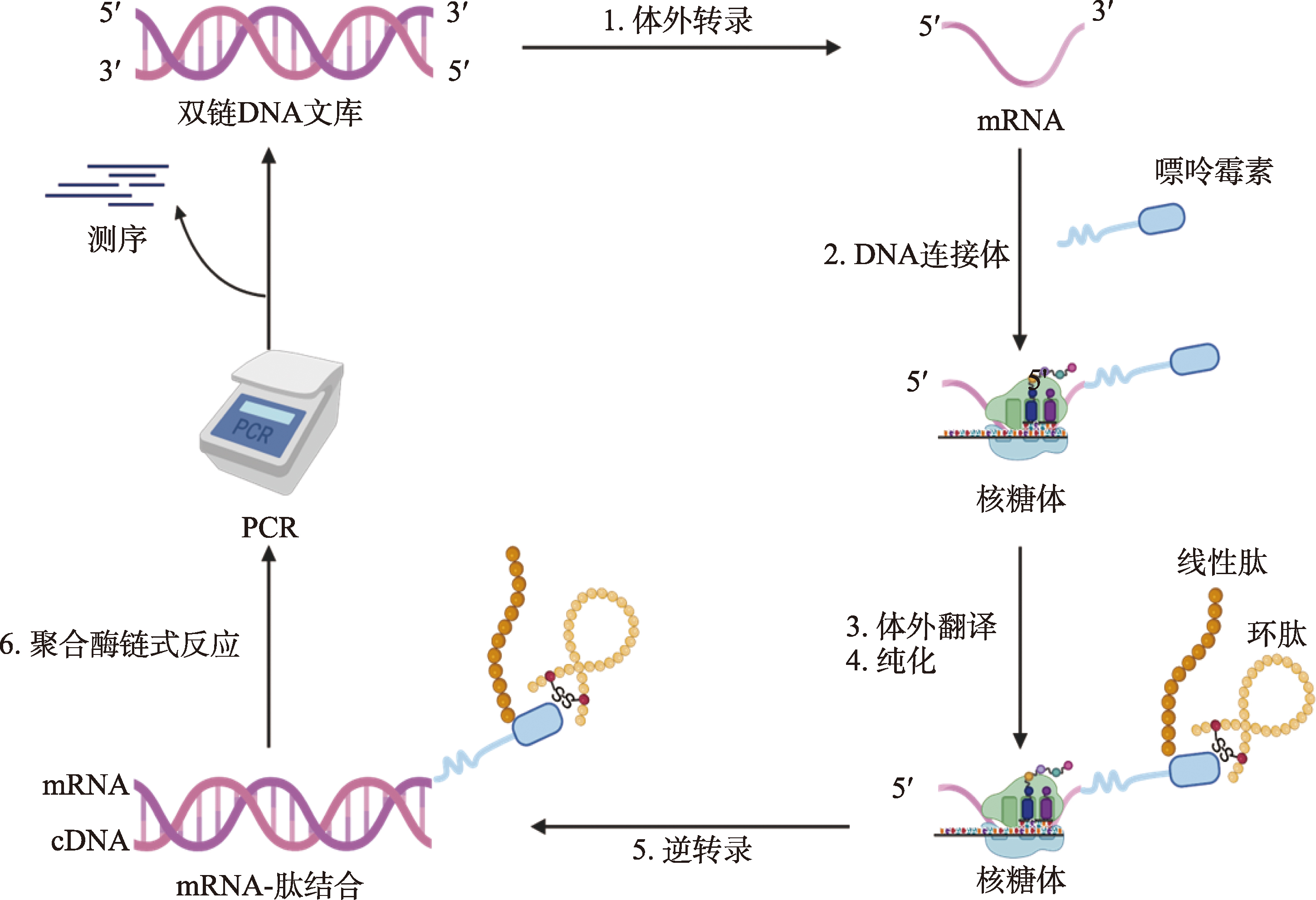
环肽作为突破传统药物开发“难以成药”靶点的重要分子形式,凭借其独特的构象约束特性,成功弥补了小分子药物与生物制剂的治疗间隙。尽管早期环肽的发现依赖于天然产物的挖掘,但是展示技术的出现将库容量提升至1015,加速了全新环肽药物的研发。mRNA展示技术作为一种基因型(mRNA)与表型(蛋白质)融合的体外多肽/蛋白质筛选技术,可在一次实验中筛选数万亿蛋白质变体以实现所需功能。近年来,随着利用mRNA展示技术筛选出的多肽药物进入临床研发阶段,从头开始的环肽药物发现领域逐渐走向成熟。本文对mRNA展示技术的原理、特点以及其在环肽药物研发过程中的应用展开综述,以期为推动基于mRNA展示技术的原创性环肽药物发现提供新的思路和策略借鉴。
王爽, 朱雪, 方晶, 薛岩, 黄志洪, 王柯 . mRNA展示技术高通量筛选环肽药物的研究进展[J]. 遗传, 2026 , 48(4) : 345 -354 . DOI: 10.16288/j.yczz.25-186
Cyclic peptides have emerged as a promising therapeutic modality for targeting classically deemed “undruggable” protein that defy conventional small-molecule intervention. Their rigid conformations improve binding affinity, selectivity and proteolytic stability, bridging the gap between low-molecular-weight drugs and large biologics. Early discovery of cyclic peptide relied on natural product isolation. However, display technologies now enable the generation and screening of libraries containing up to 1015 unique sequences. Among these, mRNA display technology offers a uniquely powerful in vitro platform that covalently links genotype (mRNA) to phenotype (encoded peptide), facilitating the ultrahigh-throughput interrogation of trillions of variants in a single selection cycle. Recent clinical translation of de novo mRNA display-derived cyclic peptides signals the approach’s maturation. In this review, we systematically evaluate mRNA display technology by outlining its methodological framework and highlighting its unique advantages for engineering macrocyclic therapeutics. We critically examine its transformative potential as well as its inherent limitations in identifying bioactive cyclic peptides, with particular attention to library diversity and the precision of on-resin screening. Through this analysis, we aim to provide insightful perspectives and strategic recommendations to guide future efforts in exploiting mRNA display for the development of innovative cyclic peptide-based drugs.
| [1] | Li X, Craven TW, Levine PM. Cyclic peptide screening methods for preclinical drug discovery. J Med Chem, 2022, 65(18): 11913-11926. |
| [2] | Valentine J, Tavassoli A. Genetically encoded cyclic peptide libraries: from hit to lead and beyond. Methods Enzymol, 2018, 610: 117-134. |
| [3] | Saw PE, Song EW. Phage display screening of therapeutic peptide for cancer targeting and therapy. Protein Cell, 2019, 10(11): 787-807. |
| [4] | Kamalinia G, Grindel BJ, Takahashi TT, Millward SW, Roberts RW. Directing evolution of novel ligands by mRNA display. Chem Soc Rev, 2021, 50(16): 9055-9103. |
| [5] | Chance R, Kang AS. Eukaryotic ribosome display for antibody discovery: a review. Hum Antibodies, 2024, 32(3): 107-120. |
| [6] | Terai T, Koike T, Nemoto N. Photocrosslinking of cDNA display molecules with their target proteins as a new strategy for peptide selection. Molecules, 2020, 25(6): 1472. |
| [7] | Li JJ, Yang YH, Li JJ, Li PX, Qi H. Cell-free display techniques for protein evolution. Adv Biochem Eng Biotechnol, 2023, 185: 59-90. |
| [8] | Dai SZA, Hu Q, Gao R, Blythe EE, Touhara KK, Peacock H, Zhang Z, Von Zastrow M, Suga H, Shokat KM. State-selective modulation of heterotrimeric Gαs signaling with macrocyclic peptides. Cell, 2022, 185(21): 3950-3965.e25. |
| [9] | Fleming MC, Chiou LF, Tumbale PP, Droby GN, Lim J, Norris-Drouin JL, Williams JG, Pearce KH, Williams RS, Vaziri C, Bowers AA. Discovery and structural basis of the selectivity of potent cyclic peptide inhibitors of MAGE-A4. J Med Chem, 2022, 65(10): 7231-7245. |
| [10] | Haberman VA, Fleming SR, Leisner TM, Puhl AC, Feng E, Xie L, Chen X, Goto Y, Suga H, Parise LV, Kireev D, Pearce KH, Bowers AA. Discovery and development of cyclic peptide inhibitors of CIB1. ACS Med Chem Lett, 2021, 12(11): 1832-1839. |
| [11] | Norman A, Franck C, Christie M, Hawkins PME, Patel K, Ashhurst AS, Aggarwal A, Low JKK, Siddiquee R, Ashley CL, Steain M, Triccas JA, Turville S, Mackay JP, Passioura T, Payne RJ. Discovery of cyclic peptide ligands to the SARS-CoV-2 spike protein using mRNA display. ACS Cent Sci, 2021, 7(6): 1001-1008. |
| [12] | Seelig B. mRNA display for the selection and evolution of enzymes from in vitro-translated protein libraries. Nat Protoc, 2011, 6(4): 540-552. |
| [13] | Fan Y, Feng RB, Zhang XY, Wang ZL, Xiong F, Zhang SH, Zhong ZF, Yu H, Zhang QW, Zhang Z, Wang YT, Li GD. Encoding and display technologies for combinatorial libraries in drug discovery: the coming of age from biology to therapy. Acta Pharm Sin B, 2024, 14(8): 3362-3384. |
| [14] | Anadolu MN, Sun JY, Li JTY, Graber TE, Ortega J, Sossin WS. Puromycin reveals a distinct conformation of neuronal ribosomes. Proc Natl Acad Sci USA, 2024, 121(7): e2306993121. |
| [15] | Iskandar SE, Chiou LF, Leisner TM, Shell DJ, Norris- Drouin JL, Vaziri C, Pearce KH, Bowers AA. Identification of covalent cyclic peptide inhibitors in mRNA display. J Am Chem Soc, 2023, 145(28): 15065-15070. |
| [16] | Ranasinghe M, Fogg JM, Catanese DJ Jr, Zechiedrich L, Demeler B. Suitability of double-stranded DNA as a molecular standard for the validation of analytical ultracentrifugation instruments. Eur Biophys J, 2023, 52(4-5): 267-280. |
| [17] | Huang PS, Boyken SE, Baker D. The coming of age of de novo protein design. Nature, 2016, 537(7620): 320-327. |
| [18] | Lang MD, Seelig B. Advances in the directed evolution of proteins. Curr Opin Chem Biol, 2014, 22: 129-136. |
| [19] | Packer MS, Liu DR. Methods for the directed evolution of proteins. Nat Rev Genet, 2015, 16(7): 379-394. |
| [20] | Mochizuki Y, Biyani M, Tsuji-Ueno S, Suzuki M, Nishigaki K, Husimi Y, Nemoto N. One-pot preparation of mRNA/cDNA display by a novel and versatile puromycin- linker DNA. ACS Comb Sci, 2011, 13(5): 478-485. |
| [21] | Shimizu Y, Ueda T. PURE technology. Methods Mol Biol, 2010, 607: 11-21. |
| [22] | Goto Y, Suga H. The RaPID platform for the discovery of pseudo-natural macrocyclic peptides. Acc Chem Res, 2021, 54(18): 3604-3617. |
| [23] | Derda R, Tang SKY, Li SC, Ng S, Matochko W, Jafari MR. Diversity of phage-displayed libraries of peptides during panning and amplification. Molecules, 2011, 16(2): 1776-1803. |
| [24] | Golynskiy MV, Haugner JC 3rd, Morelli A, Morrone D, Seelig B. In vitro evolution of enzymes. Methods Mol Biol, 2013, 978: 73-92. |
| [25] | Ebrahimizadeh W, Rajabibazl M. Bacteriophage vehicles for phage display: biology, mechanism, and application. Curr Microbiol, 2014, 69(2): 109-120. |
| [26] | Staniszewska M, Gu XL, Romano C, Kazlauskas A. A phage display-based approach to investigate abnormal neovessels of the retina. Invest Ophthalmol Vis Sci, 2012, 53(8): 4371-4379. |
| [27] | Meng FM, Zhang CH, Ai YC. Advances of development of phage display systems. Hereditas(Beijing), 2011, 33(10): 1113-1120. |
| 孟繁梅, 张朝辉, 艾云灿. 噬菌体展示技术系统发展进展. 遗传, 2011, 33(10): 1113-1120. | |
| [28] | Morelli A, Haugner J, Seelig B. Thermostable artificial enzyme isolated by in vitro selection. PLoS One, 2014, 9(11): e112028. |
| [29] | Liu ML, Morewood R, Yoshisada R, Pascha MN, Hopstaken AJP, Tarcoveanu E, Poole DA 3rd, de Haan CAM, Nitsche C, Jongkees SAK. Selective thiazoline peptide cyclisation compatible with mRNA display and efficient synthesis. Chem Sci, 2023, 14(38): 10561-10569. |
| [30] | Plückthun A. Ribosome display: a perspective. Methods Mol Biol, 2012, 805: 3-28. |
| [31] | Mcmahon C, Baier AS, Pascolutti R, Wegrecki M, Zheng SD, Ong JX, Erlandson SC, Hilger D, Rasmussen SGF, Ring AM, Manglik A, Kruse AC. Yeast surface display platform for rapid discovery of conformationally selective nanobodies. Nat Struct Mol Biol, 2018, 25(3): 289-296. |
| [32] | Smith MR, Khera E, Wen F. Engineering novel and improved biocatalysts by cell surface display. Ind Eng Chem Res, 2015, 54(16): 4021-4032. |
| [33] | Cotten SW, Zou JW, Wang R, Huang BC, Liu RH. mRNA display-based selections using synthetic peptide and natural protein libraries. Methods Mol Biol, 2012, 805: 287-297. |
| [34] | Newton MS, Cabezas-Perusse Y, Tong CL, Seelig B. In vitro selection of peptides and proteins-advantages of mRNA display. ACS Synth Biol, 2020, 9(2): 181-190. |
| [35] | Lee JH, Song HS, Park TH, Lee SG, Kim BG. Screening of cell-penetrating peptides using mRNA display. Biotechnol J, 2012, 7(3): 387-396. |
| [36] | Liu HC, Fan HX, Teng X, Sun T, Zhang SS, Wang N, Zhang X, Liu TT, Zhang YR, Wang DW. Exploring novel antioxidant cyclic peptides in corn protein hydrolysate: preparation, identification and molecular docking analysis. Food Chem, 2025, 464(Pt 2): 141747. |
| [37] | Chowdhury A, Bandyopadhyay A. Compelling cyclic peptide scaffolds for antitubercular action: an account (2011-21) of the natural source. Curr Protein Pept Sci, 2022, 23(12): 823-836. |
| [38] | You S, Mcintyre G, Passioura T. The coming of age of cyclic peptide drugs: an update on discovery technologies. Expert Opin Drug Discov, 2024, 19(8): 961-973. |
| [39] | Loktev A, Haberkorn U, Mier W. Multicyclic peptides as scaffolds for the development of tumor targeting agents. Curr Med Chem, 2017, 24(20): 2141-2155. |
| [40] | Bowler MM, Glavatskikh M, Pecot CV, Kireev D, Bowers AA. Enzymatic macrolactamization of mRNA display libraries for inhibitor selection. ACS Chem Biol, 2023, 18(1): 166-175. |
| [41] | Deweid L, Avrutina O, Kolmar H. Tailoring activity and selectivity of microbial transglutaminase. Methods Mol Biol, 2019, 2012: 151-169. |
| [42] | Tyler TJ, Durek T, Craik DJ. Native and engineered cyclic disulfide-rich peptides as drug leads. Molecules, 2023, 28(7): 3189. |
| [43] | Du HW, Hirabayashi K, Ahn S, Kren NP, Montgomery SA, Wang XH, Tiruthani K, Mirlekar B, Michaud D, Greene K, Herrera SG, Xu Y, Sun C, Chen YH, Ma XC, Ferrone CR, Pylayeva-Gupta Y, Yeh JJ, Liu RH, Savoldo B, Ferrone S, Dotti G. Antitumor responses in the absence of toxicity in solid tumors by targeting B7-H 3 via chimeric antigen receptor T cells. Cancer Cell, 2019, 35(2): 221-237.e8. |
| [44] | Seaman S, Zhu ZY, Saha S, Zhang XYM, Yang MY, Hilton MB, Morris K, Szot C, Morris H, Swing DA, Tessarollo L, Smith SW, Degrado S, Borkin D, Jain N, Scheiermann J, Feng Y, Wang YP, Li JY, Welsch D, Decrescenzo G, Chaudhary A, Zudaire E, Klarmann KD, Keller JR, Dimitrov DS, St Croix B. Eradication of tumors through simultaneous ablation of CD276/B7-H3-positive tumor cells and tumor vasculature. Cancer Cell, 2017, 31(4): 501-515.e8. |
| [45] | Lantz R, Busbee B, Wojcikiewicz EP, Du DG. Effects of disulfide bond and cholesterol derivatives on human calcitonin amyloid formation. Biopolymers, 2020, 111(5): e23343. |
| [46] | Sauter M, Uhl P, Burhenne J, Haefeli WE. Post-extraction disulfide bond cleavage for MS/MS quantification of collision-induced dissociation-resistant cystine-cyclized peptides and its application to the ultra-sensitive UPLC-MS/MS bioanalysis of octreotide in plasma. Anal Chim Acta, 2020, 1114: 42-49. |
| [47] | Zhu NY, Smallwood PM, Rattner A, Chang TH, Williams J, Wang YS, Nathans J. Utility of protein-protein binding surfaces composed of anti-parallel alpha-helices and beta-sheets selected by phage display. J Biol Chem, 2024, 300(5): 107283. |
| [48] | Kubo T, Naimuddin M. cDNA display of disulfide- containing peptide library and in vitro evolution. Methods Mol Biol, 2020, 2070: 57-77. |
| [49] | Lan T, Peng C, Yao XY, Chan RST, Wei TY, Rupanya A, Radakovic A, Wang SJ, Chen SY, Lovell S, Snyder SA, Bogyo M, Dickinson BC. Discovery of thioether-cyclized macrocyclic covalent inhibitors by mRNA display. J Am Chem Soc, 2024, 146(34): 24053-24060. |
| [50] | Chen SY, Lovell S, Lee S, Fellner M, Mace PD, Bogyo M. Identification of highly selective covalent inhibitors by phage display. Nat Biotechnol, 2021, 39(4): 490-498. |
| [51] | Huang YC, Wiedmann MM, Suga H. RNA display methods for the discovery of bioactive macrocycles. Chem Rev, 2019, 119(17): 10360-10391. |
| [52] | Peacock H, Suga H. Discovery of de novo macrocyclic peptides by messenger RNA display. Trends Pharmacol Sci, 2021, 42(5): 385-397. |
| [53] | Hacker DE, Hoinka J, Iqbal ES, Przytycka TM, Hartman MCT. Highly constrained bicyclic scaffolds for the discovery of protease-stable peptides via mRNA display. ACS Chem Biol, 2017, 12(3): 795-804. |
| [54] | Villequey C, Zurmühl SS, Cramer CN, Bhusan B, Andersen B, Ren QS, Liu HM, Qu XP, Yang Y, Pan J, Chen QJ, Münzel M. An efficient mRNA display protocol yields potent bicyclic peptide inhibitors for FGFR3c: outperforming linear and monocyclic formats in affinity and stability. Chem Sci, 2024, 15(16): 6122-6129. |
| [55] | Iskandar SE, Bowers AA. mRNA display reaches for the clinic with new PCSK9 inhibitor. ACS Med Chem Lett, 2022, 13(9): 1379-1383. |
/
| 〈 |
|
〉 |

www.chinagene.cn
备案号:京ICP备09063187号-4
总访问:,今日访问:,当前在线:
