

中国遗传资源数字序列信息专门权的体系建构
张文斐和杨菲并列第一作者。
收稿日期: 2025-11-25
修回日期: 2026-02-25
网络出版日期: 2026-03-12
基金资助
教育部人文社会科学研究青年基金项目(23YJC820055);中央高校基本科研业务费专项基金资助项目(2662025WFPY001)
System construction for sui generis right of digital sequence information on genetic resources in China
Received date: 2025-11-25
Revised date: 2026-02-25
Online published: 2026-03-12
Supported by
Research Youth Foundation of Humanities and Social Sciences of the Ministry of Education of China(23YJC820055);Fundamental Research Funds for the Central Universities(2662025WFPY001)
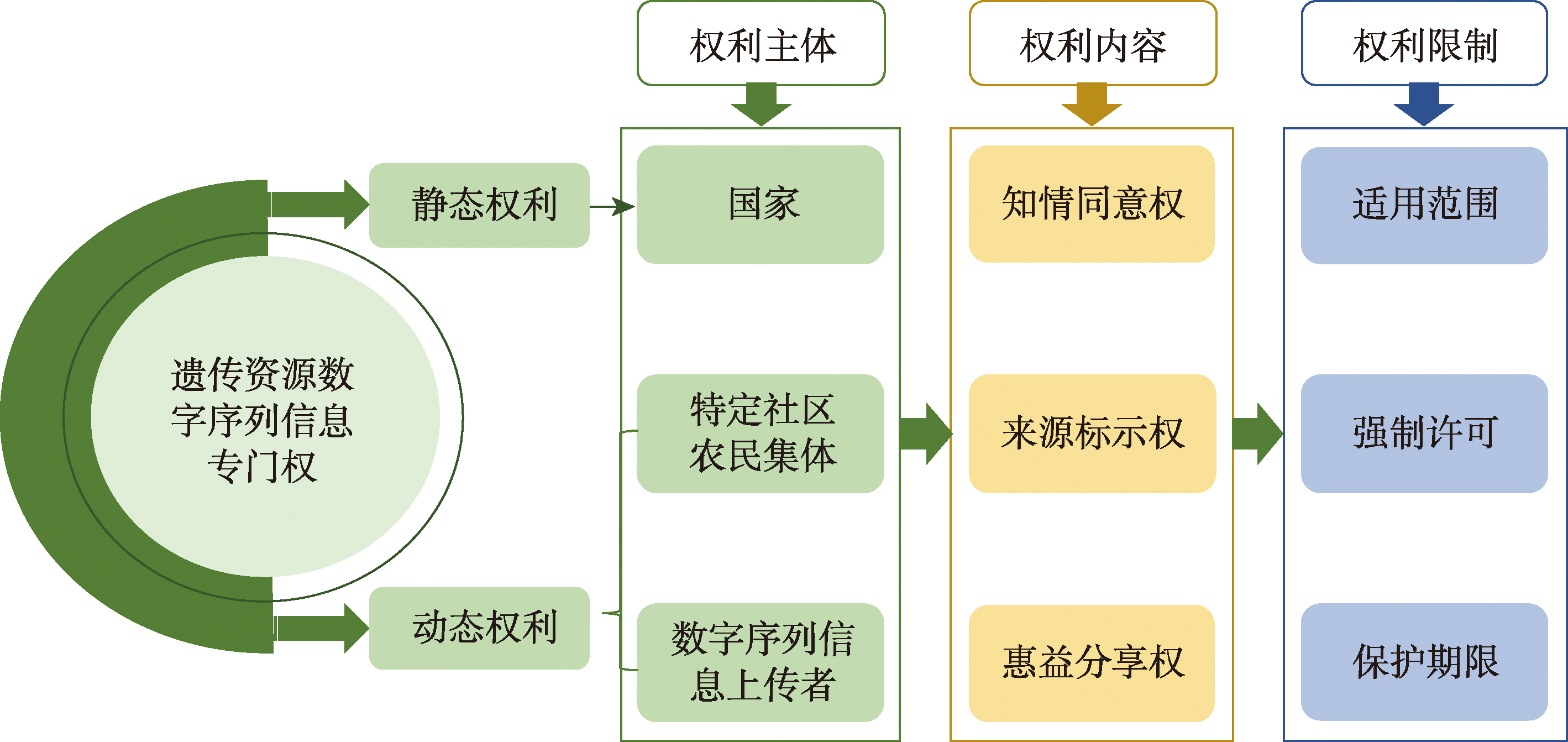
遗传资源数字序列信息在提高作物产量和减少疫病影响的研究中发挥着日益重要的作用,但其权利保护体系尚不完善,阻碍了遗传资源的保护与利用,制约了《生物多样性公约》所确立的公平公正惠益分享目标的实现。针对上述问题,本文首先通过界定遗传资源数字序列信息的内涵与属性,阐明了其与以信息为客体的现代知识产权制度具有内在的契合性,并论证了其受知识产权保护应满足新颖性、实用性的实体条件以及必要的注册登记程序条件。在此基础上,揭示了现行知识产权模式的适用困境,提出了遗传资源数字序列信息专门权的规范构造方案。方案将专门权的主体划分为两个层次:静态的权利归属于国家;动态的权利由特定社区的农民集体和数字序列信息的上传者依不同权能分别行使。权利人享有基于许可的知情同意权、来源标示权和惠益分享权,同时设置适用范围、强制许可、保护期限等权利限制制度。该方案对实现权益平衡、促进动植物育种创新及遗传多样性保护具有重要意义。
关键词: 遗传资源数字序列信息; 专门权; 知情同意; 来源标示; 惠益分享
张文斐, 杨菲, 周贤桀 . 中国遗传资源数字序列信息专门权的体系建构[J]. 遗传, 2026 , 48(6) : 557 -569 . DOI: 10.16288/j.yczz.25-305
Digital sequence information on genetic resources plays an increasingly vital role in research on improving crop yields and reducing impacts of disease. However, there are still problems such as the imperfect rights’ protection system, which hinders the protection and sustainable use of genetic resources and constrains the realization of the fair and equitable benefit-sharing objectives established by the Convention on Biological Diversity. To address these issues, we first define the connotation and legal nature of digital sequence information on genetic resources. Then, we elaborate how digital sequence information on genetic resources aligns with the modern intellectual property systems. For digital sequence information on genetic resources to be protected by intellectual property rights, we analyze the substantive conditions of novelty and practicality as well as the procedural conditions of registration. Building on this analysis, we identify the limitations of existing intellectual property frameworks in accommodating digital sequence information on genetic resources, and propose a normative structure of sui generis right of digital sequence information on genetic resources. The subjects of sui generis right are divided into two levels, i.e. static right attributed to the state, and dynamic right exercised by the farmer collective of specific communities and the uploaders of digital sequence information, exercising respectively in accordance with different functions. The contents of sui generis right include the informed consent right, the source indication right and benefit-sharing right based on licensing. Furthermore, we propose to establish the limitations on sui generis right, such as restriction on scope of application, compulsory licensing and protection periods. This framework established here is of great significance for achieving the balance of rights and interests, promoting innovation in plant breeding and protecting genetic diversity.
| [1] | Zhang WF, Jiang ZH. Trend analysis, realistic dilemmas, and realization mechanisms for biological genetic resource security under the background of breeding industrialization. Biodiversity Science, 2024, 32(11): 24274. |
| 张文斐, 江知禾. 育种产业化背景下生物遗传资源安全: 趋势研判、现实困境及实现机制. 生物多样性, 2024, 32(11): 24274. | |
| [2] | Zhu M, Tan HL, Zhao TY, Wang LX, Kuang M, Shen JZ. Harmonizing safety and development: effective conservation and sustainable utilization of China’s human genetic resources. Hereditas (Beijing), 2025, 47(6): 611-615. |
| 朱敏, 谭华璐, 赵添羽, 王林晓, 旷苗, 沈建忠. 统筹安全与发展: 中国人类遗传资源的有效保护与合理利用. 遗传, 2025, 47(6): 611-615. | |
| [3] | 陈宗波. 论生物遗传资源数字序列信息的法律性质. 江西社会科学, 2020, 40(2): 185-191. |
| [4] | Lawson C. Regulating information in molecules: the Convention on Biological Diversity and digital sequence information. Law, Technology and Humans, 2022, 4(1): 18-48. |
| [5] | 王中庆. 论遗传资源数字序列信息的数据法规制. 学术交流, 2024, (7): 43-56. |
| [6] | Liu Q. The development status and the China’s choice on the issue of digital sequence information of genetic resources. J Ecol Rural Environ, 2021, 37(9): 1109-1114. |
| 刘庆. 遗传资源数字序列信息议题的发展动态和中国选择. 生态与农村环境学报, 2021, 37(9): 1109-1114. | |
| [7] | Kharb D. The legal conundrum over regulation of access and benefit sharing obligations in digital sequence information over genetic resources-assessing Indian position. Journal of World Intellectual Property, 2021, 24 (1-2): 152-166. |
| [8] | Park N. How to approach the issue of digital sequence information: focusing on the AHTEG. Asian Business Lawyer, 2018, 21: 15-32. |
| [9] | Xiao DM. Can “Data” be integrated into the category of objects of intellectual property rights? Journal of Political Science and Law, 2024, (1): 137-148. |
| 肖冬梅. “数据”可否纳入知识产权客体范畴? 政法论丛, 2024, (1): 137-148. | |
| [10] | Jin S. On the work’s duplicability: with comments on the relationships between articles concerning work’s definition and types. Intellectual Property, 2019, (1): 59-68. |
| 金松. 论作品的“可复制性”要件——兼论作品概念条款与作品类型条款的关系. 知识产权, 2019, (1): 59-68. | |
| [11] | 黄文森. 可供性、扩散、秩序: 数字新闻流通的网络. 新闻与写作, 2022, (3): 24-34. |
| [12] | Carrizosa S, Brush SB, Wright BD, McGuire PE. 生物多样性获取与惠益分享:履行《生物多样性公约》的经验. 北京: 中国环境出版社, 2006. |
| [13] | Bagley MA. “Just” sharing: the virtues of digital sequence information benefit-sharing for the common good. Harvard International Law Journal, 2022, 63(1): 1-62. |
| [14] | 史学瀛. 生物多样性法律问题研究. 北京: 人民出版社, 2007. |
| [15] | 徐家力, 赵威. 生物遗传资源与知识产权的属性冲突与契合. 社会科学辑刊, 2020, (5): 98-105. |
| [16] | Liu XX, Zhang YT. On the special protection of agricultural genetic resources. Intellectual Property, 2016, (8): 88-98. |
| 刘旭霞, 张亚同. 论农业遗传资源权的保护. 知识产权, 2016, (8): 88-98. | |
| [17] | Fidler DP. Influenza virus samples, international law, and global health diplomacy. Emerg Infect Dis, 2008, 14(1): 88-94. |
| [18] | Li LL, Li CJ. Identification and balance of conflicts in agricultural intellectual property interest. Science and Technology Management Research, 2021, 41(4): 149-157. |
| 李玲玲, 李长健. 农业知识产权制度中利益冲突的识别与衡平. 科技管理研究, 2021, 41(4): 149-157. | |
| [19] | 董玉荣. 利益视域下遗传资源权利保护的路径研究. 知识产权, 2018, (4): 78-82, 96. |
| [20] | 朱阁, 崔国斌, 王迁, 张湖月, 张凌寒. 人工智能生成的内容(AIGC)受著作权法保护吗. 中国法律评论, 2024, 57(3): 1-28. |
| [21] | Andersen R, Winge T. The access and benefit-sharing agreement on teff genetic resources: facts and lessons. Fridtjof Nansen Institute, 2012, 159. |
| [22] | Xiong WC. Data property rights are copyrights. China Law Review, 2024, 57(3): 130-143. |
| 熊文聪. 论数据产权即著作权. 中国法律评论, 2024, 57(3): 130-143. | |
| [23] | Lei L. The criteria for justifying emerging (new) rights. Legal Forum, 2019, 34(3): 20-29. |
| 雷磊. 新兴(新型)权利的证成标准. 法学论坛, 2019, 34(3): 20-29. | |
| [24] | Peng CX, Xu SM. The expression and normative value of “new rights” in the Civil Code. Seeking Truth, 2022, 49(3): 102-113. |
| 彭诚信, 许素敏. “新型权利”在《民法典》中的表现形式及规范价值. 求是学刊, 2022, 49(3): 102-113. | |
| [25] | Mei XY. The system value and contemporary reflection of the object of civil rights. The Jurist, 2016, (6): 29-44+176. |
| 梅夏英. 民法权利客体制度的体系价值及当代反思. 法学家, 2016, (6): 29-44+176. | |
| [26] | 赵富伟. 生物遗传资源获取与惠益分享协议研究. 北京: 科学出版社, 2021. |
| [27] | 薛达元. 中国生物遗传资源现状与保护. 北京: 中国环境科学出版社, 2005. |
| [28] | Shen WX. On the data originator’s right. Journal of Comparative Law, 2024, (4): 104-117. |
| 申卫星. 论数据来源者权. 比较法研究, 2024, (4): 104-117. | |
| [29] | Huang H. Interpretation and transformation: an exposition of de-intelligence of intellectual property rights. Intellectual Property, 2007, 17(1): 11-18. |
| 黄汇. 解释与转型: 知识产权去“智力化”的阐明. 知识产权, 2007, 17(1): 11-18. | |
| [30] | Zhang SS, Chen X, Chen TT, Zhu JW, Tang BX, Wang AK, Dong LL, Zhang ZW, Sun YL, Yu CX, Zhai S, Sun YB, Chen HX, Du ZL, Xiao JF, Zhang Z, Bao YM, Wang YQ, Zhao WM. GSA-Human: genome sequence archive for human. Hereditas (Beijing), 2021, 43(10): 988-993. |
| 张思思, 陈旭, 陈婷婷, 朱军伟, 唐碧霞, 王安可, 董丽莉, 张哲文, 孙艳玲, 俞彩霞, 翟爽, 孙玉彬, 陈焕新, 杜政霖, 肖景发, 章张, 鲍一明, 王彦青, 赵文明. GSA- Human: 人类遗传资源数据管理的公共系统. 遗传, 2021, 43(10): 988-993. | |
| [31] | Greiber T, Moreno SP, Åhrén M. 遗传资源获取与惠益分享的《名古屋议定书》诠释. 北京: 中国环境出版社, 2013. |
| [32] | Kahl L, Molloy J, Patron N, Matthewman C, Haseloff J, Grewal D, Johnson R, Endy D. Opening options for material transfer. Nat Biotechnol, 2018, 36(10): 923-927. |
| [33] | Raposo DS, Cepeda ML, Ebert B, Scholz AH. Challenges and opportunities of geographical origin information in DSI benefit-sharing>: a global analysis from the academic sector. ( 2024-10-15)[2025-12-20]. https://dsiscientificnetwork.org/wp-content/uploads/2024/10/Policy-Brief-%E2%80%93-Geographical-Origin-Information-for-DSI-Benefit-Sharing-2023.pdf. |
| [34] | Decision adopted by the Conference of the Parties to the Convention on Biological Diversity on 1 November 2024.(2024-11-01)[2026-02-20]. https://www.cbd.int/decisions/cop?m=cop-16. |
| [35] | The CBD DSI matrix>: How do the DSI policy options measure up? ( 2022-09-01)[2026-02-20]. https://dsiscientificnetwork.org/wp-content/uploads/2024/10/DSI-Scientific-Network-The-CBD-DSI-matrix-How-do-the-DSI-policy-options-measure-up-EN-2022.pdf. |
| [36] | 张小勇. 遗传资源国际法的实施与续造. 北京: 知识产权出版社, 2022. |
| [37] | Lawson C, Humphries F, Rourke M. The future of information under the CBD, Nagoya Protocol, Plant Treaty, and PIP Framework, Journal of World Intellectual Property, 2019, 22(3-4): 103-119. |
/
| 〈 |
|
〉 |

www.chinagene.cn
备案号:京ICP备09063187号-4
总访问:,今日访问:,当前在线:
