

基于全基因组测序的线虫突变定位实验教学案例
收稿日期: 2026-03-25
修回日期: 2026-06-08
网络出版日期: 2026-06-18
基金资助
国家自然科学基金青年项目(C类)(32400501)
A teaching case on mapping nematode mutations based on whole-genome sequencing
Received date: 2026-03-25
Revised date: 2026-06-08
Online published: 2026-06-18
Supported by
National Natural Science Foundation of China, Youth Science Fund (Category C)(32400501)
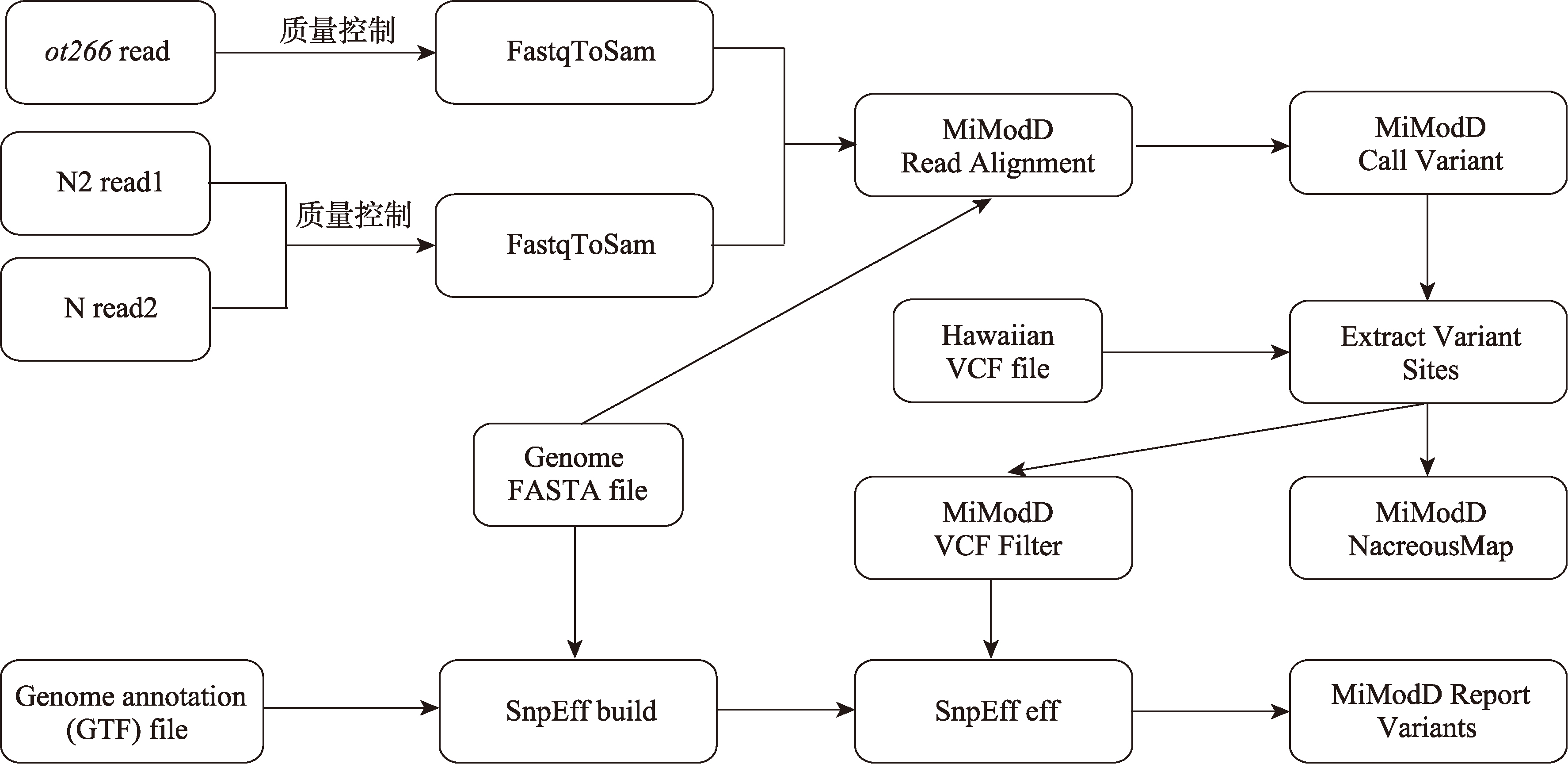
随着高通量测序技术的发展,基于全基因组测序的突变定位方法(mapping-by-sequencing)已成为现代遗传学研究的重要手段。然而,在本科生命科学课程中,学生较少有机会接触真实的测序数据分析流程,特别是在传统遗传学教学中,与测序数据分析相关的系统化教学资源仍较为缺乏。本文基于Galaxy平台和MiModD工具,对突变定位分析流程进行了教学化整理,构建了可应用于功能基因组学与生物信息学课程并可融入遗传学教学的案例。以秀丽线虫(Caenorhabditis elegans)突变体ot266的全基因组测序数据为案例,引导学生完成从测序数据质量控制、序列比对、变异检测到等位基因频率定位及候选突变筛选的完整分析流程。该教学设计为本科生物信息学或功能基因组学教学提供了一种可行的教学案例,并可作为遗传学教学内容的有益补充。
关键词: 测序突变定位; Galaxy生信平台; 秀丽线虫; 教学改革
李勇斌 . 基于全基因组测序的线虫突变定位实验教学案例[J]. 遗传, 2026 , 48(8) : 842 -852 . DOI: 10.16288/j.yczz.26-078
With advances in high-throughput sequencing technologies, whole-genome sequencing-based mutation mapping (mapping-by-sequencing) has become an important approach in modern genetic studies. However, in undergraduate life science courses, students have relatively few opportunities to engage with authentic sequencing data analysis workflows, and systematic teaching resources related to sequencing data analysis remain limited, particularly in conventional genetics teaching. Based on the Galaxy platform and the MiModD tool, this study reorganized the mutation mapping analysis workflow for instructional purposes and developed a case that can be applied in functional genomics and bioinformatics courses and integrated into genetics teaching. Using the published whole-genome sequencing data from the Caenorhabditis elegans mutant ot266 as a case, students are guided through the complete analytical workflow, including sequencing data quality control, read alignment, variant calling, allele frequency-based mapping, and candidate mutation identification. This teaching design provides a feasible teaching case for undergraduate bioinformatics or functional genomics education and can serve as a useful supplement to genetics teaching.
| [1] | Goodwin S, McPherson JD, McCombie WR. Coming of age: ten years of next-generation sequencing technologies. Nat Rev Genet, 2016, 17(6): 333-351. |
| [2] | Wang Z, Ke JY, Guo ZY, Wang Y, Lei KX, Wang SM, Chen GH, Shen ZJ, Li W, Ou GS. Transposase-assisted tagmentation: an economical and scalable strategy for single-worm whole-genome sequencing. G3 (Bethesda), 2024, 14(7): jkae094. |
| [3] | Schneeberger K. Using next-generation sequencing to isolate mutant genes from forward genetic screens. Nat Rev Genet, 2014, 15(10): 662-676. |
| [4] | Sun HQ, Schneeberger K. SHOREmap v3.0: fast and accurate identification of causal mutations from forward genetic screens. Methods Mol Biol, 2015, 1284: 381-395. |
| [5] | Zuryn S, Le Gras S, Jamet K, Jarriault S. A strategy for direct mapping and identification of mutations by whole- genome sequencing. Genetics, 2010, 186(1): 427-430. |
| [6] | Minevich G, Park DS, Blankenberg D, Poole RJ, Hobert O. CloudMap: a cloud-based pipeline for analysis of mutant genome sequences. Genetics, 2012, 192(4): 1249-1269. |
| [7] | Doitsidou M, Poole RJ, Sarin S, Bigelow H, Hobert O. C. elegans mutant identification with a one-step whole- genome-sequencing and SNP mapping strategy. PLoS One, 2010, 5(11): e15435. |
| [8] | An SN, Yang HC, Jiang S, Li JX, Zhang GF. Design and exploration of integrating bioinformatic analysis into comprehensive and exploratory epigenetic experiments. Hereditas (Beijing), 2025, 47(5): 600-608. |
| 安赛男, 杨欢淳, 姜姗, 李靖轩, 张根发. 融入生物信息学分析的综合性探究型表观遗传学实验设计与探索. 遗传, 2025, 47(5): 600-608. | |
| [9] | Yang ML, Du Z. Reaffirming the value of model organisms in training scientific minds. Nat Cell Biol, 2025, 27(10): 1589-1591. |
| [10] | Ou GS. Artificial evolution summer school and winter camp: an organized early talent development model for innovation. Chin Sci Bull, 2024, 69(30): 4327-4330. |
| 欧光朔. 人工进化暑期学校和冬令营:有组织的创新人才早期培养模式. 科学通报, 2024, 69(30): 4327-4330. | |
| [11] | Ou GS, Wang JB, Chen D, Yi PS. Artificial evolution summer school: train the next generation innovators with unresolved scientific questions. Chem Life, 2022, 42(9): 1766-1770. |
| 欧光朔, 王建斌, 陈迪, 易培珊. 人工进化暑期学校:科教融合型创新人才培养模式的探索. 生命的化学, 2022, 42(9): 1766-1770. | |
| [12] | Teng LJ, Wang JL, Wang H, Xiong YR, Yang YJ, Zhang JY. Teaching design of a multi-dimensional aging experiment using the Caenorhabditis elegans model. Hereditas (Beijing), 2026, 48(4): 432-439. |
| 腾丽娟, 王嘉乐, 王会, 熊悦然, 杨亚军, 张景彦. 基于秀丽线虫构建多维度衰老实验的教学设计. 遗传, 2026, 48(4): 432-439. | |
| [13] | Maier W. MiModD-mutation identification in model organism genomes. Zenodo, 2018, doi: 10.5281/zenodo.2582000. |
| [14] | Hiltemann S, Rasche H, Gladman S, Hotz HR, Larivière D, Blankenberg D, Jagtap PD, Wollmann T, Bretaudeau A, Goué N, Griffin TJ, Royaux C, Le Bras Y, Mehta S, Syme A, Coppens F, Droesbeke B, Soranzo N, Bacon W, Psomopoulos F, Gallardo-Alba C, Davis J, Föll MC, Fahrner M, Doyle MA, Serrano-Solano B, Fouilloux AC, Van Heusden P, Maier W, Clements D, Heyl F, Galaxy Training Network, Grüning B, Batut B. Galaxy training: a powerful framework for teaching! PLoS Comput Biol, 2023, 19(1): e1010752. |
| [15] | Batut B, Hiltemann S, Bagnacani A, Baker D, Bhardwaj V, Blank C, Bretaudeau A, Brillet-Guéguen L, Čech M, Chilton J, Clements D, Doppelt-Azeroual O, Erxleben A, Freeberg MA, Gladman S, Hoogstrate Y, Hotz HR, Houwaart T, Jagtap P, Larivière D, Le Corguillé G, Manke T, Mareuil F, Ramírez F, Ryan D, Sigloch FC, Soranzo N, Wolff J, Videm P, Wolfien M, Wubuli A, Yusuf D, Galaxy Training Network, Taylor J, Backofen R, Nekrutenko A, Grüning B. Community-driven data analysis training for biology. Cell Syst, 2018, 6(6): 752-758.e1. |
| [16] | Li YB. Mapping-by-sequencing with MiModD: a teaching dataset based on C. elegans N2 WS235. Zenodo, 2026, doi: 10.5281/zenodo.20564483. |
/
| 〈 |
|
〉 |

www.chinagene.cn
备案号:京ICP备09063187号-4
总访问:,今日访问:,当前在线:
