Hereditas(Beijing) ›› 2025, Vol. 47 ›› Issue (10): 1156-1168.doi: 10.16288/j.yczz.25-009
• Research Article • Previous Articles Next Articles
Geographical inference of dust from typical Chinese cities based on metagenomic shotgun sequencing
Qi Yang1,2( ), Kelai Kang2, Bo Zhao3,4, Kai Feng3,4, Yaosen Feng2, Jian Ye1,2(), Ye Deng3,4(), Le Wang2()
- 1. People’s Public Security University of China, Beijing 100038, China
2. Key Laboratory of Forensic Genetics, Institute of Forensic Science, Ministry of Public Security, Beijing 100038, China
3. Key Laboratory of Environmental Biotechnology of CAS, Research Center for Eco-Environmental Sciences, Chinese Academy of Sciences, Beijing 100085, China
4. College of Resources and Environment, University of Chinese Academy of Sciences, Beijing 100049, China
-
Received:2025-02-12Revised:2025-03-20Online:2025-10-20Published:2025-03-21 -
Contact:Jian Ye, Ye Deng, Le Wang E-mail:458425932@qq.com;yejian77@126.com;yedeng@rcees.ac.cn;wangle_02@163.com -
Supported by:Institute of Forensic Science, Ministry of Public Security of China(2022JB022);Ministry of Public Security of China(2023JC14)

Cite this article
Qi Yang, Kelai Kang, Bo Zhao, Kai Feng, Yaosen Feng, Jian Ye, Ye Deng, Le Wang. Geographical inference of dust from typical Chinese cities based on metagenomic shotgun sequencing[J]. Hereditas(Beijing), 2025, 47(10): 1156-1168.
share this article
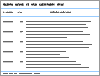
Supplementary Table 1
Latitude and longitude information of sampling sites in Beijing"
| 采样点 | 纬度 | 经度 | 采样点 | 纬度 | 经度 |
|---|---|---|---|---|---|
| BJ01-A | 40.009444 | 116.286111 | BJ15-C | 39.850833 | 116.428333 |
| BJ02-C | 39.970833 | 116.252500 | BJ17-A | 39.841389 | 116.304444 |
| BJ03-A | 39.920278 | 116.287222 | BJ17-B | 39.841111 | 116.303889 |
| BJ03-C | 39.920833 | 116.287222 | BJ18-A | 39.889722 | 116.296111 |
| BJ04-A | 39.986667 | 116.311944 | BJ18-C | 39.888889 | 116.295556 |
| BJ04-C | 39.986944 | 116.314167 | BJ19-A | 39.907222 | 116.185556 |
| BJ05-C | 39.855833 | 116.502500 | BJ20-B | 39.941944 | 116.203056 |
| BJ06-A | 39.891111 | 116.513333 | BJ20-C | 39.908889 | 116.185833 |
| BJ09-B | 39.897778 | 116.331389 | BJ21-B | 39.880000 | 116.373889 |
| BJ09-C | 39.897778 | 116.333056 | BJ21-C | 39.880833 | 116.374167 |
| BJ10-A | 39.892778 | 116.410556 | BJ22-C | 39.913889 | 116.361111 |
| BJ10-B | 39.893611 | 116.410833 | BJ23-A | 39.943611 | 116.360556 |
| BJ10-C | 39.893889 | 116.409722 | BJ23-C | 39.942778 | 116.359167 |
| BJ11-A | 39.920833 | 116.406944 | BJ24-C | 39.919444 | 116.601389 |
| BJ12-A | 39.949444 | 116.393889 | BJ25-A | 39.947500 | 116.450278 |
| BJ12-B | 39.948889 | 116.394167 | BJ25-B | 39.947778 | 116.450000 |
| BJ12-C | 39.949444 | 116.393889 | BJ25-C | 39.948333 | 116.450833 |
| BJ14-A | 39.978333 | 116.412500 | BJ27-A | 39.957778 | 116.277222 |
| BJ15-A | 39.851111 | 116.427778 | BJ27-B | 39.958333 | 116.276389 |
| BJ15-B | 39.850833 | 116.428056 | BJ28-A | 40.032222 | 116.282500 |
Supplementary Table 2
Latitude and longitude information of sampling sites in Fuzhou"
| 采样点 | 纬度 | 经度 | 采样点 | 纬度 | 经度 |
|---|---|---|---|---|---|
| FZ01-A | 25.953333 | 119.542778 | FZ11-A | 26.070556 | 119.331667 |
| FZ02-B | 25.940833 | 119.490833 | FZ11-B | 26.070556 | 119.331944 |
| FZ02-C | 25.941389 | 119.491111 | FZ11-D | 26.070278 | 119.331667 |
| FZ03-A | 25.997778 | 119.456389 | FZ12-B | 26.088333 | 119.281944 |
| FZ03-D | 25.997778 | 119.456667 | FZ12-C | 26.088611 | 119.281944 |
| FZ04-A | 26.026944 | 119.394722 | FZ12-D | 26.087500 | 119.281667 |
| FZ04-B | 26.026389 | 119.394722 | FZ13-B | 26.065000 | 119.280000 |
| FZ04-C | 26.026389 | 119.394444 | FZ13-D | 26.065000 | 119.279444 |
| FZ05-C | 25.984167 | 119.252778 | FZ15-C | 26.011389 | 119.278333 |
| FZ05-D | 25.984167 | 119.252500 | FZ16-A | 26.048333 | 119.318611 |
| FZ06-A | 25.903611 | 119.371667 | FZ16-B | 26.048333 | 119.318611 |
| FZ06-B | 25.903611 | 119.371389 | FZ16-D | 26.048333 | 119.318611 |
| FZ06-C | 25.903889 | 119.371389 | FZ17-B | 36.053056 | 119.343889 |
| FZ07-A | 25.990278 | 119.353611 | FZ17-C | 36.053056 | 119.344167 |
| FZ07-B | 25.990278 | 119.370556 | FZ19-A | 26.090000 | 119.335278 |
| FZ07-C | 25.990000 | 119.371111 | FZ19-B | 26.090556 | 119.335000 |
| FZ09-A | 26.018056 | 119.320833 | FZ20-B | 26.146944 | 119.333889 |
| FZ09-D | 26.018056 | 119.321389 | FZ20-D | 26.146667 | 119.334167 |
| FZ10-A | 26.048056 | 119.365556 | FZ21-A | 26.147778 | 119.311667 |
| FZ10-C | 26.048333 | 119.364167 | FZ22-B | 26.133611 | 119.283889 |
| FZ10-D | 26.047778 | 119.365000 | FZ23-B | 26.106389 | 119.288333 |
Supplementary Table 3
Latitude and longitude information of sampling sites in Kunming"
| 采样点 | 纬度 | 经度 | 采样点 | 纬度 | 经度 |
|---|---|---|---|---|---|
| KM02-A | 24.850556 | 102.823889 | KM16-C | 25.026111 | 102.874167 |
| KM02-B | 24.850556 | 102.823889 | KM17-A | 25.054167 | 102.796667 |
| KM02-C | 24.857778 | 102.863056 | KM17-C | 25.053333 | 102.795278 |
| KM03-A | 24.843611 | 102.845556 | KM18-A | 25.046389 | 102.741944 |
| KM03-D | 24.844167 | 102.846667 | KM18-B | 25.046111 | 102.742500 |
| KM04-A | 24.761667 | 102.803056 | KM18-C | 25.045833 | 102.741944 |
| KM05-B | 25.010833 | 102.782500 | KM19-A | 25.085556 | 102.727778 |
| KM06-B | 24.980278 | 102.822778 | KM19-B | 25.085278 | 102.727500 |
| KM08-C | 24.996667 | 102.735556 | KM20-B | 25.041667 | 102.650556 |
| KM09-A | 25.030556 | 102.752222 | KM20-C | 25.041667 | 102.650556 |
| KM09-B | 25.030278 | 102.753333 | KM20-D | 25.042500 | 102.650000 |
| KM09-C | 25.030833 | 102.751944 | KM21-A | 25.075556 | 102.697222 |
| KM09-D | 25.031111 | 102.751944 | KM21-C | 25.072500 | 102.699444 |
| KM10-A | 25.010278 | 102.624444 | KM22-B | 25.119722 | 102.745278 |
| KM11-A | 25.042778 | 102.637500 | KM22-C | 25.119167 | 102.746667 |
| KM11-C | 25.010278 | 102.624444 | KM22-D | 25.118611 | 102.745556 |
| KM12-A | 25.054722 | 102.653333 | KM23-A | 25.953889 | 102.779444 |
| KM13-A | 25.110833 | 102.719167 | KM23-C | 25.953889 | 102.779444 |
| KM13-B | 25.110833 | 102.719167 | KM24-B | 25.988333 | 102.817222 |
| KM13-C | 25.110833 | 102.719167 | KM24-C | 25.988611 | 102.817500 |
| KM14-A | 25.095278 | 102.665556 | KM25-B | 25.003056 | 102.781111 |
| KM15-B | 25.006667 | 102.822778 | KM26-B | 25.998056 | 102.782778 |
| KM15-C | 25.006389 | 102.822500 | KM27-A | 25.856111 | 102.861111 |
| KM15-D | 25.006111 | 102.823056 |
Supplementary Table 4
Latitude and longitude information of sampling sites in Urumqi"
| 采样点 | 纬度 | 经度 | 采样点 | 纬度 | 经度 |
|---|---|---|---|---|---|
| WQ01-A | 43.812222 | 87.634444 | WQ11-C | 43.842778 | 87.401389 |
| WQ01-B | 43.812222 | 87.634722 | WQ12-A | 43.869167 | 87.426111 |
| WQ02-A | 43.795278 | 87.610833 | WQ12-C | 43.868611 | 87.426667 |
| WQ02-B | 43.795000 | 87.610833 | WQ13-B | 43.840833 | 87.497222 |
| WQ03-A | 43.813611 | 87.608333 | WQ13-C | 43.840833 | 87.496944 |
| WQ03-B | 43.813611 | 87.608889 | WQ14-C | 43.883611 | 87.651111 |
| WQ03-C | 43.813611 | 87.608889 | WQ16-A | 43.818611 | 87.620000 |
| WQ03-D | 43.813889 | 87.608611 | WQ16-C | 43.818889 | 87.619722 |
| WQ04-A | 43.744722 | 87.559722 | WQ19-C | 43.965833 | 87.660556 |
| WQ05-A | 43.764722 | 87.647778 | WQ20-B | 43.953611 | 87.690278 |
| WQ05-B | 43.764722 | 87.647778 | WQ22-A | 43.890556 | 87.492778 |
| WQ05-C | 43.765000 | 87.647500 | WQ22-C | 43.890833 | 87.493056 |
| WQ05-D | 43.765000 | 87.647500 | WQ23-A | 43.906944 | 87.575556 |
| WQ06-A | 43.815278 | 87.542500 | WQ23-B | 43.907222 | 87.575556 |
| WQ06-B | 43.815278 | 87.542778 | WQ23-C | 43.906944 | 87.575833 |
| WQ06-C | 43.815556 | 87.543056 | WQ24-A | 43.863056 | 87.598056 |
| WQ07-B | 43.798889 | 87.524722 | WQ24-B | 43.863056 | 87.597778 |
| WQ08-A | 43.792500 | 87.553056 | WQ24-C | 43.863333 | 87.598056 |
| WQ09-C | 43.790278 | 87.656944 | WQ25-A | 43.857500 | 87.540000 |
| WQ10-C | 43.830278 | 87.678056 | WQ25-C | 43.857222 | 87.539444 |
| WQ11-A | 43.843611 | 87.400556 |

Supplementary Fig. 1
Rarefaction curves"


Fig. 1
The number of common and unique taxa across taxonomic levels in dust samples from the four cities"


Fig. 2
Microbial composition at the genus level in dust from resident communities across four cities"


Fig. 3
Dust α-diversity across different cities"


Fig. 4
NMDS analysis of microbial communities in different cities"


Fig. 5
LEfSe analysis results for the four cities"


Supplementary Fig. 2
Results of LEfSe analysis"


Supplementary Fig. 3
SourceTracker estimations of microbial source contributions at the city level for 51 random dust samples across 4 cities in China (The first random sampling)"


Supplementary Fig. 4
SourceTracker estimations of microbial source contributions at the city level for 51 random dust samples across 4 cities in China (The second random sampling)"


Supplementary Fig. 5
SourceTracker estimations of microbial source contributions at the city level for 51 random dust samples across 4 cities in China (The third random sampling)"


Supplementary Fig. 6
Fast expectation-maximization microbial source tracking (FEAST) estimations of microbial source contributions at the city level for 51 random dust samples across 4 cities in China (The first random sampling)"


Supplementary Fig. 7
Fast expectation-maximization microbial source tracking (FEAST) estimations of microbial source contributions at the city level for 51 random dust samples across 4 cities in China (The second random sampling)"


Supplementary Fig. 8
Fast expectation-maximization microbial source tracking (FEAST) estimations of microbial source contributions at the city level for 51 random dust samples across 4 cities in China (The third random sampling)"

Table 1
Evaluation of five machine learning models for predicting geographical origins"
| 模型 | 加权 精确度 | 加权 召回率 | 加权 F1分数 | 平均 准确率 |
|---|---|---|---|---|
| SourceTracker | 96.06% | 88.89% | 91.94% | 88.89% |
| FEAST | 95.50% | 92.16% | 93.59% | 92.16% |
| LightGBM | 98.10% | 98.04% | 98.05% | 98.04% |
| 随机森林 | 99.39% | 99.35% | 99.35% | 99.35% |
| 支持向量机 | 76.74% | 69.28% | 66.46% | 69.28% |
| [1] | Amendt J. Insects help to solve crimes. Springer Berlin Heidelberg, 2011, 227-24. |
| [2] | Liu MY, Zhao W, Zhao Y. Diatom test: development and application status in forensic diagnosis of drowning. Forensic Science and Technology, 2019, 44(4): 343-346. |
| 刘萌妍, 赵伟, 赵怡. 硅藻检验方法及其在法医学溺死诊断中的应用现状. 刑事技术, 2019, 44(4): 343-346. | |
| [3] | Zhang ZL, Liang WB, Sun HB, Yang X, Ma LY, Zheng ZX. Forensic application of plant evidence. Journal of Forensic Medicine, 2021, 37(1): 87-90, 98. |
| 张子龙, 梁伟波, 孙红兵, 杨鑫, 马丽英, 郑志祥. 植物物证的法医学应用. 法医学杂志, 2021, 37(1): 87-90, 98. | |
| [4] | 梁蕾. 豆荚作证. 现代世界警察, 2017, 6: 80-83. |
| [5] | Yang Q, Kang KL, Mei HC, Peng JJ, Yuan JH, Feng YS, Ye J, Ji AQ, Wang L. Research progress on environmental DNA detection and geographical origin inference in forensic science. Chin J Forensic Med, 2024, 39(3): 349-356. |
| 杨琪, 康克莱, 梅宏成, 彭加金, 袁嘉辉, 冯耀森, 叶健, 季安全, 王乐. 环境DNA检验及地域来源推断研究进展. 中国法医学杂志, 2024, 39(3): 349-356. | |
| [6] | Nazzal Y, Howari FM, Yaslam A, Iqbal J, Maloukh L, Ambika LK, Al-Taani AA, Ali I, Othman EM, Jamal A, Naseem M. A methodological review of tools that assess dust microbiomes, Metatranscriptomes and the particulate chemistry of indoor dust. Atmosphere, 2022, 13(8): 1276. |
| [7] |
Park JH, Lemons AR, Roseman J, Green BJ, Cox-Ganser JM. Bacterial community assemblages in classroom floor dust of 50 public schools in a large city: characterization using 16S rRNA sequences and associations with environmental factors. Microbiome, 2021, 9(1): 15.
pmid: 33472703 |
| [8] |
Zendoia II, Barandika JF, Hurtado A, López CM, Alonso E, Beraza X, Ocabo B, García-Pérez AL. Analysis of environmental dust in goat and sheep farms to assess Coxiella burnetii infection in a Q fever endemic area: geographical distribution, relationship with human cases and genotypes. Zoonoses Public Health, 2021, 68(6): 666-676.
pmid: 34240552 |
| [9] |
Danko D, Bezdan D, Afshin EE, Ahsanuddin S, Bhattacharya C, Butler DJ, Chng KR, Donnellan D, Hecht J, Jackson K, Kuchin K, Karasikov M, Lyons A, Mak L, Meleshko D, Mustafa H, Mutai B, Neches RY, Ng A, Nikolayeva O, Nikolayeva T, Png E, Ryon KA, Sanchez JL, Shaaban H, Sierra MA, Thomas D, Young B, Abudayyeh OO, Alicea J, Bhattacharyya M, Blekhman R, Castro-Nallar E, Cañas AM, Chatziefthimiou AD, Crawford RW, De Filippis F, Deng YP, Desnues C, Dias-Neto E, Dybwad M, Elhaik E, Ercolini D, Frolova A, Gankin D, Gootenberg JS, Graf AB, Green DC, Hajirasouliha I, Hastings JJA, Hernandez M, Iraola G, Jang S, Kahles A, Kelly FJ, Knights K, Kyrpides NC, Łabaj PP, Lee PKH, Leung MHY, Ljungdahl PO, Mason-Buck G, McGrath K, Meydan C, Mongodin EF, Moraes MO, Nagarajan N, Nieto-Caballero M, Noushmehr H, Oliveira M, Ossowski S, Osuolale OO, Özcan O, Paez-Espino D, Rascovan N, Richard H, Rätsch G, Schriml LM, Semmler T, Sezerman OU, Shi L, Shi T, Siam R, Song LH, Suzuki H, Court DS, Tighe SW, Tong X, Udekwu KI, Ugalde JA, Valentine B, Vassilev DI, Vayndorf EM, Velavan TP, Wu J, Zambrano MM, Zhu JF, Zhu SB, Mason CE, International MetaSUB Consortium. A global metagenomic map of urban microbiomes and antimicrobial resistance. Cell, 2021, 184(13): 3376-3393.e17.
pmid: 34043940 |
| [10] | Xie JP, Han YB, Liu G, Bai LQ. Research advances on microbial genetics in China in 2015. Hereditas (Beijing), 2016, 38(9): 765-790. |
| 谢建平, 韩玉波, 刘钢, 白林泉. 2015年中国微生物遗传学研究领域若干重要进展. 遗传, 2016, 38(9): 765-790. | |
| [11] |
Assen AM, Groves PJ, Etherington A, Gerber PF, Sexton M, Williamson S, Walkden-Brown SW. Field application of qPCR monitoring of infectious laryngotracheitis virus in settled chicken house dust and its role in control of a major outbreak. Avian Dis, 2022, 66(3): 299-307.
pmid: 36106910 |
| [12] |
Bindari YR, Kheravii SK, Morton CL, Wu SB, Walkden- Brown SW, Gerber PF. Molecular detection of eimeria species and clostridium perfringens in poultry dust and pooled excreta of commercial broiler chicken flocks differing in productive performance. Vet parasitol, 2021, 291: 109361.
pmid: 33550163 |
| [13] | Prasetyo AP, Murray JM, Kurniawan MFAK, Sales NG, Mcdevitt AD, Mariani S. Shark-dust: application of high-throughput DNA sequencing of processing residues for trade monitoring of threatened sharks and rays. Conserv Lett, 2023, 16(5): e12971. |
| [14] |
Fantinato C, Fonneløp AE, Bleka Ø, Vigeland MD, Gill P. The invisible witness: air and dust as DNA evidence of human occupancy in indoor premises. Sci Rep, 2023, 13(1): 19059.
pmid: 37925517 |
| [15] |
Grantham NS, Reich BJ, Pacifici K, Laber EB, Menninger HL, Henley JB, Barberán A, Leff JW, Fierer N, Dunn RR. Fungi identify the geographic origin of dust samples. PLoS One, 2015, 10(4): e0122605.
pmid: 25875229 |
| [16] |
Lennartz C, Kurucar J, Coppola S, Crager J, Bobrow J, Bortolin L, Comolli J. Geographic source estimation using airborne plant environmental DNA in dust. Sci Rep, 2021, 11(1): 16238.
pmid: 34376726 |
| [17] |
Haarkötter C, Saiz M, Gálvez X, Medina-Lozano MI, Álvarez JC, Lorente JA. Usefulness of microbiome for forensic geolocation: a review. Life (Basel), 2021, 11(12): 1322.
pmid: 34947853 |
| [18] |
Lax S, Hampton-Marcell JT, Gibbons SM, Colares GB, Smith D, Eisen JA, Gilbert JA. Forensic analysis of the microbiome of phones and shoes. Microbiome, 2015, 3: 21.
pmid: 25969737 |
| [19] | Ni WY, Sun HP. Crime scene analysis from spatio- temporal state left with the transferred-and-placed victim’s corpse. Forensic Science and Technology, 2019, 44(2): 162-165. |
| 倪伟勇, 孙海平. 移尸现场被害人的时空状态在现场分析中的应用. 刑事技术, 2019, 44(2): 162-165. | |
| [20] |
Karadayı S. Assessment of the link between evidence and crime scene through soil bacterial and fungal microbiome: a mock case in forensic study. Forensic Sci Int, 2021, 329: 111060.
pmid: 34736047 |
| [21] | Yuan YC, Wei XJ, Lin CW, Chang ZZ, Hu QM. Research on drug dissemination prediction and traceability method based on spatial distribution. China Computer & Communication, 2019, (7): 7-8, 11. |
| 袁毓聪, 位星剑, 林淙蔚, 常志增, 胡祁敏. 基于空间分布的毒品传播预测及溯源方法研究. 信息与电脑, 2019, (7): 7-8, 11. | |
| [22] |
Zhang J, Liu WL, Simayijiang H, Hu P, Yan JW. Application of microbiome in forensics. Genomics Proteomics Bioinformatics, 2023, 21(1): 97-107.
pmid: 36031058 |
| [23] |
Lema NK, Gemeda MT, Woldesemayat AA. Recent advances in metagenomic approaches, applications, and challenge. Curr Microbiol, 2023, 80(11): 347.
pmid: 37733134 |
| [24] | Fatima M, Hussain S, Babar M, Aftab U, Mushtaq N, Rehman HM. Microbiome and metagenome signatures: the potential toolkit for futuristic forensic investigations. Int J Forens Sci, 2022, 7(3): 000277. |
| [25] | Wang ZQ, Zhang C, Kang KL, Gong CY, Guo LL, Ji AQ, Nie SJ, Wu J, Wang L. Research progress of microbial community changes in the estimation of postmortem interval. Chin J Forensic Med, 2021, 36(5): 528-531. |
| 王梓齐, 张驰, 康克莱, 龚辰宇, 郭立亮, 季安全, 聂胜洁, 吴坚, 王乐. 微生物群落变化在死亡时间推断中的研究进展. 中国法医学杂志, 2021, 36(5): 528-531. | |
| [26] | Yang Q, Peng JJ, Wang L, Lu Q, Mei HC, Ge WD, Zhang T, Ji AQ, Ye J, Kang KL. Optimization of dust collection and DNA extraction methods on object surfaces. Prog Biochem Biophys, 2024, 51(12): 3310-3320. |
| 杨琪, 彭加金, 王乐, 卢颀, 梅宏成, 戈文东, 张涛, 季安全, 叶健, 康克莱. 物体表面灰尘采集及DNA提取方法优化研究. 生物化学与生物物理进展, 2024, 51(12): 3310-3320. | |
| [27] | Andrews S. FastQC: a quality control tool for high throughput sequence data. 2010. https://www.bioinformatics.babraham.ac.uk/projects/fastqc/. |
| [28] |
Bolger AM, Marc L, Bjoern U. Trimmomatic: a flexible trimmer for Illumina sequence data. Bioinformatics, 2014, 30(15): 2114-2120.
pmid: 24695404 |
| [29] |
Langmead B, Salzberg SL. Fast gapped-read alignment with Bowtie 2. Nat Methods, 2012, 9(4): 357-359.
pmid: 22388286 |
| [30] |
Piro VC, Dadi TH, Seiler E, Reinert K, Renard BY. Ganon: precise metagenomics classification against large and up-to-date sets of reference sequences. Bioinformatics, 2020, 36(Suppl_1): i12-i20.
pmid: 32657362 |
| [31] |
O'leary NA, Wright MW, Brister JR, Ciufo S, Haddad D, Mcveigh R, Rajput B, Robbertse B, Smith-White B, Ako-Adjei D, Astashyn A, Badretdin A, Bao YM, Blinkova O, Brover V, Chetvernin V, Choi J, Cox E, Ermolaeva O, Farrell CM, Goldfarb T, Gupta T, Haft D, Hatcher E, Hlavina W, Joardar VS, Kodali VK, Li WJ, Maglott D, Masterson P, Mcgarvey KM, Murphy MR, O'neill K, Pujar S, Rangwala SH, Rausch D, Riddick LD, Schoch C, Shkeda A, Storz SS, Sun HZ, Thibaud-Nissen F, Tolstoy I, Tully RE, Vatsan AR, Wallin C, Webb D, Wu W, Landrum MJ, Kimchi A, Tatusova T, Dicuccio M, Kitts P, Murphy TD, Pruitt KD. Reference sequence (RefSeq) database at NCBI: current status, taxonomic expansion, and functional annotation. Nucleic Acids Res, 2015, 44(D1): D733-D745.
pmid: 26553804 |
| [32] | Mountford M. An index of similarity and its application to classification problems. Progress in Soil Zoology, 1962. |
| [33] |
Segata N, Izard J, Waldron L, Gevers D, Miropolsky L, Garrett WS, Huttenhower C. Metagenomic biomarker discovery and explanation. Genome Biol, 2011, 12(6): R60.
pmid: 21702898 |
| [34] |
Knights D, Kuczynski J, Charlson ES, Zaneveld J, Mozer MC, Collman RG, Bushman FD, Knight R, Kelley ST. Bayesian community-wide culture-independent microbial source tracking. Nat Methods, 2011, 8(9): 761-763.
pmid: 21765408 |
| [35] |
Shenhav L, Thompson M, Joseph TA, Briscoe L, Furman O, Bogumil D, Mizrahi I, Pe’er I, Halperin E. FEAST: fast expectation-maximization for microbial source tracking. Nat Methods, 2019, 16(7): 627-632.
pmid: 31182859 |
| [36] | Ke GL, Meng Q, Finley T, Wang TF, Chen W, Ma WD, Ye QW, Liu TY. Lightgbm:a highly efficient gradient boosting decision tree. 31st Conference on Neural Information Processing Systems (NIPS 2017), Long Beach, CA, 2017. |
| [37] | Breiman L. Random forests. Mach Learn, 2001, 45: 5-32. |
| [38] | Cortes C. Support-vector networks. Mach Learn, 1995, 20: 273-297. |
| [39] | 方如康. 中国的地形. 北京: 商务印书馆. 1995. |
| [40] |
Allwood JS, Fierer N, Dunn RR. The future of environmental DNA in forensic science. Appl Environ Microbiol, 2020, 86(2): e01504-e01519.
pmid: 31704676 |
| [41] |
Afshinnekoo E, Meydan C, Chowdhury S, Jaroudi D, Boyer C, Bernstein N, Maritz JM, Reeves D, Gandara J, Chhangawala S, Ahsanuddin S, Simmons A, Nessel T, Sundaresh B, Pereira E, Jorgensen E, Kolokotronis SO, Kirchberger N, Garcia I, Gandara D, Dhanraj S, Nawrin T, Saletore Y, Alexander N, Vijay P, Hénaff EM, Zumbo P, Walsh M, O’mullan GD, Tighe S, Dudley JT, Dunaif A, Ennis S, O’halloran E, Magalhaes TR, Boone B, Jones AL, Muth TR, Paolantonio KS, Alter E, Schadt EE, Garbarino J, Prill RJ, Carlton JM, Levy S, Mason CE. Geospatial Resolution of Human and Bacterial Diversity with City-Scale Metagenomics. Cell Syst, 2015, 1(1): 97-97.e3.
pmid: 27135689 |
| [42] |
Salo PM, Arbes SJ Jr, Sever M, Jaramillo R, Cohn RD, London SJ, Zeldin DC. Exposure to alternaria alternata in US homes is associated with asthma symptoms. J Allergy Clin Immunol, 2006, 118(4): 892-898.
pmid: 17030243 |
| [43] |
Fröhlich-Nowoisky J, Pickersgill DA, Després VR, Pöschl U. High diversity of fungi in air particulate matter. Proc Natl Acad Sci USA, 2009, 106(31): 12814-12819.
pmid: 19617562 |
| [44] |
Su KF, Liang ZS, Zhang SM, Liao W, Gu JW, Guo YL, Li GY, An TC. The abundance and pathogenicity of microbes in automobile air conditioning filters across the typical cities of China and Europe. J Hazard Mater, 2024, 472: 134459.
pmid: 38691999 |
| [45] | Li PF. Distribution characteristics of Bacillus-like species in China[Dissertation]. Fujian: Fujian Agricultural University, 2020. |
| 李鹏飞. 中国区域芽胞杆菌分布特征[学位论文]. 福建: 福建农业大学, 2020. | |
| [46] | Chen ZH, Yang XN, Sun NJ, Xu L, Zheng Y, Yang YM. Species diversity and vertical distribution characteristics of metarhizium in Gaoligong mountains, southwestern China. Biodiversity Sci, 2018, 26(12): 1308-1317. |
| [47] |
Walker AR, Datta S. Identification of city specific important bacterial signature for the MetaSUB CAMDA challenge microbiome data. Biology Direct, 2019, 14(1): 11.
pmid: 31340852 |
| [48] | Grantham NS, Reich BJ, Laber EB, Pacifici K, Dunn RR, Fierer N, Gebert M, Allwood JS, Faith SA. Global forensic geolocation with deep neural networks. J R Stat Soc C-Appl, 2020, 69(4): 909-929. |
| [49] |
Chase J, Fouquier J, Zare M, Sonderegger DL, Knight R, Kelley ST, Siegel J, Caporaso JG. Geography and location are the primary drivers of office microbiome composition. mSystems, 2016, 1(2): e00022-16.
pmid: 27822521 |
| [1] | Liwen Zhang, Meihua Ruan, Jialan Liu, Caihong He, Jianrong Yu. Progress on research and development in diabetes mellitus [J]. Hereditas(Beijing), 2022, 44(10): 824-839. |
| [2] | WANG Ao-Xue, CHEN Xiu-Ling. Current status and industrialization of transgenic tomatoes [J]. HEREDITAS, 2011, 33(9): 962-974. |
| Viewed | ||||||
|
Full text |
|
|||||
|
Abstract |
|
|||||

