Hereditas(Beijing) ›› 2025, Vol. 47 ›› Issue (11): 1214-1230.doi: 10.16288/j.yczz.25-021
• Review • Previous Articles Next Articles
Sequence features of forensic core short tandem repeat loci
Lei Miao1,2( ), Kelai Kang1(), Chi Zhang1, Shuang Liu1, Ruilian Jiao1, Li Yuan2(), Le Wang1()
1. Key Laboratory of Forensic Genetics of Ministry of Public Security ,Institute of Forensic Science, Ministry of Public Security Beijing 100038, China 2. Collaborative Innovation Center of Judicial Civilization ,Key Laboratory of Evidence Science, Ministry of Education, China University of Political Science and Law Beijing 100088, China
-
Received:2025-03-15Revised:2025-05-22Online:2025-05-23Published:2025-05-23 -
Contact:Li Yuan, Le Wang E-mail:947676188@qq.com;kang_kl@yeah.net;yuanliwcy@126.com;wangle_02@163.com -
Supported by:National Key R&D Program of China(2022YFC3341001);Ministry of Public Security of China(2023JC15);Institute of Forensic Science, Ministry of Public Security of China(2024JB027);Institute of Forensic Science, Ministry of Public Security of China(2024JB044);Institute of Forensic Science, Ministry of Public Security of China(2024JB046)

Cite this article
Lei Miao, Kelai Kang, Chi Zhang, Shuang Liu, Ruilian Jiao, Li Yuan, Le Wang. Sequence features of forensic core short tandem repeat loci[J]. Hereditas(Beijing), 2025, 47(11): 1214-1230.
share this article

Fig. 1
The summary process of sequence features used in this review"
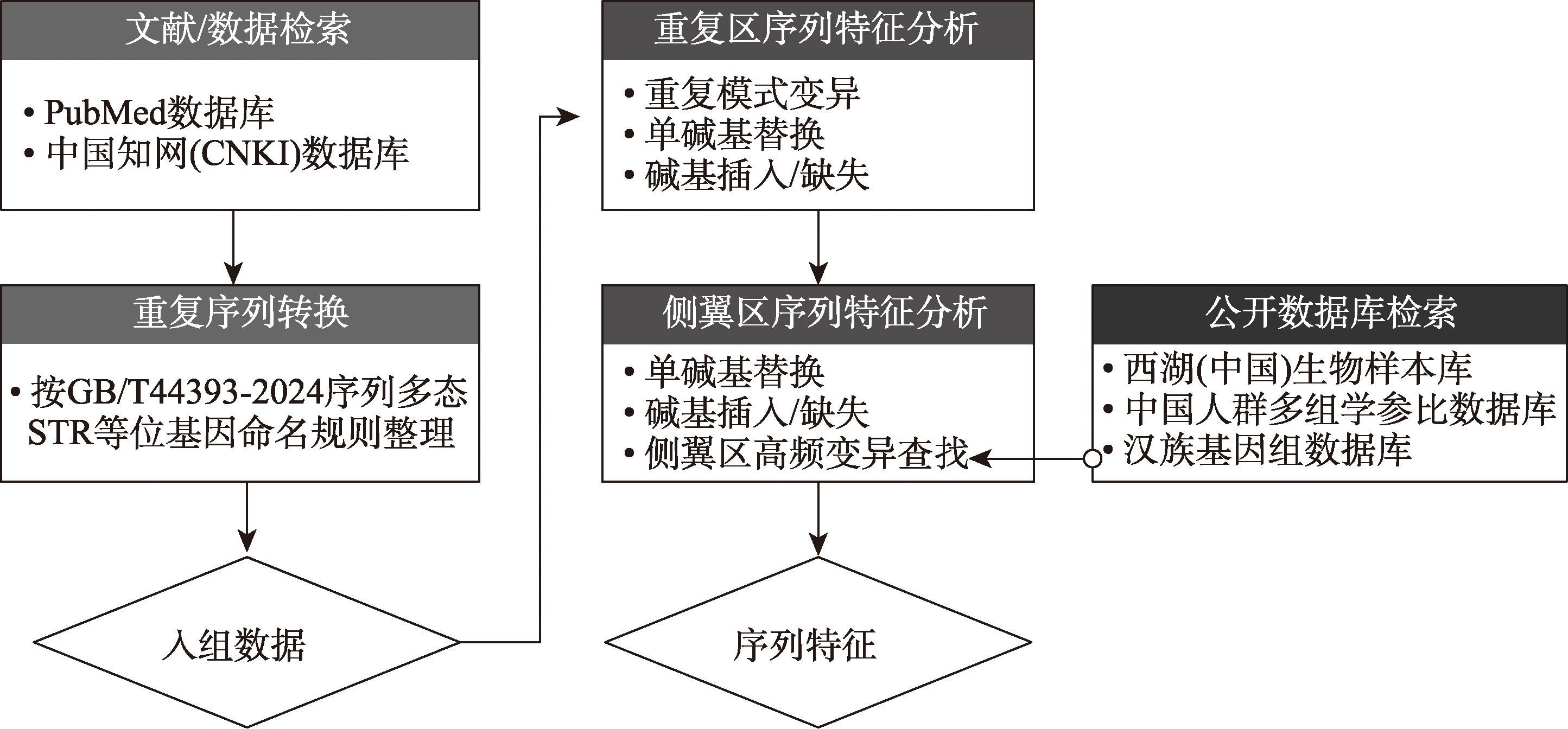
Table 1
Core STR loci used by different countries and organizations for DNA database construction and data comparison"
| 基因座 | 中国[ | ENFSI (1999)/ 国际刑警 组织[ | ENFSI (2009)[ | 德国[ | 美国(1997)[ | 美国(2017)[ |
|---|---|---|---|---|---|---|
| D1S1656 | √ | √ | ||||
| TPOX | √ | √ | √ | |||
| D2S441 | √ | √ | ||||
| D2S1338 | √ | √ | ||||
| D3S1358 | √ | √ | √ | √ | √ | √ |
| FGA | √ | √ | √ | √ | √ | √ |
| D5S818 | √ | √ | √ | |||
| CSF1PO | √ | √ | √ | |||
| D6S1043 | √ | |||||
| SE33 | √ | |||||
| D7S820 | √ | √ | √ | |||
| D8S1179 | √ | √ | √ | √ | √ | √ |
| D10S1248 | √ | √ | ||||
| TH01 | √ | √ | √ | √ | √ | √ |
| vWA | √ | √ | √ | √ | √ | √ |
| D12S391 | √ | √ | √ | |||
| D13S317 | √ | √ | √ | |||
| Penta E | √ | |||||
| D16S539 | √ | √ | √ | |||
| D18S51 | √ | √ | √ | √ | √ | √ |
| D19S433 | √ | √ | ||||
| D21S11 | √ | √ | √ | √ | √ | √ |
| Penta D | √ | |||||
| D22S1045 | √ | √ |
Table 2
Repeat structures and common repeat region sequences of 19 class A STR loci"
| 基因座 | 染色体 | GRCh38上物理位置 | 重复结构[ | 常见的重复区序列[ |
|---|---|---|---|---|
| TPOX# | 2 | 1489653~1489684 | [AATG]a | [AATG]4~14 |
| D5S818# | 5 | 123775556~123775599 | [ATCT]a | [ATCT]6~16 |
| CSF1PO# | 5 | 150076324~150076375 | [ATCT]a | [ATCT]5~16 |
| D6S1043# | 6 | 91740225~91740272 | [ATCT]a | (1)[ATCT]8~20 (2)[ATCT]3~6ATAG[ATCT]8~17 |
| D7S820# | 7 | 84160226~84160277 | [TATC]a | [TATC]6~15 |
| TH01# | 11 | 2171088~2171115 | [AATG]a | [AATG]3~12 |
| D13S317# | 13 | 82148025~82148068 | [TATC]a | [TATC]5~16 |
| Penta E# | 15 | 96831015~96831039 | [TCTTT]a | [TCTTT]5~32 |
| D16S539# | 16 | 86352702~86352745 | [GATA]a | [GATA]5~16 |
| D18S51# | 18 | 63281667~63281738 | [AGAA]a | [AGAA]8~40 |
| Penta D# | 21 | 43636205~43636269 | [AAAGA]a | [AAAGA]5~19 |
| D2S1338* | 2 | 218014859~218014950 | [GGAA]a[GGCA]b | [GGAA]5~19[GGCA]2~9 |
| D3S1358* | 3 | 45540739~45540802 | [TCTA]a[TCTG]b[TCTA]c | [TCTA][TCTG]1~4[TCTA]7~19 |
| D8S1179* | 8 | 124894865~124894916 | [TCTA]a[TCTG]b[TCTA]c | (1)[TCTA]7~16 (2)[TCTA]1~2[TCTG]1~3[TCTA]7~16 |
| vWA* | 12 | 5983977~5984044 | [TAGA]a[CAGA]bTAGA | [TAGA]7~17[CAGA]3~6TAGA |
| D12S391* | 12 | 12297020~12297095 | [AGAT]a[AGAC]b[AGAT]c | (1)[AGAT]6~18[AGAC]4~13[AGAT] (2)[AGAT]8~18[AGAC]6~13 |
| FGA† | 4 | 154587736~154587823 | [GGAA]aGGAG[AAAG]bAGAAAAAA[GAAA]c | [GGAA]2GGAG[AAAG]5~21AGAAAAAA[GAAA]3 |
| D19S433† | 19 | 29926235~29926298 | [CCTT]aCCTA[CCTT]bCTTT[CCTT]c | [CCTT]2~16CCTA[CCTT]CTTT[CCTT] |
| D21S11† | 21 | 19181973~19182099 | [TCTA]a[TCTG]b[TCTA]cTA[TCTA]dTCA[TCTA]eTCCATA[TCTA]f | [TCTA]4~13[TCTG]3~8[TCTA]2~3TA[TCTA]2~3TCA[TCTA]2TCCATA[TCTA]6~15 |
Table 3
Single nucleotide substitutions and insertions/deletions observed in the repeat region of 19 class A STR loci"
| 基因座 | 重复区单碱基替换[ | 重复区内插入/缺失[ |
|---|---|---|
| TPOX | [AATG]> TATG/AAT T | — |
| D5S818 | [ATCT]> GTCT/A GCT/AT GT/AT TT | A插入 |
| CSF1PO | [ATCT]> GTCT/ CTCT/A CCT/AT AT | A/ATC插入 |
| D6S1043 | [ATCT]>AT AT/AT GT | C/AT/ATC/ACT插入 |
| D7S820 | [TATC]> CATC/T GTC/TA CC/TAT T | T/TAC插入 |
| TH01 | [AATG]>A GTG/AA CG/AAT T/AAT A | ATG插入 |
| D13S317 | [TATC]> AATC/T GTC/TA AC/TAT T | ATC/AATCAATCATCTATCTATCTTTCTGTCTGTCTTTTTGGGCTGCCTA插入 |
| Penta E | [TCTTT]> CCTTT/T ATTT/TC CTT | TTTT/CTTT/TCTT插入 |
| D16S539 | [GATA]> TATA/ CATA/ AATA/G GTA/GA CA/GAT T | GAT插入 |
| D18S51 | [AGAA]> GGAA/A TAA/AG CA/AGA T | AG/AAAGAGAGAGGAA插入 |
| Penta D | [AAAGA]>A GAGA/AA CGA/AAA TA/AAAG G | AAAG/AAGA插入 |
| D2S1338 | [GGAA]> AGAA/G TAA/G AAA/GGA C([GGAA]a) [GGCA]>G ACA/GG AA([GGCA]b) | GAA插入([GGAA]a) |
| D3S1358 | 1. [TCTA]>TCT G([TCTA]a) 2. [TCTA]>T GTA/TCT G([TCTA]c) | A/TC插入 |
| D8S1179 | [TCTA]> CCTA/T GTA/TC CA([TCTA]c) | T插入([TCTA]c) |
| vWA | 1. [TAGA]> CAGA/T GGA/TA AA/TAG G([TAGA]a) 2. [CAGA]> TAGA/C TGA([CAGA]b) 3. TAGA> CAGA/ GAGA/TAG T(非重复序列TAGA) | T/TA/TGA插入([TAGA]a) |
| D12S391 | 1. [AGAT]>A AAT/AG GT/AGA C([AGAT]a) 2. [AGAC]> GGAC/AG GC/AGA A([AGAC]b) | T/AT/GAT插入([AGAT]a) |
| FGA | 1. GGAG>G AAG(非重复序列GGAG) 2. [AAAG]>A GAG/AA GG/AAA C([AAAG]b) 3. AGAAAAAA> GGAAAAAA(非重复序列AGAAAAAA) 4. [GAAA]> AAAA/G CAA([GAAA]c) | 1. A/AG/AAG插入([AAAG]b) 2. AA/AG插入、AG缺失(非重复序列AGAAAAAA) |
| D19S433 | 1. [CCTT]> TCTT/C TTT/C ATT/CC CT([CCTT]a) 2. CCTA>CCT G/CCT T(非重复序列CCTA) | 1. T/CTT/TTTTT插入([CCTT]a) 2. CT缺失(非重复序列CTTT) |
| D21S11 | 1. [TCTA]>T TTA/T ATA([TCTA]a) 2. [TCTG]>TC GG/TC AG([TCTG]b) 3. [TCTA]>T TTA/T GTA/TCT G([TCTA]d) 4. [TCTA]>TC GA([TCTA]e) 5. [TCTA]>T GTA([TCTA]f) | A/TA/TCA插入([TCTA]f) |
Table 4
High-frequency variations on flanking regions (within 200 bp of the repeat regions) of 19 class A STR loci among the Chinese population (f≥0.01)"
| 基因座 | 在GRCh38上的位置 | 相对重复区的 位置 | dbSNP数据库中Rs编号 | 变异类型 | 突变型在3个中国人群数据库中的频率 |
|---|---|---|---|---|---|
| TPOX | Chr.2:1489832 | +148 bp | rs13413321 | G>T | 0.5025[ |
| D5S818 | Chr.5:123775552 | -4 bp | rs73801920 | C>A | 0.048[ |
| Chr.5:123775612 | +13 bp | rs25768 | A>G | 0.943[ | |
| Chr.5:123775724 | +125 bp | rs3909331 | T>C | 0.058[ | |
| D6S1043 | Chr.6:91740418 | +146 bp | rs2325399 | G>C | 0.4256[ |
| D7S820 | Chr.7:84160110 | -116 bp | rs59186128 | C>T | 0.026[ |
| Chr.7:84160161 | -65 bp | rs7786079 | A>C | 0.0431[ | |
| Chr.7:84160204 | -22 bp | rs7789995 | T>A | 0.944[ | |
| Chr.7:84160286 | +9 bp | rs16887642 | G>A | 0.182[ | |
| TH01 | Chr.11:2171219 | +104 bp | rs369097987 | C>T | 0.017[ |
| D13S317 | Chr.13:82148069 | +1 bp | rs9546005 | A>T | 0.186[ |
| Chr.13:82148073 | +5 bp | rs202043589 | A>T | 0.036[ | |
| Chr.13:82148183 | +115 bp | rs9531308 | A>C | 0.485[ | |
| Penta E | Chr.15:96831162 | +123 bp | rs8036258 | C>T | 0.948[ |
| D16S539 | Chr.16:86352607 | -95 bp | rs1728369 | A>C | 0.244[ |
| Chr.16:86352761 | +16 bp | rs11642858 | A>C | 0.410[ | |
| D2S1338 | Chr.2:218014824 | -35 bp | rs6736691 | C>A | 0.0894[ |
| Chr.2:218015082 | +132 bp | rs72951992 | T>G | 0.4081[ | |
| vWA | Chr.12:5983882 | -95 bp | rs216870 | T>A | 0.6820[ |
| Chr.12:5983970 | -7 bp | rs75219269 | A>G | 0.2449[ | |
| Chr.12:5984116 | +72 bp | rs11063969 | A>T | 0.2638[ | |
| Chr.12:5984121 | +77 bp | rs11063970 | C>T | 0.2641[ | |
| Chr.12:5984134 | +90 bp | rs11063971 | T>C | 0.2638[ | |
| D12S391 | Chr.12:12296827 | -193 bp | rs7962284 | T>C | 0.2938[ |
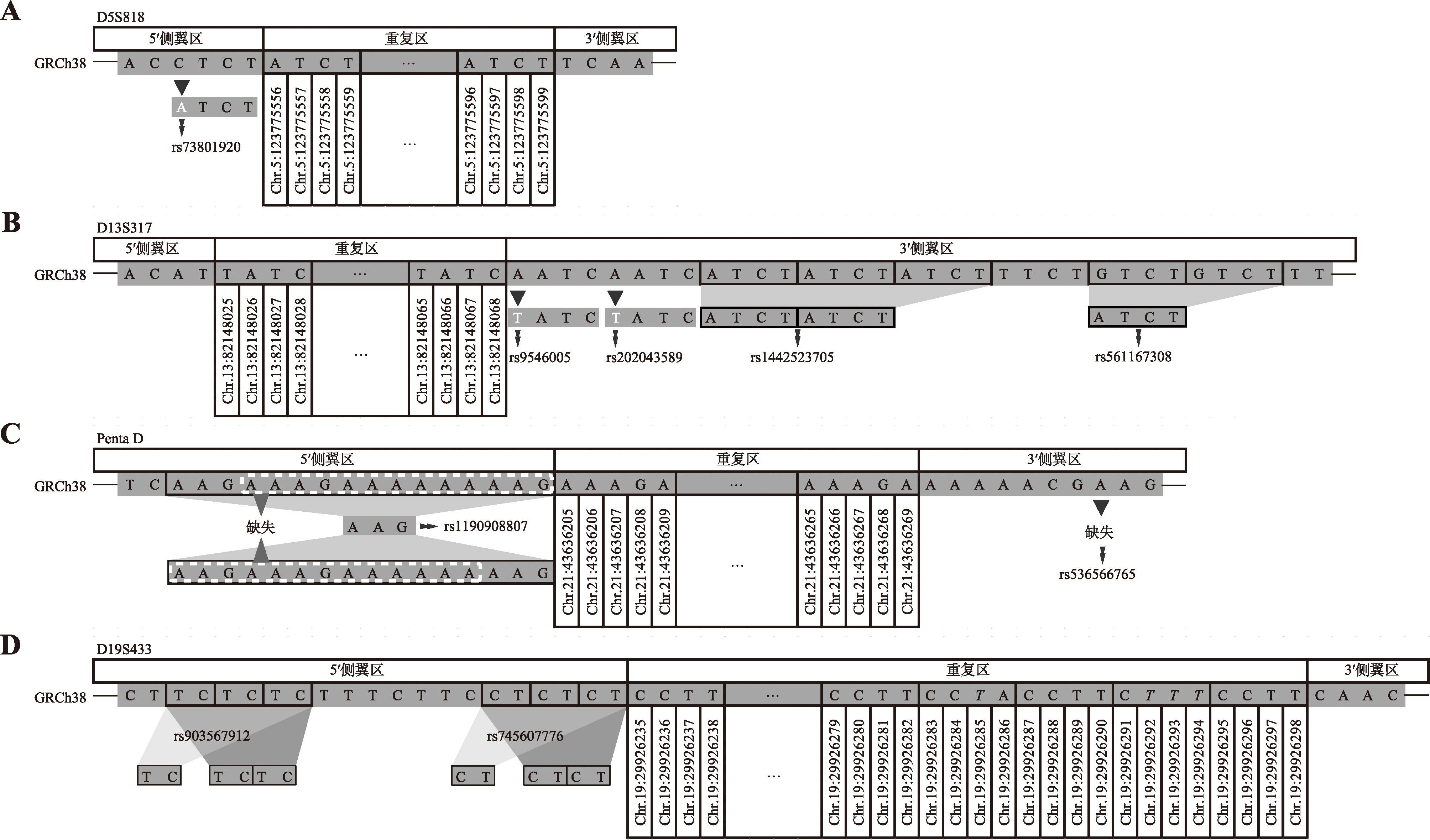
Fig. 2
Flanking region variations in four STR loci"
| [1] | Niu Y, Cheng BW, Liu F. Current legislation situation and countermeasures in DNA testing and database construction in China. Chin J Forensic Med, 2019, 34(5): 423-426. |
| 牛勇, 程宝文, 刘锋. 我国DNA检验和数据库建设立法现状与对策. 中国法医学杂志, 2019, 34(5): 423-426. | |
| [2] | National Institute of Standards and Technology. Core STR loci used in human identity testing. [2024.1.4]. https://strbase-archive.nist.gov/coreSTRs.htm. |
| [3] | 公安部物证鉴定中心, 辽宁省公安厅, 广州市刑事科学技术研究所, 河南省公安厅, 黑龙江省公安厅, 浙江省公安厅, 北京海华鑫安生物信息技术有限责任公司. 法庭科学 DNA数据库选用的基因座及其数据结构:GB/T 41009-2021. 北京: 中国标准出版社, 2021. |
| [4] | Wang L, Ji AQ, Ye J. Progress and prospects on next generation sequencing-based full resolution STR genotyping. Chin J Forensic Med, 2017, 32(2): 159-163+167. |
| 王乐, 季安全, 叶健. 基于下一代测序的全解析度STR分型研究进展与展望. 中国法医学杂志, 2017, 32(2): 159-163+167. | |
| [5] | Wang L, Ye J, Bai X, Yang F, Zhao XC. Next generation sequencing and its application in forensic genetics. Forensic Sci Technol, 2015, 40(5): 353-358. |
| 王乐, 叶健, 白雪, 杨帆, 赵兴春. 二代测序技术及其在法医遗传学中的应用. 刑事技术, 2015, 40(5): 353-358. | |
| [6] |
Wu H, Ji AC, Liu YC, Kang KL, Zhang C, Li ZW, Ji AQ, Ye J, Nie SJ, Wang L. Massively parallel sequencing of STRs using a 29-plex panel reveals stutter sequence characteristics. Electrophoresis, 2020, 41(23): 2029-2035.
pmid: 32770833 |
| [7] |
Edwards M, Allen RW. Characteristics of mutations at the D5S818 locus studied with a tightly linked marker. Transfusion, 2004, 44(1): 83-90.
pmid: 14692972 |
| [8] | Peng JJ, Guo LL, Wu H, Zhang C, Zhao J, Kang KL, Ji AQ, Wang L. Correlation study between TC ratios of STR loci and the forward/reverse sequencing depths in next generation sequencing. Life Sci Instrum, 2022, 20(5): 39-45. |
| 彭加金, 郭立亮, 吴浩, 张驰, 赵杰, 康克莱, 季安全, 王乐. STR基因座TC比例与二代测序正反向深度关联研究. 生命科学仪器, 2022, 20(5): 39-45. | |
| [9] |
Schneider PM, Martin PD. Criminal DNA databases: the European situation. Forensic Sci Int, 2001, 119(2): 232-238.
pmid: 11376989 |
| [10] |
Butler JM, Hill CR. Biology and genetics of new autosomal STR loci useful for forensic DNA analysis. Forensic Sci Rev, 2012, 24(1): 15-26.
pmid: 26231356 |
| [11] |
Butler JM. Genetics and genomics of core short tandem repeat loci used in human identity testing. J Forensic Sci, 2006, 51(2): 253-265.
pmid: 16566758 |
| [12] |
Hares DR. Expanding the CODIS core loci in the United States. Forensic Sci Int Genet, 2012, 6(1): e52-e54.
pmid: 21543275 |
| [13] |
Hares DR. Selection and implementation of expanded CODIS core loci in the United States. Forensic Sci Int Genet, 2015, 17: 33-34.
pmid: 25797140 |
| [14] |
Gettings KB, Aponte RA, Vallone PM, Butler JM. STR allele sequence variation: current knowledge and future issues. Forensic Sci Int Genet, 2015, 18: 118-130.
pmid: 26197946 |
| [15] | 公安部鉴定中心, 四川大学, 中国科学院北京基因组研究所(国家生物信息中心), 河北医科大学, 中山大学, 国家毒品实验室广东分中心, 辽宁省公安厅, 北京生物医药研究所, 北京市公安局, 中国政法大学, 北京爱普益生物科技有限公司. 序列多态STR等位基因命名规则:GB/T 44393-2024. 北京: 中国标准出版社, 2024. |
| [16] |
Fan HL, Wang LX, Liu CH, Lu XY, Xu XD, Ru K, Qiu PM, Liu C, Wen SQ. Development and validation of a novel 133-plex forensic STR panel (52 STRs and 81 Y-STRs) using single-end 400 bp massive parallel sequencing. Int J Legal Med, 2022, 136(2): 447-464.
pmid: 34741666 |
| [17] |
Gettings KB, Borsuk LA, Steffen CR, Kiesler KM, Vallone PM. Sequence-based U.S. population data for 27 autosomal STR loci. Forensic Sci Int Genet, 2018, 37: 106-115.
pmid: 30144646 |
| [18] |
Tao RY, Wang SY, Chen AQ, Xia RC, Zhang XC, Yang Q, Qu YL, Zhang SH, Li CT. Parallel sequencing of 87 STR and 294 SNP markers using the prototype of the SifaMPS panel on the MiSeq FGxTM system. Forensic Sci Int Genet, 2021, 52: 102490.
pmid: 33689955 |
| [19] |
Dash HR, Vajpayee K, Srivastava A, Das S. Prevalence and characterisation of size and sequence-based microvariant alleles at nine autosomal STR markers in the Central Indian population. Ann Hum Biol, 2021, 48(7-8): 614-620.
pmid: 34818952 |
| [20] |
Peng D, Zhang YM, Ren H, Li HX, Li R, Shen XF, Wang NN, Huang EW, Wu RG, Sun HY. Identification of sequence polymorphisms at 58 STRs and 94 iiSNPs in a Tibetan population using massively parallel sequencing. Sci Rep, 2020, 10(1): 12225-12236.
pmid: 32699278 |
| [21] |
Silva DSBS, Scheible MK, Bailey SF, Williams CL, Allwood JS, Just RS, Schuetter J, Skomrock N, Minard- Smith A, Barker-Scoggins N, Eichman C, Meiklejohn K, Faith SA. Sequence-based autosomal STR characterization in four US populations using PowerSeq™ Auto/Y system. Forensic Sci Int Genet, 2020, 48: 102311.
pmid: 32531758 |
| [22] |
Ohuchi T, Guan XT, Hirai E, Hashiyada M, Manabe S, Akane A, Adachi N, Tamaki K, Funayama M. Allele frequencies of 31 autosomal short tandem repeat (auSTR) loci obtained using the Precision ID GlobalFiler™ NGS STR Panel v2 in 322 individuals from the Japanese population. Leg Med(Tokyo), 2022, 59: 102151.
pmid: 36191412 |
| [23] |
Zhao XY, Li H, Wang Z, Ma K, Cao Y, Liu WB. Massively parallel sequencing of 10 autosomal STRs in Chinese using the ion torrent personal genome machine (PGM). Forensic Sci Int Genet, 2016, 25: 34-38.
pmid: 27497643 |
| [24] |
Kim EH, Lee HY, Kwon SY, Lee EY, Yang WI, Shin KJ. Sequence-based diversity of 23 autosomal STR loci in Koreans investigated using an in-house massively parallel sequencing panel. Forensic Sci Int Genet, 2017, 30: 134-140.
pmid: 28728056 |
| [25] |
Zhang SH, Niu Y, Bian YN, Dong RX, Liu XL, Bao Y, Jin C, Zheng HC, Li CT. Sequence investigation of 34 forensic autosomal STRs with massively parallel sequencing. Sci Rep, 2018, 8(1): 6810.
pmid: 29717145 |
| [26] |
Riman S, Ghemrawi M, Borsuk LA, Mahfouz R, Walsh S, Vallone PM. Sequence-based allelic variations and frequencies for 22 autosomal STR loci in the Lebanese population. Forensic Sci Int Genet, 2023, 65: 102872.
pmid: 37068444 |
| [27] |
Dash HR, Kaitholia K, Kumawat RK, Singh AK, Shrivastava P, Chaubey G, Das S. Sequence variations, flanking region mutations, and allele frequency at 31 autosomal STRs in the central Indian population by next generation sequencing (NGS). Sci Rep, 2021, 11(1): 23238.
pmid: 34853383 |
| [28] |
Khubrani YM, Hallast P, Jobling MA, Wetton JH. Massively parallel sequencing of autosomal STRs and identity-informative SNPs highlights consanguinity in Saudi Arabia. Forensic Sci Int Genet, 2019, 43: 102164.
pmid: 31585345 |
| [29] |
Devesse L, Davenport L, Borsuk L, Gettings K, Mason- Buck G, Vallone PM, Syndercombe Court D, Ballard D. Classification of STR allelic variation using massively parallel sequencing and assessment of flanking region power. Forensic Sci Int Genet, 2020, 48: 102356.
pmid: 32712568 |
| [30] |
Kwon YL, Kim BM, Lee EY, Shin KJ. Massively parallel sequencing of 25 autosomal STRs including SE33 in four population groups for forensic applications. Sci Rep, 2021, 11(1): 4701.
pmid: 33633141 |
| [31] |
Fan HL, Du ZM, Wang FF, Wang X, Wen SQ, Wang LX, Du PX, Liu H, Cao SP, Luo ZM, Han BB, Huang PY, Zhu BF, Qiu PM. The forensic landscape and the population genetic analyses of Hainan Li based on massively parallel sequencing DNA profiling. Int J Legal Med, 2021, 135(4): 1295-1317.
pmid: 33847803 |
| [32] |
Huszar TI, Bodmer WF, Hutnik K, Wetton JH, Jobling MA. Sequencing of autosomal, mitochondrial and Y-chromosomal forensic markers in the People of the British Isles cohort detects population structure dominated by patrilineages. Forensic Sci Int Genet, 2022, 59: 102725.
pmid: 35640311 |
| [33] |
Barber MD, McKeown BJ, Parkin BH. Structural variation in the alleles of a short tandem repeat system at the human alpha fibrinogen locus. Int J Legal Med, 1996, 108(4): 180-185.
pmid: 8652421 |
| [34] |
Szibor R, Lautsch S, Plate I, Bender K, Krause D. Population genetic data of the STR HumD3S1358 in two regions of Germany. Int J Legal Med, 1998, 111(3): 160-161.
pmid: 9587801 |
| [35] |
Wang L, Zhao XC, Ye J, Liu JJ, Chen T, Bai X, Zhang J, Ou Y, Hu L, Jiang BW, Wang F. Construction of a library of cloned short tandem repeat (STR) alleles as universal templates for allelic ladder preparation. Forensic Sci Int Genet, 2014, 12: 136-143.
pmid: 24997318 |
| [36] | Pang JB, Zhang C, Wu B, Ji AC, Li ZW, Ji AQ, Wang L, Nie SJ. Sequence polymorphism of 24 STR loci based on next generation sequencing. Chin J Forensic Med, 2019, 34(2): 125-130. |
| 庞敬博, 张驰, 武波, 计艾岑, 李志文, 季安全, 王乐, 聂胜洁. 基于二代测序的24个STR基因座序列多态性. 中国法医学杂志, 2019, 34(2): 125-130. | |
| [37] |
Wang Z, Wang L, Liu J, Ye J, Hou YP. Characterization of sequence variation at 30 autosomal STRs in Chinese Han and Tibetan populations. Electrophoresis, 2020, 41(3-4): 194-201.
pmid: 31916267 |
| [38] |
Hedman M, Palo JU. Long D13S317 variant allele: a cautionary case report. Forensic Sci Int Genet, 2015, 14: 38-41.
pmid: 25280379 |
| [39] |
Chen QF, Kang KL, Song JJ, Zhang C, Yu ZL, Zhao GB, Wu H, Ji AQ, Ye J, Wang L. Allelic diversity and forensic estimations of the Beijing Hans: comparative data on sequence-based and length-based STRs. Forensic Sci Int Genet, 2021, 51: 102424.
pmid: 33248347 |
| [40] |
Li R, Li HX, Peng D, Hao B, Wang ZY, Huang EW, Wu RG, Sun HY. Improved pairwise kinship analysis using massively parallel sequencing. Forensic Sci Int Genet, 2019, 38: 77-85.
pmid: 30368110 |
| [41] |
Tao RY, Xu QN, Wang SY, Xia RC, Yang Q, Chen AQ, Qu YL, Lv YH, Zhang SH, Li CT. Pairwise kinship analysis of 17 pedigrees using massively parallel sequencing. Forensic Sci Int Genet, 2022, 57: 102647.
pmid: 34902810 |
| [42] |
Barrio PA, Martín P, Alonso A, Müller P, Bodner M, Berger B, Parson W, Budowle B, DNASEQEX Consortium. Massively parallel sequence data of 31 autosomal STR loci from 496 Spanish individuals revealed concordance with CE-STR technology and enhanced discrimination power. Forensic Sci Int Genet, 2019, 42: 49-55.
pmid: 31252251 |
| [43] |
Wendt FR, Churchill JD, Novroski NMM, King JL, Ng J, Oldt RF, McCulloh KL, Weise JA, Smith DG, Kanthaswamy S, Budowle B. Genetic analysis of the Yavapai native Americans from west-central Arizona using the Illumina MiSeq FGx™ forensic genomics system. Forensic Sci Int Genet, 2016, 24: 18-23.
pmid: 27243782 |
| [44] |
Wu RG, Li R, Wang NN, Peng D, Li HX, Zhang YM, Zheng CH, Sun HY. Genetic polymorphism and population structure of Torghut Mongols and comparison with a Mongolian population 3000 kilometers away. Forensic Sci Int Genet, 2019, 42: 235-243.
pmid: 31382158 |
| [45] |
Silva DSBS, Sawitzki FR, Scheible MKR, Bailey SF, Alho CS, Faith SA. Genetic analysis of Southern Brazil subjects using the PowerSeq™ AUTO/Y system for short tandem repeat sequencing. Forensic Sci Int Genet, 2018, 33: 129-135.
pmid: 29275088 |
| [46] |
Moura-Neto R, King JL, Mello I, Dias V, Crysup B, Woerner AE, Budowle B, Silva R. Evaluation of Promega PowerSeq™ Auto/Y systems prototype on an admixed sample of Rio de Janeiro, Brazil: population data, sensitivity, stutter and mixture studies. Forensic Sci Int Genet, 2021, 53: 102516.
pmid: 33878618 |
| [47] |
Guo F, Liu Z, Long GN, Zhang B, Dong XY, Liu DH, Yu SB. High-resolution genotyping of 58 STRs in 635 northern Han Chinese with MiSeq FGx ® forensic genomics system. Forensic Sci Int Genet, 2023, 65: 102879.
pmid: 37150076 |
| [48] |
Gettings KB, Kiesler KM, Faith SA, Montano E, Baker CH, Young BA, Guerrieri RA, Vallone PM. Sequence variation of 22 autosomal STR loci detected by next generation sequencing. Forensic Sci Int Genet, 2016, 21: 15-21.
pmid: 26701720 |
| [49] |
Kim EH, Lee HY, Yang IS, Jung SE, Yang WI, Shin KJ. Massively parallel sequencing of 17 commonly used forensic autosomal STRs and amelogenin with small amplicons. Forensic Sci Int Genet, 2016, 22: 1-7.
pmid: 26799314 |
| [50] |
Guo F, Zhou YS, Liu F, Yu J, Song H, Shen HY, Zhao B, Jia F, Hou GW, Jiang XH. Evaluation of the early access STR kit v1 on the Ion Torrent PGM™ platform. Forensic Sci Int Genet, 2016, 23: 111-120.
pmid: 27082757 |
| [51] |
Rockenbauer E, Hansen S, Mikkelsen M, Børsting C, Morling N. Characterization of mutations and sequence variants in the D21S11 locus by next generation sequencing. Forensic Sci Int Genet, 2014, 8(1): 68-72.
pmid: 24315591 |
| [52] |
Gelardi C, Rockenbauer E, Dalsgaard S, Børsting C, Morling N. Second generation sequencing of three STRs D3S1358, D12S391 and D21S11 in Danes and a new nomenclature for sequenced STR alleles. Forensic Sci Int Genet, 2014, 12: 38-41.
pmid: 24893347 |
| [53] |
Cong PK, Bai WY, Li JC, Yang MY, Khederzadeh S, Gai SR, Li N, Liu YH, Yu SH, Zhao WW, Liu JQ, Sun Y, Zhu XW, Zhao PP, Xia JW, Guan PL, Qian Y, Tao JG, Xu L, Tian G, Wang PY, Xie SY, Qiu MC, Liu KQ, Tang BS, Zheng HF. Genomic analyses of 10,376 individuals in the Westlake BioBank for Chinese (WBBC) pilot project. Nat Commun, 2022, 13(1): 2939.
pmid: 35618720 |
| [54] |
Gao Y, Zhang C, Yuan LY, Ling YC, Wang XJ, Liu C, Pan YW, Zhang XX, Ma XX, Wang YC, Lu Y, Yuan K, Ye W, Qian JQ, Chang HD, Cao RF, Yang X, Ma L, Ju YH, Dai L, Tang YY, Han100K Initiative, Zhang GQ, Xu SH. PGG.Han: the Han Chinese genome database and analysis platform. Nucleic Acids Res, 2020, 48(D1): D971-D976.
pmid: 31584086 |
| [55] |
Jiang T, Guo HZ, Liu YD, Li GY, Cui Z, Cui XR, Liu Y, Li Y, Zhang AQ, Cao SQ, Zhao TY, Juan LR, Kong WZ, Chen M, Liu DM, Liu HR, Zhang YX, Xu KL, Wang YJ, He MA, Guo JC, Lu M, Chen J, Zhao X, Zhao GM, Dang SN, Chen C, Wu XJ, Qin QY, Li YX, Shen HB, Jin L, Liu B, Chen XD, Zhao YH, Wang YD. A comprehensive genetic variant reference for the Chinese population. Sci Bull (Beijing), 2024, 69(24): 3820-3825.
pmid: 38945749 |
| [56] |
Wang L, Chen M, Wu B, Liu YC, Zhang GF, Jiang L, Xu XL, Zhao XC, Ji AQ, Ye J. Massively parallel sequencing of forensic STRs using the Ion Chef™ and the Ion S5™ XL systems. J Forensic Sci, 2018, 63(6): 1692-1703.
pmid: 29494760 |
| [57] |
Novroski NMM, King JL, Churchill JD, Seah LH, Budowle B. Characterization of genetic sequence variation of 58 STR loci in four major population groups. Forensic Sci Int Genet, 2016, 25: 214-226.
pmid: 27697609 |
| [58] |
Wang Z, Zhou D, Wang H, Jia ZJ, Liu J, Qian XQ, Li CT, Hou YP. Massively parallel sequencing of 32 forensic markers using the precision ID GlobalFiler™ NGS STR panel and the Ion PGM™ system. Forensic Sci Int Genet, 2017, 31: 126-134.
pmid: 28938153 |
| [59] |
Griffiths RA, Barber MD, Johnson PE, Gillbard SM, Haywood MD, Smith CD, Arnold J, Burke T, Urquhart AJ, Gill P. New reference allelic ladders to improve allelic designation in a multiplex STR system. Int J Legal Med, 1998, 111(5): 267-272.
pmid: 9728756 |
| [60] | Zhang C, Kang KL, Li B, Sun BY, Miao L, Jiao RL, Meng Y, Zhao J, He L, Ji AQ, Wang L. ‘Folded sequence’ variation in a Y-STR locus revealed by next-generation sequencing helped in solving a 21-year-long cold case. Forensic Sci Technol, 2024, 49(6): 639-644. |
| 张驰, 康克莱, 李蓓, 孙博雅, 缪磊, 焦瑞莲, 孟洋, 赵杰, 贺琳, 季安全, 王乐. 二代测序Y-STR序列多态性之“折叠序列”变异助力侦破21年冷案. 刑事技术, 2024, 49(6): 639-644. | |
| [61] |
Warshauer DH, Churchill JD, Novroski N, King JL, Budowle B. Novel Y-chromosome short tandem repeat variants detected through the use of massively parallel sequencing. Genom Proteom Bioinf, 2015, 13(4): 250-257.
pmid: 26391384 |
| [62] |
Pumpernik D, Oblak B, Borstnik B. Replication slippage versus point mutation rates in short tandem repeats of the human genome. Mol Genet Genomics, 2008, 279(1): 53-61.
pmid: 17926066 |
| [63] |
Huszar TI, Jobling MA, Wetton JH. A phylogenetic framework facilitates Y-STR variant discovery and classification via massively parallel sequencing. Forensic Sci Int Genet, 2018, 35: 97-106.
pmid: 29679929 |
| [64] |
Weber JL, Wong C. Mutation of human short tandem repeats. Hum Mol Genet, 1993, 2(8): 1123-1128.
pmid: 8401493 |
| [65] | Liu ZY, Ren H, Chen C, Zhang JJ, Zhang XM, Shi Y, Shi LY, Chen Y, Cheng F, Jia L, Chen M, Fan QW, Zhang JR, Li WT, Wang MC, Ren ZL, Liu YC, Ni M, Sun HY, Yan JW. Actual mutational research of 19 autosomal STRs based on restricted mutation model and big data. Hereditas (Beijing), 2021, 43(10): 949-969. |
| 刘志勇, 任贺, 陈冲, 张京晶, 张晓梦, 石妍, 石林玉, 陈滢, 程凤, 贾莉, 陈曼, 范庆炜, 张家榕, 李万婷, 王萌春, 任子林, 刘雅诚, 倪铭, 孙宏钰, 严江伟. 基于有限突变模型和大规模数据的19个常染色体STR的实际突变率研究. 遗传, 2021, 43(10): 949-969. |
| [1] | Xin Zhu, Xin Jin, Jun Liu, Lan Yang, Lixin Zou, Caixia Li, Jiang Huang, Li Jiang. Paternal genetic structure analysis of the modern Han populations based on Y-SNP and Y-STR [J]. Hereditas(Beijing), 2024, 46(2): 149-167. |
| [2] | Xin Li, Hong Fan, Xingchun Zhao, Xiaonuo Fan, Ruoxia Yao. Rapid analyzing mixed STR profiles based on the global minimum residual method [J]. Hereditas(Beijing), 2023, 45(10): 933-944. |
| [3] | Yongqiang Kong, Jinkai Liu, Jiaqi Gu, Jingyi Xu, Yunuo Zheng, Yiliang Wei, Shaoyuan Wu. Optimization scheme of machine learning model for genetic division between northern Han, southern Han, Korean and Japanese [J]. Hereditas(Beijing), 2022, 44(11): 1028-1043. |
| [4] | Xiaoyuan Guo, Changchun Sun, Siyao Xue, Hui Zhao, Li Jiang, Caixia Li. 49AISNP: a study on the ancestry inference of the three ethnic groups in the north of East Asia [J]. Hereditas(Beijing), 2021, 43(9): 880-889. |
| [5] | Xi Li, Haoyu Wang, Yueyan Cao, Qiang Zhu, Panyin Shu, Tingyun Hou, Yuting Wang, Ji Zhang. Forensic genomics research on microhaplotypes [J]. Hereditas(Beijing), 2021, 43(10): 962-971. |
| [6] | Zhiyong Liu, Riga Wu, Ran Li, Qiangwei Wang, Hongyu Sun. Ethical issues of the research and practice in forensic genetics [J]. Hereditas(Beijing), 2021, 43(10): 994-1002. |
| [7] | Yang Liu, Changchun Sun, Mi Ma, Ling Wang, Wenting Zhao, Quan Ma, Anquan Ji, Jing Liu, Caixia Li. The ancestry inference of Chinese populations using 74-plex SNPs system [J]. Hereditas(Beijing), 2020, 42(3): 296-308. |
| [8] | Yanchao Wang,Xiaoyan Ma,Xiaofang Sun,Jiajia Xian,Shaoying Li,Wenzhi He,Xiaoman Wang,Qing Li. Alleles dropout patterns of Y-short tandem repeats in infertile males with Y chromosome microdeletions [J]. Hereditas(Beijing), 2019, 41(3): 243-253. |
| [9] | Li Jiang,Qifan Sun,Quan Ma,Wenting Zhao,Jing Liu,Lei Zhao,Anquan Ji,Caixia Li. Optimization and validation of analysis method based on 27-plex SNP panel for ancestry inference [J]. Hereditas(Beijing), 2017, 39(2): 166-173. |
| [10] | Xiuyan Ruan, Weini Wang, Yaran Yang, Bingbing Xie, Jing Chen, Yacheng Liu, Jiangwei Yan. Genetic variability and phylogenetic analysis of 39 short tandem repeat loci in Beijing Han population [J]. HEREDITAS(Beijing), 2015, 37(7): 683-691. |
| [11] | BAI Ru-Feng, YANG Li-Hai, YUAN Li, LIANG Quan-Zeng, LU Di, YANG Xue, SHI Mei-Sen. Polymorphism of 17 Y-STR loci in She ethnic population in Fujian and genetic relationship with 11 populations [J]. HEREDITAS, 2012, 34(8): 1020-1030. |
| [12] | CA Hai-Jiang, LIU Hai-Chao, SHI Bin, LI An, TANG Wen-Ru, LUO Ying. Recent Advance of Whole Genome Amplification and its Application prospect in Forensic Individual Identification [J]. HEREDITAS, 2010, 32(11): 1119-1125. |
| [13] | WEI Shu-Guang, YANG Li, ZHENG Hai-Bo, SHEN Liang, LAI Jiang-Hua. Genetic structure of X-STR loci in Bai, Dai and Yi ethnic groups and their affinity with five major populations of China [J]. HEREDITAS, 2009, 31(2): 153-159. |
| [14] | CHEN Yan-Jiong, CHEN Feng, XIN Na, ZHANG Hong, Bo, ZHENG Hai, Bo, YU Bing, LI Sheng-Bin, CHEN Teng. Genetic polymorphisms of 9 X-STR loci in Chinese Yugur ethnic group and its application [J]. HEREDITAS, 2008, 30(9): 1143-1152. |
| [15] | SHI Mei-Sen, BAI Ru-Feng, YU Xiao-Jun, TANG Jian-Pin. Polymorphism of 22 Y-STR loci in Guangdong Han population and genetic relationship with 12 populations [J]. HEREDITAS, 2008, 30(9): 1136-1142. |
| Viewed | ||||||
|
Full text |
|
|||||
|
Abstract |
|
|||||

