
遗传 ›› 2025, Vol. 47 ›› Issue (12): 1326-1339.doi: 10.16288/j.yczz.25-070
唐琳瑶1( ), 吴婧柔子2, 林戈1,2()
收稿日期:2025-03-04
修回日期:2025-05-30
出版日期:2025-06-04
发布日期:2025-06-04
通讯作者:
林戈,博士,研究员,研究方向:生殖医学。E-mail: linggf@hotmail.com作者简介:唐琳瑶,硕士研究生,专业方向:生殖医学。E-mail: tanglinyaotly@163.com
Linyao Tang1(), Jingrouzi Wu2, Ge Lin1,2()
Received:2025-03-04
Revised:2025-05-30
Published:2025-06-04
Online:2025-06-04
摘要:
胎儿染色体数目异常是导致妊娠丢失及出生缺陷的重要原因,超声因实时性、可重复性、安全性等特点成为胎儿染色体异常筛查的重要手段,但其临床应用仍受限于操作者经验差异和超声图像质量不一。随着人工智能技术引入传统超声,其预测胎儿染色体数目异常的人工智能模型突破传统筛查瓶颈且预测性能显著优于传统方法,可同步预警罕见染色体异常。本文介绍了近年来超声与人工智能在胎儿染色体数目异常预测中的协同应用,对比分析传统预测模型与人工智能预测模型各自的技术优势与局限性,探讨了多中心数据标准化、模型可解释性等挑战,为无创精准产前筛查提供新方向。
唐琳瑶, 吴婧柔子, 林戈. 超声和人工智能在胎儿染色体数目异常预测中的应用[J]. 遗传, 2025, 47(12): 1326-1339.
Linyao Tang, Jingrouzi Wu, Ge Lin. Application of ultrasound and artificial intelligence in the prediction of fetal chromosomal numerical abnormalities[J]. Hereditas(Beijing), 2025, 47(12): 1326-1339.
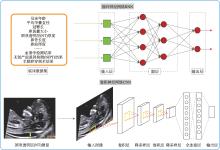
图1
超声联合人工智能预测模型"

表1
几种常见的深度学习模型在医学中的应用比较"
| 模型 | 优势 | 局限性 | 参考文献 |
|---|---|---|---|
| 卷积神经网络(CNN) | · 高效医学图像分析 · 自动学习分层特征 · 处理各种医学图像模式 | · 需要大量已标记数据 · 若计算量大存在硬件要求 · 数据量小容易过拟合 | [ |
| 递归神经网络(RNN) | · 可处理顺序数据 · 可捕获数据时间依赖性 · 可处理心电图数据 | · 出现数据梯度消失问题 · 数据序列过长时分析受阻 · 计算成本高 | [ |
| 长短期记忆递归神经网络(LSTM) | · 可缓解梯度消失问题 · 适合构建时间模式模型 · 可处理脑电图信号数据 | · 复杂架构可能导致过拟合 · 训练速度比标准CNN慢 · 无法进行超参数调优 | [ |
| Transformer | · 可处理医学文本数据 · 通过自我注意机制捕捉上下文 · 可处理可变长度的序列数据 | · 最初是用于固定序列数据分析 · 可能需要大量数据 · 若计算量大存在硬件要求 | [ |
| 残差神经网络(ResNet) | · 可处理存在深层残余链接的数据 · 可解决梯度消失问题 · 可处理图像分类问题 · 是较好的迁移学习概述模型 | · 模型较为复杂 · 需要大量训练数据 · 计算量较大 | [ |
表2
人工智能超声预测模型的优势和局限"
| 报道文献 | 算法类型 | 预测疾病类型 | 样本量 | 孕周 | 模型性能 | 优势与局限 |
|---|---|---|---|---|---|---|
| Verma等[ | 自适应梯度下降算法 | 胎儿染色体异常 | 100张超声图像 | 11~14 | 准确率98.64%; 精确率97.2% | 预测模型准确率高性能优越,但样本量较小 |
| Thomas等[ | AlexNet | 唐氏综合征 | 100张超声图像 | 11~14 | 分类准确率91.7%; AUC=0.95 | 该系统对唐氏综合征分类判断准确率极高,但样本量较小 |
| Sun等[ | LASSO回归 | 21-三体综合征 | 624例胎儿超声图像 | 11~14 | AUC=0.98 | 将颈项透明层与面部参数结合,提高早期识别能力,但需要高质量的图像和测量手段 |
| Zhang等[ | 卷积神经网络(CNN) | 21-三体综合征 | 822例胎儿超声图像 | 11~14 | 训练集AUC=0.98; 验证集AUC=0.95 | 深度学习模型优于传统方法,但需要大量已被标记的数据,数据前期处理量大 |
| Yekdast等[ | 卷积神经网络(CNN)和粒子群优算法 | 唐氏综合征 | 300张超声图像 | 11~14 | 准确率99.38% | 准确率极高,但研究为单中心研究且样本量稍小 |
| Tang等[ (Fgds-EL) | 卷积神经网络(CNN)和随机森林(RF)集成学习 | 多种遗传性疾病 | 932张胎儿超声图像 | 11~14 | 敏感性0.92 | 实现多类型染色体数目异常同步筛查,但需要多种遗传疾病的标记数据 |
| Tang等[ (Pgds-ResNet) | 深度神经网络(DNN) | 多种遗传性疾病 | 1,120例胎儿超声图像 | 11~14 | 敏感性0.83~0.96 | 可通过非侵入性方法筛查多种遗传性疾病,但对罕见疾病的识别还需进一步研究 |
| [1] | Chen HJ, Liu XY, Liu L, Xiao YY, Hu ZQ, Zhang H, Xu ZH. Detection of fetal chromosomal abnormalities by different prenatal diagnostic indicators and analysis of the results of follow-up. Chin J Fam Plan, 2022, 30(8): 1881-1887. |
| 陈惠娟, 刘小燕, 刘霖, 肖媛媛, 胡芷晴, 张浩, 徐志红. 不同产前诊断指征孕妇胎儿染色体异常检测及随访结果分析. 中国计划生育学杂志, 2022, 30(8): 1881-1887. | |
| [2] |
Yang X, Yu LQ, Li SL, Wen HX, Luo DD, Bian C, Qin J, Ni D, Heng PA. Towards automated semantic segmentation in prenatal volumetric ultrasound. IEEE Trans Med Imaging, 2019, 38(1): 180-193.
pmid: 30040635 |
| [3] |
Alzubaidi M, Agus M, Alyafei K, Althelaya KA, Shah U, Abd-Alrazaq A, Anbar M, Makhlouf M, Househ M. Toward deep observation: a systematic survey on artificial intelligence techniques to monitor fetus via ultrasound images. iScience, 2022, 25(8): 104713.
pmid: 35856024 |
| [4] |
Jiang HY, Diao ZS, Shi TY, Zhou Y, Wang FY, Hu WR, Zhu XL, Luo SJ, Tong GY, Yao YD. A review of deep learning-based multiple-lesion recognition from medical images: classification, detection and segmentation. Comput Biol Med, 2023, 157: 106726.
pmid: 36924732 |
| [5] |
Romero ST, Geiersbach KB, Paxton CN, Rose NC, Schisterman EF, Branch DW, Silver RM. Differentiation of genetic abnormalities in early pregnancy loss. Ultrasound Obstet Gynecol, 2015, 45(1): 89-94.
pmid: 25358469 |
| [6] |
Warren JE, Silver RM. Genetics of pregnancy loss. Clin Obstet Gynecol, 2008, 51(1): 84-95.
pmid: 18303502 |
| [7] |
Dawood Y, Buijtendijk MFJ, Shah H, Smit JA, Jacobs K, Hagoort J, Oostra RJ, Bourne T, van den Hoff MJB, de Bakker BS. Imaging fetal anatomy. Semin Cell Dev Biol, 2022, 131: 78-92.
pmid: 35282997 |
| [8] | Habehh H, Gohel S. Machine learning in healthcare. Curr Genomic, 2021, 22(4): 291-300. |
| [9] |
Kushnir VA, Frattarelli JL. Aneuploidy in abortuses following IVF and ICSI. J Assist Reprod Genet, 2009, 26(2-3): 93-97.
pmid: 19224361 |
| [10] |
Shearer BM, Thorland EC, Carlson AW, Jalal SM, Ketterling RP. Reflex fluorescent in situ hybridization testing for unsuccessful product of conception cultures: a retrospective analysis of 5555 samples attempted by conventional cytogenetics and fluorescent in situ hybridization. Genet Med, 2011, 13(6): 545-552.
pmid: 21415758 |
| [11] |
Morales C, Sanchez A, Bruguera J, Margarit E, Borrell A, Borobio V, Soler A. Cytogenetic study of spontaneous abortions using semi-direct analysis of chorionic villi samples detects the broadest spectrum of chromosome abnormalities. Am J Med Genet A, 2008, 146A(1): 66-70.
pmid: 18074370 |
| [12] |
Lin Q, Zhou Y, Shi S, Zhang Y, Yin S, Liu X, Peng Q, Huang S, Jiang Y, Cui C, She R, Xu J, Dong F. How much can AI see in early pregnancy: a multi-center study of fetus head characterization in week 10-14 in ultrasound using deep learning. Comput Methods Programs Biomed, 2022, 226: 107170.
pmid: 36272307 |
| [13] |
Xu L, Liu M, Shen Z, Wang H, Liu X, Wang X, Wang S, Li T, Yu S, Hou M, Guo J, Zhang J, He Y. DW-Net: A cascaded convolutional neural network for apical four-chamber view segmentation in fetal echocardiography. Comput Med Imaging Graph, 2020, 80: 101690.
pmid: 31968286 |
| [14] |
Yasrab R, Fu Z, Zhao H, Lee LH, Sharma H, Drukker L, Papageorgiou AT, Noble JA. A machine learning method for automated description and workflow analysis of first trimester ultrasound scans. IEEE Trans Med Imaging, 2023, 42(5): 1301-1313.
pmid: 36455084 |
| [15] |
International Society of Ultrasound in Obstetrics and Gynecology, Bilardo CM, Chaoui R, Hyett JA, Kagan KO, Karim JN, Papageorghiou AT, Poon LC, Salomon LJ, Syngelaki A, Nicolaides KH. ISUOG Practice Guidelines (updated): performance of 11-14-week ultrasound scan. Ultrasound Obstet and Gynecol, 2023, 61(1): 127-143.
pmid: 36594739 |
| [16] |
Volpe N, Dall’Asta A, Di Pasquo E, Frusca T, Ghi T. First-trimester fetal neurosonography: technique and diagnostic potential. Ultrasound Obstet Gynecol, 2021, 57(2): 204-214.
pmid: 33049801 |
| [17] |
Mahdavi S, Karami F, Sabbaghi S. Non-invasive prenatal diagnosis of foetal gender through maternal circulation in first trimester of pregnancy. J Obstet Gynaecol, 2019, 39(8): 1071-1074.
pmid: 31177896 |
| [18] |
Nicolaides KH. Nuchal translucency and other first- trimester sonographic markers of chromosomal abnormalities. Am J Obstet Gynecol, 2004, 191(1): 45-67.
pmid: 15295343 |
| [19] |
Salomon LJ, Alfirevic Z, Berghella V, Bilardo CM, Chalouhi GE, Costa FDS, Hernandez-Andrade E, Malinger G, Munoz H, Paladini D, Prefumo F, Sotiriadis A, Toi A, Lee W. ISUOG Practice Guidelines (updated): performance of the routine mid-trimester fetal ultrasound scan. Ultrasound Obstet Gynecol, 2022, 59(6): 840-856.
pmid: 35592929 |
| [20] |
Khalil A, Sotiriadis A, D'Antonio F, Da Silva Costa F, Odibo A, Prefumo F, Papageorghiou AT, Salomon LJ. ISUOG Practice Guidelines: performance of third- trimester obstetric ultrasound scan. Ultrasound Obstet Gynecol, 2024, 63(1): 131-147.
pmid: 38166001 |
| [21] |
Drukker L, Bradburn E, Rodriguez GB, Roberts NW, Impey L, Papageorghiou AT. How often do we identify fetal abnormalities during routine third-trimester ultrasound? a systematic review and meta-analysis. BJOG, 2021, 128(2): 259-269.
pmid: 32790134 |
| [22] |
Bellai-Dussault K, Dougan SD, Fell DB, Little J, Meng L, Okun N, Walker MC, Armour CM, Potter BK. Ultrasonographic fetal nuchal translucency measurements and cytogenetic outcomes. JAMA Network Open, 2024, 7(3): e243689-e243689.
pmid: 38530313 |
| [23] |
Gadsbøll K, Brix N, Sandager P, Petersen OB, Souka AP, Nicolaides KH, Vogel I. Increased nuchal translucency thickness and normal chromosomal microarray: danish nationwide cohort study. Ultrasound Obstet Gynecology, 2025, 65(4): 462-469.
pmid: 40017000 |
| [24] |
Hui L, Pynaker C, Bonacquisto L, Lindquist A, Poulton A, Kluckow E, Hutchinson B, Norris F, Pertile MD, Gugasyan L, Kulkarni A, Harraway J, Howden A, McCoy R, da Silva Costa F, Menezes M, Palma-Dias R, Nisbet D, Martin N, Bethune M, Poulakis Z, Halliday J. Reexamining the optimal nuchal translucency cutoff for diagnostic testing in the cell-free DNA and microarray era: results from the Victorian Perinatal Record Linkage study. Am obstetrics Obstet Gynecol, 2021, 225(5): 527.e1-527.e12.
pmid: 33957116 |
| [25] |
Bet BB, Lugthart MA, Linskens IH, van Maarle MC, van Leeuwen E, Pajkrt E. Adverse pregnancy outcome in fetuses with early increased nuchal translucency: prospective cohort study. Ultrasound Obstet Gynecol, 2024, 64(2): 164-172.
pmid: 38411313 |
| [26] |
Zhang HJ, Wang S, Feng CL, Zhao HY, Zhang WW, Sun Y, Yang HX. Chromosomal abnormalities and structural defects in fetuses with increased nuchal translucency at a Chinese tertiary medical center. Frontiers in Medicine, 2023, 10: 1158554.
pmid: 37287743 |
| [27] |
Guo ZL, Yang WK, Zhao QR, Zhang YW, Wang X, Wang JM, Wang RL, Hao BT, Liao SX. Pregnancy outcomes of 4,200 fetuses with increased nuchal translucency in Henan, China. Front Med (Lausanne), 2025, 12: 1514504.
pmid: 40241902 |
| [28] |
Manegold-Brauer G, Maymon R, Shor S, Cuckle H, Gembruch U, Geipel A. Down's syndrome screening at 11-14 weeks' gestation using prenasal thickness and nasal bone length. Arch Gynecol Obstet, 2019, 299(4): 939-945.
pmid: 30739175 |
| [29] |
Ekmekci E, Demirel E, Kelekci S. Nasal bone to nasal tip length ratio for describing nasal bone hypoplasia and predicting trisomy 21. Arch Med Sci, 2022, 18(2): 395-399.
pmid: 35316896 |
| [30] |
Vos FI, Bakker M, Tromp E, Manten GTR, Bilardo CM. Facial profile markers in second-and third-trimester fetuses with trisomy 18. Ultrasound Obstet Gynecol, 2015, 46(1): 66-72.
pmid: 25196037 |
| [31] |
Yazdi B, Sonek J, Oettling C, Hoopmann M, Abele H, Schaelike M, Kagan KO. Prefrontal space ratio in second-and third-trimester screening for trisomy 21. Ultrasound Obstet Gynecol, 2013, 41(3): 262-266.
pmid: 22791586 |
| [32] |
Roosen AM, Oelmeier K, Möllers M, Willy D, Sondern KM, Köster HA, De Santis C, Eveslage M, Schmitz R. 3D ultrasound evaluation of fetal ears in prenatal syndrome diagnosis-a comparative study. Ultraschall Med, 2024, 45(6): 604-614.
pmid: 38272060 |
| [33] |
Yoneda S, Shiozaki A, Yoneda N, Sameshima A, Ito M, Shima T, Nakashima A, Yoshino O, Kigawa M, Takamori R, Shinagawa Y, Saito S. A yolk sac larger than 5 mm suggests an abnormal fetal karyotype, whereas an absent embryo indicates a normal fetal karyotype. J Ultrasound Med, 2018, 37(5): 1233-1241.
pmid: 29090486 |
| [34] |
Tekesin I. The value of detailed first-trimester ultrasound anomaly scan for the detection of chromosomal abnormalities. Ultraschall Med, 2019, 40(6): 743-748.
pmid: 30241105 |
| [35] |
Ginsberg NA, Strom C, Verlinsky Y. Crown-rump lengths in missed miscarriages and trisomy 21. Ultrasound Obstet Gynecol, 2001, 18(5): 488-490.
pmid: 11844170 |
| [36] |
Wagner P, Sonek J, Hoopmann M, Abele H, Kagan KO. First-trimester screening for trisomies 18 and 13, triploidy and Turner syndrome by detailed early anomaly scan. Ultrasound Obstet Gynecol, 2016, 48(4): 446-451.
pmid: 26611869 |
| [37] |
Liu YK, Liu YL, Chen H, Li Q, Meng LL, Chen LB, Du T, Zhang JP. Relationship of karyotype to embryo crown- rump length and maternal serum human chorionic gonadotropin level in early miscarriage. Am J Perinatol, 2015, 32(1): 15-22.
pmid: 24705969 |
| [38] | Yuan M, Ge Q, Wang XJ, Sheng J, Wang YY, Rong F. Value of prenatal ultrasonography combined with serological indicators detections for screening fetal chromosomal abnormality. Chin J Fam Plan, 2021, 29(10): 2211-2214. |
| 员敏, 葛群, 汪雪菁, 盛军, 王园园, 荣锋. 产前超声检查联合血清学检测筛查胎儿染色体异常价值. 中国计划生育学杂志 2021, 29(10): 2211-2214. | |
| [39] |
Zumaeta AM, Wright A, Syngelaki A, Maritsa VA, Bardani E, Nicolaides KH. Screening for trisomy at 11-13 weeks' gestation: use of pregnancy-associated plasma protein-A, placental growth factor or both. Ultrasound Obstet Gynecol, 2020, 56(3): 408-415.
pmid: 32621353 |
| [40] | Liu ZX, Zhang J. Diagnostic value of ultrasound combined with non-invasive DNA for fetal chromosomal abnormalities. Chin J Pract Med, 2023, 50(2): 84-87. |
| 刘智霞, 张娟. 超声联合无创DNA检查对胎儿染色体异常的诊断价值. 中国实用医刊 2023, 50(2): 84-87. | |
| [41] | Wang XY, Qu HZ, Fang XD. Omics big data and medical artificial intelligence. Hereditas (Beijing), 2021, 43(10): 930-937. |
| 王昕玥, 渠鸿竹, 方向东. 组学大数据和医学人工智能. 遗传 2021, 43(10): 930-937. | |
| [42] |
Hamet P, Tremblay J. Artificial intelligence in medicine. Metabolism, 2017, 69S: S36-S40.
pmid: 28126242 |
| [43] |
Yang YJ, Bang CS. Application of artificial intelligence in gastroenterology. World J Gastroenterol, 2019, 25(14): 1666-1683.
pmid: 31011253 |
| [44] |
Guiot J, Vaidyanathan A, Deprez L, Zerka F, Danthine D, Frix AN, Lambin P, Bottari F, Tsoutzidis N, Miraglio B, Walsh S, Vos W, Hustinx R, Ferreira M, Lovinfosse P, Leijenaar RTH. A review in radiomics: making personalized medicine a reality via routine imaging. Med Res Rev, 2022, 42(1): 426-440.
pmid: 34309893 |
| [45] |
Avanzo M, Wei LS, Stancanello J, Vallières M, Rao A, Morin O, Mattonen SA, El Naqa I. Machine and deep learning methods for radiomics. Med Phys, 2020, 47(5): e185-e202.
pmid: 32418336 |
| [46] |
Nirthika R, Manivannan S, Ramanan A, Wang RX. Pooling in convolutional neural networks for medical image analysis: a survey and an empirical study. Neural Comput Appl, 2022, 34(7): 5321-5347.
pmid: 35125669 |
| [47] |
Gao J, Jiang Q, Zhou B, Chen DZ. Convolutional neural networks for computer-aided detection or diagnosis in medical image analysis: an overview. Math Biosci Eng, 2019, 16(6): 6536-6561.
pmid: 31698575 |
| [48] |
Ran XD, Shan ZG, Fan YK, Gao L. A model based LSTM and graph convolutional network for stock trend prediction. PeerJ Comput Sci, 2024, 10: e2326.
pmid: 39650434 |
| [49] |
Rajeev R, Samath JA, Karthikeyan NK. An intelligent recurrent neural network with long short-term memory (LSTM) based batch normalization for medical image denoising. J Med Syst, 2019, 43(8): 234.
pmid: 31203556 |
| [50] |
Takahashi S, Sakaguchi Y, Kouno N, Takasawa K, Ishizu K, Akagi Y, Aoyama R, Teraya N, Bolatkan A, Shinkai N, Machino H, Kobayashi K, Asada K, Komatsu M, Kaneko S, Sugiyama M, Hamamoto R. Comparison of vision transformers and convolutional neural networks in medical image analysis: a systematic review. J Med Syst, 2024, 48(1): 84.
pmid: 39264388 |
| [51] |
Xu WN, Fu YL, Zhu DM. ResNet and its application to medical image processing: research progress and challenges. Comput Methods Programs Biomed, 2023, 240: 107660.
pmid: 37320940 |
| [52] | Zhou ZH. Machine Learning. Springer Nature, 2021. |
| [53] |
Gore JC. Artificial intelligence in medical imaging. Magn Reson Imaging, 2020, 68: A1-A4.
pmid: 31857130 |
| [54] |
Verma D, Agrawal S, Iwendi C, Sharma B, Bhatia S, Basheer S. A novel framework for abnormal risk classification over fetal nuchal translucency using adaptive stochastic gradient descent algorithm. Diagnostics (Basel), 2022, 12(11): 2643.
pmid: 36359487 |
| [55] | Thomas MC, Arjunan SP. Deep learning measurement model to segment the nuchal translucency region for the early identification of down syndrome. Meas. Sci. Rev, 2022, 22(4): 187-192. |
| [56] |
Sun Y, Zhang L, Dong D, Li X, Wang J, Yin C, Poon LC, Tian J, Wu Q. Application of an individualized nomogram in first-trimester screening for trisomy 21. Ultrasound Obstet Gynecol, 2021, 58(1): 56-66.
pmid: 32438493 |
| [57] |
Zhang LW, Dong D, Sun YQ, Hu CE, Sun CX, Wu QQ, Tian J. Development and validation of a deep learning model to screen for trisomy 21 during the first trimester from nuchal ultrasonographic images. JAMA Netw Open, 2022, 5(6): e2217854.
pmid: 35727579 |
| [58] | Yekdast R. An intelligent method for down syndrome detection in fetuses using ultrasound images and deep learning neural networks. Comput Res Prog Appl Sci Eng, 2019, 5(3): 92-97. |
| [59] |
Tang JJ, Han J, Xie BB, Xue JX, Zhou H, Jiang YX, Hu LT, Chen CY, Zhang KH, Zhu FF, Lu L. The two-stage ensemble learning model based on aggregated facial features in screening for fetal genetic diseases. Int J Environ Res Public Health, 2023, 20(3): 2377.
pmid: 36767743 |
| [60] |
Tang JJ, Han J, Xue JX, Zhen L, Yang X, Pan M, Hu LT, Li R, Jiang YX, Zhang YL, Jing XY, Li FC, Chen GL, Zhang KH, Zhu FF, Liao C, Lu LL. A deep-learning-based method can detect both common and rare genetic disorders in fetal ultrasound. Biomedicines, 2023, 11(6): 1756.
pmid: 37371851 |
| [61] |
Stirnemann JJ, Besson R, Spaggiari E, Rojo S, Loge F, Peyro-Saint-Paul H, Allassonniere S, Le Pennec E, Hutchinson C, Sebire N, Ville Y. Development and clinical validation of real-time artificial intelligence diagnostic companion for fetal ultrasound examination. Ultrasound Obstet Gynecol, 2023, 62(3): 353-360.
pmid: 37161503 |
| [62] |
Zhang B, Liu H, Luo H, Li K. Automatic quality assessment for 2D fetal sonographic standard plane based on multitask learning. Medicine (Baltimore), 2021, 100(4): e24427.
pmid: 33530242 |
| [63] |
Kebaili A, Lapuyade-Lahorgue J, Ruan S. Deep learning approaches for data augmentation in medical imaging: a review. J Imaging, 2023, 9(4): 81.
pmid: 37103232 |
| [64] |
Hesse LS, Aliasi M, Moser F, INTERGROWTH-21(st) Consortium, Haak MC, Xie WD, Jenkinson M, Namburete AIL. Subcortical segmentation of the fetal brain in 3D ultrasound using deep learning. Neuroimage, 2022, 254: 119117.
pmid: 35331871 |
| [65] |
Lee J, Lee SM, Ahn JM, Lee TR, Kim W, Cho EH, Ki CS. Development and performance evaluation of an artificial intelligence algorithm using cell-free DNA fragment distance for non-invasive prenatal testing (aiD-NIPT). Front Genet, 2022, 13: 999587.
pmid: 36523771 |
| [66] |
Currie G, Hawk KE, Rohren E, Vial A, Klein R. Machine learning and deep learning in medical imaging: intelligent imaging. J Med Imaging Radiat Sci, 2019, 50(4): 477-487.
pmid: 31601480 |
| [67] |
van der Velden BHM, Kuijf HJ, Gilhuijs KGA, Viergever MA. Explainable artificial intelligence (XAI) in deep learning-based medical image analysis. Med Image Anal, 2022, 79: 102470.
pmid: 35576821 |
| [68] |
Sendra-Balcells C, Campello VM, Torrents-Barrena J, Ahmed YA, Elattar M, Ohene-Botwe B, Nyangulu P, Stones W, Ammar M, Benamer LN, Kisembo HN, Sereke SG, Wanyonyi SZ, Temmerman M, Gratacós E, Bonet E, Eixarch E, Mikolaj K, Tolsgaard MG, Lekadir K. Generalisability of fetal ultrasound deep learning models to low-resource imaging settings in five African countries. Sci Rep, 2023, 13(1): 2728.
pmid: 36792642 |
| [69] | Zhu DN, Ji P. Reflections on ethical review and management of medical artificial intelligence social experiment projects. Chin Med Ethics, 2024, 37(2): 210-213. |
| 祝丹娜, 吉萍. 医学人工智能社会实验项目伦理审查与管理思考. 中国医学伦理学 2024, 37(2): 210-213. |
| [1] | 雷定伟, 顾睿初, 谢晓雪, 丁时之, 温翰. 计算方法在m6A研究中的应用及展望[J]. 遗传, 2025, 47(8): 903-927. |
| [2] | 郑广勇, 曾涛, 李亦学. 前沿信息技术在生物医学大数据中的应用及展望[J]. 遗传, 2021, 43(10): 924-929. |
| [3] | 王昕玥, 渠鸿竹, 方向东. 组学大数据和医学人工智能[J]. 遗传, 2021, 43(10): 930-937. |
| [4] | 赵学彤, 杨亚东, 渠鸿竹, 方向东. 组学时代下机器学习方法在临床决策支持中的应用[J]. 遗传, 2018, 40(9): 693-703. |
| 阅读次数 | ||||||
|
全文 |
|
|||||
|
摘要 |
|
|||||

www.chinagene.cn
备案号:京ICP备09063187号-4
总访问:,今日访问:,当前在线:

