
遗传 ›› 2026, Vol. 48 ›› Issue (11): 1054-1065.doi: 10.16288/j.yczz.26-199
满鑫( ), 周金秋
收稿日期:2026-08-13
修回日期:2026-09-12
出版日期:2026-11-20
发布日期:2026-09-17
通讯作者:
满鑫,博士,博士后,研究方向:RNA生物学。E-mail: manxin@sibcb.ac.cn基金资助:
Xin Man(), Jinqiu Zhou
Received:2026-08-13
Revised:2026-09-12
Published:2026-11-20
Online:2026-09-17
Supported by:摘要:
剪接体内含子是真核生物基因组的重要组成部分,广泛存在于编码基因中,并在RNA成熟过程中被剪接移除。剪接体内含子去除被认为是真核基因表达调控和生命活动的重要基础,也被认为是真核生物进化的重要驱动力之一。现存可独立生活的真核生物都有剪接体内含子。然而,内含子及剪接体是否为真核细胞生存所必需仍是一个重要的基础生物学问题。近年来,合成生物学与基因组工程的发展为探索真核生命的基本组成提供了新的研究策略。通过合成基因组设计和系统性基因组简化,研究发现酿酒酵母能够在缺失全部已知剪接体内含子的情况下维持生存,表明剪接体内含子并非维持酵母生命所必需的遗传元件,剪接体也并非维持酵母生命所必需的分子机器。这一发现挑战了对内含子功能及剪接体必需性的传统认识,为理解内含子的进化意义提供了新的视角,也为人工设计和合成真核基因组提供了指导原则。本文系统梳理内含子的类型与多层次功能,重点介绍无剪接体内含子酿酒酵母SYNE27α的构建、存活与生长代价,以及在该背景下剪接体非必需性的证据,并讨论其对内含子进化保留和最小真核基因组构建的启示。
满鑫, 周金秋. 无剪接体内含子的真核细胞:重新审视内含子和剪接体进化意义[J]. 遗传, 2026, 48(11): 1054-1065.
Xin Man, Jinqiu Zhou. Spliceosomal intron-free eukaryotic cells: rethinking the evolutionary significance of introns and the spliceosome[J]. Hereditas(Beijing), 2026, 48(11): 1054-1065.
图1
内含子的类型与剪接机制 A:I型自剪接内含子通过游离鸟苷酸(G)的3′-OH亲核攻击5′剪接位点,引发第一次转酯反应;随后外显子3′-OH攻击3′剪接位点,完成外显子连接并释放线性内含子;B:II型内含子和核pre-mRNA内含子均通过分支位点腺苷(A)的2′-OH启动剪接反应,形成具有2′-5′磷酸二酯键连接的套索结构。随后外显子连接,释放套索状内含子。II型自剪接内含子与核pre-mRNA内含子的套索形成机制具有相似性,提示二者可能具有共同的进化起源;C:tRNA内含子则通过特异性的tRNA剪接内切酶识别并切除内含子,产生两个外显子片段,随后经连接反应形成成熟tRNA。根据文献[14,24]修改绘制。"
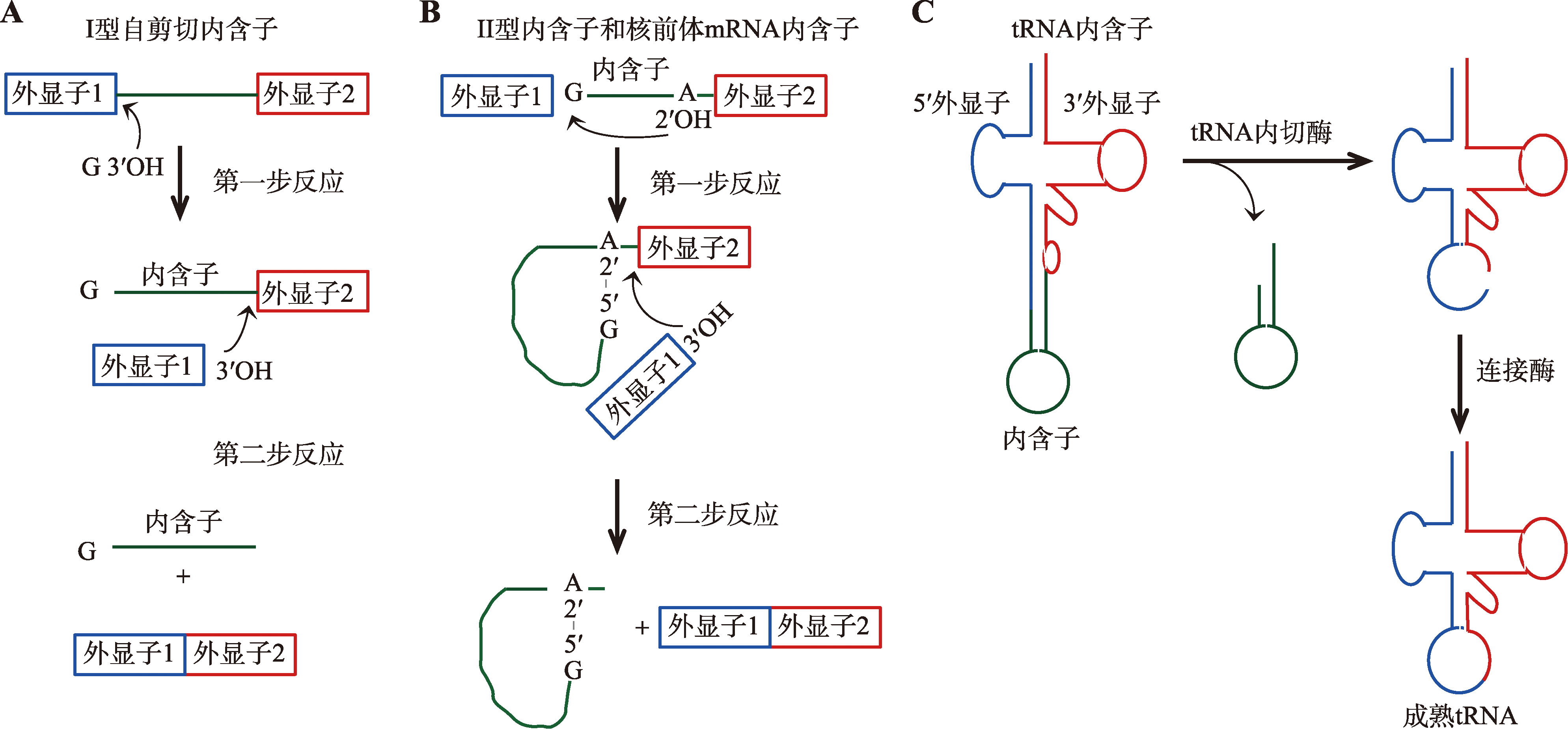
图2
酿酒酵母的简化生活史 单倍体酵母细胞具有两种交配型之一:MATa(a型细胞)或MATα(α型细胞)。这些细胞可通过出芽进行有丝分裂,产生子细胞。在实验室酵母菌株中,由于缺乏具有功能的HO内切核酸酶,单倍体细胞的交配型通常保持稳定。两种交配型的细胞可分别释放信息素,诱导细胞形成接合突起(shmoo)并发生交配,最终形成稳定的MATa/MATα(a/α型)二倍体细胞。二倍体细胞同样可以通过出芽进行有丝分裂,产生与母细胞遗传组成相同的子细胞。在氮源缺乏等营养限制条件下,二倍体细胞可被诱导进入减数分裂并形成4个单倍体孢子。孢子萌发后可产生两个MATa型和两个MATα型单倍体细胞,从而完成酿酒酵母的生活史循环。根据文献[42]修改绘制。"
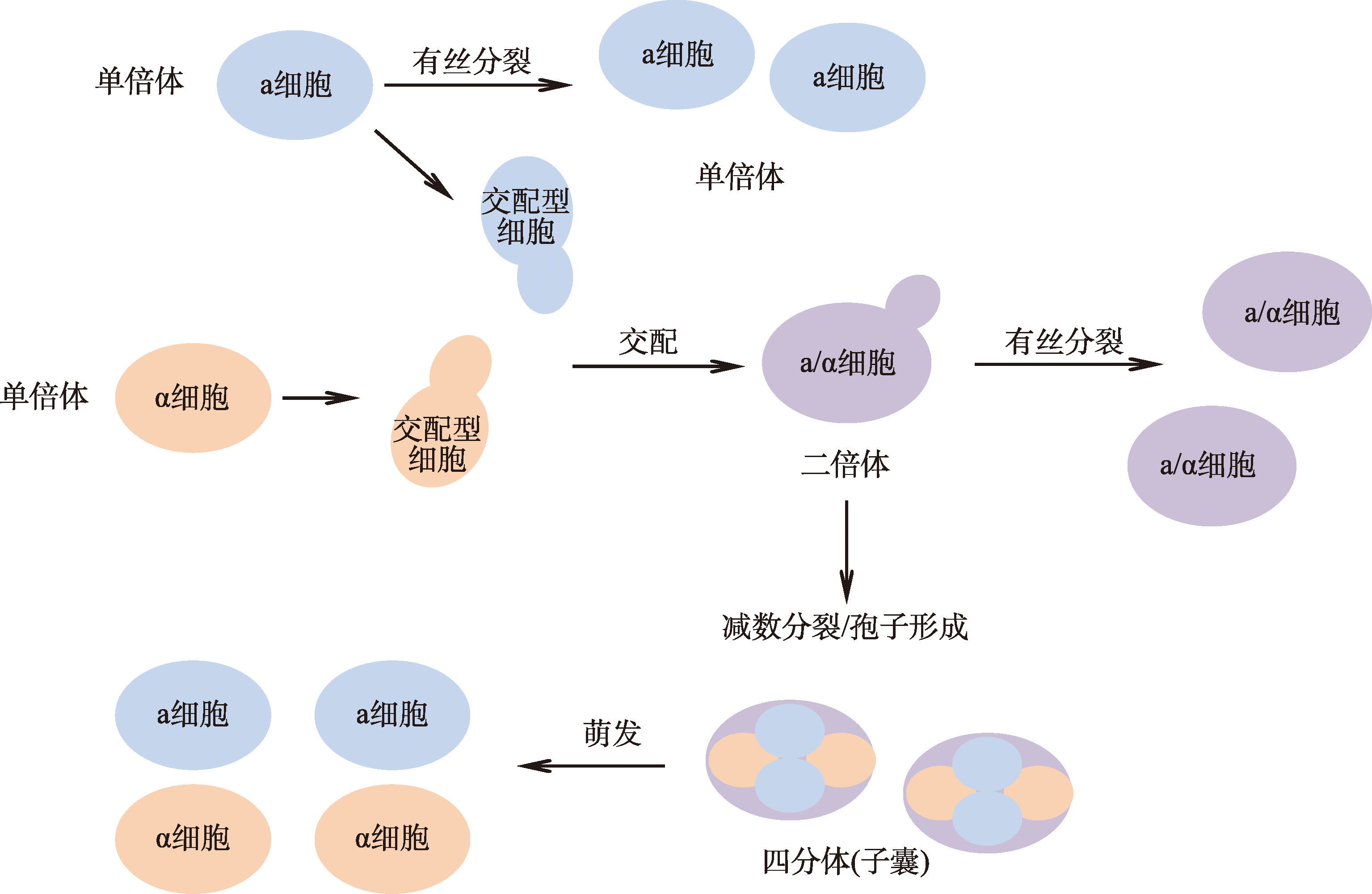
图3
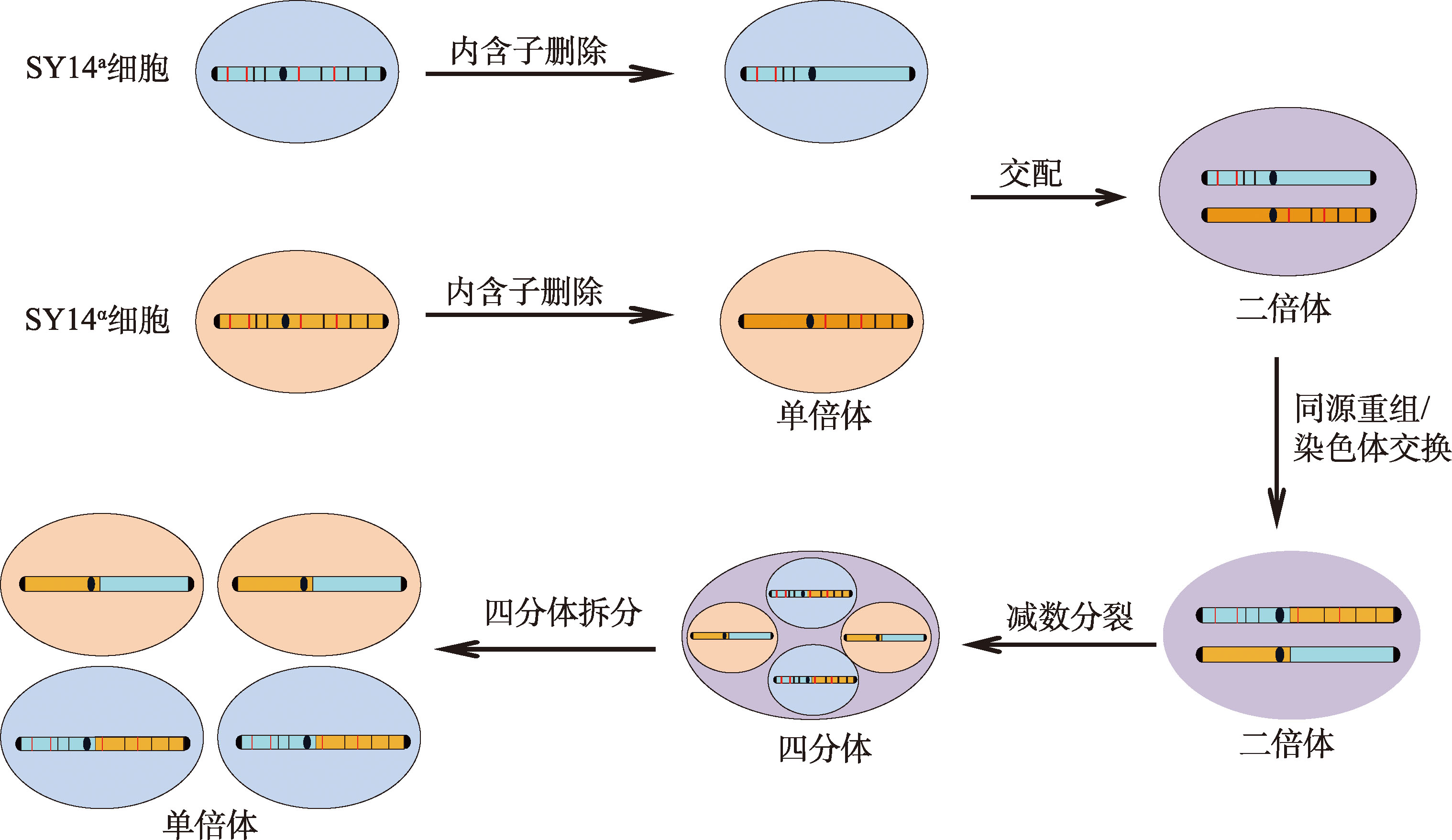
无剪接体内含子酿酒酵母的构建策略示意图 以单染色体酿酒酵母菌株SY14a和SY14α为起始菌株,通过分组并行策略逐步删除基因组中的剪接体内含子,获得携带不同内含子缺失组合的单倍体菌株。随后,将携带不同内含子缺失组合的单倍体菌株进行交配,形成二倍体。再经减数分裂和孢子筛选,获得具有目标内含子缺失组合的单倍体后代。"
| [1] |
Man X, Zhang WT, Zhang YD, Li QX, Dai PF, Jiang WM, Zhou JQ. A spliceosome-independent eukaryote generated by complete intron removal. Cell, 2026, 189(15): 4637-4649.e5.
pmid: 42456655 |
| [2] |
Avery OT, Macleod CM, McCarty M. Studies on the chemical nature of the substance inducing transformation of pneumococcal types: induction of transformation by a desoxyribonucleic acid fraction isolated from pneumococcus type III. J Exp Med, 1944, 79(2): 137-158.
pmid: 19871359 |
| [3] |
Crick FH. On protein synthesis. Symp Soc Exp Biol, 1958, 12: 138-163.
pmid: 13580867 |
| [4] |
Berget SM, Moore C, Sharp PA. Spliced segments at the 5′ terminus of adenovirus 2 late mRNA. Proc Natl Acad Sci USA, 1977, 74(8): 3171-3175.
pmid: 269380 |
| [5] |
Chow LT, Gelinas RE, Broker TR, Roberts RJ. An amazing sequence arrangement at the 5′ ends of adenovirus 2 messenger RNA. Cell, 1977, 12(1): 1-8.
pmid: 902310 |
| [6] |
Gilbert W. Why genes in pieces? Nature, 1978, 271(5645): 501.
pmid: 622185 |
| [7] |
Irimia M, Roy SW. Origin of spliceosomal introns and alternative splicing. Cold Spring Harb Perspect Biol, 2014, 6(6): a016071.
pmid: 24890509 |
| [8] |
Haugen P, Simon DM, Bhattacharya D. The natural history of group I introns. Trends Genet, 2005, 21(2): 111-119.
pmid: 15661357 |
| [9] |
Hedberg A, Johansen SD. Nuclear group I introns in self-splicing and beyond. Mob DNA, 2013, 4(1): 17.
pmid: 23738941 |
| [10] |
Fedorova O, Zingler N. Group II introns: structure, folding and splicing mechanism. Biol Chem, 2007, 388(7): 665-678.
pmid: 17570818 |
| [11] |
Pyle AM. Group II Intron self-splicing. Annu Rev Biophys, 2016, 45(1): 183-205.
pmid: 27391926 |
| [12] |
Phizicky EM, Hopper AK. tRNA biology charges to the front. Genes Dev, 2010, 24(17): 1832-1860.
pmid: 20810645 |
| [13] |
Abelson J, Trotta CR, Li H. tRNA splicing. J Biol Chem, 1998, 273(21): 12685-12688.
pmid: 9582290 |
| [14] |
Popow J, Schleiffer A, Martinez J. Diversity and roles of (t)RNA ligases. Cell Mol Life Sci, 2012, 69(16): 2657-2670.
pmid: 22426497 |
| [15] |
Chan PP, Lowe TM. GtRNAdb 2.0:an expanded database of transfer RNA genes identified in complete and draft genomes. Nucleic Acids Res, 2016, 44(D1): D184-D189.
pmid: 26673694 |
| [16] |
Wilkinson ME, Charenton C, Nagai K. RNA splicing by the spliceosome. Annu Rev Biochem, 2020, 89: 359-388.
pmid: 31794245 |
| [17] |
Wan RX, Yan CY, Bai R, Wang L, Huang M, Wong CCL, Shi YG. The 3.8 Å structure of the U4/U6.U5 tri-snRNP: insights into spliceosome assembly and catalysis. Science, 2016, 351(6272): 466-475.
pmid: 26743623 |
| [18] |
Plaschka C, Newman AJ, Nagai K. Structural basis of nuclear pre-mRNA splicing: lessons from yeast. Cold Spring Harb Perspect Biol, 2019, 11(5): a032391.
pmid: 30765413 |
| [19] |
Bon E, Casaregola S, Blandin G, Llorente B, Neuvéglise C, Munsterkotter M, Guldener U, Mewes HW, van Helden J, Dujon B, Gaillardin C. Molecular evolution of eukaryotic genomes: hemiascomycetous yeast spliceosomal introns. Nucleic Acids Res, 2003, 31(4): 1121-1135.
pmid: 12582231 |
| [20] |
Lorkovic ZJ, Lehner R, Forstner C, Barta A. Evolutionary conservation of minor U12-type spliceosome between plants and humans. RNA, 2005, 11(7): 1095-1107.
pmid: 15987817 |
| [21] |
Borao S, Ayté J, Hümmer S. Evolution of the early spliceosomal complex-from constitutive to regulated splicing. Int J Mol Sci, 2021, 22(22): 12444.
pmid: 34830325 |
| [22] |
Will CL, Lührmann R. Splicing of a rare class of introns by the U12-dependent spliceosome. Biol Chem, 2005, 386(8): 713-724.
pmid: 16201866 |
| [23] |
Roy SW, Gilbert W. The evolution of spliceosomal introns: patterns, puzzles and progress. Nat Rev Genet, 2006, 7(3): 211-221.
pmid: 16485020 |
| [24] |
Jacquier A. Self-splicing group II and nuclear pre-mRNA introns: how similar are they? Trends Biochem Sci, 1990, 15(9): 351-354.
pmid: 2238045 |
| [25] |
Pan Q, Shai O, Lee LJ, Frey BJ, Blencowe BJ. Deep surveying of alternative splicing complexity in the human transcriptome by high-throughput sequencing. Nat Genet, 2008, 40(12): 1413-1415.
pmid: 18978789 |
| [26] |
Muzafar S, Sharma RD, Chauhan N, Prasad R. Intron distribution and emerging role of alternative splicing in fungi. FEMS Microbiol Lett, 2021, 368(19): fnab135.
pmid: 34718529 |
| [27] |
Parenteau J, Durand M, Morin G, Gagnon J, Lucier JF, Wellinger RJ, Chabot B, Elela SA. Introns within ribosomal protein genes regulate the production and function of yeast ribosomes. Cell, 2011, 147(2): 320-331.
pmid: 22000012 |
| [28] |
Petibon C, Parenteau J, Catala M, Elela SA. Introns regulate the production of ribosomal proteins by modulating splicing of duplicated ribosomal protein genes. Nucleic Acids Res, 2016, 44(8): 3878-3891.
pmid: 26945043 |
| [29] |
Parenteau J, Elela SA. Introns: good day junk is bad day treasure. Trends Genet, 2019, 35(12): 923-934.
pmid: 31668856 |
| [30] |
Valencia P, Dias AP, Reed R. Splicing promotes rapid and efficient mRNA export in mammalian cells. Proc Natl Acad Sci USA, 2008, 105(9): 3386-3391.
pmid: 18287003 |
| [31] |
Chorev M, Carmel L. The function of introns. Front Genet, 2012, 3: 55.
pmid: 22518112 |
| [32] |
Rekosh D, Hammarskjold ML. Intron retention in viruses and cellular genes: detention, border controls and passports. Wiley Interdiscip Rev RNA, 2018, 9(3): e1470.
pmid: 29508942 |
| [33] |
Zheng JT, Lin CX, Fang ZY, Li HD. Intron retention as a mode for RNA-Seq data analysis. Front Genet, 2020, 11: 586.
pmid: 32733531 |
| [34] |
Juneau K, Miranda M, Hillenmeyer ME, Nislow C, Davis RW. Introns regulate RNA and protein abundance in yeast. Genetics, 2006, 174(1): 511-518.
pmid: 16816425 |
| [35] |
Kalyna M, Simpson CG, Syed NH, Lewandowska D, Marquez Y, Kusenda B, Marshall J, Fuller J, Cardle L, McNicol J, Dinh HQ, Barta A, Brown JWS. Alternative splicing and nonsense-mediated decay modulate expression of important regulatory genes in Arabidopsis. Nucleic Acids Res, 2012, 40(6): 2454-2469.
pmid: 22127866 |
| [36] |
Hooks KB, Naseeb S, Parker S, Griffiths-Jones S, Delneri D. Novel intronic RNA structures contribute to maintenance of phenotype in Saccharomyces cerevisiae. Genetics, 2016, 203(3): 1469-1481.
pmid: 27194751 |
| [37] |
Danin-Kreiselman M, Lee CY, Chanfreau G. RNase III-mediated degradation of unspliced pre-mRNAs and lariat introns. Mol Cell, 2003, 11(5): 1279-1289.
pmid: 12769851 |
| [38] |
Morgan JT, Fink GR, Bartel DP. Excised linear introns regulate growth in yeast. Nature, 2019, 565(7741): 606-611.
pmid: 30651636 |
| [39] |
Hayashi S, Mori S, Suzuki T, Suzuki T, Yoshihisa T. Impact of intron removal from tRNA genes on Saccharomyces cerevisiae. Nucleic Acids Res, 2019, 47(11): 5936-5949.
pmid: 30997502 |
| [40] |
Mori S, Kajita T, Endo T, Yoshihisa T. The intron of tRNA-TrpCCA is dispensable for growth and translation of Saccharomyces cerevisiae. RNA, 2011, 17(9): 1760-1769.
pmid: 21784868 |
| [41] |
Nostramo RT, Sinopoli PL, Bao A, Metcalf S, Peltier LM, Hopper AK. Free introns of tRNAs as complementarity- dependent regulators of gene expression. Mol Cell, 2025, 85(4): 726-741.e6.
pmid: 39938518 |
| [42] |
Duina AA, Miller ME, Keeney JB. Budding yeast for budding geneticists: a primer on the Saccharomyces cerevisiae model system. Genetics, 2014, 197(1): 33-48.
pmid: 24807111 |
| [43] |
Goffeau A, Barrell BG, Bussey H, Davis RW, Dujon B, Feldmann H, Galibert F, Hoheisel JD, Jacq C, Johnston M, Louis EJ, Mewes HW, Murakami Y, Philippsen P, Tettelin H, Oliver SG. Life with 6000 genes. Science, 1996, 274(5287): 563-567.
pmid: 8849441 |
| [44] |
Shao YY, Lu N, Wu ZF, Cai C, Wang SS, Zhang LL, Zhou F, Xiao SJ, Liu L, Zeng XF, Zheng HJ, Yang C, Zhao ZH, Zhao GP, Zhou JQ, Xue XL, Qin ZJ. Creating a functional single-chromosome yeast. Nature, 2018, 560(7718): 331-335.
pmid: 30069045 |
| [45] |
Parenteau J, Durand M, Véronneau S, Lacombe AA, Morin G, Guérin V, Cecez B, Gervais-Bird J, Koh CS, Brunelle D, Wellinger RJ, Chabot B, Elela SA. Deletion of many yeast introns reveals a minority of genes that require splicing for function. Mol Biol Cell, 2008, 19(5): 1932-1941.
pmid: 18287520 |
| [46] |
Parenteau J, Maignon L, Berthoumieux M, Catala M, Gagnon V, Elela SA. Introns are mediators of cell response to starvation. Nature, 2019, 565(7741): 612-617.
pmid: 30651641 |
| [47] |
Gu X, Ye TT, Zhang XR, Nie LY, Wang H, Li W, Lu R, Fu CH, Du LL, Zhou JQ. Single-chromosome fission yeast models reveal the configuration robustness of a functional genome. Cell Rep, 2022, 40(8): 111237.
pmid: 36001961 |
| [48] |
Wang Y, Qu Z, Fang Y, Chen YL, Peng JY, Song JW, Li JS, Shi J, Zhou JQ, Zhao Y. Chromosome territory reorganization through artificial chromosome fusion is compatible with cell fate determination and mouse development. Cell Discov, 2023, 9(1): 11.
pmid: 36693846 |
| [49] |
Dai J, Yang H, Pretorius IS, Cai Y, Shen CY, Chang M, Yuan Y. A spotlight on global collaboration in the Sc2.0 yeast consortium. Cell Genom, 2023, 3(11): 100441.
pmid: 38020973 |
| [50] |
Cheng L, Zhao SJ, Li TY, Hou S, Luo ZQ, Xu JS, Yu WF, Jiang SY, Monti M, Schindler D, Zhang WM, Hou CH, Ma YX, Cai YZ, Boeke JD, Dai JB. Large-scale genomic rearrangements boost SCRaMbLE in Saccharomyces cerevisiae. Nat Commun, 2024, 15(1): 770.
pmid: 38278805 |
| [51] |
Luo ZQ, Yu K, Xie SQ, Monti M, Schindler D, Fang Y, Zhao SJ, Liang ZZ, Jiang SY, Luan MW, Xiao CL, Cai YZ, Dai JB. Compacting a synthetic yeast chromosome arm. Genome Biol, 2021, 22(1): 5.
pmid: 33397424 |
| [52] |
Jiang SY, Cai ZL, Wang Y, Zeng C, Zhang JY, Yu WF, Su CH, Zhao SJ, Chen Y, Shen Y, Ma YX, Cai YZ, Dai JB. High plasticity of ribosomal DNA organization in budding yeast. Cell Rep, 2024, 43(2): 113742.
pmid: 38324449 |
| [1] | 李慧敏,陈丹. 人与小鼠核糖体蛋白基因内含子中的转录调控位点分析[J]. 遗传, 2012, 34(12): 1577-1582. |
| [2] | 栾鹏涛,兰天,彭丹,于黎,张亚平. 等位基因杂合子现象及其在系统发育学分析中的研究概述[J]. 遗传, 2009, 31(9): 875-881. |
| [3] | 邓科君,杨足君,刘成,赵为,刘畅,冯娟,任正隆. 红景天线粒体nad7基因内含子2序列测定及其系统发育意义[J]. 遗传, 2007, 29(3): 371-371―375. |
| [4] | 黄军,严美姣,陈国宏,许盛海,鞠慧萍,程金花,吴云良. 东方鲀生长激素基因内含子2的克隆与多态性分析[J]. 遗传, 2007, 29(11): 1378-1384. |
| [5] | 李桢,邹红岩,邵超鹏,唐斯,王大明,程良红. HLA-B*2736等位基因的序列分析[J]. 遗传, 2007, 29(11): 1367-1372. |
| [6] | 李凌燕,柴宝峰,梁爱华,孙永华,王伟 . 八肋游仆虫Rab家族新成员Eo-rab-1N基因的克隆与序列分析[J]. 遗传, 2006, 28(4): 437-442. |
| [7] | 戴君勇,曹祥荣,石磊,张锡然,徐春茂,胡均. 麂亚科动物钾离子通道基因片段及其内含子 序列的克隆与进化分析[J]. 遗传, 2005, 27(1): 95-100. |
| [8] | 王爱华,李宁,吴常信. 猪LHβ亚基基因的单核苷酸多态性研究 [J]. 遗传, 2002, 24(6): 649-652. |
| [9] | 任莉莉,龚炜,周荣家,程汉华. Sox8基因HMG盒区内含子剪接位点分析[J]. 遗传, 2001, 23(4): 298-300. |
| 阅读次数 | ||||||
|
全文 |
|
|||||
|
摘要 |
|
|||||

www.chinagene.cn
备案号:京ICP备09063187号-4
总访问:,今日访问:,当前在线: