
遗传 ›› 2026, Vol. 48 ›› Issue (6): 589-600.doi: 10.16288/j.yczz.25-222
赵佳宁1( ), 伍津正2(), 张树冰1()
收稿日期:2025-10-15
修回日期:2025-12-22
出版日期:2025-12-29
发布日期:2025-12-29
通讯作者:
伍津正,硕士,助理研究员,研究方向:肿瘤生物学。E-mail: wujinzheng@csu.edu.cn;作者简介:赵佳宁,硕士研究生,专业方向:细胞生物学。E-mail: jianingzhao1225@163.com
基金资助:
Jianing Zhao1(), Jinzheng Wu2(), Shubing Zhang1()
Received:2025-10-15
Revised:2025-12-22
Published:2025-12-29
Online:2025-12-29
Supported by:摘要:
TP53基因致病性胚系突变是遗传性肿瘤易感综合征的核心驱动因素。p53的DNA结合域热点突变的致癌机制已明确,但非热点残基错义突变的功能影响仍有待揭示。本研究解析了p53非热点突变p.Arg267Trp(p.R267W)的分子致病机制及临床意义。通过整合进化保守性分析、结构预测和功能实验(CCK-8、平板克隆、Transwell、划痕愈合实验、qPCR、Western blot、单荧光素酶报告基因实验和流式细胞术),在非小细胞肺癌模型(A549/NCI-H1299)中评估R267W对TP53靶基因(CDKN1A)调控及肿瘤抑制表型(增殖、集落形成、迁移)的影响。实验证实突变体未改变p53蛋白稳定性,推测其对蛋白功能的影响,源于突变对DNA结合结构域构象的破坏。突变体TP53转录活性较野生型显著降低(P<0.001),致使下游靶基因CDKN1A的mRNA表达水平同步下降,并削弱细胞周期阻滞功能。在肿瘤抑制功能方面,突变体导致非小细胞肺癌细胞的增殖、集落形成和迁移抑制率显著低于野生型(P<0.05)。本研究结果表明,R267W通过破坏TP53转录功能,进而驱动细胞周期失调及肺癌恶性表型,为TP53临床意义未明变异的致病性评级提供了分子依据。
赵佳宁, 伍津正, 张树冰. p53 R267W突变干预p21介导的细胞周期阻滞促进肺癌细胞增殖与迁移[J]. 遗传, 2026, 48(6): 589-600.
Jianing Zhao, Jinzheng Wu, Shubing Zhang. The p53 R267W mutation intervenes p21-mediated cell cycle arrest and promotes proliferation and migration of lung cancer cells[J]. Hereditas(Beijing), 2026, 48(6): 589-600.
表1
本研究所用的引物序列"
| 基因名称 | 引物序列(5′→3′) | 产物大小(bp) |
|---|---|---|
| TP53 | F:CAGCACATGACGGAGGTTGT | 125 |
| R:TCATCCAAATACTCCACACGC | ||
| CDKN1A | F:CGATGGAACTTCGACTTTGTCA | 220 |
| R:GCACAAGGGTACAAGACAGTG | ||
| GAPDH | F:ATGTTCGTCATGGGTGTGAA | 160 |
| R:CAGTGATGGCATGGACTGT |
表2
p53 R267W突变携带状态与家系临床表型"
| 个体编号 | 与先证者关系 | 基因突变状态 | 癌症类型 | 发病年龄 | 备注 |
|---|---|---|---|---|---|
| I-2 | 奶奶 | 未知 | 肺腺癌 | 64 | 已故,未检测 |
| II-2 | 父亲 | 未知 | 肺腺癌 | 55 | 已故,未检测 |
| II-3 | 叔叔 | 未知 | 肺腺癌 | 52 | 已故,未检测 |
| III-1 | 先证者 | R267W | 肾细胞癌 | 46 | 全外显子测序 |
| III-2 | 妹妹 | R267W | 胶质瘤、肺腺癌 | 31 | 全外显子测序 |
| III-3 | 弟弟 | R267W | 尚未发病 | − | 全外显子测序 |
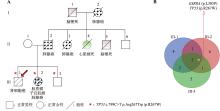
图1
家族性TP53突变谱系及个体间共有和独特变异 A:携带TP53突变的家庭谱系;B:维恩图展示了先证者III-1、先证者之妹III-2及先证者之弟III-3的突变基因集合,并可视化其独有与共享突变的基因。"
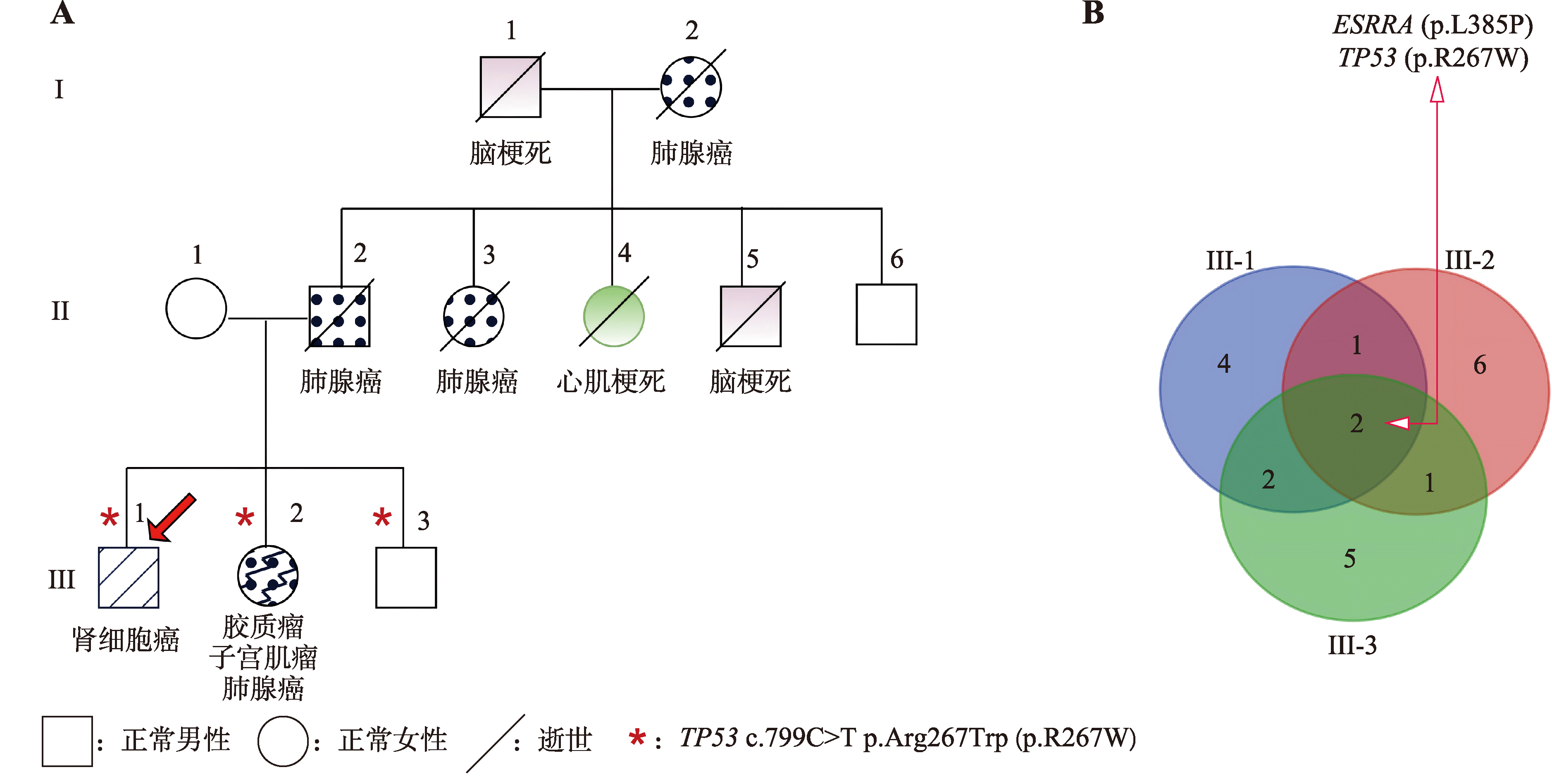
图2
p53 R267W突变的保守性、致病性及结构扰动分析 A:人类p53蛋白质结构示意图。c.799C>T(p.R267W)由箭头标示。TAD:转录激活域;PRD:富含脯氨酸区域;DBD:DNA结合域;TET:四聚体化域;CTD:C末端调控域;B:VarSite数据库的保守性评估p53 R267W突变(p53-Mut)位于DNA结合域高度保守区域;C:基于多种生物信息学工具对R267W突变进行的致病性预测分析结果;D:Swiss-model分析R267W突变,极性保留伴随静电势改变与疏水性降低;E:SOPMA数据库对p53野生型(p53-WT)和p53-Mut蛋白二级结构的预测结果;F:用PyMOL可视化对p53-WT和p53-Mut三维结构的预测效果图。图中红圈标注的即为267R(上)和267W(下)。蓝色代表正电荷,红色代表负电荷。"
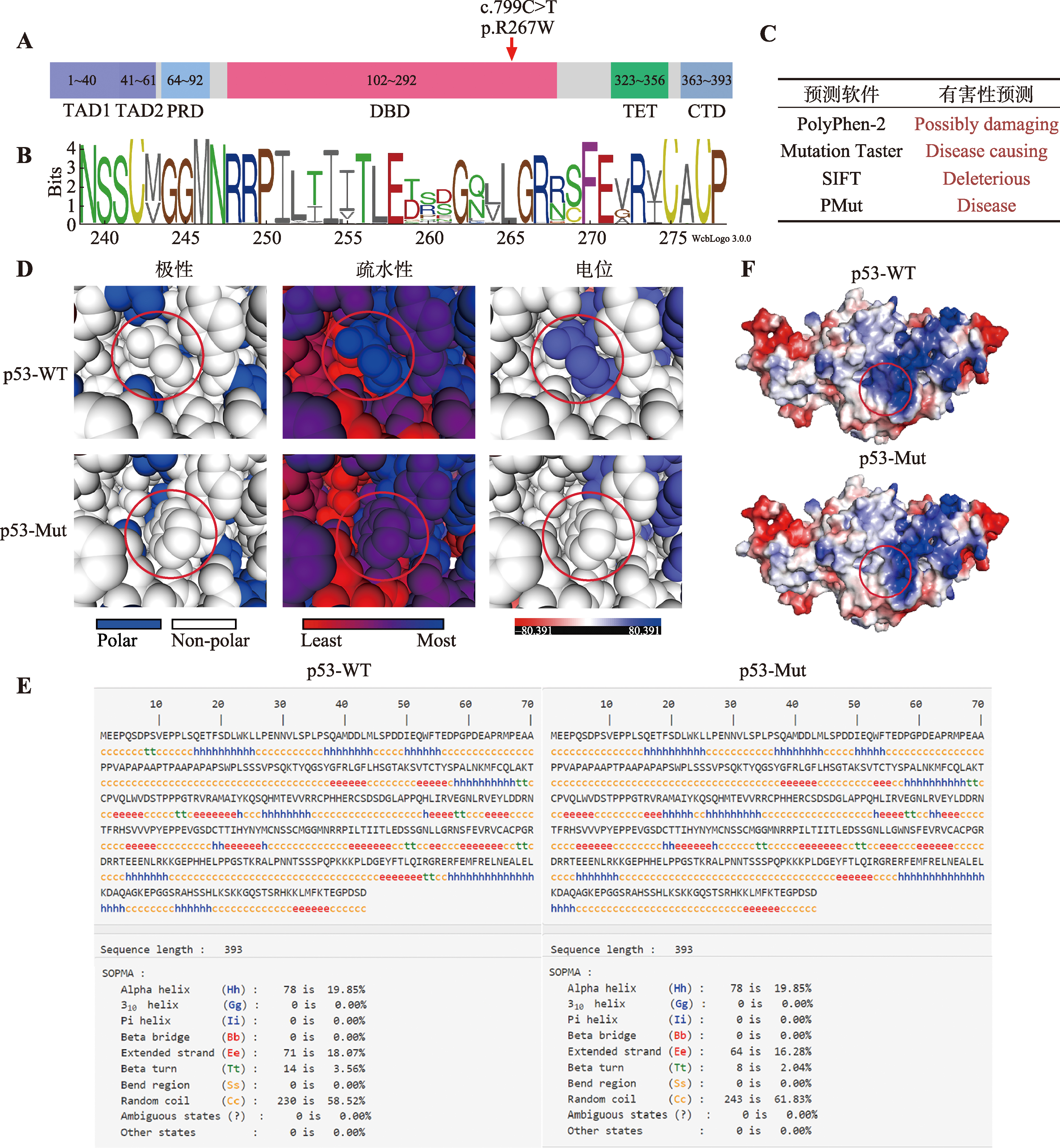
图3
p53 R267W对非小细胞肺癌细胞增殖抑制功能的影响 A和B:qPCR和Western blot检测p53-WT和p53-Mut在A549和NCI-H1299细胞中的mRNA和蛋白表达水平;C:CCK-8实验检测p53-WT和p53-Mut对A549和NCI-H1299细胞增殖的影响。数据为均值±标准差(n=3),因标准差<均值的5%,误差线在当前尺寸下未清晰显示;D和E:平板克隆实验分析p53-WT和p53-Mut对A549和NCI-H1299细胞集落形成的影响及定量分析。*:P<0.05;**:P<0.01;***:P<0.001。n:样本数。"
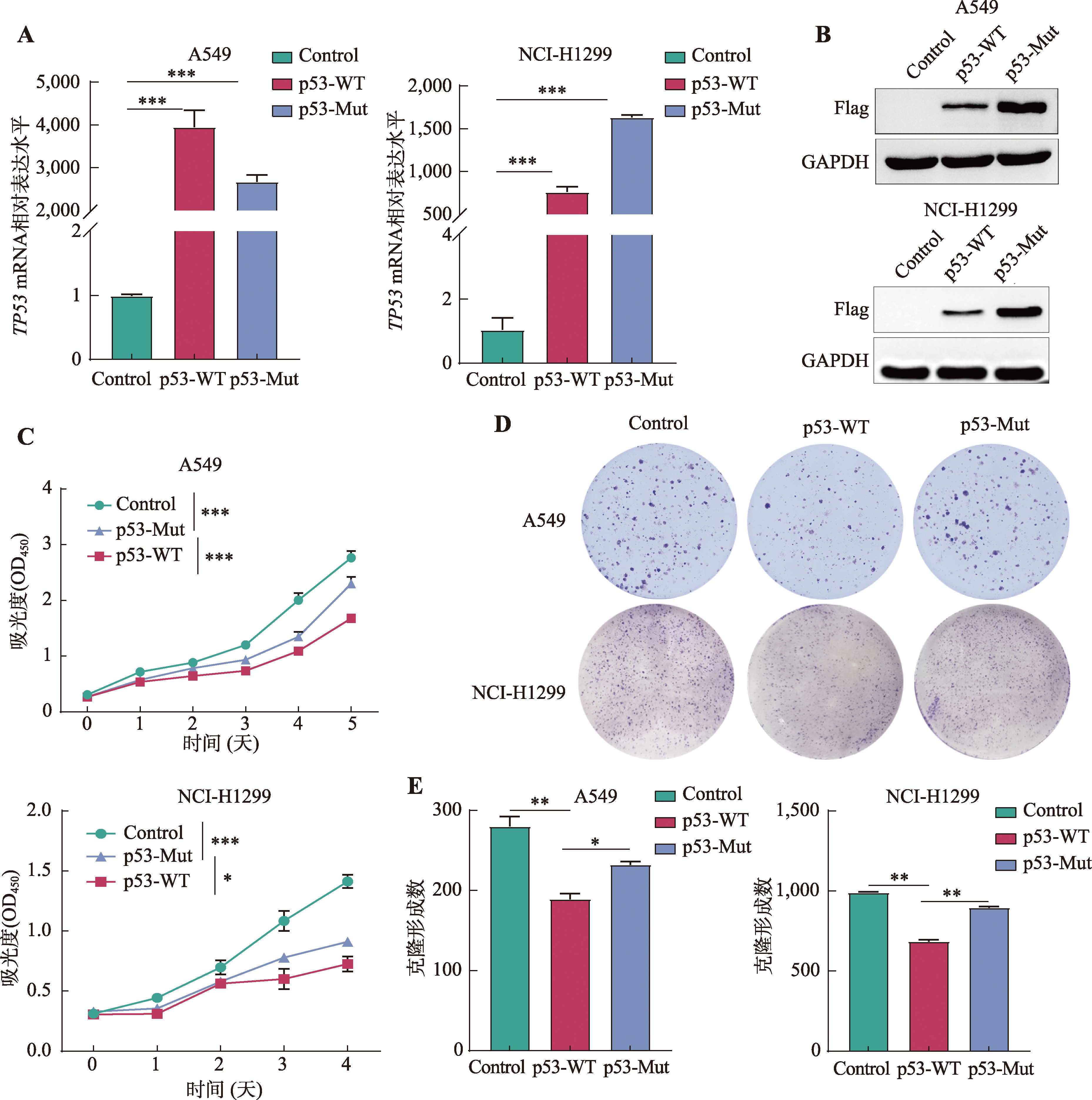
图4
p53 R267W对非小细胞肺癌细胞迁移抑制功能的影响 A和B:Transwell实验分析p53-WT和p53-Mut对A549和NCI-H1299细胞迁移的影响及定量分析;C~F:划痕实验分析p53-WT和p53-Mut对A549和NCI-H1299细胞愈合速度的影响及定量分析。*:P<0.05;**:P<0.01;***:P<0.001。"

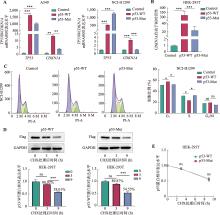
图5
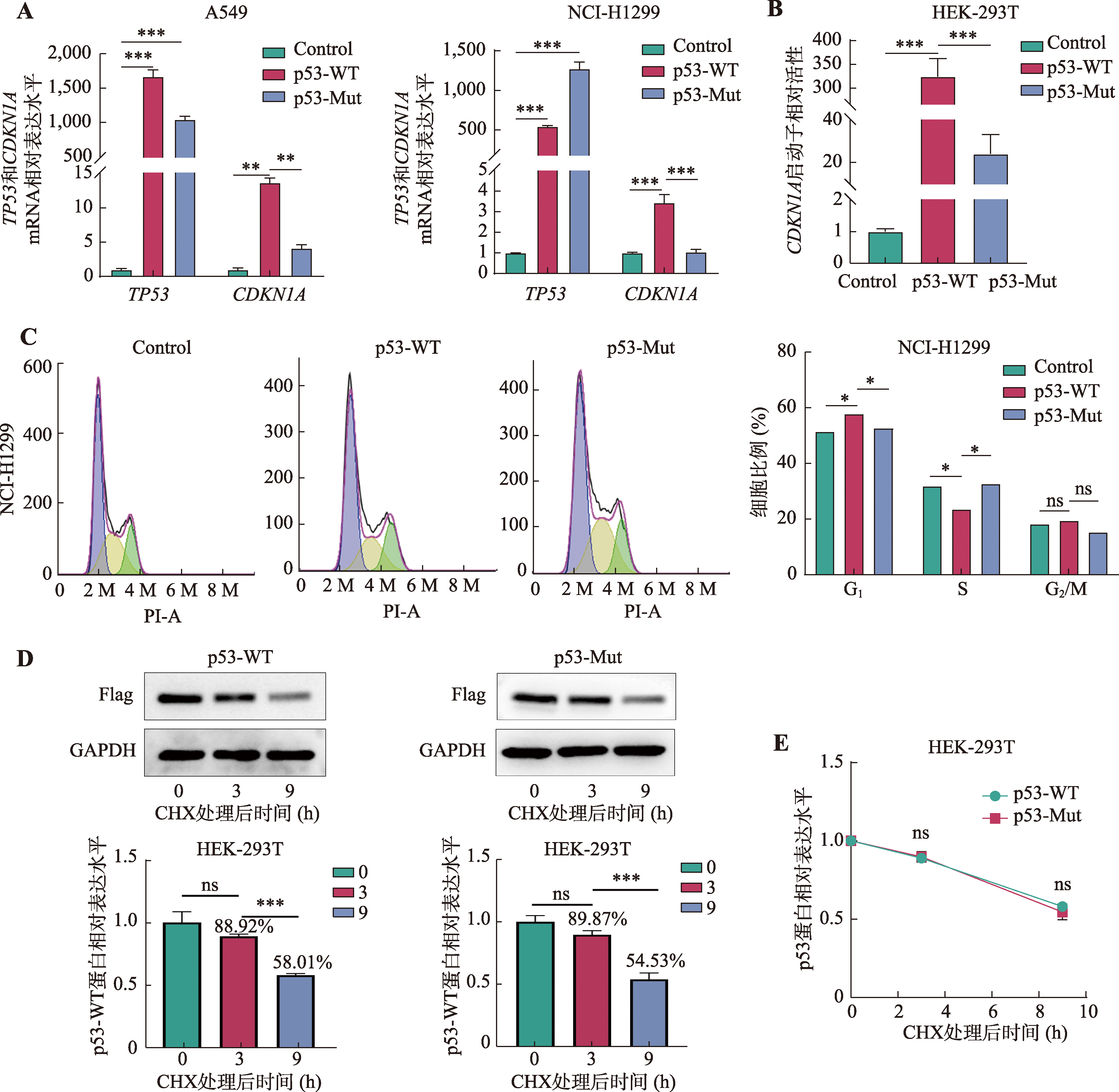
p53 R267W突变削弱转录激活功能但不影响蛋白稳定性 A:在A549和NCI-H1299细胞中过表达p53-WT和p53-Mut,qPCR检测CDKN1A mRNA水平;B:利用单荧光素酶报告基因实验在HEK-293T细胞中评估人CDKN1A基因启动子的转录活性;C:p53-WT和p53-Mut对NCI-H1299细胞周期分布的影响;D:Western blot检测HEK-293T细胞经环己酰亚胺(CHX)处理不同时间点(0 h、3 h、9 h)下p53-WT和p53-Mut蛋白的表达水平变化。使用ImageJ软件对p53-WT和p53-Mut蛋白条带进行灰度定量分析,数据采用归一化处理:以“CHX处理0 h时p53蛋白表达量为100%”,计算各时间点p53-WT和p53-Mut的相对表达量;E:p53-WT和p53-Mut蛋白经量化后的统计分析图,差异无统计学意义(P>0.05)。*:P<0.05;**:P<0.01;***:P<0.001。"
| [1] |
Mckay GE, Zakas AL, Osman F, Parkes A. Factors affecting genetic consultation in adolescent and young adult patients with sarcoma. J Natl Compr Canc Netw, 2021, 1-8.
pmid: 34666309 |
| [2] |
Bieging KT, Mello SS, Attardi LD. Unravelling mechanisms of p53-mediated tumour suppression. Nat Rev Cancer, 2014, 14(5): 359-370.
pmid: 24739573 |
| [3] | Lu SQ, Jia ST, Luo Y. Recent advances in mutant p53 and novel personalized strategies for cancer therapy. Hereditas (Beijing), 2011, 33(6): 539-548. |
| 陆思千, 贾舒婷, 罗瑛. 突变p53功能研究新进展与个性化的肿瘤治疗新策略. 遗传, 2011, 33(6): 539-548. | |
| [4] |
Marvalim C, Datta A, Lee SC. Role of p53 in breast cancer progression: an insight into p53 targeted therapy. Theranostics, 2023, 13(4): 1421-1442.
pmid: 36923534 |
| [5] |
Hassin O, Oren M. Drugging p53 in cancer: one protein, many targets. Nat Rev Drug Discov, 2023, 22(2): 127-144.
pmid: 36216888 |
| [6] |
Wang HL, Guo M, Wei HD, Chen YH. Targeting p53 pathways: mechanisms, structures, and advances in therapy. Signal Transduct Target Ther, 2023, 8(1): 92.
pmid: 36859359 |
| [7] |
Nian ZG, Dou YC, Shen YQ, Liu JT, Du XH, Jiang Y, Zhou YG, Fu BQ, Sun R, Zheng XH, Tian ZG, Wei HM. Interleukin-34-orchestrated tumor-associated macrophage reprogramming is required for tumor immune escape driven by p53 inactivation. Immunity, 2024, 57(10): 2344-2361.e2347.
pmid: 39321806 |
| [8] | Malkin D, Li FP, Strong LC, Fraumeni JF Jr, Nelson CE, Kim DH, Kassel J, Gryka MA, Bischoff FZ, Tainsky MA. Germ line p53 mutations in a familial syndrome of breast cancer, sarcomas, and other neoplasms. Science, 1990, 250(4985): 1233-1238. |
| [9] |
Zhao S, Wen HY, Wang BQ, Xiong QL, Li LX, Cheng AL. p53: a player in the tumor microenvironment. Oncol Res, 2025, 33(4): 795-810.
pmid: 40191727 |
| [10] |
Stein Y, Rotter V, Aloni-Grinstein R. Gain-of-Function Mutant p53: all the roads lead to tumorigenesis. Int J Mol Sci, 2019, 20(24): 6197.
pmid: 31817996 |
| [11] |
Joerger AC, Stiewe T, Soussi T. TP53: the unluckiest of genes? Cell Death Differ, 2025, 32(2): 219-224.
pmid: 39443700 |
| [12] |
Funk JS, Klimovich M, Drangenstein D, Pielhoop O, Hunold P, Borowek A, Noeparast M, Pavlakis E, Neumann M, Balourdas DI, Kochhan K, Merle N, Bullwinkel I, Wanzel M, Elmshäuser S, Teply-Szymanski J, Nist A, Procida T, Bartkuhn M, Humpert K, Mernberger M, Savai R, Soussi T, Joerger AC, Stiewe T. Deep CRISPR mutagenesis characterizes the functional diversity of TP53 mutations. Nat Genet, 2025, 57(1): 140-153.
pmid: 39774325 |
| [13] | Li DH, Zhang LQ, He FC. Advances on mutant p53 research. Hereditas (Beijing), 2008, 30(6): 697-703. |
| 李大虎, 张令强, 贺福初. 突变体p53研究进展. 遗传, 2008, 30(6): 697-703. | |
| [14] |
Kennedy MC, Lowe SW. Mutant p53: it's not all one and the same. Cell Death Differ, 2022, 29(5): 983-987.
pmid: 35361963 |
| [15] |
Chen XH, Zhang TT, Su W, Dou ZH, Zhao DP, Jin XD, Lei HW, Wang J, Xie XD, Cheng B, Li Q, Zhang H, Di CX. Mutant p53 in cancer: from molecular mechanism to therapeutic modulation. Cell Death Dis, 2022, 13(11): 974.
pmid: 36400749 |
| [16] |
Leroy B, Fournier JL, Ishioka C, Monti P, Inga A, Fronza G, Soussi T. The TP53 website: an integrative resource centre for the TP53 mutation database and TP53 mutant analysis. Nucleic Acids Res, 2013, 41(Database issue): D962-D969.
pmid: 23161690 |
| [17] |
Muller PAJ, Vousden KH. p53 mutations in cancer. Nat Cell Biol, 2013, 15(1): 2-8.
pmid: 23263379 |
| [18] |
Shah MV, Arber DA, Hiwase DK. TP53-Mutated Myeloid Neoplasms: 2024 update on diagnosis, risk-stratification, and management. Am J Hematol, 2025, 100 Suppl 4(Suppl 4): 88-115.
pmid: 40066944 |
| [19] |
Kotler E, Shani O, Goldfeld G, Lotan-Pompan M, Tarcic O, Gershoni A, Hopf TA, Marks DS, Oren M, Segal E. A systematic p53 mutation library links differential functional impact to cancer mutation pattern and evolutionary conservation. Mol Cell, 2018, 71(5): 873.
pmid: 30193102 |
| [20] |
Zhang C, Liu J, Xu DD, Zhang TL, Hu WW, Feng ZH. Gain-of-function mutant p53 in cancer progression and therapy. J Mol Cell Biol, 2020, 12(9): 674-687.
pmid: 32722796 |
| [21] |
Liu YQ, Su ZY, Tavana O, Gu W. Understanding the complexity of p 53 in a new era of tumor suppression. Cancer Cell, 2024, 42(6): 946-967.
pmid: 38729160 |
| [22] |
Riley T, Sontag E, Chen P, Levine A. Transcriptional control of human p53-regulated genes. Nat Rev Mol Cell Biol, 2008, 9(5): 402-412.
pmid: 18431400 |
| [23] |
Cho Y, Gorina S, Jeffrey PD, Pavletich NP. Crystal structure of a p 53 tumor suppressor-DNA complex: understanding tumorigenic mutations. Science, 1994, 265(5170): 346-355.
pmid: 8023157 |
| [24] |
Su ZY, Kon N, Yi JJ, Zhao HQ, Zhang WW, Tang QS, Li H, Kobayashi H, Li ZM, Duan SF, Liu YQ, Olive KP, Zhang ZG, Honig B, Manfredi JJ, Rustgi AK, Gu W. Specific regulation of BACH1 by the hotspot mutant p53R175H reveals a distinct gain-of-function mechanism. Nat Cancer, 2023, 4(4): 564-581.
pmid: 36973430 |
| [25] |
Klemm N, Schimmer RR, Konrad NK, Thelen F, Fullin J, Topçu E, Koch C, Treacy M, Leventhal MJ, Bühler MM, Lysenko V, Theocharides APA, Kurppa KJ, Balabanov S, Baubec T, Krivtsov AV, Miller PG, Armstrong SA, Ebert BL, Manz MG, Nombela-Arrieta C, Boettcher S. The prolonged half-life of the p53 missense variant R248Q promotes accumulation and heterotetramer formation with wild-type p53 to exert the dominant-negative effect. Cancer Res, 2025, 85(11): 1978-1996.
pmid: 40163352 |
| [26] |
Olivier M, Hollstein M, Hainaut P. TP53 mutations in human cancers: origins, consequences, and clinical use. Cold Spring Harb Perspect Biol, 2010, 2(1): a001008.
pmid: 20182602 |
| [27] |
Pan ZZ, Wang K, Wang XN, Jia ZR, Yang YQ, Duan YL, Huang LZ, Wu ZX, Zhang JY, Ding XS. Cholesterol promotes EGFR-TKIs resistance in NSCLC by inducing EGFR/Src/Erk/SP1 signaling-mediated ERRα re-expression. Mol Cancer, 2022, 21(1): 77.
pmid: 35303882 |
| [28] |
Feng C, Kong DM, Tong BH, Liang YH, Xu FY, Yang YY, Wu YY, Chi XD, Wei PF, Yang Y, Zhang GL, Tian G, Xu ZW. Hypoxia-triggered ERRα acetylation enhanced its oncogenic role and promoted progression of renal cell carcinoma by coordinating autophagosome-lysosome fusion. Cell Death Dis, 2025, 16(1): 23.
pmid: 39820331 |
| [29] |
Xu-Monette ZY, Wu L, Visco C, Tai YC, Tzankov A, Liu WM, Montes-Moreno S, Dybkaer K, Chiu A, Orazi A, Zu YL, Bhagat G, Richards KL, Hsi ED, Zhao XF, Choi WWL, Zhao XY, Van Krieken JH, Huang Q, Huh J, Ai WY, Ponzoni M, Ferreri AJM, Zhou F, Kahl BS, Winter JN, Xu W, Li JY, Go RS, Li Y, Piris MA, Møller MB, Miranda RN, Abruzzo LV, Medeiros LJ, Young KH. Mutational profile and prognostic significance of TP53 in diffuse large B-cell lymphoma patients treated with R-CHOP:report from an International DLBCL Rituximab-CHOP Consortium Program Study. Blood, 2012, 120(19): 3986-3996.
pmid: 22955915 |
| [30] |
Fang Y, Zhang MC, He Y, Li C, Fang H, Xu PP, Cheng S, Zhao Y, Feng Y, Liu Q, Wang L, Zhao WL. Human endogenous retroviruses as epigenetic therapeutic targets in TP53-mutated diffuse large B-cell lymphoma. Signal Transduct Target Ther, 2023, 8(1): 381.
pmid: 37798292 |
| [31] |
Abduljaleel Z. Molecular insights into TP53 mutation (p. Arg267Trp) and its connection to choroid plexus carcinomas and Li-Fraumeni syndrome. Genes Genomics, 2024, 46(8): 941-953.
pmid: 38896352 |
| [32] |
Ma FY, Laster K, Dong ZG. The comparison of cancer gene mutation frequencies in Chinese and U.S. patient populations. Nat Commun, 2022, 13(1): 5651.
pmid: 36163440 |
| [33] |
Bray F, Laversanne M, Sung H, Ferlay J, Siegel RL, Soerjomataram I, Jemal A. Global cancer statistics 2022: GLOBOCAN estimates of incidence and mortality worldwide for 36 cancers in 185 countries. CA Cancer J Clin, 2024, 74(3): 229-263.
pmid: 38572751 |
| [34] | Levine AJ. The p53 tumor-suppressor gene. N Engl J Med, 1992, 326(20): 1350-1352. |
| [35] |
Engeland K. Cell cycle regulation: p53-p21-RB signaling. Cell Death Differ, 2022, 29(5): 946-960.
pmid: 35361964 |
| [36] |
Klimovich B, Merle N, Neumann M, Elmshäuser S, Nist A, Mernberger M, Kazdal D, Stenzinger A, Timofeev O, Stiewe T. p53 partial loss-of-function mutations sensitize to chemotherapy. Oncogene, 2022, 41(7): 1011-1023.
pmid: 34907344 |
| [37] |
Fulci G, Ishii N, Maurici D, Gernert KM, Hainaut P, Kaur B, Van Meir EG. Initiation of human astrocytoma by clonal evolution of cells with progressive loss of p 53 functions in a patient with a 283H TP53 germ-line mutation: evidence for a precursor lesion. Cancer Res, 2002, 62(10): 2897-2905.
pmid: 12019170 |
| [1] | 张德洋, 周文川, 李佳乐, 王哲鹏. ABCG2基因错义突变C21R与略阳乌鸡褐壳显著关联[J]. 遗传, 2024, 46(12): 1066-1075. |
| [2] | 孙清玙, 周阳, 杜丽娟, 张梦珂, 王家乐, 任媛媛, 刘芳. 巨噬细胞相关基因与非小细胞肺癌预后和肿瘤微环境的分析[J]. 遗传, 2023, 45(8): 684-699. |
| [3] | 宋青青, 张素素, 张振, 孙嘉, 杨锐, 李佶桐, 陈宏. 一例CYP11B基因突变导致11β-羟化酶缺乏症的诊疗和基因检测分析[J]. 遗传, 2022, 44(12): 1175-1182. |
| [4] | 王娅洁, 吴爽爽, 储江, 孔祥阳. 肺部微生物组通过炎症反应介导慢性阻塞性肺疾病转化为肺癌的研究进展[J]. 遗传, 2021, 43(1): 30-39. |
| [5] | 孙晓伟,李宏阳,王健,程博. PRC1.6复合体表观遗传调控生殖谱系特异性基因的时空表达[J]. 遗传, 2019, 41(4): 271-284. |
| [6] | 吴保军,王卓,董宇,邓宇亮,施奇惠. 肺癌恶性胸腔积液中稀有肿瘤细胞的鉴定与单细胞测序分析[J]. 遗传, 2019, 41(2): 175-184. |
| [7] | 史悦,许争争,鲁欢,慈维敏. 肿瘤突变特征与病理分型的关联研究[J]. 遗传, 2018, 40(11): 1033-1038. |
| [8] | 付思玲,赵婉滢,张雯婧,宋海,季红斌,汤楠. Hippo信号通路在肺发育、再生和疾病中的功能[J]. 遗传, 2017, 39(7): 597-606. |
| [9] | 王诗铭, 宋晓, 赵雪莹, 陈红岩, 王久存, 吴俊杰, 高志强, 钱吉, 白春学, 李强, 韩宝惠, 卢大儒. 自噬通路基因多态性与晚期非小细胞肺癌含铂化疗疗效的相关性分析[J]. 遗传, 2017, 39(3): 250-262. |
| [10] | 杨丽华,董琢,龚朝辉. 细胞外微RNA:一种新型的肺癌分子生物标志物[J]. 遗传, 2012, 34(6): 651-658. |
| [11] | 李海静,刘岩,郝海生,杜卫华,赵学明,王栋,秦彤,马友记,朱化彬. 表皮生长因子受体与肺脏发育的关系[J]. 遗传, 2012, 34(1): 27-32. |
| [12] | 张晓博,赵振宏,陈红岩,王久存,钱吉,杨亚军,魏庆义,黄建,卢大儒. 人染色体8p11(CHRNB3-CHRNA6)区域基因多态性与中国汉族人群肺癌易感性的相关性[J]. 遗传, 2011, 33(8): 886-894. |
| [13] | 马克学,席兴字. Polycomb group蛋白复合体[J]. 遗传, 2009, 31(10): 977-981. |
| [14] | 黄骥,张红生. TFⅢA型锌指蛋白及在提高植物耐逆性中的作用[J]. 遗传, 2007, 29(8): 915-922. |
| [15] | 田春艳,张令强,贺福初. KRAB型锌指蛋白(KZNF)的研究进展[J]. 遗传, 2006, 28(11): 1451-1456. |
| 阅读次数 | ||||||
|
全文 |
|
|||||
|
摘要 |
|
|||||

www.chinagene.cn
备案号:京ICP备09063187号-4
总访问:,今日访问:,当前在线:

