
遗传 ›› 2026, Vol. 48 ›› Issue (6): 614-627.doi: 10.16288/j.yczz.25-349
张曼婷1( ), 卢梓豪1, 聂敏琪1, 谭裕翔1, 梁启梅1, 骆懋彦1, 戴永东1, 李锦涛1, 陈炜1, 陈紫媚1, 和家贤1,2, 李美娜1()
收稿日期:2025-12-29
修回日期:2026-03-09
出版日期:2026-06-20
发布日期:2026-04-02
通讯作者:
李美娜,博士,教授,研究方向:大豆杂种优势和生物钟与环境互作。E-mail: limeina@gzhu.edu.cn作者简介:张曼婷,硕士研究生,专业方向:植物学。E-mail: 1436291159@qq.com
基金资助:
Manting Zhang1(), Zihao Lu1, Minqi Nie1, Yuxiang Tan1, Qimei Liang1, Maoyan Luo1, Yongdong Dai1, Jintao Li1, Wei Chen1, Zimei Chen1, Jiaxian He1,2, Meina Li1()
Received:2025-12-29
Revised:2026-03-09
Published:2026-06-20
Online:2026-04-02
Supported by:摘要:
我国的大豆(Glycine max)供给严重依赖国际市场,提升国内自给能力已成为保障粮食安全的紧迫任务。全国土壤普查数据显示,我国拥有约5亿亩盐渍土资源,其中约2亿亩具备农业开发潜力。在耕地资源紧张的背景下,培育耐盐碱大豆新品种,是实现盐碱地资源有效利用、扩大种植面积并应对土壤盐渍化挑战的战略性举措。快速碱化因子(rapid alkalinization factor,RALF)是一类作为配体的植物小肽,通过结合质膜受体复合物启动下游信号,协调植物生长发育与逆境响应。然而RALF小肽在大豆等重要作物中介导盐碱胁迫应答的具体分子机制尚不明确。本研究通过对大豆RALF家族进行表达模式分析,并结合碱性盐处理下的转录组数据,发现拟南芥(Arabidopsis thaliana)的AtRALF34在大豆中的两个同源基因GmRALF34a和GmRALF34b在根中优势表达,且其表达在碱性盐处理后受到显著抑制。利用基因编辑技术获得Gmralf34ab双突变体,该突变体表现为对碱性盐胁迫敏感性增强,相比之下,在中性盐胁迫下,突变体与野生型无显著差异。大田表型鉴定进一步表明,突变体在株高、节数和单株产量等农艺性状上均显著降低。综上,本研究初步揭示了GmRALF34s在大豆响应碱性盐胁迫及盐碱地适应性中扮演着重要角色,为深入解析其分子机制提供了重要遗传材料,并为大豆耐盐碱育种奠定了理论与材料基础。
张曼婷, 卢梓豪, 聂敏琪, 谭裕翔, 梁启梅, 骆懋彦, 戴永东, 李锦涛, 陈炜, 陈紫媚, 和家贤, 李美娜. 大豆快速碱化因子GmRALF34s响应盐碱胁迫的功能研究[J]. 遗传, 2026, 48(6): 614-627.
Manting Zhang, Zihao Lu, Minqi Nie, Yuxiang Tan, Qimei Liang, Maoyan Luo, Yongdong Dai, Jintao Li, Wei Chen, Zimei Chen, Jiaxian He, Meina Li. Functional study of the soybean rapid alkalinization factor GmRALF34s in response to saline-alkali stress[J]. Hereditas(Beijing), 2026, 48(6): 614-627.
表1
本研究所用的引物信息"
| 引物名称 | 引物序列(5′→3′) | 用途 |
|---|---|---|
| sgRNA-1 | CCTGTCCCCTGTCCCCTGTC | 敲除靶点 |
| sgRNA-2 | AGGTTGGCGTGCAGGCGCAG | |
| sgRNA-3 | CCCACGTTGCCGTGCAGGCG | |
| sgRNA-4 | CGTTGCCGTGCAGGCGCACA | |
| TEST | F:TGCTACCCTCATCCATCAGTC | 骨架鉴定 |
| R:TGTTGTGTGGAATTGTGAGCG | ||
| RALF34a | F:ATGGCTTCTTCTCTTCCTCTTC | 靶点测序 |
| R:TCATCTCCGGCAGCGCGTGATG | ||
| RALF34b | F:ATGGCTTCTCTTCTCACCCTCGC | |
| R:TCATCTCCGGCAGCGCGTGATG | ||
| qRT-34a | F:AACTCATACCTGTGACCGTG | qRT-PCR |
| R:TCCGACATGAGGTTCAAGCC | ||
| qRT-34b | F:ATGGCTTCTCTTCTCACCCT | |
| R:ACTTCATCCGCCGCCAGAAC | ||
| F-box | F:ATGGTCGCCGTTTAGAACAC | 内参基因 |
| R:GGGATAACCAGTGCAGAAGC |
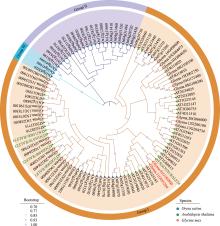
图1
大豆、拟南芥和水稻RALF小肽的进化关系 基于大豆、拟南芥和水稻中RALF小肽氨基酸序列,使用MEGA11软件进行多重序列比对后通过NJ法构建系统发育树,Bootstrap值设置为1,000。使用iTOL软件对分支分别使用橙色、蓝色和紫色进行区分,紫色圆圈代表分支支持率,圆圈越大,支持率越高。红色字体指示本研究的目的基因,绿色字体指示已发表的调控拟南芥生长发育和胁迫响应的关键RALF小肽。"
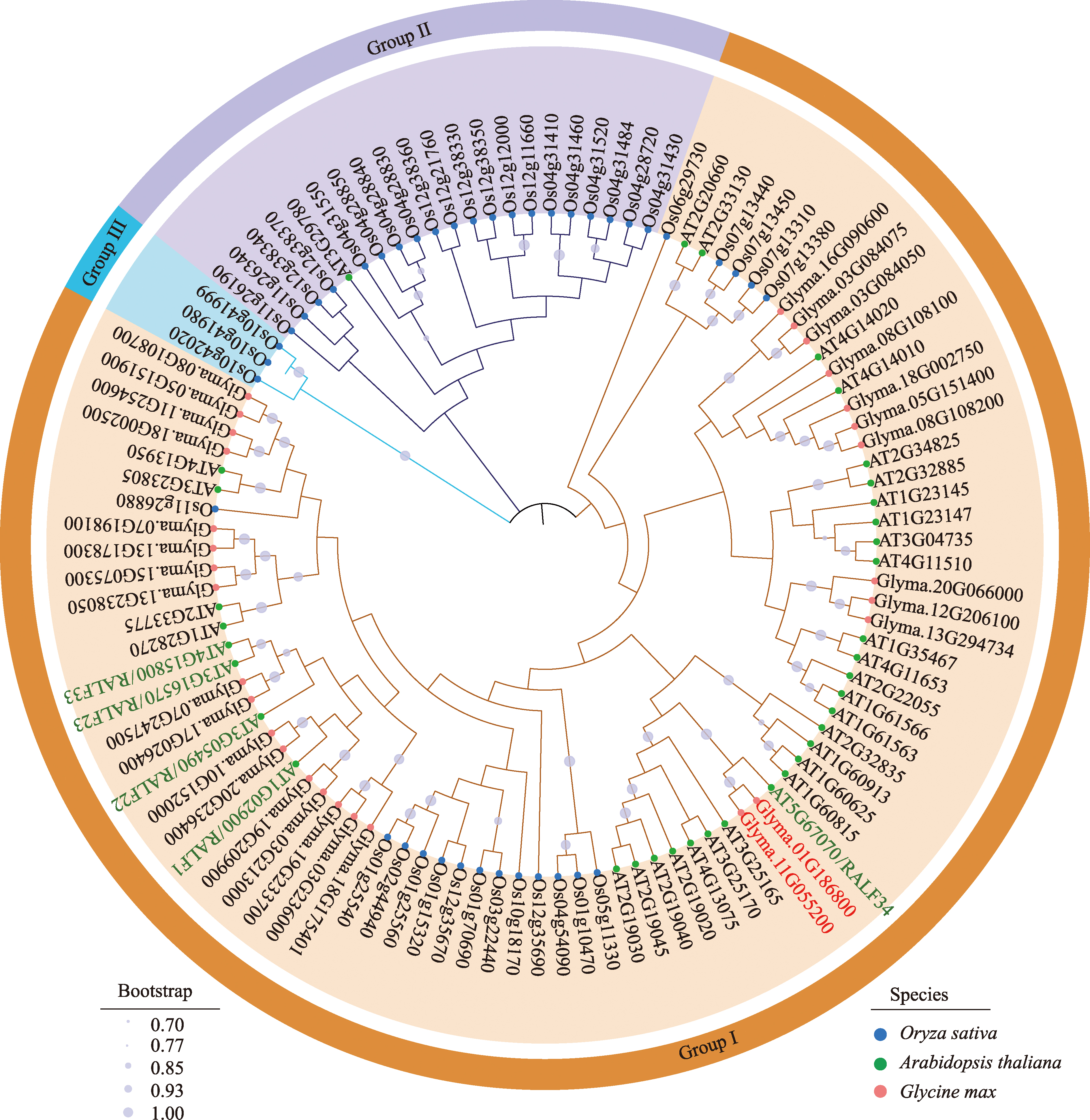
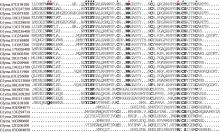
图2
大豆RALF小肽C端序列分析 利用DNAMAN软件对大豆RALF小肽氨基酸C端序列进行序列比对分析。红色五角星对应碱性基序,由两个丝氨酸连接而成;黑色五角星对应YISY基序;蓝色五角星对应半胱氨酸残基。"
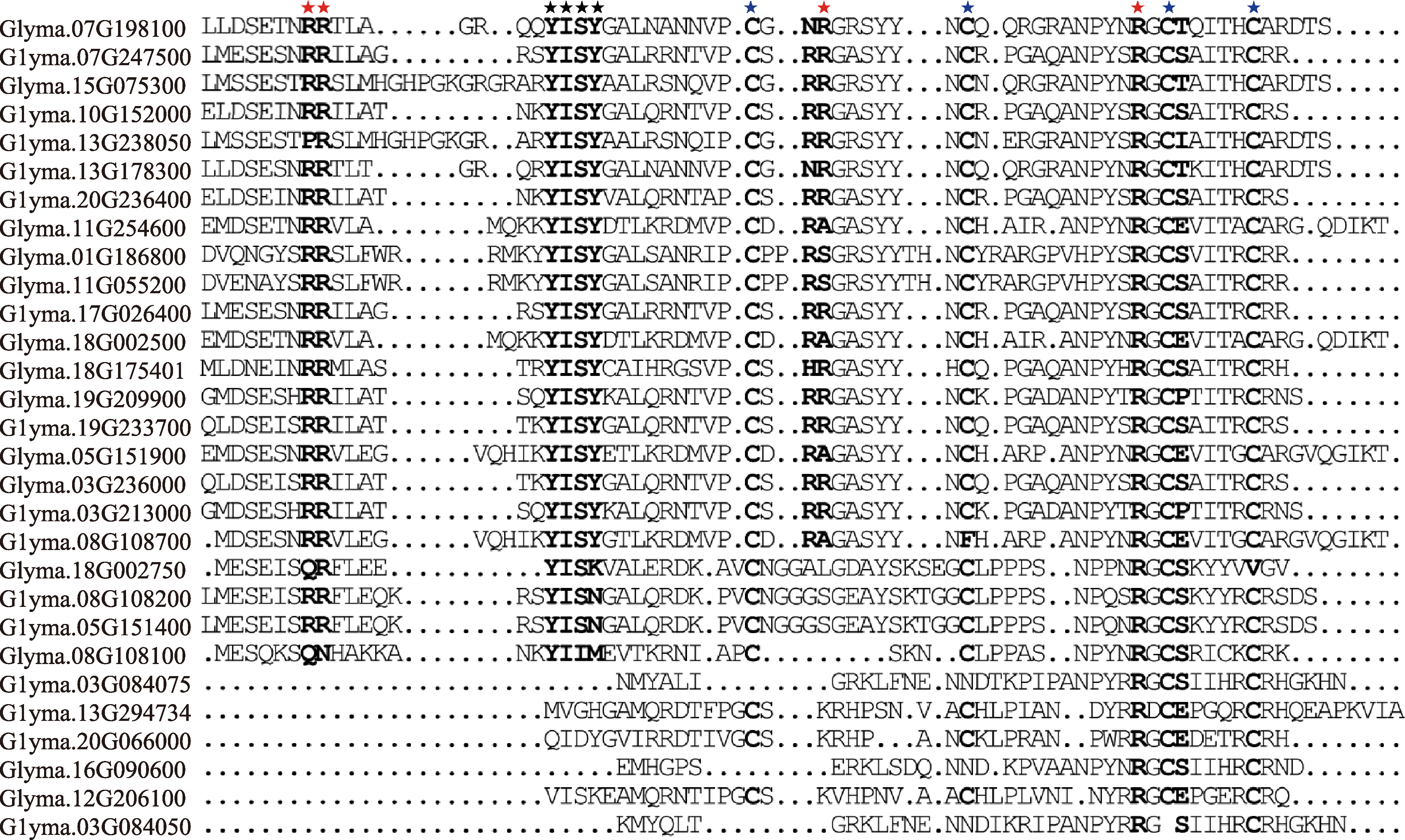
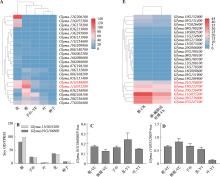
图3
大豆GmRALF组织表达特异性及碱性盐胁迫响应 A:大豆RALF家族基因在花、根、VE(emergence)期子叶、叶和种子中的FPKM数值表达热图及系统聚类分析(数据来源Soy OD)。热图颜色梯度代表标准化表达信号值(红色:高表达;蓝色:低表达)。B:公共数据库转录组数据中Glyma.01G186800与Glyma.11G055200在根、子叶、叶、花和种子中的表达丰度。C和D:qRT-PCR验证Glyma.01G186800与Glyma.11G055200在VC(cotyledon)时期根与侧根、子叶、V1(first trifoliolate)时期的茎和叶片的表达丰度。内参基因为F-box。E:RALF家族基因在大豆根组织(50 mmol/L NaHCO3,pH 8.5)碱性盐胁迫处理4 h后的FPKM数值表达热图及系统聚类分析。CK代表对照组(0 mmol/L NaHCO3,pH 5.8),热图颜色梯度代表标准化表达信号值(红色:高表达;蓝色:低表达)。"
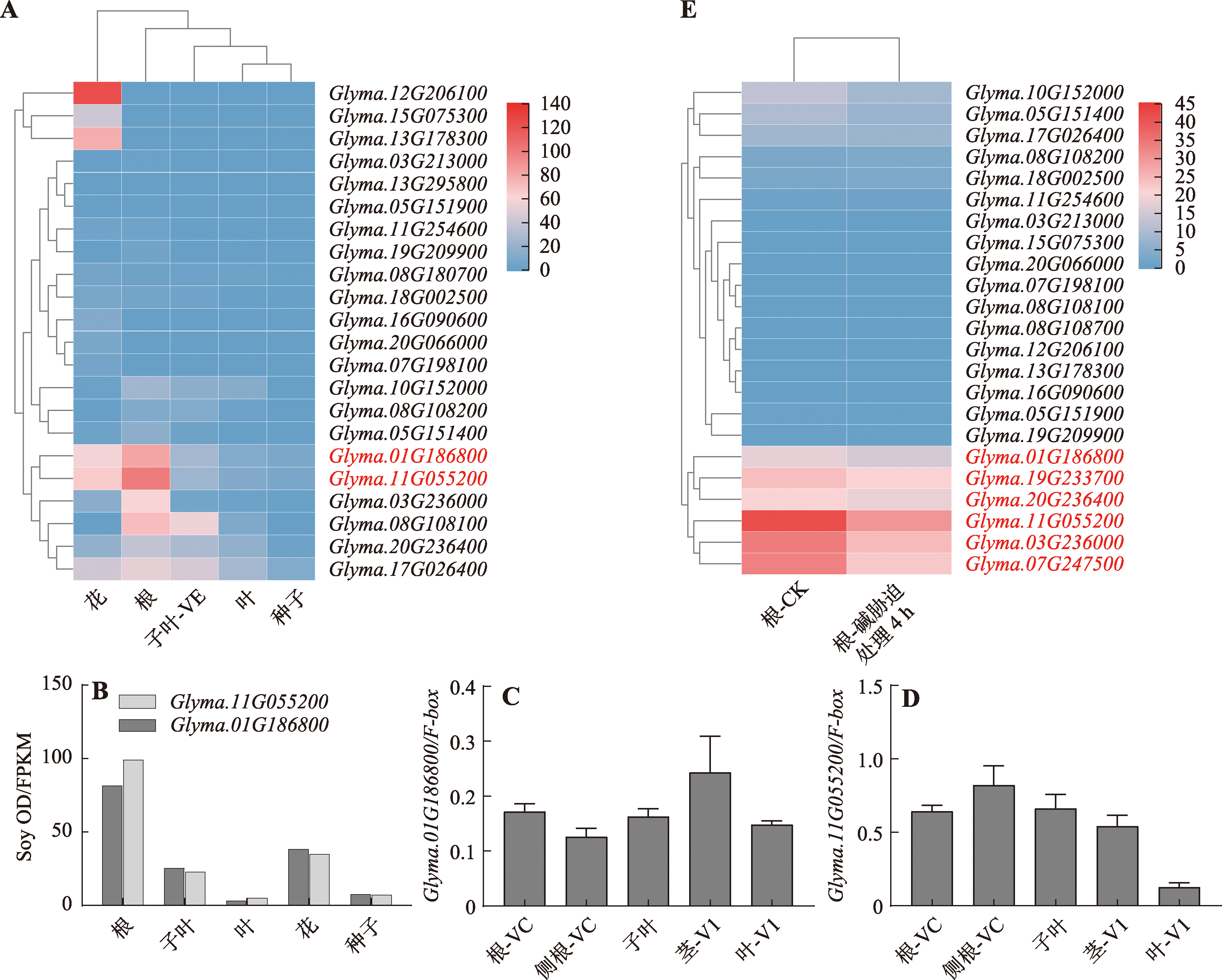
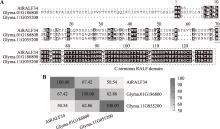
图4
大豆GmRALF34s与AtRALF34蛋白序列比对和相似性分析 A:利用DNAMAN软件对拟南芥AtRALF34与大豆Glyma.11G055200、Glyma.01G186800的氨基酸序列进行比对分析;B:利用TBtool软件分析拟南芥AtRALF34与大豆Glyma.11G055200、Glyma.01G186800三者的亲缘关系。相似性矩阵及热图颜色深度与相似性正相关。"
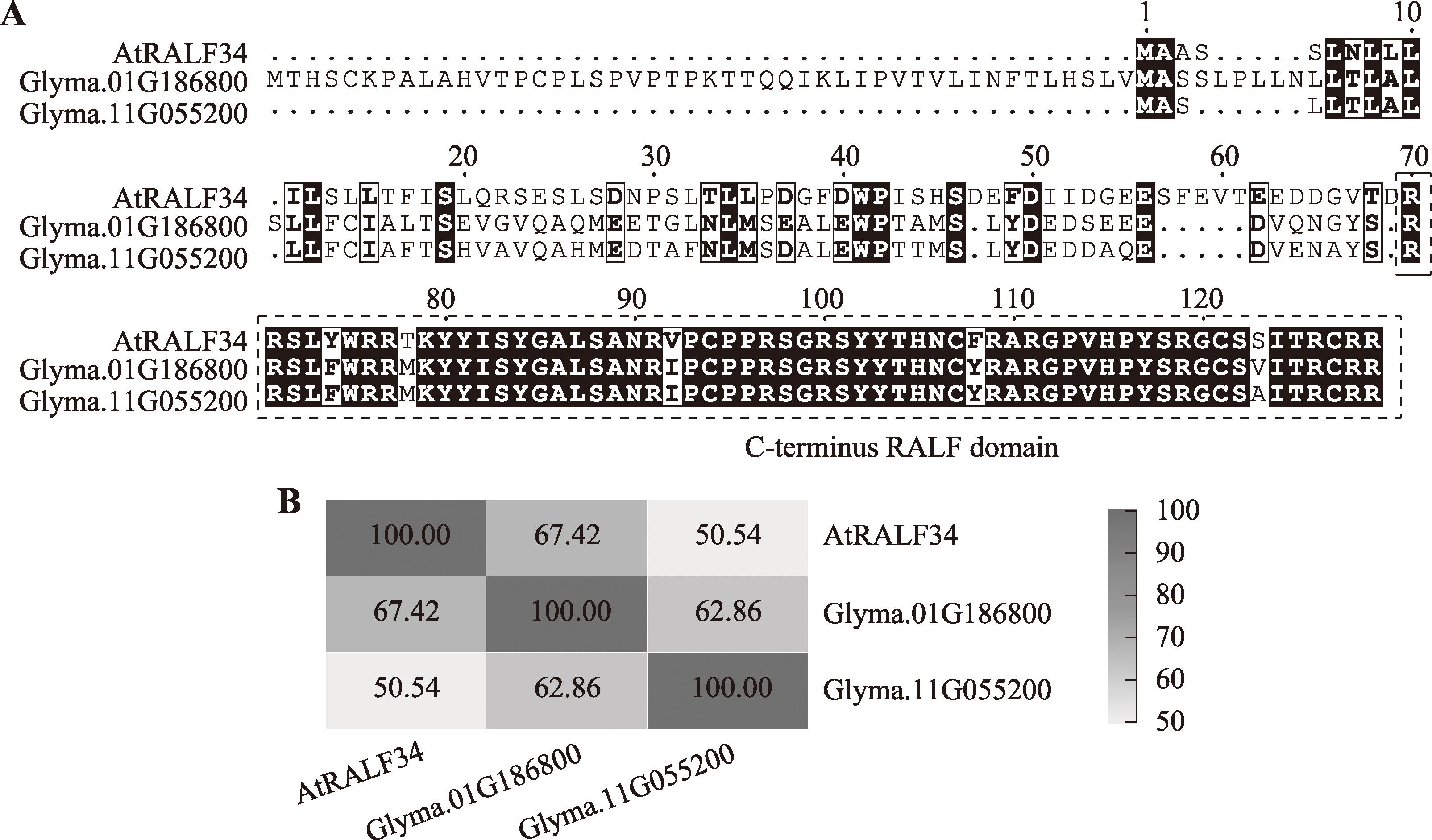
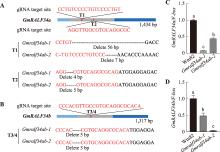
图5
大豆GmRALF34s基因结构及基因编辑突变体示意图 A:GmRALF34a基因结构及突变形式。B:GmRALF34b基因结构及突变形式。浅蓝色方框:5′-UTR;深蓝色方框:3′-UTR;灰色方框:外显子区域;红色方框:靶点位置;黑色虚线:缺失。C和D:Gmralf34ab-1和Gmralf34ab-2双突变体中GmRALF34a和GmRALF34b基因的相对表达量。采用单因素方差分析进行显著性分析,数据为3次生物学重复的均值±标准差,不同小写字母表示处理间差异极显著(P<0.0001)。"
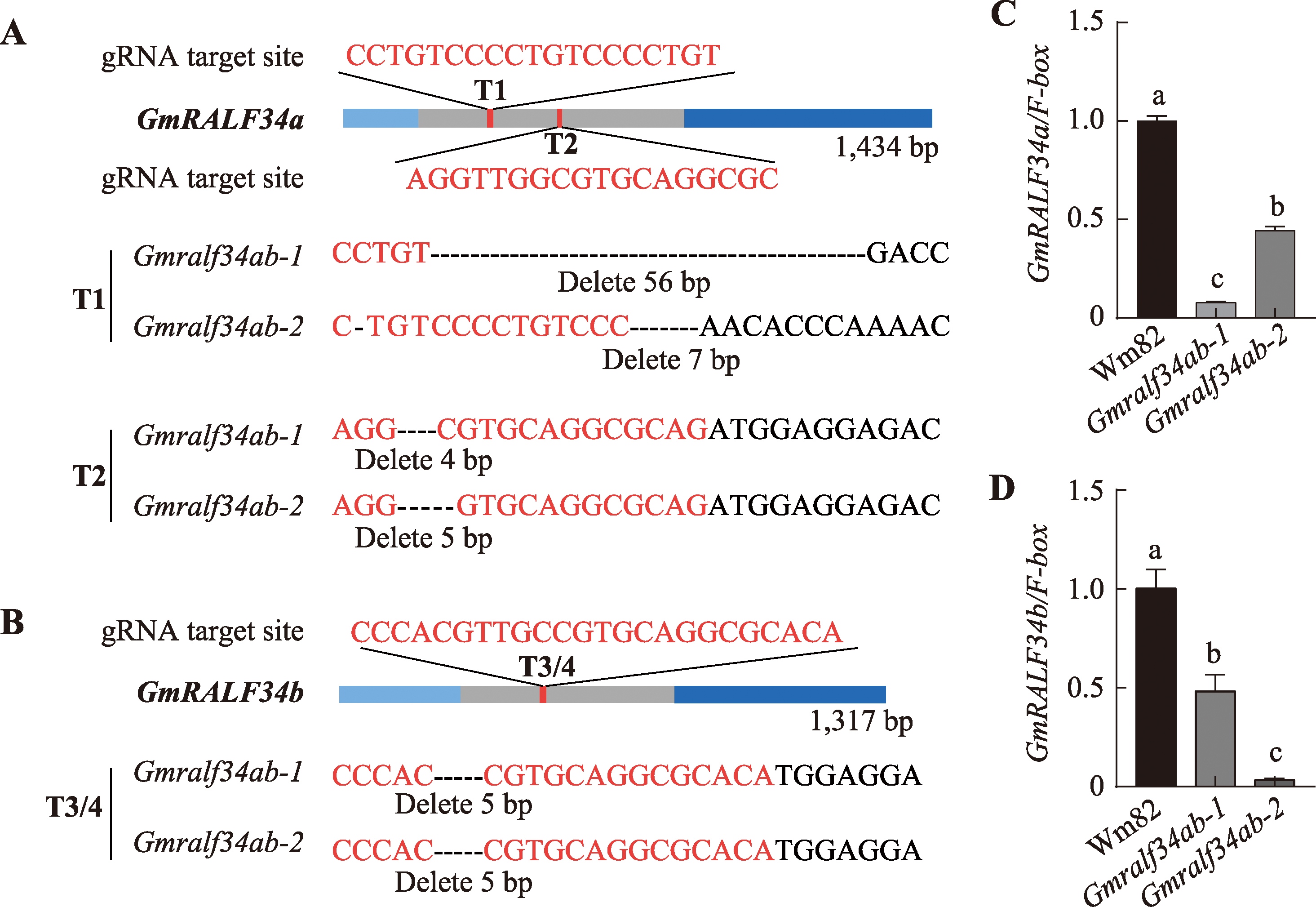
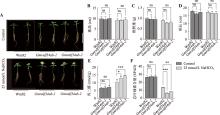
图6
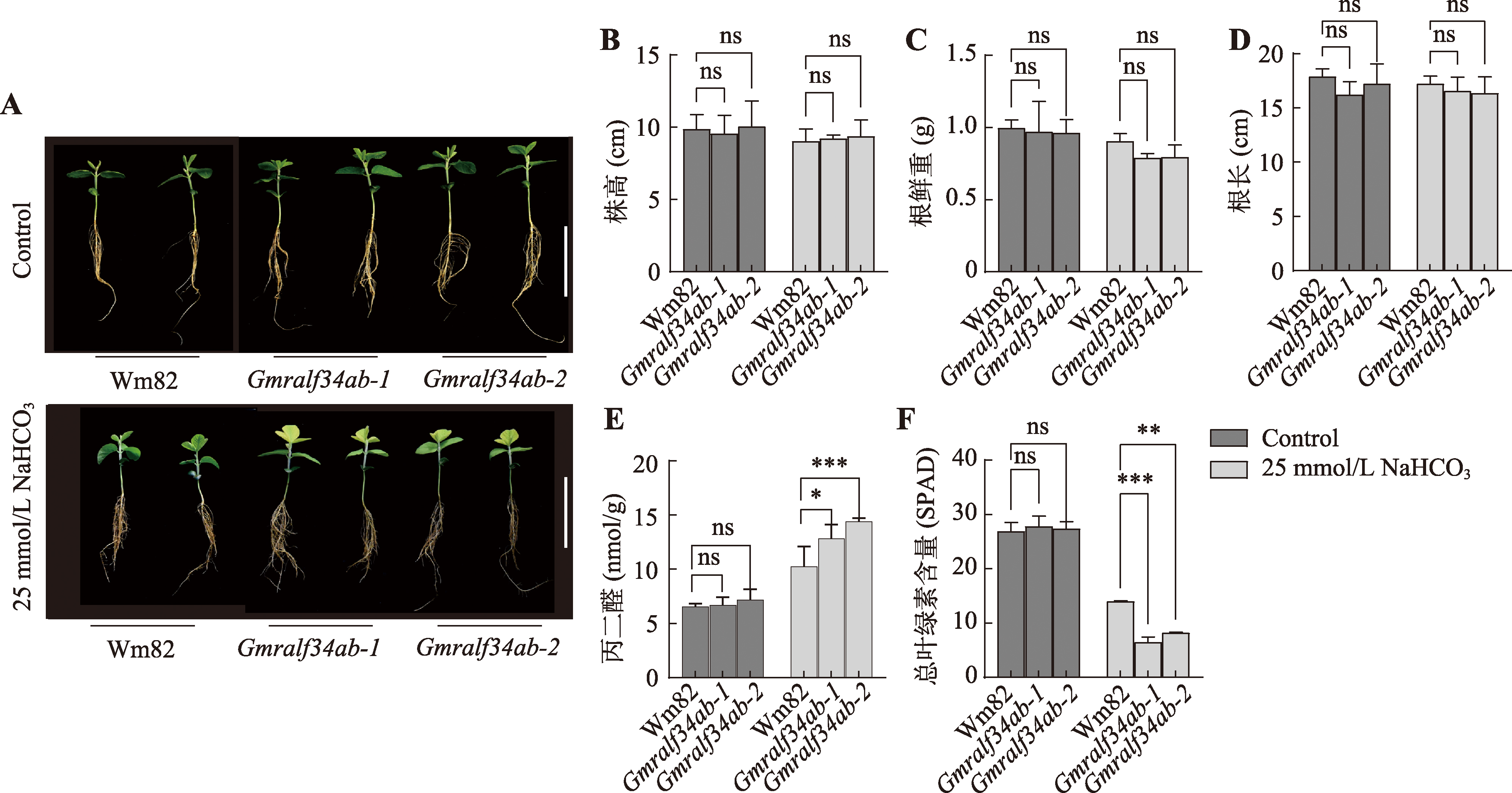
大豆GmRALF34s功能缺失突变体在碱性盐胁迫下的表型及生理参数分析 A:碱性盐胁迫下大豆Gmralf34ab双突变体的表型。将5日龄野生型Wm82、Gmralf34ab-1与Gmralf34ab-2双突变体置于0 mmol/L NaHCO3(pH 5.8) (Control)和25 mmol/L NaHCO3(pH 8.3)条件下,生长12天后拍照记录,比例尺为10 cm。B~F:对应处理下野生型Wm82、Gmralf34ab-1与Gmralf34ab-2双突变体的株高、根鲜重、根长、丙二醛(MDA)含量和总叶绿素含量。采用t检验进行显著性分析,ns表示无显著性差异(P>0.05),*P<0.05表示差异显著,**P<0.01和***P<0.001表示差异极显著,n≥6。"
附图1
大豆GmRALF34s功能缺失突变体在中性盐胁迫下的表型及生理参数分析 A:野生型Wm82与Gmralf34ab-1双突变体在0 mmol/L NaCl(Control)及75 mmol/L NaCl下的植株表型。比例尺:10 cm。;B~E:对应处理下的根长、根鲜重、苗鲜重和株高。采用单因素方差分析进行显著性分析,n≥6,相同字母表示组间差异不显著(P>0.05)。"
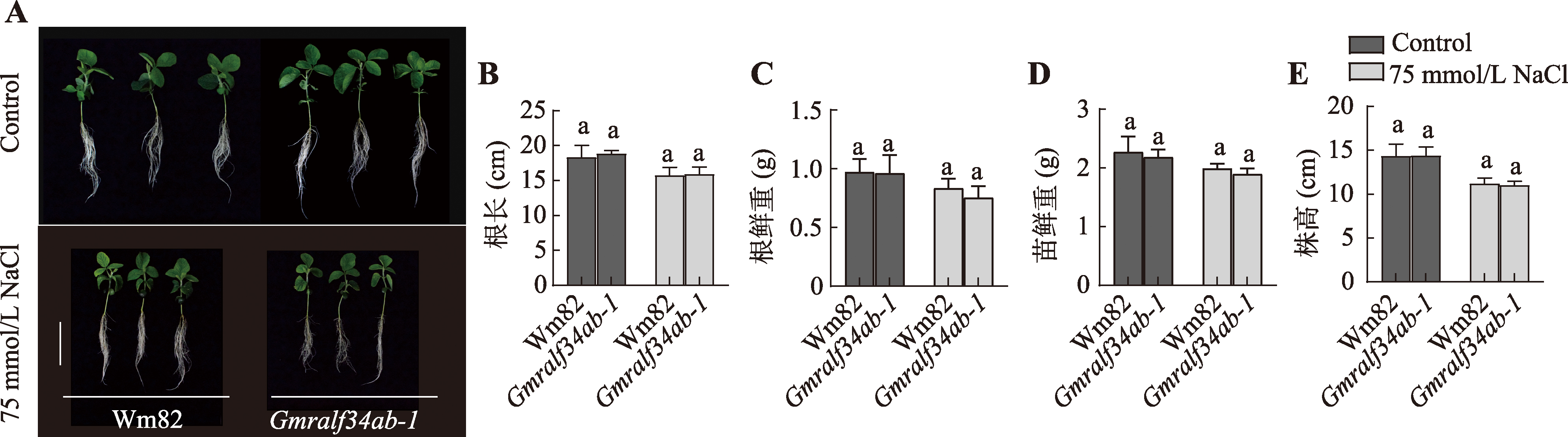
图7
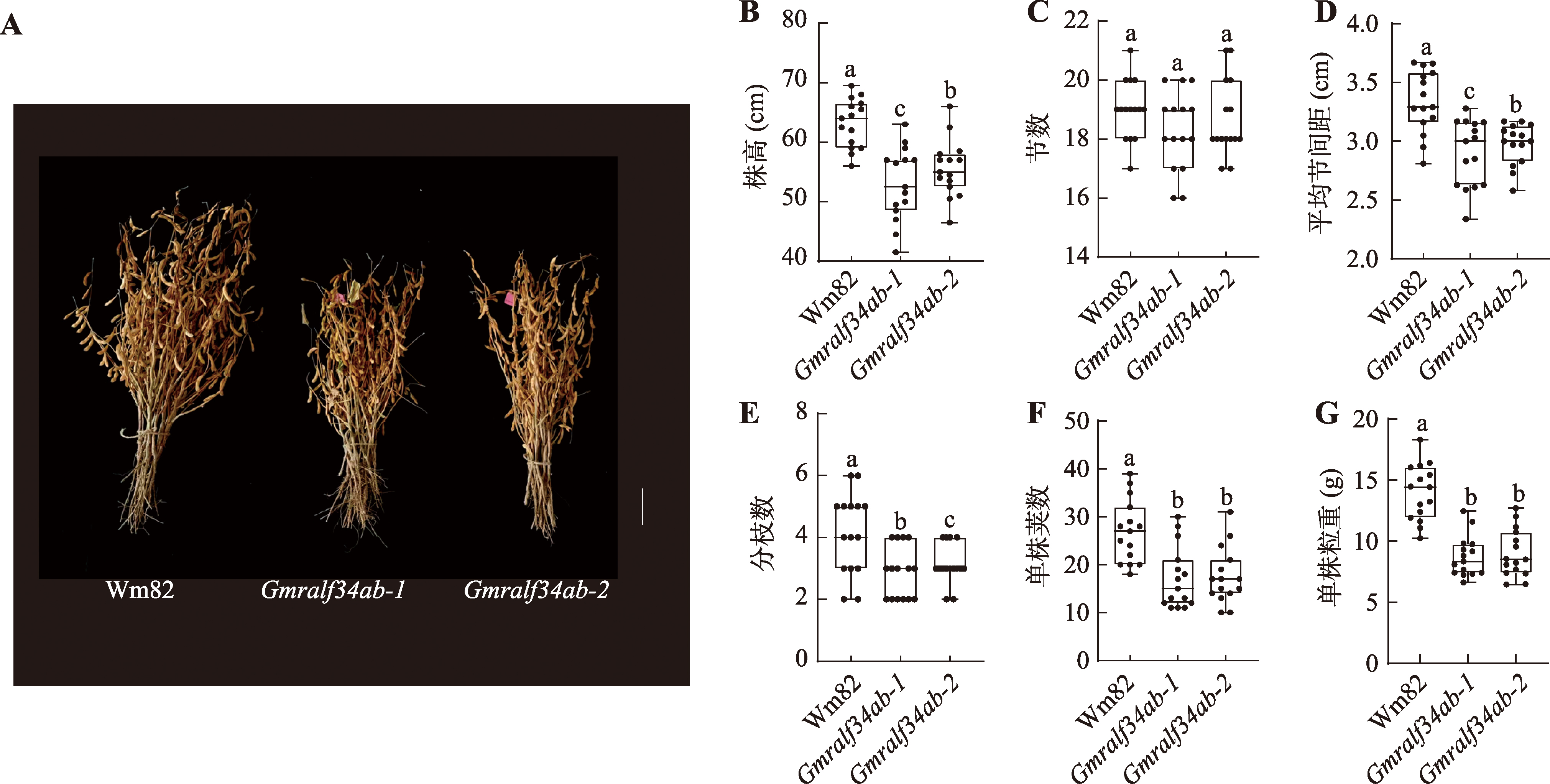
大豆Gmralf34ab双突变体盐碱地表型鉴定 A:野生型Wm82与Gmralf34ab-1、Gmralf34ab-2双突变体的盐碱地植株表型(n=15,比例尺为10 cm,数量为15株);B:株高;C:节数;D:平均节间距;E:分枝数;F:单株荚数;G:单株粒重。数据以平均值±标准差表示,通过单因素方差分析检验显著性,n≥15,相同字母表示组间差异不显著(P>0.05),不同字母表示组间差异显著(P<0.05)。"
| [1] | Liu YC, Shen YT, Tian ZX. Advances in soybean pan-genome research. Hereditas (Beijing), 2024, 46(3): 183-198. |
| 刘羽诚, 申妍婷, 田志喜. 大豆泛基因组研究进展. 遗传, 2024, 46(3): 183-198. | |
| [2] | Zhu W, Gu SG, Jiang R, Zhang X, Hatano R. Saline-alkali soil reclamation contributes to soil health improvement in China. Agric, 2024, 14(8): 1210. |
| [3] |
Ma L, Li JR, Li JF, Huo YD, Yang YQ, Jiang CF, Guo Y. Plant salt-tolerance mechanisms: Classic signaling pathways, emerging frontiers, and future perspectives. Mol Plant, 2026, 19(3): 538-570.
pmid: 41403128 |
| [4] |
Tibesigwa DG, Zhuang WH, Matola SH, Zhao HQ, Li WX, Yang L, Ren JR, Liu QQ, Yang JL. Molecular insights into salt stress adaptation in plants. Plant Cell Environ, 2025, 48(7): 5604-5615.
pmid: 40211820 |
| [5] |
Hu YF, Wang D, Zhang XH, Lv XD, Li B. Current progress in deciphering the molecular mechanisms underlying plant salt tolerance. Curr Opin Plant Biol, 2025, 83: 102671.
pmid: 39603169 |
| [6] |
Apse MP, Aharon GS, Snedden WA, Blumwald E. Salt tolerance conferred by overexpression of a vacuolar Na+/H+antiport in Arabidopsis. Science, 1999, 285(5431): 1256-1258.
pmid: 10455050 |
| [7] |
Zhao SS, Zhang QK, Liu MY, Zhou HP, Ma CL, Wang PP. Regulation of plant responses to salt stress. Int J Mol Sci, 2021, 22(9): 4609.
pmid: 33924753 |
| [8] |
Jia WS, Wang YQ, Zhang SQ, Zhang JH. Salt-stress- induced ABA accumulation is more sensitively triggered in roots than in shoots. J Exp Bot, 2002, 53(378): 2201-2206.
pmid: 12379787 |
| [9] |
Waadt R, Seller CA, Hsu PK, Takahashi Y, Munemasa S, Schroeder JI. Plant hormone regulation of abiotic stress responses. Nat Rev Mol Cell Biol, 2022, 23(10): 680-694.
pmid: 35513717 |
| [10] |
Manchanda P, Geitmann A. The tri-molecular interaction controlling plant cell structure. Curr Opin Cell Biol, 2025, 95: 102538.
pmid: 40411925 |
| [11] |
Pearce G, Moura DS, Stratmann J, Ryan CA. RALF, a 5-kDa ubiquitous polypeptide in plants, arrests root growth and development. Proc Natl Acad Sci USA, 2001, 98(22): 12843-12847.
pmid: 11675511 |
| [12] |
Srivastava R, Liu JX, Guo HQ, Yin YH, Howell SH. Regulation and processing of a plant peptide hormone, AtRALF23, in Arabidopsis. Plant J, 2009, 59(6): 930-939.
pmid: 19473327 |
| [13] |
Feng HQ, Liu C, Fu R, Zhang MM, Li H, Shen LP, Wei QQ, Sun X, Xu L, Ni B, Li C. LORELEI-LIKE GPI-ANCHORED PROTEINS 2/3 regulate pollen tube growth as chaperones and coreceptors for ANXUR/BUPS receptor kinases in Arabidopsis. Mol Plant, 2019, 12(12): 1612-1623.
pmid: 31541739 |
| [14] |
Murphy E, Vu LD, Van den Broeck L, Lin ZF, Ramakrishna P, van de Cotte B, Gaudinier A, Goh T, Slane D, Beeckman T, Inzé D, Brady SM, Fukaki H, De Smet I. RALFL34 regulates formative cell divisions in Arabidopsis pericycle during lateral root initiation. J Exp Bot, 2016, 67(16): 4863-4875.
pmid: 27521602 |
| [15] |
Zhang R, Shi PT, Zhou M, Liu HZ, Xu XJ, Liu WT, Chen KM. Rapid alkalinization factor: function, regulation, and potential applications in agriculture. Stress Biol, 2023, 3(1): 16.
pmid: 37676530 |
| [16] |
Stes E, Gevaert K, De Smet I. Phosphoproteomics-based peptide ligand-receptor kinase pairing. Commentary on: “A peptide hormone and its receptor protein kinase regulate plant cell expansion”. Front Plant Sci, 2015, 6: 224.
pmid: 25914705 |
| [17] |
Lu R, Lanooij J, Smakowska-Luzan E. From roots to reproduction: the multifaceted roles of rapid alkalinization factor and epidermal patterning factor peptides in plants. J Exp Bot, 2025, 76(19): 5713-5727.
pmid: 40624948 |
| [18] |
Li LX, Chen HH, Alotaibi SS, Pěnčík A, Adamowski M, Novák O, Friml J. RALF1 peptide triggers biphasic root growth inhibition upstream of auxin biosynthesis. Proc Natl Acad Sci USA, 2022, 119(31): e2121058119.
pmid: 35878023 |
| [19] |
Lu YQ, Zhang Y, Li MY, Yao LJ, Zhang XP, Yuan XY, Su X, Lin JX, Cui YN, Li XJ. Spatiotemporal dynamics of AHA 2 reveal that RALF1 induces its endocytosis and vacuolar degradation. Plant Commun, 2025, 6(12): 101535.
pmid: 40999687 |
| [20] |
Schoenaers S, Lee HK, Gonneau M, Faucher E, Levasseur T, Akary E, Claeijs N, Moussu S, Broyart C, Balcerowicz D, AbdElgawad H, Bassi A, Damineli DSC, Costa A, Feijó JA, Moreau C, Bonnin E, Cathala B, Santiago J, Höfte H, Vissenberg K. Rapid alkalinization factor 22 has a structural and signalling role in root hair cell wall assembly. Nat Plants, 2024, 10(3): 494-511.
pmid: 38467800 |
| [21] |
Liu MCJ, Yeh FLJ, Yvon R, Simpson K, Jordan S, Chambers J, Wu HM, Cheung AY. Extracellular pectin-RALF phase separation mediates FERONIA global signaling function. Cell, 2024, 187(2): 312-330.e22.
pmid: 38157854 |
| [22] |
Feng W, Kita D, Peaucelle A, Cartwright HN, Doan V, Duan QH, Liu MC, Maman J, Steinhorst L, Schmitz-Thom I, Yvon R, Kudla J, Wu HM, Cheung AY, Dinneny JR. The FERONIA receptor kinase maintains cell-wall integrity during salt stress through Ca2+ signaling. Curr Biol, 2018, 28(5): 666-675.e5.
pmid: 29456142 |
| [23] |
Zhao CZ, Zayed O, Yu ZP, Jiang W, Zhu PP, Hsu CC, Zhang LR, Tao WA, Lozano-Durán R, Zhu JK. Leucine-rich repeat extensin proteins regulate plant salt tolerance in Arabidopsis. Proc Natl Acad Sci USA, 2018, 115(51): 13123-13128.
pmid: 30514814 |
| [24] |
He YH, Chen SY, Chen XY, Xu YP, Liang Y, Cai XZ. RALF22 promotes plant immunity and amplifies the Pep3 immune signal. J Integr Plant Biol, 2023, 65(11): 2519-2534.
pmid: 37698076 |
| [25] |
Stegmann M, Monaghan J, Smakowska-Luzan E, Rovenich H, Lehner A, Holton N, Belkhadir Y, Zipfel C. The receptor kinase FER is a RALF-regulated scaffold controlling plant immune signaling. Science, 2017, 355(6322): 287-289.
pmid: 28104890 |
| [26] |
Liu YH, Chen YH, Jiang HK, Shui ZW, Zhong YJ, Shang J, Yang H, Sun X, Du JB. Genome-wide characterization of soybean RALF genes and their expression responses to Fusarium oxysporum. Front Plant Sci, 2022, 13: 1006028.
pmid: 36275562 |
| [27] |
Gonneau M, Desprez T, Martin M, Doblas VG, Bacete L, Miart F, Sormani R, Hématy K, Renou J, Landrein B, Murphy E, Van De Cotte B, Vernhettes S, De Smet I, Höfte H. Receptor kinase THESEUS1 is a rapid alkalinization factor 34 receptor in Arabidopsis. Curr Biol, 2018, 28(15): 2452-2458.e4.
pmid: 30057301 |
| [28] |
Ge ZX, Bergonci T, Zhao YL, Zou YJ, Du S, Liu MC, Luo XJ, Ruan H, García-Valencia LE, Zhong S, Hou SY, Huang QP, Lai LH, Moura DS, Gu HY, Dong J, Wu HM, Dresselhaus T, Xiao JY, Cheung AY, Qu LJ. Arabidopsis pollen tube integrity and sperm release are regulated by RALF-mediated signaling. Science, 2017, 358(6370): 1596-1600.
pmid: 29242234 |
| [29] |
Bai MY, Yuan CC, Kuang HQ, Sun Q, Hu XC, Cui LN, Lin WX, Peng CY, Yue P, Song SK, Guo ZB, Guan YF. Combination of two multiplex genome-edited soybean varieties enables customization of protein functional properties. Mol Plant, 2022, 15(7): 1081-1083.
pmid: 35643862 |
| [30] |
Kumar S, Stecher G, Li M, Knyaz C, Tamura K. MEGA X: molecular evolutionary genetics analysis across computing platforms. Mol Biol Evol, 2018, 35(6): 1547-1549.
pmid: 29722887 |
| [31] |
Letunic I, Bork P. Interactive Tree of Life (iTOL) v6: recent updates to the phylogenetic tree display and annotation tool. Nucleic Acids Res, 2024, 52(W1): W78-W82.
pmid: 38613393 |
| [32] |
Chen CJ, Chen H, Zhang Y, Thomas HR, Frank MH, He YH, Xia R. TBtools: an integrative toolkit developed for interactive analyses of big biological data. Mol Plant, 2020, 13(8): 1194-1202.
pmid: 32585190 |
| [33] |
He JX, Lin JY, Wang N, Yang J, Yang XC, Chen YF, Zhang MT, Chen RF, Chen XL, Dong LD, Kong FJ, Liu BH, Zhang CB, Tian ZX, Li MN. The clock component LHY1b negatively regulates alkaline stress by repressing AOX1-mediated oxidative responses in soybean. Plant Physiol, 2025, 198(3): kiaf253.
pmid: 40513111 |
| [34] |
Ma XL, Zhang QY, Zhu QL, Liu W, Chen Y, Qiu R, Wang B, Yang ZF, Li HY, Lin YR, Xie YY, Shen RX, Chen SF, Wang Z, Chen YL, Guo JX, Chen LT, Zhao XC, Dong ZC, Liu YG. A robust CRISPR/Cas9 system for convenient, high-efficiency multiplex genome editing in monocot and dicot plants. Mol Plant, 2015, 8(8): 1274-1284.
pmid: 25917172 |
| [35] | Yang J, Xing GJ, Du X, Sui L, Guo DQ, Niu L, Yang XD. Effects of different soybean genotypes on the transformation efficiency of soybean and analysis of the T-DNA insertions in the soybean genome. Soyb Sci, 2016, 35(4): 562-567. |
| 杨静, 邢国杰, 杜茜, 隋丽, 郭东全, 牛陆, 杨向东. 不同大豆基因型对大豆遗传转化效率的影响及外源T-DNA插入分析. 大豆科学, 2016, 35(4): 562-567. | |
| [36] |
Liu WZ, Xie XR, Ma XL, Li J, Chen JH, Liu YG. DSDecode: a web-based tool for decoding of sequencing chromatograms for genotyping of targeted mutations. Mol Plant, 2015, 8(9): 1431-1433.
pmid: 26032088 |
| [37] |
Blackburn MR, Haruta M, Moura DS. Twenty years of progress in physiological and biochemical investigation of RALF peptides. Plant Physiol, 2020, 182(4): 1657-1666.
pmid: 32071151 |
| [38] |
Schoenaers S, Vissenberg K. Overlooked aspects of CrRLK1L-RALF signaling. New Phytol, 2025, 248(2): 549-554.
pmid: 40716037 |
| [39] | He JX, Chen YF, Zhang MT, Qiu YJ, Zhou HP, Li MN. Current perspectives on improving soybean performance on saline-alkaline lands. New Crops, 2026, 3(6): 100079. |
| [40] |
Abarca A, Franck CM, Zipfel C. Family-wide evaluation of RAPID ALKALINIZATION FACTOR peptides. Plant Physiol, 2021, 187(2): 996-1010.
pmid: 34608971 |
| [41] |
Pearce G, Yamaguchi Y, Munske G, Ryan CA. Structure- activity studies of RALF, rapid alkalinization factor, reveal an essential-YISY-motif. Peptides, 2010, 31(11): 1973-1977.
pmid: 20800638 |
| [42] |
Haruta M, Sabat G, Stecker K, Minkoff BB, Sussman MR. A peptide hormone and its receptor protein kinase regulate plant cell expansion. Science, 2014, 343(6169): 408-411.
pmid: 24458638 |
| [1] | 王梓豪, 杨昭庆. 基因编辑中定点敲入技术的研究进展[J]. 遗传, 2026, 48(2): 128-141. |
| [2] | 郑少辉, 刘洋, 夏新欣, 刘彦梅. 碱基编辑技术及其在斑马鱼中的开发应用[J]. 遗传, 2026, 48(1): 46-60. |
| [3] | 马宝霞, 杨森, 吕明, 王昱人, 常立业, 韩艺帆, 王建刚, 郭杨, 徐坤. 不同CRISPR/Cas9供体适配基因编辑系统的比较及优化研究[J]. 遗传, 2024, 46(6): 466-477. |
| [4] | 曹振林, 李金红, 周铭辉, 张曼婷, 王宁, 陈一飞, 李嘉欣, 祝青松, 宫雯珺, 杨绪晨, 方小龙, 和家贤, 李美娜. 大豆花药优势表达基因GmFLA22a调控雄性育性的功能研究[J]. 遗传, 2024, 46(4): 333-345. |
| [5] | 刘羽诚, 申妍婷, 田志喜. 大豆泛基因组研究进展[J]. 遗传, 2024, 46(3): 183-198. |
| [6] | 鲍艳春, 戴伶俐, 刘在霞, 马凤英, 王宇, 刘永斌, 谷明娟, 娜日苏, 张文广. CRISPR/Cas9系统在畜禽遗传改良中研究进展[J]. 遗传, 2024, 46(3): 219-231. |
| [7] | 赖笔威, 陈磊, 芦思佳. 大豆光周期适应性研究进展[J]. 遗传, 2023, 45(9): 793-800. |
| [8] | 王秉政, 张超, 张佳丽, 孙锦. 利用单转录本表达Cas9和sgRNA条件性编辑果蝇基因组[J]. 遗传, 2023, 45(7): 593-601. |
| [9] | 刘梅珍, 王立人, 李咏梅, 马雪云, 韩红辉, 李大力. 利用CRISPR/Cas9技术构建基因编辑大鼠模型[J]. 遗传, 2023, 45(1): 78-87. |
| [10] | 张潇筠, 徐坤, 沈俊岑, 穆璐, 钱泓润, 崔婕妤, 马宝霞, 陈知龙, 张智英, 魏泽辉. 一种新型提高HDR效率的CRISPR/Cas9-Gal4BD供体适配基因编辑系统[J]. 遗传, 2022, 44(8): 708-719. |
| [11] | 张充, 魏子璇, 王敏, 陈瑶生, 何祖勇. 利用CRISPR/Cas9在人类黑色素瘤细胞中编辑MC1R与功能分析[J]. 遗传, 2022, 44(7): 581-590. |
| [12] | 刘尧, 周先辉, 黄舒泓, 王小龙. 引导编辑:突破碱基编辑类型的新技术[J]. 遗传, 2022, 44(11): 993-1008. |
| [13] | 韩玉婷, 许博文, 李羽童, 卢心怡, 董习之, 邱雨浩, 车沁耘, 朱芮葆, 郑丽, 李孝宸, 司绪, 倪建泉. 模式动物果蝇的基因调控前沿技术[J]. 遗传, 2022, 44(1): 3-14. |
| [14] | 杨光武, 田嫄. 果蝇F-box基因Ppa促进脂肪储存[J]. 遗传, 2021, 43(6): 615-622. |
| [15] | 文钟灵, 杨旻恺, 陈星雨, 郝晨宇, 任然, 储淑娟, 韩洪苇, 林红燕, 陆桂华, 戚金亮, 杨永华. 酸铝胁迫土壤中耐铝大豆根际不同部位细菌群落结构、功能及其对促生菌富集作用的研究[J]. 遗传, 2021, 43(5): 487-500. |
| 阅读次数 | ||||||
|
全文 |
|
|||||
|
摘要 |
|
|||||

www.chinagene.cn
备案号:京ICP备09063187号-4
总访问:,今日访问:,当前在线:

