
遗传 ›› 2026, Vol. 48 ›› Issue (7): 714-725.doi: 10.16288/j.yczz.26-042
胡雨琴1( ), 刘帆1, 李颖1, 王璐1,2()
收稿日期:2026-02-28
修回日期:2026-04-09
出版日期:2026-07-20
发布日期:2026-05-15
通讯作者:
王璐,博士,研究员,研究方向:发育生物学,干细胞与再生医学。E-mail: wanglu1@ihcams.ac.cn作者简介:胡雨琴,硕士研究生,专业方向:干细胞与再生医学。E-mail: huyuqin@ihcams.ac.cn
基金资助:
Yuqin Hu1(), Fan Liu1, Ying Li1, Lu Wang1,2()
Received:2026-02-28
Revised:2026-04-09
Published:2026-07-20
Online:2026-05-15
Supported by:摘要:
血管发育始于胚胎早期的血管发生,该过程受到多层面、高度整合的分子网络调控,其中转录后调控机制仍有待系统解析。细胞质多聚腺苷酸结合蛋白1a (cytoplasmic poly(A) binding protein 1a,Pabpc1a)是一种关键的RNA结合蛋白,通过转录后调控参与多种生理与病理过程,但其在血管发育中的功能仍不清楚。本研究首先发现pabpc1a在血管发生的关键时间窗口于内皮细胞中表达,随后利用CRISPR/Cas9技术构建了pabpc1a基因缺失模型。功能实验表明,pabpc1a基因缺失导致动静脉特化相关基因表达失调,动静脉血管直径比例异常;而过表达pabpc1a可以有效挽救血管发生缺陷。机制上,组学分析显示pabpc1a基因缺失引起内皮细胞中广泛的基因表达紊乱,其中翻译、核糖体生物合成及能量代谢相关通路显著下调。这些结果提示,Pabpc1a可能通过协调蛋白质合成与代谢稳态来确保血管发生的正常进行。综上所述,本研究证明Pabpc1a是血管发生过程中一个不可或缺的转录后调节因子,为理解血管发育的调控网络提供了新视角。
胡雨琴, 刘帆, 李颖, 王璐. Pabpc1a调控斑马鱼血管发生的机制研究[J]. 遗传, 2026, 48(7): 714-725.
Yuqin Hu, Fan Liu, Ying Li, Lu Wang. Regulatory mechanism of Pabpc1a during zebrafish vasculogenesis[J]. Hereditas(Beijing), 2026, 48(7): 714-725.
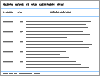
附表1
本研究所用的引物信息"
| 基因名称 | 引物序列(5′→3′) | 用途 |
|---|---|---|
| pabpc1a | F:GTTTTCACCATTCGGCACCA R:GATCTGACCTTGTGTTAGACGG | 探针合成 |
| hey2 | F:CTGCCAAGTTGGAGAAAGCG R:GTTTCCAACACAGTGCGACG | |
| pabpc1a | F:TCTATCCGGGTGTGCAGAGA R:TGTTACCCACACCGCTCTTC | qRT-PCR |
| dltC | F:ATTATTGCACCGAACCCA R:AAAATAGACCGCCCCAAC | |
| flt4 | F:TCCCTTCTTCTCAGGTCTGGT R:CTGACCCTGGCGATCAGTAA | |
| hey2 | F:ATTGATGTGGGCAGCGAGAA R:TGGGATGTGGTGGATGTGGA | |
| pabpc1a | F:TATTATCTCGAGATGAACCCCAGCGCGCCCAGT R:TATTATTCTAGATTAGACGGCGGGCACAGCAG | mRNA合成 |
| pabpc1a | Pabpc1a-hifi-F:TGATGACAAGATGAACCCCAGCGCGCCC Pabpc1a-hifi-R:AAGCTGGGTCGACGGCGGGCACAGCAGG Vector-hifi-F:GCCCGCCGTCGACCCAGCTTTCTTGTAC Vector-hifi-R:TGGGGTTCATCTTGTCATCATCGTCCTTG | 质粒构建 |
| pabpc1a | F:GAAGAGCGGTGTGGGTAAC R:AACCCTGATGTAAGGCGGTG | 基因型鉴定 |
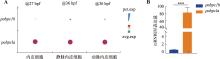
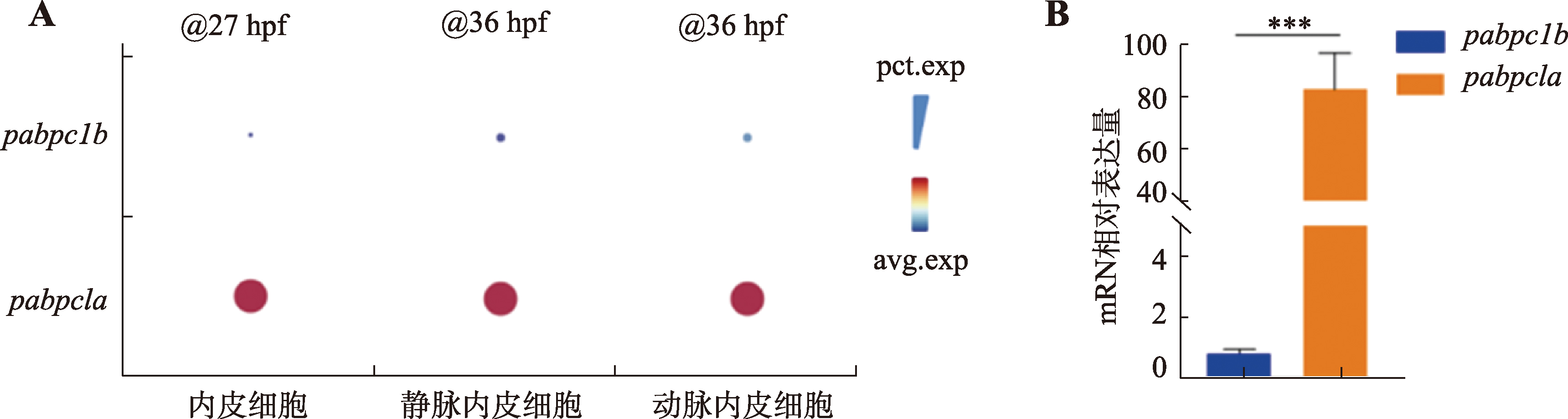
附图1
内皮细胞中pabpc1a和pabpc1b表达水平 A:利用公共斑马鱼单细胞数据库(https://ngdc.cncb.ac.cn/hematlas/)分析不同时期内皮细胞中pabpc1a和pabpc1b的表达水平。pct.exp指示表达百分比,avg.exp指示平均表达量。B:qRT-PCR检测24 hpf fli1a+的内皮细胞中pabpc1a和pabpc1b mRNA的相对表达量。共计3次生物学重复,数据展示为平均值±标准差,使用双尾独立t检验分析组间差异,***P<0.001。"
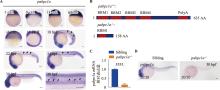
附图2
pabpc1a表达谱及pabpc1a-/-构建 A:利用WISH检测pabpc1a在不同时期斑马鱼胚胎中的表达谱情况。黑色箭头指示pabpc1a在斑马鱼的血管区域高表达。B:利用蛋白结构预测pabpc1a-/-产生的截短蛋白。C:qRT-PCR检测24 hpf对照组与pabpc1a-/-组pabpc1a mRNA相对表达量。共计3次生物学重复,数据展示为平均值±标准差,使用双尾独立t检验分析组间差异,****P<0.0001。D:利用WISH检测30 hpf对照组与pabpc1a-/-组pabpc1a的表达。A和D图比例尺为100 μm。"

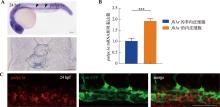
图1
pabpc1a表达于内皮细胞 A:利用WISH方法检测24 hpf pabpc1a的表达及胚胎的冰冻切片。黑色箭头指示pabpc1a在斑马鱼的AGM区域存在表达,黑色虚线代表pabpc1a在背主动脉和后主静脉内皮细胞中表达。B:qRT-PCR检测fli1a-的非内皮细胞和fli1a+的内皮细胞中pabpc1a mRNA的相对表达量。共计3次生物学重复,数据展示为平均值±标准差,使用双尾独立t检验分析组间差异,***P<0.001。C:荧光原位杂交联合免疫荧光显示24 hpf的Tg(fli1a:EGFP)中pabpc1a(红色)与内皮细胞(绿色)共定位。A图整胚比例尺为100 μm,冰冻切片比例尺为10 μm,C图比例尺为40 μm。"

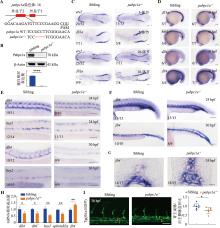
图2
缺失pabpc1a导致血管发生异常 A:利用CRISPR/Cas9技术敲除斑马鱼pabpc1a基因靶点示意图,该靶点靶向2号外显子,最终产生-4 bp的突变类型。B:蛋白免疫印迹检测24 hpf时pabpc1a-/-的敲除效果。共计3次生物学重复,数据展示为平均值±标准差,使用双尾独立t检验分析组间差异,****P<0.0001。C:利用WISH检测5-体节、10-体节时对照组与pabpc1a-/-组etv2和fli1a的表达。D:利用WISH检测18 hpf时对照组与pabpc1a-/-组fli1a、kdrl、dll4和flt4的表达。E:利用WISH检测24 hpf、30 hpf时对照组与pabpc1a-/-组dll4和hey2的表达。F:利用WISH检测24 hpf、30 hpf时对照组与pabpc1a-/-组flt4的表达。G:冰冻切片展示24 hpf时对照组与pabpc1a-/-组flt4原位杂交染色后的胚胎横截面。黄色虚线标识了静脉所在区域,红色虚线标识了动脉所在区域。H:qRT-PCR检测24 hpf时对照组与pabpc1a-/-组dll4、dltC、hey2、ephrinB2a和flt4 mRNA相对表达量。共计3次生物学重复,数据展示为平均值±标准差,使用双尾独立t检验分析组间差异,*P<0.05,**P<0.01。I:活体成像显示30 hpf时Tg(fli1a:EGFP)背景下对照组与pabpc1a-/-组的背主动脉和后主静脉形态。黄线标识血管直径,数据展示为平均值±标准差,使用双尾独立t检验分析组间差异,*P<0.05。C~F图比例尺为100 μm,G图比例尺为10 μm,I图比例尺为50 μm。"

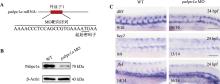
图3
敲低pabpc1a导致动静脉特化异常 A:pabpc1a MO靶向pabpc1a mRNA外显子1上的序列。B:蛋白免疫印迹检测24 hpf时pabpc1a MO的敲低效果。C:利用WISH检测24 hpf时野生型组与pabpc1a MO组dll4、hey2和flt4的表达。比例尺为100 μm。"

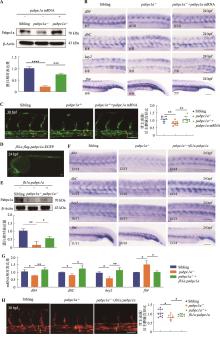
图4
Pabpc1a以内皮细胞自主性的方式调控血管发生 A:蛋白免疫印迹检测24 hpf pabpc1a mRNA的回救效果。共计3次生物学重复,数据展示为平均值±标准差,使用双尾独立t检验分析组间差异,***P<0.001,****P<0.0001。B:利用WISH检测24 hpf对照组、pabpc1a-/-组和pabpc1a mRNA回救组dll4、dltC、hey2和flt4的表达。C:活体成像显示30 hpf时Tg(fli1a:EGFP)背景下的对照组、pabpc1a‒/‒组和pabpc1a mRNA回救组的背主动脉和后主静脉形态。黄线标识血管直径,数据展示为平均值±标准差,使用双尾独立t检验分析组间差异,**P<0.01。D:活体成像展示24 hpf时Tg(fli1a:flag-pabpc1a-EGFP)胚胎的荧光表达。E:蛋白免疫印迹检测24 hpf fli1a:flag-pabpc1a-EGFP(图中简写为fli1a:pabpc1a)的回救效果。共计3次生物学重复,数据展示为平均值±标准差,使用双尾独立t检验分析组间差异,*P<0.05,**P<0.01。F:利用WISH检测24 hpf时对照组、pabpc1a‒/‒组和fli1a:flag-pabpc1a-EGFP回救组dll4、dltC、hey2和flt4的表达。G:qRT-PCR检测24 hpf时对照组、pabpc1a‒/‒组和fli1a:flag-pabpc1a-EGFP回救组dll4、dltC、hey2和flt4 mRNA的相对表达量。数据展示为平均值±标准差,使用双尾独立t检验分析组间差异,*P<0.05,**P<0.01。H:活体成像显示30 hpf时Tg(kdrl:mCherry)背景下对照组、pabpc1a‒/‒组和fli1a:flag-pabpc1a-EGFP回救组的背主动脉和后主静脉形态。黄线标识血管直径,数据展示为平均值±标准差,使用双尾独立t检验分析组间差异,*P<0.05。B、D、F图比例尺为100 μm,C和H图比例尺为50 μm。"

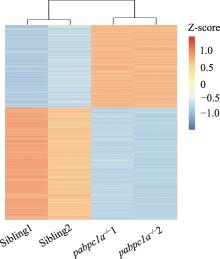
附图3
RNA-seq的差异表达基因热图 热图显示对照组与pabpc1a-/-组中的差异表达基因。红色代表表达量高的基因,蓝色代表表达量低的基因。"
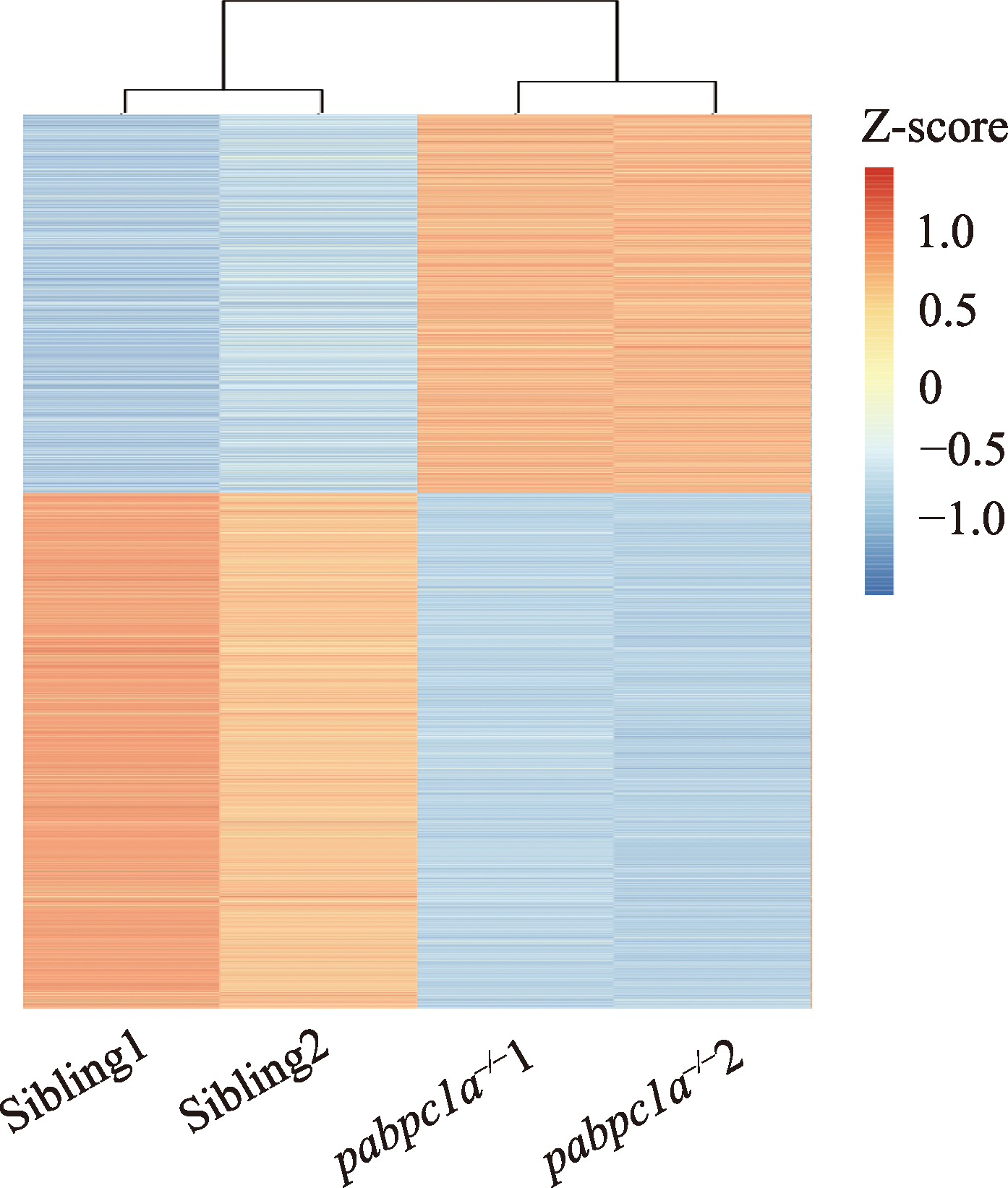
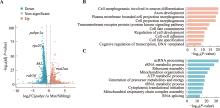
图5
pabpc1a缺失导致内皮细胞基因转录程序失调 A:对照组与pabpc1a‒/‒组的差异基因火山图;B:pabpc1a‒/‒组上调差异表达基因的GO富集分析;C:pabpc1a‒/‒组下调差异表达基因的GO富集分析。"

| [1] |
Eberlein J, Herdt L, Malchow J, Rittershaus A, Baumeister S, Helker CS. Molecular and cellular mechanisms of vascular development in zebrafish. Life (Basel), 2021, 11(10): 1088.
pmid: 34685459 |
| [2] |
Wolf K, Hu HD, Isaji T, Dardik A. Molecular identity of arteries, veins, and lymphatics. J Vasc Surg, 2019, 69(1): 253-262.
pmid: 30154011 |
| [3] |
Ellertsdóttir E, Lenard A, Blum Y, Krudewig A, Herwig L, Affolter M, Belting HG. Vascular morphogenesis in the zebrafish embryo. Dev Biol, 2010, 341(1): 56-65.
pmid: 19895803 |
| [4] |
Greenspan LJ, Weinstein BM. To be or not to be: endothelial cell plasticity in development, repair, and disease. Angiogenesis, 2021, 24(2): 251-269.
pmid: 33449300 |
| [5] |
Bai W, Yin DP, Chen G, Lu Y, Jiang Q, Li KR, Yao J, Cao C. Endothelial RAB5IF is required for pathological and developmental retinal angiogenesis. Nat Commun, 2025, 16(1): 11402.
pmid: 41390488 |
| [6] |
Zhao P, Li D, Liu XW. DcR3, stabilized by the RNA-binding protein IGF2BP2, promotes proliferation, invasion, and migration of trophoblast cells and facilitates angiogenesis. BMC Pregnancy Childbirth, 2025, 26(1): 2.
pmid: 41299320 |
| [7] |
Han HX, Lin T, Wang ZY, Song JJ, Fang ZY, Zhang J, You XM, Du YP, Ye J, Zhou GX. RNA-binding motif 4 promotes angiogenesis in HCC by selectively activating VEGF-A expression. Pharmacol Res, 2023, 187: 106593.
pmid: 36496136 |
| [8] |
Biziaev N, Shuvalov A, Salman A, Egorova T, Shuvalova E, Alkalaeva E. The impact of mRNA poly(A) tail length on eukaryotic translation stages. Nucleic Acids Res, 2024, 52(13): 7792-7808.
pmid: 38874498 |
| [9] |
Kajjo S, Sharma S, Chen S, Brothers WR, Cott M, Hasaj B, Jovanovic P, Larsson O, Fabian MR. PABP prevents the untimely decay of select mRNA populations in human cells. EMBO J, 2022, 41(6): e108650.
pmid: 35156721 |
| [10] |
Cao SM, Wu H, Yuan GH, Pan YH, Zhang J, Liu YX, Li SQ, Xu YF, Wei MY, Yang L, Chen LL. Altered nucleocytoplasmic export of adenosine-rich circRNAs by PABPC 1 contributes to neuronal function. Mol Cell, 2024, 84(12): 2304-2319.e8.
pmid: 38838666 |
| [11] |
Boeynaems S, Dorone Y, Zhuang YR, Shabardina V, Huang GZ, Marian A, Kim G, Sanyal A, Şen NE, Griffith D, Docampo R, Lasker K, Ruiz-Trillo I, Auburger G, Holehouse AS, Kabashi E, Lin Y, Gitler AD. Poly(A)-binding protein is an ataxin-2 chaperone that regulates biomolecular condensates. Mol Cell, 2023, 83(12): 2020-2034.e6.
pmid: 37295429 |
| [12] |
Wang JL, Zhang X, Greene GH, Xu GY, Dong XN. PABP/purine-rich motif as an initiation module for cap-independent translation in pattern-triggered immunity. Cell, 2022, 185(17): 3186-3200.e17.
pmid: 35907403 |
| [13] |
Sun CG, Xu X, Chen ZY, Zhou FQ, Wang W, Chen JZ, Sun MY, Wang F, Jiang LJ, Ji M, Liu SQ, Xu JY, He MM, Su BW, Liu XL, Gao YD, Wei H, Li J, Wang XS, Zhao M, Yu J, Ma YN. Selective translational control by PABPC1 phase separation regulates blast crisis and therapy resistance in chronic myeloid leukaemia. Nat Cell Biol, 2025, 27(4): 683-695.
pmid: 40102686 |
| [14] |
Chen ZH, Zeng CW, Yang L, Che Y, Chen ML, Sau L, Wang BT, Zhou KR, Chen Y, Qing Y, Shen C, Zhang TJ, Wunderlich M, Wu D, Li W, Wang K, Leung K, Sun M, Tang TT, He X, Zhang LJ, Swaminathan S, Mulloy JC, Muschen M, Huang HL, Weng HY, Xiao G, Deng XL, Chen JJ. YTHDF2 promotes ATP synthesis and immune evasion in B cell malignancies. Cell, 2025, 188(2): 331-351.e30.
pmid: 39694037 |
| [15] |
Lawson ND, Weinstein BM. In vivo imaging of embryonic vascular development using transgenic zebrafish. Dev Biol, 2002, 248(2): 307-318.
pmid: 12167406 |
| [16] |
Bertrand JY, Chi NC, Santoso B, Teng ST, Stainier DYR, Traver D. Haematopoietic stem cells derive directly from aortic endothelium during development. Nature, 2010, 464(7285): 108-111.
pmid: 20154733 |
| [17] | Zhang CX, Liu F. A brief protocol for high-resolution whole mount in situ hybridization in zebrafish. Hereditas(Beijing), 2013, 35(4): 522-528. |
| 张春霞, 刘峰. 斑马鱼高分辨率整胚原位杂交实验方法与流程. 遗传, 2013, 35(4): 522-528. | |
| [18] |
Kimmel CB, Ballard WW, Kimmel SR, Ullmann B, Schilling TF. Stages of embryonic development of the zebrafish. Dev Dyn, 1995, 203(3): 253-310.
pmid: 8589427 |
| [19] |
Mishima Y, Fukao A, Kishimoto T, Sakamoto H, Fujiwara T, Inoue K. Translational inhibition by deadenylation- independent mechanisms is central to microRNA- mediated silencing in zebrafish. Proc Natl Acad Sci USA, 2012, 109(4): 1104-1109.
pmid: 22232654 |
| [20] |
Li Y, Li C, Liu MY, Liu SC, Liu F, Wang L. The RNA-binding protein CSDE1 promotes hematopoietic stem and progenitor cell generation via translational control of Wnt signaling. Development, 2023, 150(21): dev201890.
pmid: 37874038 |
| [21] |
Mitchell CD, Morris CA, Wild M, Cunningham A, Chuesiang P, Mohammed AA, Nagalo BM, Rusch NJ, Fouda AY, Shosha E. HDAC3 mediates retinal endothelial cell metabolic reprogramming and angiogenesis. Acta Pharmacol Sin, 2026, 47(4): 1058-1069.
pmid: 41023273 |
| [22] |
Dong XX, Zhang QQ, Yu XY, Wang D, Ma JM, Ma J, Shi SH. Metabolic lactate production coordinates vasculature development and progenitor behavior in the developing mouse neocortex. Nat Neurosci, 2022, 25(7): 865-875.
pmid: 35726058 |
| [23] |
Jin DQ, Zhu DQ, Fang YB, Chen YW, Yu GH, Pan WJ, Liu D, Li F, Zhong TP. Vegfa signaling regulates diverse artery/vein formation in vertebrate vasculatures. J Genet Genomics, 2017, 44(10): 483-492.
pmid: 29037991 |
| [24] |
Lawson ND, Scheer N, Pham VN, Kim CH, Chitnis AB, Campos-Ortega JA, Weinstein BM. Notch signaling is required for arterial-venous differentiation during embryonic vascular development. Development, 2001, 128(19): 3675-3683.
pmid: 11585794 |
| [25] |
Moser M, Patterson C. Bone morphogenetic proteins and vascular differentiation: BMPing up vasculogenesis. Thromb Haemost, 2005, 94(4): 713-718.
pmid: 16270622 |
| [26] |
Zhou R, Hu L, Li R, Chen H, Zhang XL, Hua L, Che LQ, Lin Y, Xu SY, Feng B, Jin C, Wu D, Zhuo Y, Fang ZF. Methionine adenosyl-transferase 2A promotes placental angiogenesis by regulating VEGF-A translation via the mTORC1 signalling pathway. J Physiol, 2026, 604(5): 2191-2211.
pmid: 41579147 |
| [27] |
Shen XY, Wen ZZ, Deng SZ, Qiu YX, Ma WJ, Dong XY, Gong J, Zhang Y, Liu D, Xu B. Regulation of hindbrain vascular development by rps20 in zebrafish. Cells, 2025, 14(14): 1070.
pmid: 40710323 |
| [28] |
De Bruin RG, Van Der Veer EP, Prins J, Lee DH, Dane MJC, Zhang HY, Roeten MK, Bijkerk R, De Boer HC, Rabelink TJ, Van Zonneveld AJ, Van Gils JM. The RNA-binding protein quaking maintains endothelial barrier function and affects VE-cadherin and β-catenin protein expression. Sci Rep, 2016, 6: 21643.
pmid: 26905650 |
| [29] |
Kurosu T, Ohga N, Hida Y, Maishi N, Akiyama K, Kakuguchi W, Kuroshima T, Kondo M, Akino T, Totsuka Y, Shindoh M, Higashino F, Hida K. HuR keeps an angiogenic switch on by stabilising mRNA of VEGF and COX-2 in tumour endothelium. Br J Cancer, 2011, 104(5): 819-829.
pmid: 21285980 |
| [30] |
Galbán S, Kuwano Y, Pullmann R, Martindale JL, Kim HH, Lal A, Abdelmohsen K, Yang XL, Dang YJ, Liu JO, Lewis SM, Holcik M, Gorospe M. RNA-binding proteins HuR and PTB promote the translation of hypoxia- inducible factor 1alpha. Mol Cell Biol, 2008, 28(1): 93-107.
pmid: 17967866 |
| [31] |
Swift MR, Weinstein BM. Arterial-venous specification during development. Circ Res, 2009, 104(5): 576-588.
pmid: 19286613 |
| [32] |
Modic M, Kuret K, Steinhauser S, Faraway R, Van Genderen E, De Los Mozos IR, Novljan J, Vičič Ž, Lee FCY, Ten Berge D, Luscombe NM, Ule J. Poised PABP- RNA hubs implement signal-dependent mRNA decay in development. Nat Struct Mol Biol, 2024, 31(9): 1439-1447.
pmid: 39054355 |
| [1] | 欧阳沛东, 唐嘉兰, 吴成超, 李晓玉, 柯珊珊, 张晶晶. 基于斑马鱼模型探究synpo在颅内出血中的作用机制[J]. 遗传, 2026, 48(4): 407-420. |
| [2] | 李雨洁, 李飞飞, 张文清, 陈琪. tcirg1b基因缺失导致斑马鱼中枢神经稳态失衡的机制[J]. 遗传, 2026, 48(2): 201-212. |
| [3] | 郑少辉, 刘洋, 夏新欣, 刘彦梅. 碱基编辑技术及其在斑马鱼中的开发应用[J]. 遗传, 2026, 48(1): 46-60. |
| [4] | 高云海, 邓家杰, 肖霄, 潘鲁湲, 何牡丹, 张蕴斌. 斑马鱼ppp6r3调控性腺分化和配子发生的作用研究[J]. 遗传, 2025, 47(9): 1023-1031. |
| [5] | 林杰豪, 杨童舒, 张文清, 刘伟. Lyl1不同转录本在斑马鱼原始造血中的作用[J]. 遗传, 2025, 47(5): 573-588. |
| [6] | 寇涵婧, 黄志斌, 张文清, 陈琪. V-ATPase a3亚基调控小胶质细胞吞噬体成熟的机制[J]. 遗传, 2025, 47(11): 1256-1268. |
| [7] | 刘吉祥, 赖思婷, 白晶, 徐进. Il34拯救甲硝唑导致的斑马鱼中枢神经系统轴突再生障碍[J]. 遗传, 2024, 46(6): 478-489. |
| [8] | 洪佳馨, 徐颂恩, 张文清, 刘伟. Pu.1和cMyb在斑马鱼中性粒细胞发育中的相互作用[J]. 遗传, 2024, 46(4): 319-332. |
| [9] | 孙飘, 李颖, 刘帆, 王璐. TPI缺乏症斑马鱼模型的构建及分析[J]. 遗传, 2024, 46(3): 232-241. |
| [10] | 杨晓君, 黄振瀚, 刘伟, 张文清, 黄志斌. CD209同源基因在斑马鱼中的鉴定及功能表征[J]. 遗传, 2024, 46(11): 947-957. |
| [11] | 李凯伦, 卢荆奥, 陈小辉, 张文清, 刘伟. 尿囊素促进破骨细胞缺陷斑马鱼骨折修复[J]. 遗传, 2023, 45(4): 341-353. |
| [12] | 卢荆澳, 黄春燕, 林芷茵, 唐政, 马宁, 黄志斌. cd99l2基因调控斑马鱼白细胞组织间的迁移机制[J]. 遗传, 2022, 44(9): 798-809. |
| [13] | 郑鹏飞, 谢海波, 朱盼盼, 赵呈天. 斑马鱼神经底板处神经元的分布及特征[J]. 遗传, 2022, 44(6): 510-520. |
| [14] | 张婷婷, 刘峰. 斑马鱼蛋白酪氨酸硫酸化修饰的检测方法研究[J]. 遗传, 2022, 44(2): 178-186. |
| [15] | 贾婷婷, 雷蕾, 吴歆媛, 蔡顺有, 陈艺璇, 薛钰. 二甲双胍对斑马鱼骨骼发育及损伤修复的机制研究[J]. 遗传, 2022, 44(1): 68-79. |
| 阅读次数 | ||||||
|
全文 |
|
|||||
|
摘要 |
|
|||||

www.chinagene.cn
备案号:京ICP备09063187号-4
总访问:,今日访问:,当前在线:

