
遗传 ›› 2026, Vol. 48 ›› Issue (7): 690-700.doi: 10.16288/j.yczz.26-015
黄丹青1( ), 郭婧1,2, 郭燕1, 杨铁林1,2()
收稿日期:2026-01-23
修回日期:2026-04-09
出版日期:2026-04-20
发布日期:2026-04-20
通讯作者:
杨铁林,博士,教授,研究方向:生物医学信息大数据挖掘和疾病标志物鉴定与机制解析。E-mail: yangtielin@xjtu.edu.cn作者简介:黄丹青,硕士研究生,专业方向:遗传发育与生物信息学。E-mail: hdq3029@stu.xjtu.edu.cn
基金资助:
Danqing Huang1(), Jing Guo1,2, Yan Guo1, Tielin Yang1,2()
Received:2026-01-23
Revised:2026-04-09
Published:2026-04-20
Online:2026-04-20
Supported by:摘要:
随着全球人口老龄化加剧,开发能够精准量化个体衰老状态、突破时序年龄评估局限的技术方法,已成为衰老研究与精准医学的重要需求。生物学年龄通过整合多组学数据与器官特异性生物标志物,为评估个体真实生理衰老进程及疾病风险提供了重要工具。本文系统综述了衰老评估方法的发展,重点阐述了基于表观遗传学标志物以及转录组学、蛋白质组学和代谢组学标志物的衰老时钟构建策略及其演变,并探讨了基于影像学数据与多组学数据整合的器官特异性衰老评估新方法。结合这些方法在衰老相关疾病早期筛查与风险分层、个性化干预及健康管理中的临床应用证据,本文还进一步阐明了生物学年龄在精准衰老评估与干预中的重要价值与临床转化前景。
黄丹青, 郭婧, 郭燕, 杨铁林. 生物学年龄评估衰老及其临床应用[J]. 遗传, 2026, 48(7): 690-700.
Danqing Huang, Jing Guo, Yan Guo, Tielin Yang. Assessment of biological age for aging evaluation and its clinical applications[J]. Hereditas(Beijing), 2026, 48(7): 690-700.

图1
衰老生物标志物的分类及临床应用 图左侧展示衰老生物标志物的主要分类,包括临床标志物和组学标志物;右侧展示标志物在临床中的应用场景,涵盖疾病筛查与风险分层、抗衰老个性化干预及个体健康管理。图由 https://www.biorender.com/绘制并获授权。"

表1
基于组学标志物的衰老时钟的优劣势对比"
| 生物标志物 类型 | 衰老时钟名称 | 优势 | 劣势 |
|---|---|---|---|
| 表观遗传学 | Hannum时钟[ | • 预测精度高,跨组织/器官适用性强 • 可干预性明确,可逆性已临床验证 | • 临床可及性有限,检测成本高 • 数据异质性高,不同平台和批次存在系统差异 |
| 转录组学 | Peters时钟[ | • 模型可解释性强,直接关联基因表达 • 实验可验证性高 | • 预测精度较低,不同队列间差异大 • 可干预性证据不足,调控效应不明确 • 临床可及性有限,不同平台数据异质性高 |
| 蛋白组学 | Tanaka时钟[ | • 预测精度较高 • 功能关联性强,与临床结局密切相关 | • 临床可及性中等,检测成本高于代谢组,不同平台数据异质性高 • 可干预性证据有限,系统性干预证据不足 |
| 代谢组学 | Van den Akker时钟[ | • 临床可及性高,检测成本低,适配大规模队列分析 • 代谢物通路富集明确 | • 预测精度最低 • 可干预性证据不足,调控效应不明确 |
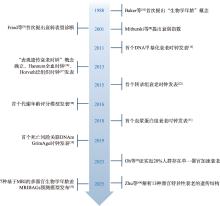
图2
生物学年龄研究进展时间轴(1988~2025) 该图系统梳理了自1988年“生物学年龄”概念提出以来,从表型评估、单一组学衰老时钟开发,到多组学整合、器官特异性评估及因果机制解析的重要进展。图由 https://www.biorender.com/绘制并获授权。"

| [1] |
Seals DR, Justice JN, LaRocca TJ. Physiological geroscience: targeting function to increase healthspan and achieve optimal longevity. J Physiol, 2015, 594(8): 2001-2024.
pmid: 25639909 |
| [2] |
Partridge L, Deelen J, Slagboom PE. Facing up to the global challenges of ageing. Nature, 2018, 561(7721): 45-56.
pmid: 30185958 |
| [3] | 民政部, 全国老龄办. 2024年度国家老龄事业发展公报. [2025-07-25]. https://www.mca.gov.cn/n152/n166/c1662004999980006135/content.html. |
| [4] | Yuan J, Cai SQ. The regulatory mechanisms of behavioral and cognitive aging. Hereditas(Beijing), 2021, 43(6): 545-570. |
| 袁洁, 蔡时青. 衰老过程中行为和认知功能退化的调控机制研究. 遗传, 2021, 43(6): 545-570. | |
| [5] | Gao CY, Li MH, Gu ZG, Zhao XK, Wang PP, Liu ZY, Wang W. Progress in biological age research. J Zhengzhou Univ(Med Sci), 2025, 60(4): 445-451. |
| 高晨阳, 李梦涵, 谷志广, 赵祥凯, 王彭彭, 刘足云, 王威. 生物学年龄研究进展. 郑州大学学报(医学版), 2025, 60(4): 445-451. | |
| [6] |
Li X, Li CT, Zhang WY, Wang YA, Qian PX, Huang H. Inflammation and aging: signaling pathways and intervention therapies. Signal Transduct Target Ther, 2023, 8(1): 239.
pmid: 37291105 |
| [7] |
Rockwood K, Hogan DB, MacKnight C. Conceptualisation and measurement of frailty in elderly people. Drugs Aging, 2000, 17(4): 295-302.
pmid: 11087007 |
| [8] |
Mitnitski AB, Mogilner AJ, Rockwood K. Accumulation of deficits as a proxy measure of aging. ScientificWorld Journal, 2001, 1: 323-336.
pmid: 12806071 |
| [9] |
Fried LP, Tangen CM, Walston J, Newman AB, Hirsch C, Gottdiener J, Seeman T, Tracy R, Kop WJ, Burke G, McBurnie MA, Cardiovascular Health Study Collaborative Research Group. Frailty in older adults: evidence for a phenotype. J Gerontol A Biol Sci Med Sci, 2001, 56(3): M146-M156.
pmid: 11253156 |
| [10] |
Baker GT 3rd, Sprott RL. Biomarkers of aging. Exp Gerontol, 1988, 23(4-5): 223-239.
pmid: 3058488 |
| [11] |
Moqri M, Herzog C, Poganik JR, Biomarkers of Aging Consortium, Justice J, Belsky DW, Higgins-Chen A, Moskalev A, Fuellen G, Cohen AA, Bautmans I, Widschwendter M, Ding JZ, Fleming A, Mannick J, Han JDJ, Zhavoronkov A, Barzilai N, Kaeberlein M, Cummings S, Kennedy BK, Ferrucci L, Horvath S, Verdin E, Maier AB, Snyder MP, Sebastiano V, Gladyshev VN. Biomarkers of aging for the identification and evaluation of longevity interventions. Cell, 2023, 186(18): 3758-3775.
pmid: 37657418 |
| [12] |
Bortz J, Guariglia A, Klaric L, Tang D, Ward P, Geer M, Chadeau-Hyam M, Vuckovic D, Joshi PK. Biological age estimation using circulating blood biomarkers. Commun Biol, 2023, 6(1): 1089.
pmid: 37884697 |
| [13] |
Aging Biomarker Consortium, Bao HN, Cao JN, Chen MT, Chen M, Chen W, Chen X, Chen YH, Chen Y, Chen YT, Chen ZY, Chhetri JK, Ding YJ, Feng JL, Guo J, Guo MM, He CT, Jia YJ, Jiang HP, Jing Y, Li DF, Li JM, Li JY, Liang QH, Liang R, Liu F, Liu XQ, Liu ZJ, Luo OJH, Lv JW, Ma JY, Mao KH, Nie JW, Qiao XH, Sun XP, Tang XQ, Wang JF, Wang QR, Wang SY, Wang X, Wang YN, Wang YH, Wu RM, Xia K, Xiao FH, Xu LY, Xu YY, Yan HT, Yang L, Yang RC, Yang YX, Ying YL, Zhang L, Zhang WW, Zhang WW, Zhang X, Zhang Z, Zhou M, Zhou R, Zhu QC, Zhu ZM, Cao F, Cao ZW, Chan P, Chen C, Chen GB, Chen HZ, Chen J, Ci WM, Ding BS, Ding QR, Gao F, Han JDJ, Huang K, Ju ZY, Kong QP, Li J, Li J, Li X, Liu BH, Liu F, Liu L, Liu Q, Liu Q, Liu XG, Liu Y, Luo XH, Ma S, Ma XR, Mao ZY, Nie J, Peng YJ, Qu J, Ren J, Ren RB, Song MS, Songyang Z, Sun YE, Sun Y, Tian M, Wang SS, Wang S, Wang X, Wang XN, Wang YJ, Wang YF, Wong CCL, Xiang AP, Xiao YC, Xie ZW, Xu DC, Ye J, Yue R, Zhang CT, Zhang HB, Zhang L, Zhang WQ, Zhang Y, Zhang YW, Zhang ZH, Zhao TB, Zhao YZ, Zhu DH, Zou WG, Pei G, Liu GH. Biomarkers of aging. Sci China Life Sci, 2023, 66(5): 893-1066.
pmid: 37076725 |
| [14] |
Meyer DH, Schumacher B. Aging clocks based on accumulating stochastic variation. Nat Aging, 2024, 4(6): 871-885.
pmid: 38724736 |
| [15] |
Bocklandt S, Lin W, Sehl ME, Sánchez FJ, Sinsheimer JS, Horvath S, Vilain E. Epigenetic predictor of age. PLoS One, 2011, 6(6): e14821.
pmid: 21731603 |
| [16] |
Hannum G, Guinney J, Zhao L, Zhang L, Hughes G, Sadda S, Klotzle B, Bibikova M, Fan JB, Gao Y, Deconde R, Chen M, Rajapakse I, Friend S, Ideker T, Zhang K. Genome-wide methylation profiles reveal quantitative views of human aging rates. Mol Cell, 2013, 49(2): 359-367.
pmid: 23177740 |
| [17] |
Horvath S. DNA methylation age of human tissues and cell types. Genome Biol, 2013, 14(10): R115.
pmid: 24138928 |
| [18] |
Yang Z, Wong A, Kuh D, Paul DS, Rakyan VK, Leslie RD, Zheng SC, Widschwendter M, Beck S, Teschendorff AE. Correlation of an epigenetic mitotic clock with cancer risk. Genome Biol, 2016, 17(1): 205.
pmid: 27716309 |
| [19] |
Lu AT, Quach A, Wilson JG, Reiner AP, Aviv A, Raj K, Hou LF, Baccarelli AA, Li Y, Stewart JD, Whitsel EA, Assimes TL, Ferrucci L, Horvath S. DNA methylation GrimAge strongly predicts lifespan and healthspan. Aging (Albany NY), 2019, 11(2): 303-327.
pmid: 30669119 |
| [20] |
Levine ME, Lu AT, Quach A, Chen BH, Assimes TL, Bandinelli S, Hou LF, Baccarelli AA, Stewart JD, Li Y, Whitsel EA, Wilson JG, Reiner AP, Aviv A, Lohman K, Liu YM, Ferrucci L, Horvath S. An epigenetic biomarker of aging for lifespan and healthspan. Aging (Albany NY), 2018, 10(4): 573-591.
pmid: 29676998 |
| [21] |
Belsky DW, Caspi A, Arseneault L, Baccarelli A, Corcoran DL, Gao X, Hannon E, Harrington HL, Rasmussen LJ, Houts R, Huffman K, Kraus WE, Kwon D, Mill J, Pieper CF, Prinz JA, Poulton R, Schwartz J, Sugden K, Vokonas P, Williams BS, Moffitt TE. Quantification of the pace of biological aging in humans through a blood test, the DunedinPoAm DNA methylation algorithm. eLife, 2020, 9: e54870.
pmid: 32367804 |
| [22] |
Peters MJ, Joehanes R, Pilling LC, Schurmann C, Conneely KN, Powell J, Reinmaa E, Sutphin GL, Zhernakova A, Schramm K, Wilson YA, Kobes S, Tukiainen T, NABEC/UKBEC Consortium, Ramos YF, Göring HHH, Fornage M, Liu YM, Gharib SA, Stranger BE, De Jager PL, Aviv A, Levy D, Murabito JM, Munson PJ, Huan TX, Hofman A, Uitterlinden AG, Rivadeneira F, van Rooij J, Stolk L, Broer L, Verbiest MMPJ, Jhamai M, Arp P, Metspalu A, Tserel L, Milani L, Samani NJ, Peterson P, Kasela S, Codd V, Peters A, Ward-Caviness CK, Herder C, Waldenberger M, Roden M, Singmann P, Zeilinger S, Illig T, Homuth G, Grabe HJ, Völzke H, Steil L, Kocher T, Murray A, Melzer D, Yaghootkar H, Bandinelli S, Moses EK, Kent JW, Curran JE, Johnson MP, Williams-Blangero S, Westra HJ, McRae AF, Smith JA, Kardia SLR, Hovatta I, Perola M, Ripatti S, Salomaa V, Henders AK, Martin NG, Smith AK, Mehta D, Binder EB, Nylocks KM, Kennedy EM, Klengel T, Ding JZ, Suchy-Dicey AM, Enquobahrie DA, Brody J, Rotter JI, Chen YDI, Houwing-Duistermaat J, Kloppenburg M, Slagboom PE, Helmer Q, den Hollander W, Bean S, Raj T, Bakhshi N, Wang QP, Oyston LJ, Psaty BM, Tracy RP, Montgomery GW, Turner ST, Blangero J, Meulenbelt I, Ressler KJ, Yang J, Franke L, Kettunen J, Visscher PM, Neely GG, Korstanje R, Hanson RL, Prokisch H, Ferrucci L, Esko T, Teumer A, van Meurs JBJ, Johnson AD. The transcriptional landscape of age in human peripheral blood. Nat Commun, 2015, 6(1): 8570.
pmid: 26490707 |
| [23] |
Fleischer JG, Schulte R, Tsai HH, Tyagi S, Ibarra A, Shokhirev MN, Huang L, Hetzer MW, Navlakha S. Predicting age from the transcriptome of human dermal fibroblasts. Genome Biol, 2018, 19(1): 221.
pmid: 30567591 |
| [24] |
Meyer DH, Schumacher B. BiT age: a transcriptome-based aging clock near the theoretical limit of accuracy. Aging Cell, 2021, 20(3): e13320.
pmid: 33656257 |
| [25] |
Hipp MS, Kasturi P, Hartl FU. The proteostasis network and its decline in ageing. Nat Rev Mol Cell Biol, 2019, 20(7): 421-435.
pmid: 30733602 |
| [26] | Li JL, Li J, Wang H. Age-associated proteostasis collapse. Hereditas(Beijing), 2022, 44(9): 733-744. |
| 黎嘉丽, 李瑾, 汪虎. 衰老相关的蛋白稳态失衡. 遗传, 2022, 44(9): 733-744. | |
| [27] |
Suhre K, McCarthy MI, Schwenk JM. Genetics meets proteomics: perspectives for large population-based studies. Nat Rev Genet, 2020, 22(1): 19-37.
pmid: 32860016 |
| [28] |
Pappireddi N, Martin L, Wühr M. A review on quantitative multiplexed proteomics. Chembiochem, 2019, 20(10): 1210-1224.
pmid: 30609196 |
| [29] |
Baird GS, Nelson SK, Keeney TR, Stewart A, Williams S, Kraemer S, Peskind ER, Montine TJ. Age-dependent changes in the cerebrospinal fluid proteome by slow off-rate modified aptamer array. Am J Pathol, 2012, 180(2): 446-456.
pmid: 22122984 |
| [30] |
Menni C, Kiddle SJ, Mangino M, Viñuela A, Psatha M, Steves C, Sattlecker M, Buil A, Newhouse S, Nelson S, Williams S, Voyle N, Soininen H, Kloszewska I, Mecocci P, Tsolaki M, Vellas B, Lovestone S, Spector TD, Dobson R, Valdes AM. Circulating proteomic signatures of chronological age. J Gerontol A Biol Sci Med Sci, 2015, 70(7): 809-816.
pmid: 25123647 |
| [31] |
Tanaka T, Biancotto A, Moaddel R, Moore AZ, Gonzalez-Freire M, Aon MA, Candia J, Zhang PB, Cheung F, Fantoni G, CHI consortium, Semba RD, Ferrucci L. Plasma proteomic signature of age in healthy humans. Aging Cell, 2018, 17(5): e12799.
pmid: 29992704 |
| [32] |
Lehallier B, Gate D, Schaum N, Nanasi T, Lee SE, Yousef H, Moran Losada P, Berdnik D, Keller A, Verghese J, Sathyan S, Franceschi C, Milman S, Barzilai N, Wyss-Coray T. Undulating changes in human plasma proteome profiles across the lifespan. Nat Med, 2019, 25(12): 1843-1850.
pmid: 31806903 |
| [33] |
Tanaka T, Basisty N, Fantoni G, Candia J, Moore AZ, Biancotto A, Schilling B, Bandinelli S, Ferrucci L. Plasma proteomic biomarker signature of age predicts health and life span. eLife, 2020, 9: e61073.
pmid: 33210602 |
| [34] |
Johnson AA, Shokhirev MN, Lehallier B. The protein inputs of an ultra-predictive aging clock represent viable anti-aging drug targets. Ageing Res Rev, 2021, 70: 101404.
pmid: 34242807 |
| [35] |
Johnson AA, Shokhirev MN, Wyss-Coray T, Lehallier B. Systematic review and analysis of human proteomics aging studies unveils a novel proteomic aging clock and identifies key processes that change with age. Ageing Res Rev, 2020, 60: 101070.
pmid: 32311500 |
| [36] |
Williams SA, Kivimaki M, Langenberg C, Hingorani AD, Casas JP, Bouchard C, Jonasson C, Sarzynski MA, Shipley MJ, Alexander L, Ash J, Bauer T, Chadwick J, Datta G, DeLisle RK, Hagar Y, Hinterberg M, Ostroff R, Weiss S, Ganz P, Wareham NJ. Plasma protein patterns as comprehensive indicators of health. Nat Med, 2019, 25(12): 1851-1857.
pmid: 31792462 |
| [37] |
Fischer K, Kettunen J, Würtz P, Haller T, Havulinna AS, Kangas AJ, Soininen P, Esko T, Tammesoo ML, Mägi R, Smit S, Palotie A, Ripatti S, Salomaa V, Ala-Korpela M, Perola M, Metspalu A. Biomarker profiling by nuclear magnetic resonance spectroscopy for the prediction of all-cause mortality: an observational study of 17,345 persons. PLoS Med, 2014, 11(2): e1001606.
pmid: 24586121 |
| [38] |
Deelen J, Kettunen J, Fischer K, van der Spek A, Trompet S, Kastenmüller G, Boyd A, Zierer J, van den Akker EB, Ala-Korpela M, Amin N, Demirkan A, Ghanbari M, van Heemst D, Ikram MA, van Klinken JB, Mooijaart SP, Peters A, Salomaa V, Sattar N, Spector TD, Tiemeier H, Verhoeven A, Waldenberger M, Würtz P, Davey Smith G, Metspalu A, Perola M, Menni C, Geleijnse JM, Drenos F, Beekman M, Jukema JW, van Duijn CM, Slagboom PE. A metabolic profile of all-cause mortality risk identified in an observational study of 44,168 individuals. Nat Commun, 2019, 10(1): 3346.
pmid: 31431621 |
| [39] |
Hertel J, Friedrich N, Wittfeld K, Pietzner M, Budde K, Van der Auwera S, Lohmann T, Teumer A, Völzke H, Nauck M, Grabe HJ. Measuring biological age via metabonomics: the metabolic age score. J Proteome Res, 2016, 15(2): 400-410.
pmid: 26652958 |
| [40] |
Van den Akker EB, Trompet S, Barkey Wolf JJH, Beekman M, Suchiman HED, Deelen J, Asselbergs FW, Boersma E, Cats D, Elders PM, Geleijnse JM, Ikram MA, Kloppenburg M, Mei HL, Meulenbelt I, Mooijaart SP, Nelissen RGHH, Netea MG, Penninx BWJH, Slofstra M, Stehouwer CDA, Swertz MA, Teunissen CE, Terwindt GM ‘t Hart LM, van den Maagdenberg AMJM, van der Harst P, van der Horst ICC, van der Kallen CJH, van Greevenbroek MMJ, van Spil WE, Wijmenga C, Zhernakova A, Zwinderman AH, Sattar N, Jukema JW, van Duijn CM, Boomsma DI, Reinders MJT, Slagboom PE. Metabolic age based on the BBMRI-NL 1H-NMR metabolomics repository as biomarker of age-related disease. Circ Genom Precis Med, 2020, 13(5): 541-547.
pmid: 33079603 |
| [41] |
Robinson O, Chadeau Hyam M, Karaman I, Climaco Pinto R, Ala-Korpela M, Handakas E, Fiorito G, Gao H, Heard A, Jarvelin MR, Lewis M, Pazoki R, Polidoro S, Tzoulaki I, Wielscher M, Elliott P, Vineis P. Determinants of accelerated metabolomic and epigenetic aging in a UK cohort. Aging Cell, 2020, 19(6): e13149.
pmid: 32363781 |
| [42] |
Gertsman I, Barshop BA. Promises and pitfalls of untargeted metabolomics. J Inherit Metab Dis, 2018, 41(3): 355-366.
pmid: 29536203 |
| [43] |
Bingol K. Recent advances in targeted and untargeted metabolomics by NMR and MS/NMR methods. High Throughput, 2018, 7(2): 9.
pmid: 29670016 |
| [44] |
Krumsiek J, Suhre K, Evans AM, Mitchell MW, Mohney RP, Milburn MV, Wägele B, Römisch-Margl W, Illig T, Adamski J, Gieger C, Theis FJ, Kastenmüller G. Mining the unknown: a systems approach to metabolite identification combining genetic and metabolic information. PLoS Genet, 2012, 8(10): e1003005.
pmid: 23093944 |
| [45] |
Poganik JR, Zhang BH, Baht GS, Tyshkovskiy A, Deik A, Kerepesi C, Yim SH, Lu AT, Haghani A, Gong T, Hedman AM, Andolf E, Pershagen G, Almqvist C, Clish CB, Horvath S, White JP, Gladyshev VN. Biological age is increased by stress and restored upon recovery. Cell Metab, 2023, 35(5): 807-820.e5.
pmid: 37086720 |
| [46] | Zhu ZW, Cheng SS, Cheng X, Chen WH, Wang CL. A research of omics-based biological aging clocks and their applications. Chin J Epidemiol, 2024, 45(9): 1291-1301. |
| 朱紫微, 程珊珊, 程朔, 陈卫红, 王超龙. 基于生物组学数据的衰老时钟研究及其应用. 中华流行病学杂志, 2024, 45(9): 1291-1301. | |
| [47] |
Argentieri MA, Xiao SH, Bennett D, Winchester L, Nevado-Holgado AJ, Ghose U, Albukhari A, Yao P, Mazidi M, Lv J, Millwood I, Fry H, Rodosthenous RS, Partanen J, Zheng ZL, Kurki M, Daly MJ, Palotie A, Adams CJ, Li LM, Clarke R, Amin N, Chen ZM, van Duijn CM. Proteomic aging clock predicts mortality and risk of common age-related diseases in diverse populations. Nat Med, 2024, 30(9): 2450-2460.
pmid: 39117878 |
| [48] |
Prattichizzo F, Frigé C, Pellegrini V, Scisciola L, Santoro A, Monti D, Rippo MR, Ivanchenko M, Olivieri F, Franceschi C. Organ-specific biological clocks: ageotyping for personalized anti-aging medicine. Ageing Res Rev, 2024, 96: 102253.
pmid: 38447609 |
| [49] |
Wen JH. Towards a multi-organ, multi-omics medical digital twin. Nat Biomed Eng, 2025, 9(9): 1386-1389.
pmid: 40855122 |
| [50] |
Boquet-Pujadas A, Zeng J, Tian YE, Yang ZJ, Shen L, Zalesky A, Davatzikos C, MULTI Consortium, Wen JH. MUTATE: a human genetic atlas of multiorgan artificial intelligence endophenotypes using genome-wide association summary statistics. Brief Bioinform, 2025, 26(2): bbaf125.
pmid: 40135505 |
| [51] |
Xiong J, Zhu XT, Guo YT, Tang H, Dong CJ, Wang B, Liu MR, Li ZY, Tu YF. Multi-omic underpinnings of heterogeneous aging across multiple organ systems. Cell Genom, 2025, 5(12): 101032.
pmid: 41043431 |
| [52] |
MULTI Consortium, Cao HZ, Song ZY, Duggan MR, Erus G, Srinivasan D, Tian YE, Bai WJ, Rafii MS, Aisen P, Belsky DW, Walker KA, Zalesky A, Ferrucci L, Davatzikos C, Wen JH. MRI-based multi-organ clocks for healthy aging and disease assessment. Nat Med, 2025, 32(1): 82-92.
pmid: 41102562 |
| [53] |
Rutledge J, Oh H, Wyss-Coray T. Measuring biological age using omics data. Nat Rev Genet, 2022, 23(12): 715-727.
pmid: 35715611 |
| [54] |
Oh HSH, Rutledge J, Nachun D, Pálovics R, Abiose O, Moran-Losada P, Channappa D, Urey DY, Kim K, Sung YJ, Wang LH, Timsina J, Western D, Liu MH, Kohlfeld P, Budde J, Wilson EN, Guen Y, Maurer TM, Haney M, Yang AC, He ZH, Greicius MD, Andreasson KI, Sathyan S, Weiss EF, Milman S, Barzilai N, Cruchaga C, Wagner AD, Mormino E, Lehallier B, Henderson VW, Longo FM, Montgomery SB, Wyss-Coray T. Organ aging signatures in the plasma proteome track health and disease. Nature, 2023, 624(7990): 164-172.
pmid: 38057571 |
| [55] |
Fuentealba M, Rouch L, Guyonnet S, Lemaitre JM, de Souto Barreto P, Vellas B, Andrieu S, Furman D. A blood-based epigenetic clock for intrinsic capacity predicts mortality and is associated with clinical, immunological and lifestyle factors. Nat Aging, 2025, 5(7): 1207-1216.
pmid: 40467932 |
| [56] |
Wang YH, Xiao SH, Liu BW, Jiang RT, Liu YX, Hang Y, Chen L, Chen RS, Vitiello MV, Bennett D, Wang BH, Lv J, Yu CQ, Haslam DE, Zheng QY, Gerszten RE, Bao YP, Shi J, Xie JQ, Lu L, Li LM, van Duijn CM, Wang DD, Chen ZM, Chan AT. Organ-specific proteomic aging clocks predict disease and longevity across diverse populations. Nat Aging, 2025, 6(1): 162-180.
pmid: 41299092 |
| [57] |
Fiorito G, Caini S, Palli D, Bendinelli B, Saieva C, Ermini I, Valentini V, Assedi M, Rizzolo P, Ambrogetti D, Ottini L, Masala G. DNA methylation-based biomarkers of aging were slowed down in a two-year diet and physical activity intervention trial: the DAMA study. Aging Cell, 2021, 20(10): e13439.
pmid: 34535961 |
| [58] |
You YW, Chen YQ, Ding H, Liu QY, Wang R, Xu KL, Wang QY, Gasevic D, Ma XD. Relationship between physical activity and DNA methylation-predicted epigenetic clocks. NPJ Aging, 2025, 11(1): 27.
pmid: 40221397 |
| [59] |
Horvath S, Raj K. DNA methylation-based biomarkers and the epigenetic clock theory of ageing. Nat Rev Genet, 2018, 19(6): 371-384.
pmid: 29643443 |
| [60] |
Li M, Bao LT, Zhu P, Wang SX. Effect of metformin on the epigenetic age of peripheral blood in patients with diabetes mellitus. Front Genet, 2022, 13: 955835.
pmid: 36226195 |
| [61] |
Marra PS, Yamanashi T, Crutchley KJ, Wahba NE, Anderson ZEM, Modukuri M, Chang G, Tran T, Iwata M, Cho HR, Shinozaki G. Metformin use history and genome-wide DNA methylation profile: potential molecular mechanism for aging and longevity. Aging (Albany NY), 2023, 15(3): 601-616.
pmid: 36734879 |
| [62] | Huang XY, Feng JC, Deng RL. Application of epigenetic clocks in precision medicine. Chin J Biochem Mol Biol, 2025, doi: 10.13865/j.cnki.cjbmb.2025.09.1288. |
| 黄星宇, 冯嘉财, 邓仁丽. 表观遗传时钟在精准医学中的应用. 中国生物化学与分子生物学报, 2025, doi: 10.13865/j.cnki.cjbmb.2025.09.1288. | |
| [63] |
de Magalhaes JP. Distinguishing between driver and passenger mechanisms of aging. Nat Genet, 2024, 56(2): 204-211.
pmid: 38242993 |
| [64] |
Zhu RJ, Guo Y, Wang JH, Yu K, Shi W, Pan W, Yu XL, Chen W, Dong SS, Yang TL. Revealing the genetic architectures underlying organ-specific aging based on proteomic data. Nat Commun, 2025, 17(1): 528.
pmid: 41381541 |
| [65] |
Li ZP, Du ZZ, Huang DS, Teschendorff AE. Interpretable deep learning of single-cell and epigenetic data reveals novel molecular insights in aging. Sci Rep, 2025, 15(1): 5048.
pmid: 39934290 |
| [66] |
Chen CR, Ding SC, Wang J. Digital health for aging populations. Nat Med, 2023, 29(7): 1623-1630.
pmid: 37464029 |
| [67] |
Feng XR, Sun Y, Wu Y, Wang HB, Wu Y. Innovations in digital health from a global perspective: proceedings of PRC-HI 2024. Health Care Sci, 2025, 4(1): 66-69.
pmid: 40026636 |
| [1] | 腾丽娟, 王嘉乐, 王会, 熊悦然, 杨亚军, 张景彦. 基于秀丽线虫构建多维度衰老实验的教学设计[J]. 遗传, 2026, 48(4): 432-439. |
| [2] | 赵敏, 应慧琪, 杨益雷, 陈青绿, 林文, 蔡振寨, 林李淼, 滕洋洋. 泛癌分析SERINC2作为肿瘤预后和免疫生物标志物的潜力[J]. 遗传, 2026, 48(3): 287-300. |
| [3] | 李欣然, 冯彦涵, 夏梽丹. 肌肉减少症的发病机制和风险因素[J]. 遗传, 2026, 48(1): 26-45. |
| [4] | 虞达浪, 杨佳宁, 张建威, 张皖豫, 李海鹏. 基于个人计算机的进化生物学分析新时代:以eGPS为例新时代多功能软件探讨[J]. 遗传, 2025, 47(2): 271-285. |
| [5] | 杨韵霏, 沈义栋. 脉络丛及其与衰老相关疾病的关系[J]. 遗传, 2024, 46(2): 109-125. |
| [6] | 章子怡, 王棨临, 张俊有, 段迎迎, 刘家欣, 刘赵硕, 李春燕. 多组学数据驱动的机器学习模型在乳腺癌生存及治疗响应预测中的应用[J]. 遗传, 2024, 46(10): 820-832. |
| [7] | 万欣坤, 虞诗诚, 梅松青, 钟雯. 孟德尔随机化分析在结直肠癌血液标志物遗传背景研究中的应用[J]. 遗传, 2024, 46(10): 833-848. |
| [8] | 何山, 赵健, 宋晓峰. N6-甲基腺苷修饰对女性生殖系统功能的影响[J]. 遗传, 2023, 45(6): 472-487. |
| [9] | 商晓康, 张思萌, 倪军军. 组织蛋白酶B参与脑衰老及阿尔兹海默症发生发展研究进展[J]. 遗传, 2023, 45(3): 212-220. |
| [10] | 张茜, 王子豪, 田烨. 跨组织线粒体应激信号交流调控机体衰老研究进展[J]. 遗传, 2023, 45(3): 187-197. |
| [11] | 黎嘉丽, 李瑾, 汪虎. 衰老相关的蛋白稳态失衡[J]. 遗传, 2022, 44(9): 733-744. |
| [12] | 郝艳, 雷富民. 适应性演化的分子遗传机制:以高海拔适应为例[J]. 遗传, 2022, 44(8): 635-654. |
| [13] | 雷常贵, 贾学渊, 孙文靖. 基于癌症基因组图谱计划多组学数据构建胶质母细胞瘤六基因预后模型[J]. 遗传, 2021, 43(7): 665-679. |
| [14] | 袁洁, 蔡时青. 衰老过程中行为和认知功能退化的调控机制研究[J]. 遗传, 2021, 43(6): 545-570. |
| [15] | 刘紫妍, 高艾. 炎性衰老在血液系统疾病中的研究进展[J]. 遗传, 2021, 43(12): 1132-1141. |
| 阅读次数 | ||||||
|
全文 |
|
|||||
|
摘要 |
|
|||||

www.chinagene.cn
备案号:京ICP备09063187号-4
总访问:,今日访问:,当前在线:

