
遗传 ›› 2026, Vol. 48 ›› Issue (9): 892-903.doi: 10.16288/j.yczz.26-133
唐中杰1( ), 谢德意1, 房卫平1, 路风银1(), 朱伟2()
收稿日期:2026-06-08
修回日期:2026-08-07
出版日期:2026-08-20
发布日期:2026-08-20
通讯作者:
路风银,硕士,研究员,研究方向:作物育种及成果转化。E-mail: LFY1968@163.com;作者简介:唐中杰,硕士,副研究员,研究方向:棉花遗传育种。E-mail: 909010496@qq.com
基金资助:
Zhongjie Tang1(), Deyi Xie1, Weiping Fang1, Fengyin Lu1(), Wei Zhu2()
Received:2026-06-08
Revised:2026-08-07
Published:2026-08-20
Online:2026-08-20
Supported by:摘要:
针对新疆棉花长期依赖本地种质导致遗传基础狭窄、高产与优质难以协同提升的瓶颈问题,本研究引入内地优异种质资源,构建了16个与新疆优良品种新陆中51的杂交群体,通过河南-新疆(豫疆)穿梭育种、多生态交替选择,并采用GGE双标图对后代品系的丰产性和稳产性进行精准评价。结果表明:豫疆穿梭育种显著提升了皮棉产量,2018~2025年间年均增产54.143 kg/hm2(回归方程y=54.143x+2,440.7,R2=0.827),证实了该策略对产量的持续改良效应;筛选出以M3为代表的高产、稳产且纤维品质优良的新品系,其纤维长度增加1.6 mm,马克隆值由C1级提升至B1级,实现了产量与品质的同步优化。相关性分析显示,皮棉产量与种植密度、株铃数及衣分呈显著正相关(P<0.05),与铃重呈负相关,为栽培密度优化与株型改良提供了理论依据。研究表明,利用内地资源开展豫疆穿梭育种可有效拓宽新疆棉花遗传基础,增强环境适应性,是突破区域育种瓶颈、协同提升产量与纤维品质的有效技术路径。
唐中杰, 谢德意, 房卫平, 路风银, 朱伟. 基于内地优异棉花资源开展豫疆穿梭育种的研究与实践[J]. 遗传, 2026, 48(9): 892-903.
Zhongjie Tang, Deyi Xie, Weiping Fang, Fengyin Lu, Wei Zhu. Research and practice on shuttle breeding between Henan and Xinjiang based on elite cotton germplasm from China’s mainland[J]. Hereditas(Beijing), 2026, 48(9): 892-903.
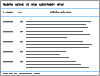
表1
试验材料编号及来源"
| 编号 | 来源 |
|---|---|
| M1 | 中棉所49/新陆中51 |
| M2 | 中棉所79/新陆中51 |
| M3 | 银山4号/新陆中51 |
| M4 | 银山6号/新陆中51 |
| M5 | 银山8号/新陆中51 |
| M6 | 鲁棉研21号/新陆中51 |
| M7 | 鲁棉研28号/新陆中51 |
| M8 | 冀棉228/新陆中51 |
| M9 | 豫棉668/新陆中51 |
| M10 | 豫棉19号/新陆中51 |
| M11 | 豫棉21号/新陆中51 |
| M12 | 中植棉2号/新陆中51 |
| M13 | 双价321/新陆中51 |
| M14 | 石抗39/新陆中51 |
| M15 | 百棉1号/新陆中51 |
| M16 | 百棉3号/新陆中51 |
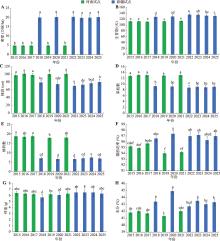
图1
2015~2025年河南新疆试点后代材料的农艺性状 A:密度,新疆试点种植密度显著高于河南,且差距逐年扩大;B:生育期,新疆试点生育期显著长于河南,且差距保持稳定;C:株高,新疆试点株高显著低于河南,且差距逐年缩小;D:果枝数,新疆试点果枝数显著少于河南,且差距保持稳定;E:株铃数,新疆试点单株结铃数显著少于河南,且差距保持稳定;F:霜前花率,新疆试点霜前花率显著高于河南,且差距逐年扩大;G:铃重,新疆试点铃重与河南差异不显著;H:衣分,新疆试点衣分显著高于河南,且年际间有差异。不同小写字母表示不同年份间差异显著,P<0.05。"

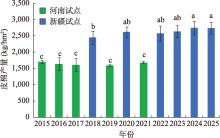
图2
2015~2025年河南-新疆试点后代材料的皮棉产量 不同小写字母表示不同年份间差异显著,P<0.05。"
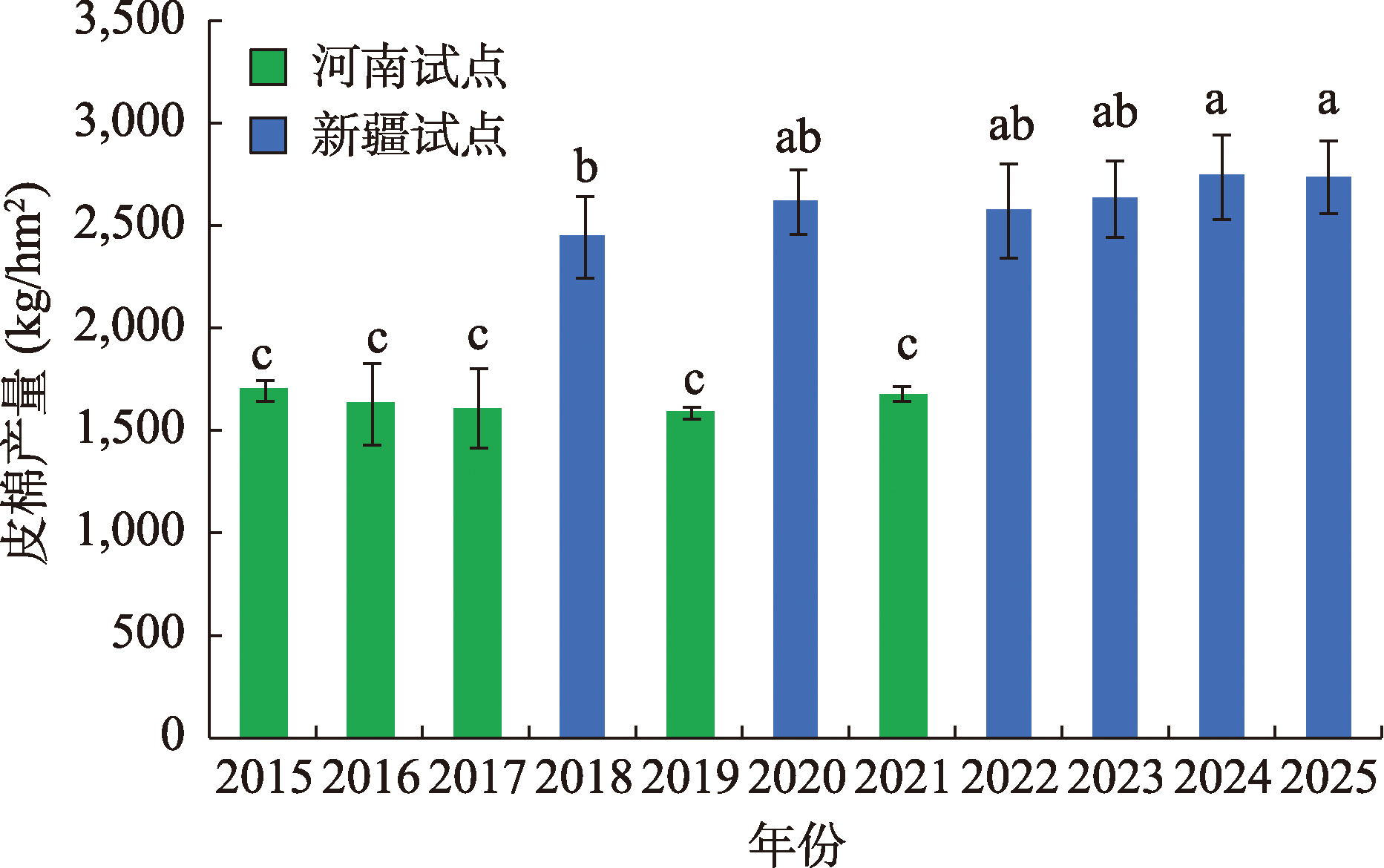
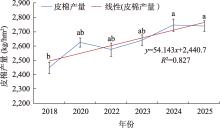
图3
2018~2025年新疆试点后代材料的皮棉产量趋势图 不同小写字母表示不同年份间差异显著,P<0.05。"
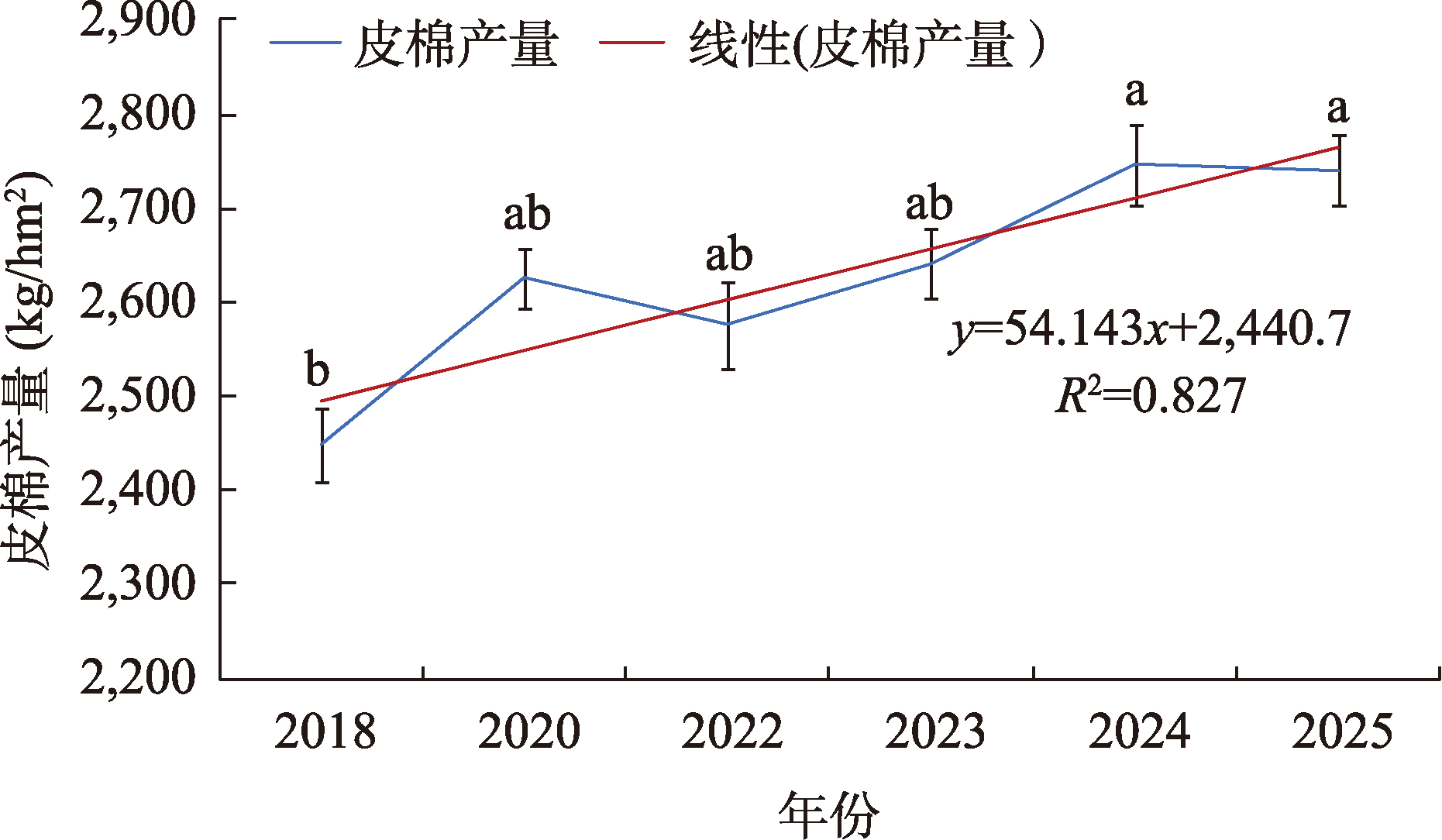
表2
穿梭育种棉花后代新疆试点皮棉产量回归方程"
| 编号 | 回归方程 | 斜率 | 决定系数(R2) |
|---|---|---|---|
| M1 | y=-3.00x+2,795 | -3.00 | 0.003 |
| M2 | y=60.21x+2,066 | 60.21 | 0.606 |
| M3 | y=58.67x+2,392 | 58.67 | 0.550 |
| M4 | y=17.4x+1,897 | 17.40 | 0.155 |
| M5 | y=73.75x+2,367 | 73.75 | 0.698 |
| M6 | y=111.0x+2,668 | 111.0 | 0.618 |
| M7 | y=79.07x+2,293 | 79.07 | 0.799 |
| M8 | y=69.12x+2,881 | 69.12 | 0.369 |
| M9 | y=81.51x+1,894 | 81.51 | 0.587 |
| M10 | y=55.92x+2,495 | 55.92 | 0.370 |
| M11 | y=32.82x+2,093 | 32.82 | 0.373 |
| M12 | y=51.00x+2,622 | 51.00 | 0.510 |
| M13 | y=109.5x+2,749 | 109.50 | 0.612 |
| M14 | y=43.92x+2,323 | 43.92 | 0.225 |
| M15 | y=-38.22x+3,335 | -38.22 | 0.304 |
| M16 | y=70.07x+2,194 | 70.07 | 0.629 |
表3
河南和新疆两地棉花产量因子的相关性分析"
| 性状 | 河南 | 新疆 | ||||||
|---|---|---|---|---|---|---|---|---|
| 密度 | 株铃数 | 铃重 | 衣分 | 密度 | 株铃数 | 铃重 | 衣分 | |
| 密度 | 1.000 | 1.000 | ||||||
| 株铃数 | 0.076 | 1.000 | -0.419** | 1.000 | ||||
| 铃重 | -0.088 | -0.463** | 1.000 | -0.156 | 0.061 | 1.000 | ||
| 衣分 | 0.147 | 0.084 | 0.087 | 1.000 | -0.216* | 0.105 | -0.387** | 1.000 |
| 皮棉产量 | -0.001 | -0.058 | 0.060 | 0.386** | 0.187 | 0.421** | -0.221* | 0.346** |
表4
穿梭育种棉花后代历年纤维品质指标"
| 生态区 | 年份 | 上半部平均长度(mm) | 断裂比强度(cN/tex) | 马克隆值 | 整齐度(%) | 纺纱均匀性指数 |
|---|---|---|---|---|---|---|
| 河南 | 2015 | 29.3 | 32.0 | 5.0 | 85.0 | 145.0 |
| 2016 | 29.4 | 32.4 | 5.1 | 84.9 | 144.8 | |
| 2017 | 29.4 | 32.6 | 5.1 | 85.1 | 146.3 | |
| 2019 | 29.5 | 32.5 | 5.0 | 85.4 | 148.7 | |
| 2021 | 29.1 | 32.6 | 5.2 | 85.1 | 145.2 | |
| 极小值 | 29.1 | 32.0 | 5.0 | 84.9 | 144.8 | |
| 极大值 | 29.5 | 32.6 | 5.2 | 85.4 | 148.7 | |
| 平均 | 29.3 | 32.4 | 5.1 | 85.1 | 146.0 | |
| 新疆 | 2018 | 30.2 | 29.9 | 4.4 | 85.3 | 150.3 |
| 2020 | 29.5 | 29.9 | 4.6 | 85.1 | 146.1 | |
| 2022 | 32.3 | 29.6 | 4.2 | 84.9 | 153.1 | |
| 2023 | 30.8 | 30.6 | 4.4 | 85.8 | 155.9 | |
| 2024 | 31.2 | 33.1 | 4.7 | 85.8 | 161.6 | |
| 2025 | 31.4 | 31.5 | 4.4 | 86.0 | 159.9 | |
| 极小值 | 29.5 | 29.6 | 4.2 | 84.9 | 146.1 | |
| 极大值 | 32.3 | 33.1 | 4.7 | 86.0 | 161.6 | |
| 平均 | 30.9 | 30.8 | 4.5 | 85.5 | 154.5 |
表5
后代品系的农艺性状及皮棉产量分析"
| 材料编号 | 生育期(天) | 株高(cm) | 单株果枝数 | 单株铃数 | 铃重(g) | 衣分(%) | 霜前花率(%) | 皮棉产量(kg/hm2) | 增产率(%) |
|---|---|---|---|---|---|---|---|---|---|
| M1 | 128.0 | 78.8 | 9.0 | 6.3 | 6.4 | 41.6 | 99.3 | 180.7 abAB | 3.5 |
| M2 | 127.7 | 76.7 | 8.9 | 6.3 | 6.4 | 42.6 | 99.4 | 175.0 bAB | 0.2 |
| M3 | 128.8 | 79.0 | 8.5 | 6.8 | 6.1 | 43.6 | 98.7 | 195.2 aA | 11.7 |
| M4 | 126.8 | 79.9 | 8.8 | 6.9 | 6.3 | 44.7 | 97.6 | 174.1 bB | -0.4 |
| M5 | 129.0 | 79.7 | 8.4 | 6.9 | 6.3 | 44.5 | 98.6 | 177.3 abAB | 1.5 |
| M6 | 130.7 | 83.8 | 8.8 | 7.0 | 6.2 | 44.5 | 97.9 | 170.9 bB | -2.2 |
| M7 | 130.7 | 76.6 | 8.6 | 5.4 | 6.4 | 43.5 | 97.4 | 166.2 bB | -4.8 |
| M8 | 123.5 | 73.6 | 7.6 | 5.2 | 5.6 | 43.9 | 99.5 | 136.2 cC | -22.0 |
| M9 | 127.3 | 87.0 | 9.3 | 5.8 | 6.0 | 43.3 | 98.8 | 172.6 bB | -1.2 |
| M10 | 130.0 | 81.1 | 8.7 | 7.1 | 6.7 | 42.5 | 99.0 | 192.3 aA | 10.1 |
| M11 | 130.0 | 83.5 | 8.0 | 6.1 | 6.6 | 44.3 | 98.1 | 173.7 bB | -0.6 |
| M12 | 129.0 | 80.1 | 8.9 | 7.2 | 6.5 | 42.6 | 98.8 | 192.0 abAB | 9.9 |
| M13 | 129.7 | 77.0 | 9.1 | 6.6 | 6.2 | 43.1 | 97.8 | 173.2 bB | -0.9 |
| M14 | 128.5 | 77.7 | 8.4 | 7.2 | 6.1 | 44.5 | 95.3 | 174.5 bB | -0.1 |
| M15 | 128.3 | 83.0 | 8.2 | 6.9 | 6.2 | 43.7 | 94.0 | 176.7 abAB | 1.1 |
| M16 | 130.7 | 74.3 | 8.6 | 6.1 | 6.4 | 44.1 | 98.0 | 169.0 bB | -3.3 |
| 对照 | 127.2 | 82.7 | 7.8 | 6.0 | 5.8 | 43.1 | 97.6 | 174.7 bB | 0.0 |
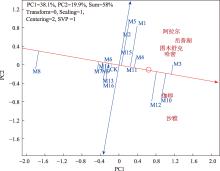
图4
后代品系丰产性和稳产性的GGE双标图 ○表示平均环境(各试点平均值);红色箭头所指方向为平均环境轴(AEA)及品种高产方向;品种在AEA上垂足位置反映丰产性,越靠近箭头方向丰产性越好;从品种垂直于AEA的线段长短表示其稳产性,线段越短稳产性越好。"
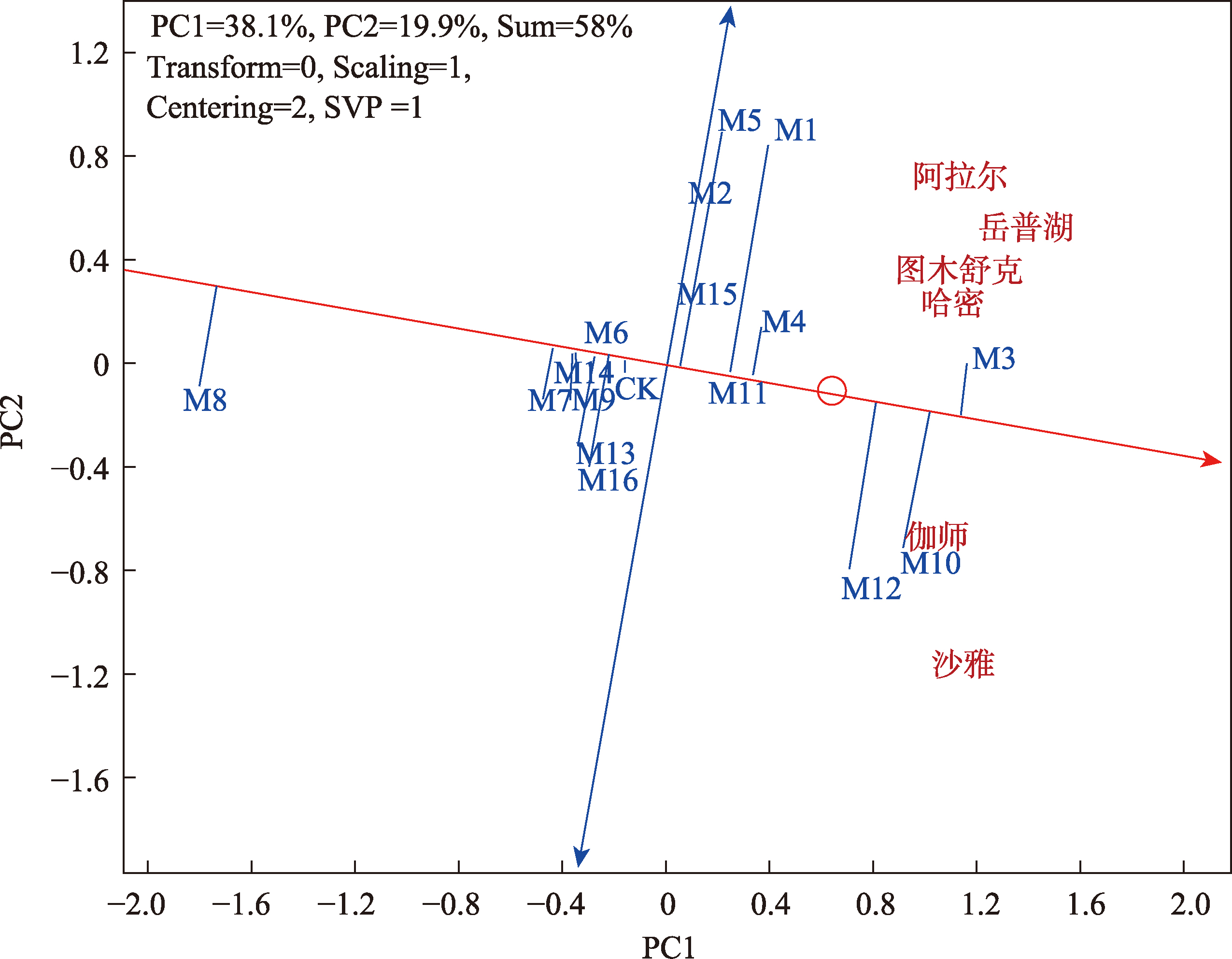
表6
参试品种棉花纤维品质检测"
| 编号 | 上半部平均 长度(mm) | 断裂比强度 (cN/tex) | 马克隆值 | 整齐度 (%) | 纺纱均匀 性指数 |
|---|---|---|---|---|---|
| M1 | 29.9 | 27.6 | 4.5 | 85.3 | 142.7 |
| M2 | 30.2 | 30.4 | 4.2 | 85.6 | 155.4 |
| M3 | 30.4 | 31.6 | 4.3 | 85.9 | 161.5 |
| M4 | 30.6 | 29.7 | 4.7 | 85.0 | 147.3 |
| M5 | 28.9 | 28.3 | 5.1 | 83.8 | 130.3 |
| M6 | 31.8 | 32.7 | 4.2 | 86.0 | 166.7 |
| M7 | 31.7 | 32.5 | 4.1 | 86.5 | 170.6 |
| M8 | 29.4 | 29.1 | 4.8 | 84.7 | 140.6 |
| M9 | 30.6 | 28.0 | 4.5 | 84.2 | 140.4 |
| M10 | 30.5 | 31.8 | 4.4 | 86.0 | 160.9 |
| M11 | 31.0 | 31.4 | 4.1 | 85.3 | 159.9 |
| M12 | 30.6 | 32.7 | 4.4 | 86.0 | 163.9 |
| M13 | 30.8 | 30.8 | 4.1 | 85.7 | 159.0 |
| M14 | 29.5 | 26.6 | 4.4 | 84.7 | 136.9 |
| M15 | 32.0 | 30.3 | 4.3 | 86.3 | 160.3 |
| M16 | 30.1 | 29.6 | 4.6 | 85.2 | 147.2 |
| 对照 | 30.4 | 30.2 | 4.1 | 85.7 | 155.2 |
| [1] | Zhang RW, Chen YL, Zhao DJ. Current status and suggestions on cotton seed industry development in Xinjiang. Co-Operat Econ Sci, 2023, (15): 31-33. |
| 张若薇, 陈玉兰, 赵达君. 新疆棉花种业发展现状及建议. 合作经济与科技, 2023, (15): 31-33. | |
| [2] | Du XM, Liu F, Wang KB, Jia YH, Zhou ZL, He SP, Gong WF, Pan ZE, Wang LR, Geng XL, Pang BY. Collection, evaluation and utilization of cotton germplasm. Cotton Sci, 2017, 29(S1): 51-61. |
| 杜雄明, 刘方, 王坤波, 贾银华, 周忠丽, 何守朴, 龚文芳, 潘兆娥, 王立如, 耿晓丽, 庞保印. 棉花种质资源收集鉴定与创新利用. 棉花学报, 2017, 29(增刊): 51-61. | |
| [3] | Du XM, Sun JL, Zhou ZL, Jia YH, Pan ZE, He SP, Pang BY, Wang LR. Current situation and the future in collection, preservation, evaluation and utilization of cotton germplasm in China. J Plant Genet Resour, 2012, 13(2): 163-168. |
| 杜雄明, 孙君灵, 周忠丽, 贾银华, 潘兆娥, 何守朴, 庞保印, 王立如. 棉花资源收集、保存、评价与利用现状及未来. 植物遗传资源学报, 2012, 13(2): 163-168. | |
| [4] | Tang ZJ, Lü SP, Li W, Nie LH, Wang S, Xie DY. Study on optimal identification and cluster utilization of 206 cotton resources. Seed, 2020, 39(6): 59-63. |
| 唐中杰, 吕淑平, 李武, 聂利红, 王舜, 谢德意. 206份棉花资源的优选鉴定及聚类利用研究. 种子, 2020, 39(6): 59-63. | |
| [5] | Tang ZJ, Xie DY, Yu YB, Fang WP, Lu FY. Evaluation of inland superior cotton resources and their application in Xinjiang cotton breeding. J Henan Agric Sci, 2024, 53(2): 37-45. |
| 唐中杰, 谢德意, 于跃波, 房卫平, 路风银. 内地棉区优势棉花资源评价及其在新疆棉花育种中的应用. 河南农业科学, 2024, 53(2): 37-45. | |
| [6] | Chen XM. International Centre for maize and wheat improvement (ICMW) wheat shuttle breeding and field identification. J Hebei Agric Sci, 1988, (4): 32-34. |
| 陈新民. 国际玉米小麦改良中心小麦穿梭育种及异地鉴定. 河北农业科学, 1988, (4): 32-34. | |
| [7] | Lü ZT, Tang SQ, Min SK. Selection efficiency of rice shuttle breeding method. Chin J Rice Sci, 1992, 6(1): 15-20. |
| 吕子同, 唐绍清, 闵绍楷. 水稻穿梭育种的选择效应. 中国水稻科学, 1992, 6(1): 15-20. | |
| [8] | Xie ZJ, Liu ZH, Zhang JF, Lazar Kojic. The mutual complement studies for Yugoslavia maize population improvement through the shuttle breeding. J Beijing Univ Agric, 2001, 16(1): 5-9. |
| 谢振江, 刘自华, 张锦芬, Lazar Kojic. 中南穿梭育种对南斯拉夫玉米群体改良的互补性研究. 北京农学院学报, 2001, 16(1): 5-9. | |
| [9] | Guan ZB, Dong YH, Zhang YW, Tian JH, Zhao WG, Zhao XG, Wei SH, Li SQ, Zhang WX, Wang XF, Li DR. Ecological shuttle breeding application on breeding of brassica napus cultivars. Chin J Oil Crop Sci, 2017, 39(4): 462-466. |
| 关周博, 董育红, 张耀文, 田建华, 赵卫国, 赵小光, 韦世豪, 李少钦, 张文学, 王学芳, 李殿荣. 生态穿梭育种在油菜品种选育中的应用. 中国油料作物学报, 2017, 39(4): 462-466. | |
| [10] | Li CQ, Li PY, Wang HL, Fu YZ, Wang QL. Correlation of cotton earliness and lint yield in different ecological environments. J Henan Inst Sci Technol (Nat Sci Ed), 2015, 43(5): 1-5. |
| 李成奇, 李鹏云, 王浩丽, 付远志, 王清连. 不同生态环境下棉花早熟性与皮棉产量的关系. 河南科技学院学报(自然科学版), 2015, 43(5): 1-5. | |
| [11] | Tang ZJ, Yu YB, Yang XJ, Lü SP, Nie LH, Xie DY. The adaptability analysis in Korla, Xinjiang of cotton varieties from Henan. Chin Cotton, 2018, 45(5): 9-12. |
| 唐中杰, 于跃波, 杨晓杰, 吕淑平, 聂利红, 谢德意. 河南部分棉花品种在新疆库尔勒的适应性分析. 中国棉花, 2018, 45(5): 9-12. | |
| [12] | Wang JM, Hou ZQ, Yang MF, Ji CR. Analysis of the influence of climate factors on cotton growth and yield in Northern Xinjiang. Cotton Sci, 2021, 43(5): 24-32. |
| 王金梅, 侯志强, 杨明凤, 吉春容. 新疆北疆地区气候要素对棉花生长和产量的影响分析. 棉花科学, 2021, 43(5): 24-32. | |
| [13] | Xu HY, Yin YH, Li HY, Tian M, Wang XT. The response of cotton climatic yield in Reclamation Area of the Eighth Division of Xinjiang Production and Construction Corps to thermal change. Hubei Agric Sci, 2022, 61(10): 5-9+14. |
| 许浩翊, 尹育红, 李红英, 田苗, 王啸天. 新疆农八师垦区棉花气候产量对热量变化的响应. 湖北农业科学, 2022, 61(10): 5-9+14. | |
| [14] | Yan WK. Optimal use of biplots in analysis of multi- location variety test data. Acta Agron Sin, 2010, 36(11): 1805-1819. |
| 严威凯. 双标图分析在农作物品种多点试验中的应用. 作物学报, 2010, 36(11): 1805-1819. | |
| [15] | Xu NY, Rong YH, Li J, Fu YH, Mei HC. Evaluation of upland cotton yield stability and adaptability using GGE-biplot analysis: A case study of ‘Ezamian 30’ cotton cultivar in Yangtze River Valley. Chin J Eco-Agric, 2017, 25(6): 884-892. |
| 许乃银, 荣义华, 李健, 付永红, 梅汉成. GGE双标图在陆地棉高产稳产和适应性分析中的应用——以长江流域棉区国审棉花新品种‘鄂杂棉30’为例. 中国生态农业学报, 2017, 25(6): 884-892. | |
| [16] | 国家农作物品种审定委员会. 国家级棉花品种审定标准(2025年修订)[EB/OL]. ( 2025-11-20). .https://nync.xingtai.gov.cn/news_show.aspx?id=7852 |
| [17] | Pan GT, Yang KC, Gao SB. History and practice of maize ecological breeding in sichuan agricultural university. J Maize Sci, 2023, 31(2): 1-8. |
| 潘光堂, 杨克诚, 高世斌. 四川农业大学玉米生态育种的历史与实践. 玉米科学, 2023, 31(2): 1-8. | |
| [18] | Wang JK. Quantitative Genetics. Beijing: Science Press, 2017, P219-223, 236-238. |
| 王建康. 数量遗传学. 北京: 科学出版社, 2017, P219-223, 236-238. | |
| [19] | Zhang BY. Drought stress response revealed by 3D genomic variation and transcriptional regulation in cotton[Dissertation]. Huazhong Agricultural University, 2023. |
| 张伯阳. 基于三维基因组及转录调控解析棉花干旱胁迫应答机制[学位论文]. 华中农业大学, 2023. | |
| [20] | Li LL. Physiological mechanism of exogenous silicon in improving salinity tolerance of cotton[Dissertation]. Chinese Academy of Agricultural Sciences, 2022. |
| 李磊磊. 外源硅提高棉花耐盐性的生理机制[学位论文]. 中国农业科学院, 2022. | |
| [21] | Guo JH, Wang WM, Zhao H, Yao YD, Li YG. Effects of planting density on growth, yield and quality of cotton under mechanical harvesting. J Anhui Agric Sci, 2024, 52(24): 38-41+45. |
| 郭景红, 王维民, 赵海, 姚炎帝, 李玉国. 机采种植模式下密度对棉花生长发育·产量及品质的影响. 安徽农业科学, 2024, 52(24): 38-41+45. | |
| [22] | Xiong ZW, Wang XJ, Gu SH, Zhang LZ, Zhou ZG. Correlation between meteorological factors and cotton fiber quality in major cotton-producing regions of China. Cotton Sci, 2014, 26(2): 95-104. |
| 熊宗伟, 王雪姣, 顾生浩, 张立祯, 周治国. 中国主产棉区气象因子和纤维品质的相关性研究. 棉花学报, 2014, 26(2): 95-104. | |
| [23] | Chen G, Zhao JX. Effects of climate difference on biological and quality characteristics of cotton. J Shanxi Agric Sci, 2020, 48(7): 1115-1118. |
| 陈耕, 赵俊侠. 气候差异对棉花生物学特性及品质特性的影响. 山西农业科学, 2020, 48(7): 1115-1118. | |
| [24] | Feng CH, Zhang YC, Bie S, Zhang JH, Wang XG, Xia SB, Zhang C, Qin HD. Research progress on improvement for verticillium wilt resistance by molecular marker-assisted selection in cotton. Crops, 2017(5): 21-25. |
| 冯常辉, 张友昌, 别墅, 张教海, 王孝纲, 夏松波, 张成, 秦鸿德. 棉花黄萎病抗性分子标记辅助选择改良研究进展. 作物杂志, 2017(5): 21-25. | |
| [25] | Fu JC. Functional verification and marker development of genes related to drought resistance in Gossypium hirsutum[Dissertation]. Xinjiang Agricultural University, 2023. |
| 付锦程. 陆地棉抗旱相关基因功能验证及标记开发[学位论文]. 新疆农业大学, 2023. | |
| [26] | Tuo MZ, Chang XY, Wei YT, Zhang ZX, Abudukeyoumu Abudurezike, Xu L, You CY, Li ZB, Lin HR, Xu JW, Wu YL, Nie XH. Mapping QTLs related to fiber quality and yield traits of cotton based on imported lines of Gossypium mustelinum. J Plant Genet Resour, 2026, 27(2): 407-423. |
| 拓明喆, 常鑫燚, 卫雅亭, 张子昕, 阿布都克尤木·阿不都热孜克, 徐麟, 尤春源, 李志博, 林海荣, 徐建伟, 吴元龙, 聂新辉. 基于黄褐棉导入系群体定位棉花纤维品质和产量性状QTLs. 植物遗传资源学报, 2026, 27(2): 407-423. | |
| [27] | Guo DC, Lü T, Cai YS, Maiwuluda Aihemaiti, Chen QJ, Qu YY, Zheng K. Meta-analysis of QTL and identification of candidate genes for fiber quality in cotton. Acta Agron Sin, 2025, 51(6): 1445-1466. |
| 郭栋财, 吕涛, 蔡永生, 买吾鲁达·艾合买提, 陈全家, 曲延英, 郑凯. 棉花纤维品质相关性状QTL元分析及候选基因鉴定. 作物学报, 2025, 51(6): 1445-1466. | |
| [28] | Zhou CZ, Huang YW, Zhou DY, Huang LY, Wu YZ, Fu SY, Peng J, Kuang M. Research progress on the genetic basis and QTL mapping of cottonseed protein and oil content. Cotton Sci, 2024, 36(2): 145-162. |
| 周超泽, 黄义文, 周大云, 黄龙雨, 吴玉珍, 付守阳, 彭军, 匡猛. 棉籽蛋白与油分含量的遗传基础与QTL定位研究进展. 棉花学报, 2024, 36(2): 145-162. |
| [1] | 陈佳丹, 林涛, 王弯, 金成, 左建儒, 粘金沯. 水稻大穗突变体hry1的鉴定与基因定位[J]. 遗传, 2025, 47(7): 797-812. |
| [2] | 鲍艳春, 戴伶俐, 刘在霞, 马凤英, 王宇, 刘永斌, 谷明娟, 娜日苏, 张文广. CRISPR/Cas9系统在畜禽遗传改良中研究进展[J]. 遗传, 2024, 46(3): 219-231. |
| [3] | 陈赢男, 陆静. CRISPR/Cas9系统在林木基因编辑中的应用[J]. 遗传, 2020, 42(7): 657-668. |
| [4] | 吴比, 胡伟, 邢永忠. 中国水稻遗传育种历程与展望[J]. 遗传, 2018, 40(10): 841-857. |
| [5] | 文莹, 张立新. 阿维菌素的中国“智”造[J]. 遗传, 2018, 40(10): 888-899. |
| [6] | 黄娇娇, 曹春伟, 郑国民, 赵建国. 基因组编辑技术在猪遗传改良中的应用[J]. 遗传, 2017, 39(11): 1078-1089. |
| [7] | 任勇, 李生荣, 罗建明, 何中虎, 杜小英, 周强,何员江,魏育明, 郑有良. 绵麦37特异位点在其衍生品种中的遗传贡献率分析[J]. 遗传, 2014, 36(2): 145-151. |
| [8] | 雍洪军 王建军 张德贵 张晓聪 李明顺 白丽 张世煌 李新海. 美洲地区主要玉米群体特征及其利用途径分析[J]. 遗传, 2013, 35(6): 703-713. |
| [9] | 吴比,韩忠民,李志新,邢永忠. 普通野生稻中增产相关QTL的发掘[J]. 遗传, 2012, 34(2): 215-222. |
| [10] | 王峰,官春云. 甘蓝型油菜遗传图谱的构建及单株产量构成因素的QTL分析[J]. 遗传, 2010, 32(3): 271-277. |
| [11] | 石玉真,张保才,李俊文,刘爱英,袁有禄. 棉花纤维品质性状主要由母体植株基因型决定[J]. 遗传, 2008, 30(11): 1466-1476. |
| [12] | Sansern Jampatong,Porn Rungchang,. 泰国玉米生产和遗传改良研究[J]. 遗传, 2000, 22(6): 423-429. |
| [13] | 王素,徐兆生,魏民. 菜用大豆产量相关性状的遗传分析[J]. 遗传, 1996, 18(3): 34-36. |
| [14] | 王敏. 小麦杂种世代生育期与产量的遗传关系[J]. 遗传, 1996, 18(2): 11-14. |
| [15] | 李有春. 小麦提型不育系和杂交种种子生活力遗传改良初探[J]. 遗传, 1995, 17(6): 12-16. |
| 阅读次数 | ||||||
|
全文 |
|
|||||
|
摘要 |
|
|||||

www.chinagene.cn
备案号:京ICP备09063187号-4
总访问:,今日访问:,当前在线:

