
遗传 ›› 2026, Vol. 48 ›› Issue (10): 973-985.doi: 10.16288/j.yczz.26-140
王伊萌1( ), 臧潇1,2()
收稿日期:2026-06-11
修回日期:2026-08-04
出版日期:2026-09-01
发布日期:2026-09-01
通讯作者:
臧潇,博士,助理研究员,研究方向:细胞生物学。E-mail: xiaozang@intl.zju.edu.cn作者简介:王伊萌,硕士研究生,专业方向:生物化学与分子生物学。E-mail: yimeng.23@intl.zju.edu.cn
基金资助:
Yimeng Wang1(), Xiao Zang1,2()
Received:2026-06-11
Revised:2026-08-04
Published:2026-09-01
Online:2026-09-01
Supported by:摘要:
对基因表达的时空特异性操控是解析基因功能、阐明发育过程及揭示复杂生理机制的重要前提。作为模式生物,秀丽隐杆线虫(Caenorhabditis elegans)在基础生物学研究中发挥了重要的作用,并为实现上述操控提供了理想的实验体系。近年来,随着单拷贝转基因、CRISPR/Cas9基因编辑以及条件性重组和诱导系统的发展,线虫中时空特异性乃至单细胞分辨率调控基因表达的遗传工具不断丰富。本文系统梳理了在线虫研究中应用的主要时空特异性基因表达调控策略,重点介绍了组织特异性RNA干扰、条件性蛋白降解系统、可诱导转录调控系统,以及新近发展的Ribo-on/Ribo-off等方法,并从调控层级、技术优势、局限性及适用场景等方面进行了比较分析。这些工具覆盖了从转录、转录后到蛋白质水平的多个调控环节,为发育生物学、衰老机制、跨组织信号传递以及疾病模型构建等研究提供了重要的技术支持,也为解析复杂生命过程中的细胞自主性和非自主性调控机制奠定了方法学基础。
王伊萌, 臧潇. 秀丽隐杆线虫时空特异性基因表达调控工具与策略研究进展[J]. 遗传, 2026, 48(10): 973-985.
Yimeng Wang, Xiao Zang. Advances in tools and strategies for spatiotemporal regulation of gene expression in Caenorhabditis elegans[J]. Hereditas(Beijing), 2026, 48(10): 973-985.
图1
线虫中主要的蛋白降解系统策略 A:生长素诱导降解系统(AID)示意图;B:GFP纳米抗体介导的蛋白降解系统示意图。图中展示了系统的核心组件、调控逻辑及作用机制:组织特异性启动子驱动靶标识别组分表达,使带有特定标签的靶蛋白被募集至E3泛素连接酶复合物,通过泛素-蛋白酶体途径降解。Cul1和Cul2均为Cullin家族成员,分别为SCF和ECS两个E3复合物的关键组分;degron:降解子。"
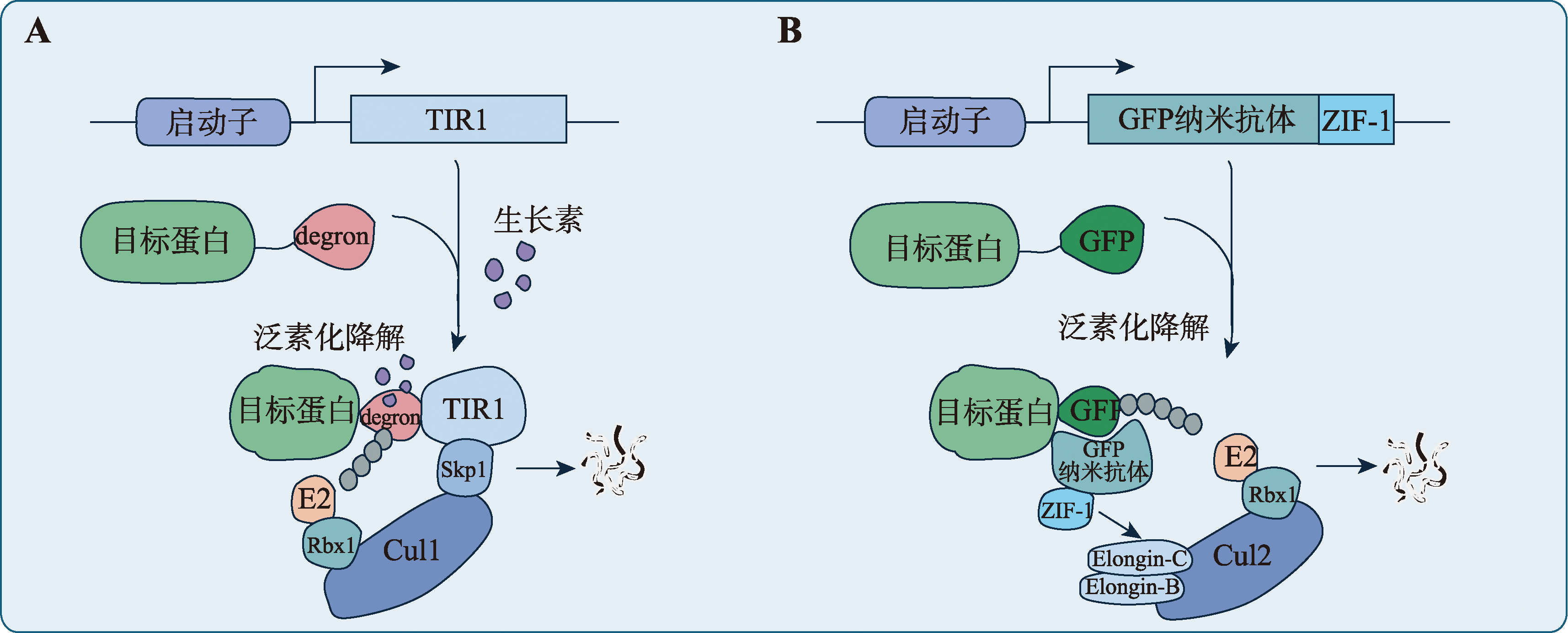
图2
线虫中Q系统及其衍生系统的基因表达调控策略 A:经典Q系统;B:分裂Q系统;C:QF-GR药物诱导系统;D:Tet/Q杂合系统。不同颜色代表不同功能元件,箭头指示调控方向,不同组织或细胞特异性启动子使用“启动子1”和“启动子2”表示。QUAS:顺式作用元件;QF:转录激活因子;QS:阻遏因子;QF-BD:QF DNA结合域;QF-AD:QF转录激活域;Zip:亮氨酸拉链;GR:糖皮质激素受体;TetO:四环素操纵子;rTetR:反式四环素抑制子;rtTA:反式四环素转录激活因子;QA:奎宁酸;Dex:地塞米松;Dox:多西环素。"
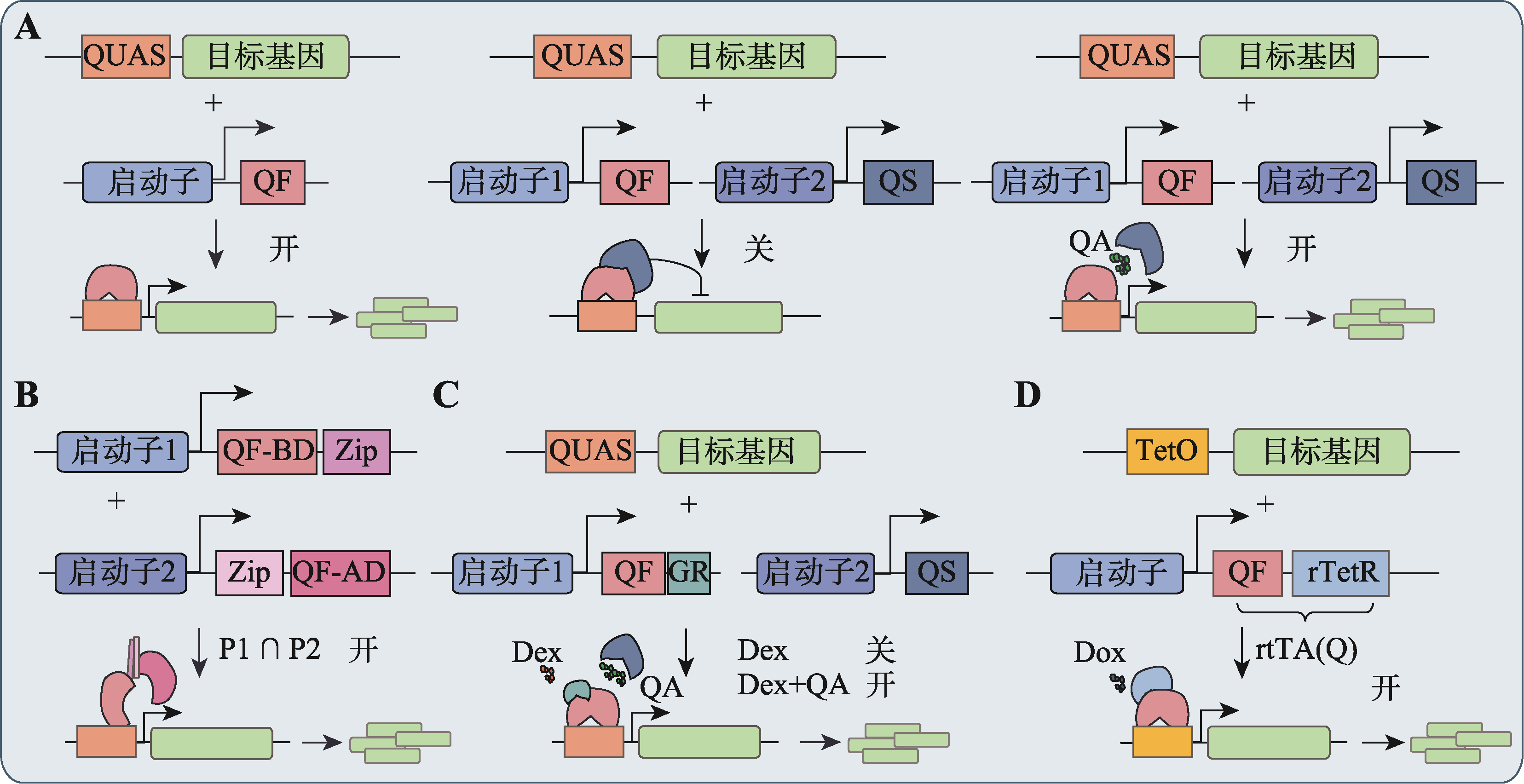
图3
线虫中Ribo-on与Ribo-off系统策略 A:Ribo-on通过切除活性核酶,使表达由“关闭”转为“开启”;B:Ribo-off通过切除核酶阻断元件,使表达由“开启”转为“关闭”。两种策略均可通过组织特异性或诱导型启动子驱动Cre重组酶实现在空间或时间的精准控制。Rz:核酶(ribozyme);蓝色波浪线代表成熟mRNA;红色叉表示mRNA降解。"
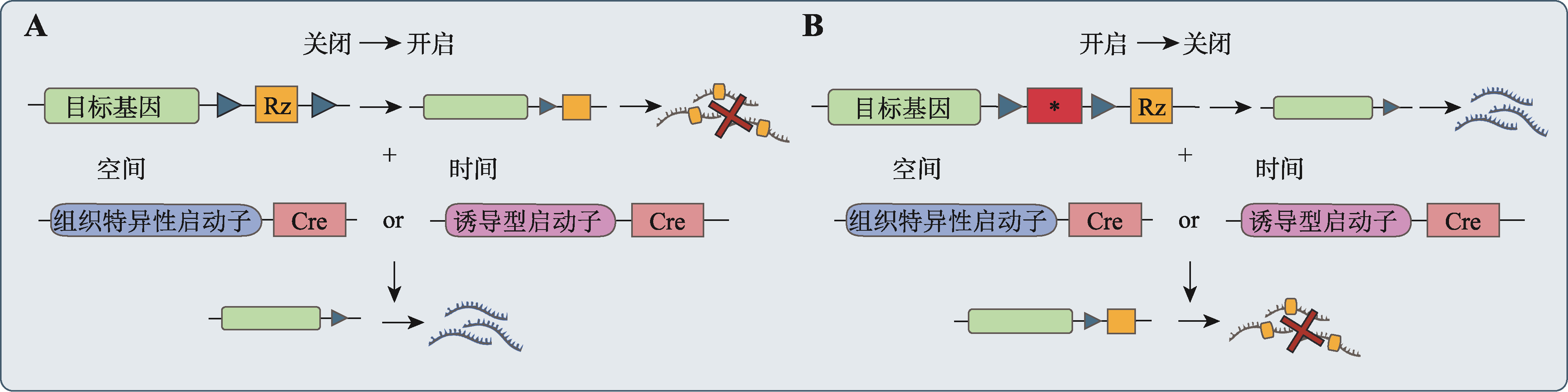
表1
线虫中主要时空特异性基因表达调控系统比较"
| 系统 | 调控层级 | 空间控制 方式 | 时间控制 方式 | 是否作用于内 源基因 | 可逆性 | 主要优点 | 主要局限 | 潜在毒性/扰动 | 优先适用场景 |
|---|---|---|---|---|---|---|---|---|---|
| 组织特异性RNAi | mRNA降解 | 组织特异性启动子恢复RNAi活性 | 喂食RNAi起始时间可控 | 是,无需标签化 | 部分可逆,取决于dsRNA清除时间 | 操作简便,适合筛选 | 依赖RNAi敏感性,受启动子限制 | 总体较低,需考虑脱靶和系统性传播 | 高通量初筛、低成本组织特异性敲降 |
| AID/AIDv2 | 蛋白质降解 | 组织特异性表达TIR1 | 外源生长素或衍生物诱导与撤除 | 是,需内源敲入降解子 | 可逆,撤药后依赖靶蛋白重新合成 | 响应较快,适合急性功能分析 | 需标签化改造,处理条件需优化 | AID有本底降解及高浓度配体影响;AIDv2通常较低 | 必需基因蛋白降解、不同时间蛋白降解 |
| GFP纳米抗体- ZIF-1蛋白降解 | 蛋白质降解 | 组织特异性表达降解模块 | 无,取决于降解模块表达时序 | 是,需内源引入GFP标记 | 不可逆 | 适配GFP资源丰富 | 依赖GFP标记 | 生殖系表达可导致不育,GFP标签可能影响蛋白功能 | 有现有GFP内源敲入资源的体细胞降解 |
| 热休克系统 | 转录激活 | 组织特异性启动子恢复热应激能力 | 短时升温或局部激光触发 | 通常否,主要驱动转基因 | 可撤除,需等待mRNA/蛋白降解 | 操作简单,诱导快 | 早期胚胎和生殖系诱导受限 | 热应激可改变细胞状态 | 短时脉冲、单细胞激光诱导 |
| cGAL系统 | 转录激活 | 组织特异性启动子驱动cGAL | 无 | 否,主要驱动转基因 | 几乎不可逆,通常为组成型驱动 | 模块清晰,构建成熟 | 剂量控制与可逆性有限 | 通常较低,需评估高表达效应 | 稳定组织特异性表达和模块化品系组合 |
| Q系统 | 转录激活/抑制 | QF/QS/QUAS组合 | QA解除QS抑制 | 否,主要驱动转基因 | 可逆,受QA清除和产物周转限制 | 背景较低,可进行抑制-激活控制 | 诱导动力学较慢 | QA通常较低 | 需要抑制/解除抑制逻辑的转基因表达 |
| 分裂Q系统 | 转录 | 两个启动子交集控制 | 依赖模块重建 | 否,主要驱动转基因 | 有限,与QS联用增加可调性 | 分辨率更高,适合细胞亚群 | 构建复杂 | 通常较低,元件增多可能增加背景 | 稀有细胞或神经元亚群交叉定位 |
| QF-GR | 转录 | 启动子限制QF-GR表达 | Dex诱导核转位 | 否,主要驱动转基因 | 可逆,撤掉Dex后逐步恢复 | 低泄漏,时间控制增强 | 药物条件需优化 | Dex剂量依赖,需药物对照 | 需持续诱导表达的实验 |
| Tet/Q融合系统 | 转录 | 结合Q与Tet模块 | 四环素类药物调控 | 否,主要驱动转基因 | 可逆,撤掉Dox后逐步关闭 | 灵活度高,动态调节能力强 | 系统复杂 | Dox剂量依赖,需评估药物本身效应 | 较稳健的药物诱导表达 |
| Cre/FLP三元系统 | DNA重组 | 双启动子交集控制 | 重组酶条件激活 | 是,需编辑靶位点 | 不可逆,DNA重组 | 构建AND门,提高特异性 | 元件较多,构建复杂 | 较低,非预期重组可形成永久效应 | 谱系示踪、永久激活、稀有细胞类型 |
| Ribo-on、Ribo-off | DNA重组 | Cre/loxP限制核酶活化或切除 | 重组酶诱导 | 是,需敲入核酶 | Cre触发后通常不可逆 | 直接作用于内源mRNA | 系统较新,应用范围待拓展 | 总体较低,需排除RNA加工和基础表达扰动 | 内源基因条件性开启/关闭、必需基因研究 |
| [1] |
Brenner S. The genetics of Caenorhabditis elegans. Genetics, 1974, 77(1): 71-94.
pmid: 4366476 |
| [2] |
Sulston JE, Horvitz HR. Post-embryonic cell lineages of the nematode, Caenorhabditis elegans. Dev Biol, 1977, 56(1): 110-156.
pmid: 838129 |
| [3] |
Fire A. Integrative transformation of Caenorhabditis elegans. EMBO J, 1986, 5(10): 2673-2680.
pmid: 16453714 |
| [4] |
Mello CC, Kramer JM, Stinchcomb D, Ambros V. Efficient gene transfer in C. elegans: extrachromosomal maintenance and integration of transforming sequences. EMBO J, 1991, 10(12): 3959-3970.
pmid: 1935914 |
| [5] |
Mello C, Fire A. DNA transformation. Methods Cell Biol, 1995, 48: 451-482.
pmid: 8531738 |
| [6] |
Frøkjær-Jensen C, Wayne Davis M, Hopkins CE, Newman BJ, Thummel JM, Olesen SP, Grunnet M, Jorgensen EM. Single-copy insertion of transgenes in Caenorhabditis elegans. Nat Genet, 2008, 40(11): 1375-1383.
pmid: 18953339 |
| [7] |
Zhang F, Wen Y, Guo X. CRISPR/Cas9 for genome editing: progress, implications and challenges. Hum Mol Genet, 2014, 23(R1): R40-R46.
pmid: 24651067 |
| [8] | Williams GC. Pleiotropy, natural selection, and the evolution of senescence. Evolution, 1957, 11(4): 398-411. |
| [9] |
Blaxter ML, De Ley P, Garey JR, Liu LX, Scheldeman P, Vierstraete A, Vanfleteren JR, Mackey LY, Dorris M, Frisse LM, Vida JT, Thomas WK. A molecular evolutionary framework for the phylum Nematoda. Nature, 1998, 392(6671): 71-75.
pmid: 9510248 |
| [10] |
Sulston JE, Schierenberg E, White JG, Thomson JN. The embryonic cell lineage of the nematode Caenorhabditis elegans. Dev Biol, 1983, 100(1): 64-119.
pmid: 6684600 |
| [11] |
C. elegans Sequencing Consortium. Genome sequence of the nematode C. elegans: a platform for investigating biology. Science, 1998, 282(5396): 2012-2018.
pmid: 9851916 |
| [12] |
Lai CH, Chou CY, Chang LY, Liu CS, Lin W. Identification of novel human genes evolutionarily conserved in Caenorhabditis elegans by comparative proteomics. Genome Res, 2000, 10(5): 703-713.
pmid: 10810093 |
| [13] |
Stinchcomb DT, Shaw JE, Carr SH, Hirsh D. Extrachromosomal DNA transformation of Caenorhabditis elegans. Mol Cell Biol, 1985, 5(12): 3484-3496.
pmid: 3837845 |
| [14] |
Fire A, Waterston RH. Proper expression of myosin genes in transgenic nematodes. EMBO J, 1989, 8(11): 3419-3428.
pmid: 2583105 |
| [15] |
Kelly WG, Xu S, Montgomery MK, Fire A. Distinct requirements for somatic and germline expression of a generally expressed Caenorhabditis elegans gene. Genetics, 1997, 146(1): 227-238.
pmid: 9136012 |
| [16] |
Kelly WG, Fire A. Chromatin silencing and the maintenance of a functional germline in Caenorhabditis elegans. Development, 1998, 125(13): 2451-2456.
pmid: 9609828 |
| [17] |
Praitis V, Casey E, Collar D, Austin J. Creation of low-copy integrated transgenic lines in Caenorhabditis elegans. Genetics, 2001, 157(3): 1217-1226.
pmid: 11238406 |
| [18] |
Mariol MC, Walter L, Bellemin S, Gieseler K. A rapid protocol for integrating extrachromosomal arrays with high transmission rate into the C. elegans genome. J Vis Exp, 2013(82): e50773.
pmid: 24379027 |
| [19] |
Frøkjær-Jensen C, Davis MW, Ailion M, Jorgensen EM. Improved Mos1-mediated transgenesis in C. elegans. Nat Methods, 2012, 9(2): 117-118.
pmid: 22290181 |
| [20] |
Jinek M, Chylinski K, Fonfara I, Hauer M, Doudna JA, Charpentier E. A programmable dual-RNA-guided DNA endonuclease in adaptive bacterial immunity. Science, 2012, 337(6096): 816-821.
pmid: 22745249 |
| [21] |
Friedland AE, Tzur YB, Esvelt KM, Colaiácovo MP, Church GM, Calarco JA. Heritable genome editing in C. elegans via a CRISPR-Cas9 system. Nat Methods, 2013, 10(8): 741-743.
pmid: 23817069 |
| [22] |
Lo TW, Pickle CS, Lin S, Ralston EJ, Gurling M, Schartner CM, Bian Q, Doudna JA, Meyer BJ. Precise and heritable genome editing in evolutionarily diverse nematodes using TALENs and CRISPR/Cas9 to engineer insertions and deletions. Genetics, 2013, 195(2): 331-348.
pmid: 23934893 |
| [23] |
Dickinson DJ, Ward JD, Reiner DJ, Goldstein B. Engineering the Caenorhabditis elegans genome using Cas9-triggered homologous recombination. Nat Methods, 2013, 10(10): 1028-1034.
pmid: 23995389 |
| [24] |
Wolkow CA, Kimura KD, Lee MS, Ruvkun G. Regulation of C. elegans life-span by insulinlike signaling in the nervous system. Science, 2000, 290(5489): 147-150.
pmid: 11021802 |
| [25] |
Libina N, Berman JR, Kenyon C. Tissue-specific activities of C. elegans DAF-16 in the regulation of lifespan. Cell, 2003, 115(4): 489-502.
pmid: 14622602 |
| [26] |
Zhang YP, Zhang WH, Zhang P, Li Q, Sun Y, Wang JW, Zhang SO, Cai T, Zhan C, Dong MQ. Intestine-specific removal of DAF-2 nearly doubles lifespan in Caenorhabditis elegans with little fitness cost. Nat Commun, 2022, 13(1): 6339.
pmid: 36284093 |
| [27] |
Durieux J, Wolff S, Dillin A. The cell-non-autonomous nature of electron transport chain-mediated longevity. Cell, 2011, 144(1): 79-91.
pmid: 21215371 |
| [28] |
Fire A, Xu S, Montgomery MK, Kostas SA, Driver SE, Mello CC. Potent and specific genetic interference by double-stranded RNA in Caenorhabditis elegans. Nature, 1998, 391(6669): 806-811.
pmid: 9486653 |
| [29] |
Timmons L, Fire A. Specific interference by ingested dsRNA. Nature, 1998, 395(6705): 854.
pmid: 9804418 |
| [30] |
Winston WM, Molodowitch C, Hunter CP. Systemic RNAi in C. elegans requires the putative transmembrane protein SID-1. Science, 2002, 295(5564): 2456-2459.
pmid: 11834782 |
| [31] |
Feinberg EH, Hunter CP. Transport of dsRNA into cells by the transmembrane protein SID-1. Science, 2003, 301(5639): 1545-1547.
pmid: 12970568 |
| [32] |
Simmer F, Tijsterman M, Parrish S, Koushika SP, Nonet ML, Fire A, Ahringer J, Plasterk RHA. Loss of the putative RNA-directed RNA polymerase RRF-3 makes C. elegans hypersensitive to RNAi. Curr Biol, 2002, 12(15): 1317-1319.
pmid: 12176360 |
| [33] |
Kennedy S, Wang D, Ruvkun G. A conserved siRNA- degrading RNase negatively regulates RNA interference in C. elegans. Nature, 2004, 427(6975): 645-649.
pmid: 14961122 |
| [34] |
Calixto A, Chelur D, Topalidou I, Chen XY, Chalfie M. Enhanced neuronal RNAi in C. elegans using SID-1. Nat Methods, 2010, 7(7): 554-559.
pmid: 20512143 |
| [35] |
Tabara H, Sarkissian M, Kelly WG, Fleenor J, Grishok A, Timmons L, Fire A, Mello CC. The rde-1 gene, RNA interference, and transposon silencing in C. elegans. Cell, 1999, 99(2): 123-132.
pmid: 10535731 |
| [36] |
Tabara H, Yigit E, Siomi H, Mello CC. The dsRNA binding protein RDE-4 interacts with RDE-1, DCR-1, and a DExH-box helicase to direct RNAi in C. elegans. Cell, 2002, 109(7): 861-871.
pmid: 12110183 |
| [37] |
Qadota H, Inoue M, Hikita T, Köppen M, Hardin JD, Amano M, Moerman DG, Kaibuchi K. Establishment of a tissue-specific RNAi system in C. elegans. Gene, 2007, 400(1-2): 166-173.
pmid: 17681718 |
| [38] |
Zou LN, Wu D, Zang X, Wang Z, Wu ZX, Chen D. Construction of a germline-specific RNAi tool in C. elegans. Sci Rep, 2019, 9(1): 2354.
pmid: 30787374 |
| [39] |
Nishimura K, Fukagawa T, Takisawa H, Kakimoto T, Kanemaki M. An auxin-based degron system for the rapid depletion of proteins in nonplant cells. Nat Methods, 2009, 6(12): 917-922.
pmid: 19915560 |
| [40] |
Holland AJ, Fachinetti D, Han JS, Cleveland DW. Inducible, reversible system for the rapid and complete degradation of proteins in mammalian cells. Proc Natl Acad Sci USA, 2012, 109(49): E3350-E3357.
pmid: 23150568 |
| [41] |
Zhang LY, Ward JD, Cheng Z, Dernburg AF. The auxin-inducible degradation (AID) system enables versatile conditional protein depletion in C. elegans. Development, 2015, 142(24): 4374-4384.
pmid: 26552885 |
| [42] |
Kerk SY, Kratsios P, Hart M, Mourao R, Hobert O. Diversification of C. elegans motor neuron identity via selective effector gene repression. Neuron, 2017, 93(1): 80-98.
pmid: 28056346 |
| [43] |
Yesbolatova A, Saito Y, Kitamoto N, Makino-Itou H, Ajima R, Nakano R, Nakaoka H, Fukui K, Gamo K, Tominari Y, Takeuchi H, Saga Y, Hayashi KI, Kanemaki MT. The auxin-inducible degron 2 technology provides sharp degradation control in yeast, mammalian cells, and mice. Nat Commun, 2020, 11(1): 5701.
pmid: 33177522 |
| [44] |
Hills-Muckey K, Martinez MAQ, Stec N, Hebbar S, Saldanha J, Medwig-Kinney TN, Moore FEQ, Ivanova M, Morao A, Ward JD, Moss EG, Ercan S, Zinovyeva AY, Matus DQ, Hammell CM. An engineered, orthogonal auxin analog/AtTIR1(F79G) pairing improves both specificity and efficacy of the auxin degradation system in Caenorhabditis elegans. Genetics, 2022, 220(2): iyab174.
pmid: 34739048 |
| [45] |
Negishi T, Kitagawa S, Horii N, Tanaka Y, Haruta N, Sugimoto A, Sawa H, Hayashi KI, Harata M, Kanemaki MT. The auxin-inducible degron 2 (AID2) system enables controlled protein knockdown during embryogenesis and development in Caenorhabditis elegans. Genetics, 2022, 220(2): iyab218.
pmid: 34865044 |
| [46] |
Sepers JJ, Verstappen NHM, Vo AA, Ragle JM, Ruijtenberg S, Ward JD, Boxem M. The mIAA7 degron improves auxin-mediated degradation in Caenorhabditis elegans. G3 (Bethesda), 2022, 12(10): jkac222.
pmid: 36029236 |
| [47] |
Caussinus E, Kanca O, Affolter M. Fluorescent fusion protein knockout mediated by anti-GFP nanobody. Nat Struct Mol Biol, 2012, 19(1): 117-121.
pmid: 22157958 |
| [48] |
Derenzo C, Reese KJ, Seydoux G. Exclusion of germ plasm proteins from somatic lineages by cullin-dependent degradation. Nature, 2003, 424(6949): 685-689.
pmid: 12894212 |
| [49] |
Nance J, Munro EM, Priess JR. C. elegans PAR-3 and PAR-6 are required for apicobasal asymmetries associated with cell adhesion and gastrulation. Development, 2003, 130(22): 5339-5350.
pmid: 13129846 |
| [50] |
Wang SH, Tang NH, Lara-Gonzalez P, Zhao ZL, Cheerambathur DK, Prevo B, Chisholm AD, Desai A, Oegema K. A toolkit for GFP-mediated tissue-specific protein degradation in C. elegans. Development, 2017, 144(14): 2694-2701.
pmid: 28619826 |
| [51] |
Armenti ST, Lohmer LL, Sherwood DR, Nance J. Repurposing an endogenous degradation system for rapid and targeted depletion of C. elegans proteins. Development, 2014, 141(23): 4640-4647.
pmid: 25377555 |
| [52] |
Stringham EG, Dixon DK, Jones D, Candido EP. Temporal and spatial expression patterns of the small heat shock (hsp16) genes in transgenic Caenorhabditis elegans. Mol Biol Cell, 1992, 3(2): 221-233.
pmid: 1550963 |
| [53] |
Lis J, Wu C. Protein traffic on the heat shock promoter: parking, stalling, and trucking along. Cell, 1993, 74(1): 1-4.
pmid: 8334697 |
| [54] |
Bacaj T, Shaham S. Temporal control of cell-specific transgene expression in Caenorhabditis elegans. Genetics, 2007, 176(4): 2651-2655.
pmid: 17603102 |
| [55] |
Churgin MA, He LP, Murray JI, Fang-Yen C. Efficient single-cell transgene induction in Caenorhabditis elegans using a pulsed infrared laser. G3 (Bethesda), 2013, 3(10): 1827-1832.
pmid: 23979939 |
| [56] |
Webster N, Jin JR, Green S, Hollis M, Chambon P. The yeast UASG is a transcriptional enhancer in human hela cells in the presence of the GAL 4 trans-activator. Cell, 1988, 52(2): 169-178.
pmid: 2830022 |
| [57] |
Fischer JA, Giniger E, Maniatis T, Ptashne M. GAL4 activates transcription in Drosophila. Nature, 1988, 332(6167): 853-856.
pmid: 3128741 |
| [58] |
Wang H, Liu J, Gharib S, Chai CM, Schwarz EM, Pokala N, Sternberg PW. cGAL, a temperature-robust GAL4- UAS system for Caenorhabditis elegans. Nat Methods, 2017, 14(2): 145-148.
pmid: 27992408 |
| [59] |
Hittinger CT, Gonçalves P, Sampaio JP, Dover J, Johnston M, Rokas A. Remarkably ancient balanced polymorphisms in a multi-locus gene network. Nature, 2010, 464(7285): 54-58.
pmid: 20164837 |
| [60] |
Triezenberg SJ, Kingsbury RC, Mcknight SL. Functional dissection of VP16, the trans-activator of herpes simplex virus immediate early gene expression. Genes Dev, 1988, 2(6): 718-729.
pmid: 2843425 |
| [61] |
Beerli RR, Segal DJ, Dreier B, Barbas CF. Toward controlling gene expression at will: specific regulation of the erbB-2/HER-2 promoter by using polydactyl zinc finger proteins constructed from modular building blocks. Proc Natl Acad Sci USA, 1998, 95(25): 14628-14633.
pmid: 9843940 |
| [62] | Giles NH, Geever RF, Asch DK, Avalos J, Case ME. Organization and regulation of the qa (quinic acid) genes in Neurospora crassa and other fungi. J Hered, 1991, 82(1): 1-7. |
| [63] |
Potter CJ, Tasic B, Russler EV, Liang L, Luo LQ. The Q system: a repressible binary system for transgene expression, lineage tracing, and mosaic analysis. Cell, 2010, 141(3): 536-548.
pmid: 20434990 |
| [64] |
Seydoux G, Fire A. Soma-germline asymmetry in the distributions of embryonic RNAs in Caenorhabditis elegans. Development, 1994, 120(10): 2823-2834.
pmid: 7607073 |
| [65] | Wei X, Potter CJ, Luo LQ, Shen K. Controlling gene expression with the Q repressible binary expression system in Caenorhabditis elegans. Nat Methods, 2012, 9(4): 391-395. |
| [66] |
Picard D, Salser SJ, Yamamoto KR. A movable and regulable inactivation function within the steroid binding domain of the glucocorticoid receptor. Cell, 1988, 54(7): 1073-1080.
pmid: 2843290 |
| [67] |
Nance J, Frøkjær-Jensen C. The Caenorhabditis elegans transgenic toolbox. Genetics, 2019, 212(4): 959-990.
pmid: 31405997 |
| [68] | Ghosh I, Hamilton AD, Regan L. Antiparallel leucine zipper-directed protein reassembly: application to the green fluorescent protein. J Am Chem Soc, 2000, 122(23): 5658-5659. |
| [69] |
Monsalve GC, Yamamoto KR, Ward JD. A new tool for inducible gene expression in Caenorhabditis elegans. Genetics, 2019, 211(2): 419-430.
pmid: 30504365 |
| [70] | Brand AH, Manoukian AS, Perrimon N. Ectopic expression in Drosophila. Methods Cell Biol, 1994, 44: 635-654. |
| [71] |
Zhang DL, Tu SK, Stubna M, Wu WS, Huang WC, Weng ZP, Lee HC. The piRNA targeting rules and the resistance to piRNA silencing in endogenous genes. Science, 2018, 359(6375): 587-592.
pmid: 29420292 |
| [72] |
Frøkjær-Jensen C, Jain N, Hansen L, Davis MW, Li YB, Zhao D, Rebora K, Millet JRM, Liu X, Kim SK, Dupuy D, Jorgensen EM, Fire AZ. An abundant class of non-coding DNA can prevent stochastic gene silencing in the C. elegans germline. Cell, 2016, 166(2): 343-357.
pmid: 27374334 |
| [73] |
Gossen M, Bujard H. Tight control of gene expression in mammalian cells by tetracycline-responsive promoters. Proc Natl Acad Sci USA, 1992, 89(12): 5547-5551.
pmid: 1319065 |
| [74] |
Ridgway P, Quivy JP, Almouzni G. Tetracycline-regulated gene expression switch in Xenopus laevis. Exp Cell Res, 2000, 256(2): 392-399.
pmid: 10772812 |
| [75] | Stebbins MJ, Urlinger S, Byrne G, Bello B, Hillen W, Yin JCP. Tetracycline-inducible systems for Drosophila. Proc Natl Acad Sci USA, 2001, 98(19): 10775-10780. |
| [76] |
Gossen M, Freundlieb S, Bender G, Müller G, Hillen W, Bujard H. Transcriptional activation by tetracyclines in mammalian cells. Science, 1995, 268(5218): 1766-1769.
pmid: 7792603 |
| [77] |
Knopf F, Schnabel K, Haase C, Pfeifer K, Anastassiadis K, Weidinger G. Dually inducible TetON systems for tissue-specific conditional gene expression in zebrafish. Proc Natl Acad Sci USA, 2010, 107(46): 19933-19938.
pmid: 21041642 |
| [78] |
Mao SS, Qi YC, Zhu HH, Huang XX, Zou Y, Chi T. A Tet/Q hybrid system for robust and versatile control of transgene expression in C. elegans. iScience, 2019, 11: 224-237.
pmid: 30634168 |
| [79] |
Riabinina O, Luginbuhl D, Marr E, Liu S, Wu MN, Luo LQ, Potter CJ. Improved and expanded Q-system reagents for genetic manipulations. Nat Methods, 2015, 12(3): 219-222.
pmid: 25581800 |
| [80] |
Hoier EF, Mohler WA, Kim SK, Hajnal A. The Caenorhabditis elegans APC-related gene apr-1 is required for epithelial cell migration and Hox gene expression. Genes Dev, 2000, 14(7): 874-886.
pmid: 10766743 |
| [81] |
Davis MW, Morton JJ, Carroll D, Jorgensen EM. Gene activation using FLP recombinase in C. elegans. PLoS Genet, 2008, 4(3): e1000028.
pmid: 18369447 |
| [82] | Voutev R, Hubbard EJA. A “FLP-Out” system for controlled gene expression in Caenorhabditis elegans. Genetics, 2008, 180(1): 103-119. |
| [83] | Hubbard EJA. FLP/FRT and Cre/lox recombination technology in C. elegans. Methods, 2014, 68(3): 417-424. |
| [84] |
Ge MH, Wang W, Wu TH, Wen X, Al-Sheikh U, Chen LL, Yin SW, Wu JJ, Huang JH, He QQ, Liu H, Li R, Wang PZ, Wu ZX. Dual recombining-out system for spatiotemporal gene expression in C. elegans. iScience, 2020, 23(10): 101567.
pmid: 33083734 |
| [85] | Leifer AM, Fang-Yen C, Gershow M, Alkema MJ, Samuel ADT. Optogenetic manipulation of neural activity in freely moving Caenorhabditis elegans. Nat Methods, 2011, 8(2): 147-152. |
| [86] |
Yumerefendi H, Dickinson DJ, Wang H, Zimmerman SP, Bear JE, Goldstein B, Hahn K, Kuhlman B. Control of protein activity and cell fate specification via light- mediated nuclear translocation. PLoS One, 2015, 10(6): e0128443.
pmid: 26083500 |
| [87] | Fang J, Wang J, Wang YZ, Liu XF, Chen BH, Zou W. Ribo-On and Ribo-Off tools using a self-cleaving ribozyme allow manipulation of endogenous gene expression in C. elegans. Commun Biol, 2023, 6(1): 816. |
| [88] |
Yen L, Svendsen J, Lee JS, Gray JT, Magnier M, Baba T, D'amato RJ, Mulligan RC. Exogenous control of mammalian gene expression through modulation of RNA self-cleavage. Nature, 2004, 431(7007): 471-476.
pmid: 15386015 |
| [89] |
Zhong GC, Wang HM, He WH, Li YJ, Mou HH, Tickner ZJ, Tran MH, Ou TL, Yin YM, Diao HT, Farzan M. A reversible RNA on-switch that controls gene expression of AAV-delivered therapeutics in vivo. Nat Biotechnol, 2020, 38(2): 169-175.
pmid: 31873216 |
| [1] | 张曼婷, 卢梓豪, 聂敏琪, 谭裕翔, 梁启梅, 骆懋彦, 戴永东, 李锦涛, 陈炜, 陈紫媚, 和家贤, 李美娜. 大豆快速碱化因子GmRALF34s响应盐碱胁迫的功能研究[J]. 遗传, 2026, 48(6): 614-627. |
| [2] | 王梓豪, 杨昭庆. 基因编辑中定点敲入技术的研究进展[J]. 遗传, 2026, 48(2): 128-141. |
| [3] | 郑少辉, 刘洋, 夏新欣, 刘彦梅. 碱基编辑技术及其在斑马鱼中的开发应用[J]. 遗传, 2026, 48(1): 46-60. |
| [4] | 马宝霞, 杨森, 吕明, 王昱人, 常立业, 韩艺帆, 王建刚, 郭杨, 徐坤. 不同CRISPR/Cas9供体适配基因编辑系统的比较及优化研究[J]. 遗传, 2024, 46(6): 466-477. |
| [5] | 鲍艳春, 戴伶俐, 刘在霞, 马凤英, 王宇, 刘永斌, 谷明娟, 娜日苏, 张文广. CRISPR/Cas9系统在畜禽遗传改良中研究进展[J]. 遗传, 2024, 46(3): 219-231. |
| [6] | 王秉政, 张超, 张佳丽, 孙锦. 利用单转录本表达Cas9和sgRNA条件性编辑果蝇基因组[J]. 遗传, 2023, 45(7): 593-601. |
| [7] | 刘梅珍, 王立人, 李咏梅, 马雪云, 韩红辉, 李大力. 利用CRISPR/Cas9技术构建基因编辑大鼠模型[J]. 遗传, 2023, 45(1): 78-87. |
| [8] | 张潇筠, 徐坤, 沈俊岑, 穆璐, 钱泓润, 崔婕妤, 马宝霞, 陈知龙, 张智英, 魏泽辉. 一种新型提高HDR效率的CRISPR/Cas9-Gal4BD供体适配基因编辑系统[J]. 遗传, 2022, 44(8): 708-719. |
| [9] | 张充, 魏子璇, 王敏, 陈瑶生, 何祖勇. 利用CRISPR/Cas9在人类黑色素瘤细胞中编辑MC1R与功能分析[J]. 遗传, 2022, 44(7): 581-590. |
| [10] | 刘尧, 周先辉, 黄舒泓, 王小龙. 引导编辑:突破碱基编辑类型的新技术[J]. 遗传, 2022, 44(11): 993-1008. |
| [11] | 韩玉婷, 许博文, 李羽童, 卢心怡, 董习之, 邱雨浩, 车沁耘, 朱芮葆, 郑丽, 李孝宸, 司绪, 倪建泉. 模式动物果蝇的基因调控前沿技术[J]. 遗传, 2022, 44(1): 3-14. |
| [12] | 杨光武, 田嫄. 果蝇F-box基因Ppa促进脂肪储存[J]. 遗传, 2021, 43(6): 615-622. |
| [13] | 彭定威, 李瑞强, 曾武, 王敏, 石翾, 曾检华, 刘小红, 陈瑶生, 何祖勇. 编辑MSTN半胱氨酸节基元促进两广小花猪肌肉生长[J]. 遗传, 2021, 43(3): 261-270. |
| [14] | 王娜, 甲芝莲, 吴强. RFX5调控原钙粘蛋白α基因簇的表达[J]. 遗传, 2020, 42(8): 760-774. |
| [15] | 李国玲, 杨善欣, 吴珍芳, 张献伟. 提高CRISPR/Cas9介导的动物基因组精确插入效率 研究进展[J]. 遗传, 2020, 42(7): 641-656. |
| 阅读次数 | ||||||
|
全文 |
|
|||||
|
摘要 |
|
|||||

www.chinagene.cn
备案号:京ICP备09063187号-4
总访问:,今日访问:,当前在线: