
遗传 ›› 2026, Vol. 48 ›› Issue (5): 471-482.doi: 10.16288/j.yczz.25-166
魏文琦1,2( ), 蔡大伟1,2()
收稿日期:2025-07-18
修回日期:2025-10-13
出版日期:2025-11-13
发布日期:2025-11-13
通讯作者:
蔡大伟,博士,教授,研究方向:分子考古学。E-mail: caidw@jlu.edu.cn作者简介:魏文琦,博士研究生,研究方向:分子考古学。E-mail: weiwq0304@163.com
基金资助:
Wenqi Wei1,2(), Dawei Cai1,2()
Received:2025-07-18
Revised:2025-10-13
Published:2025-11-13
Online:2025-11-13
Supported by:摘要:
古DNA研究在历史重建和生物进化研究中发挥着关键作用,但样本降解和测序覆盖度低等问题制约着研究进展。基因型填充技术通过利用单倍型参考序列集预测缺失基因型,显著提升了古DNA遗传信息的获取能力。本文系统评述了GLIMPSE、Beagle和QUILT等前沿计算工具与算法,这些方法为解析古代人类与动物的遗传结构及演化模式提供了更全面的分析手段。尽管采样策略和单倍型参考序列集组成等因素可能影响分析准确性,但该领域仍展现出巨大的发展潜力。未来的重点发展方向包括:(1)算法优化;(2)计算效率提升;(3)新兴技术整合;(4)研究领域拓展。这些进展有望为古DNA研究的发展和古代生命系统的理解提供新的视角。
魏文琦, 蔡大伟. 基因型填充技术在古DNA研究中的应用与潜在价值[J]. 遗传, 2026, 48(5): 471-482.
Wenqi Wei, Dawei Cai. Application and potential value of genotype imputation techniques in ancient DNA research[J]. Hereditas(Beijing), 2026, 48(5): 471-482.
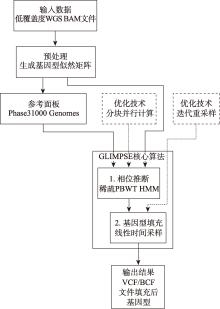
图1
GLIMPSE计算流程"
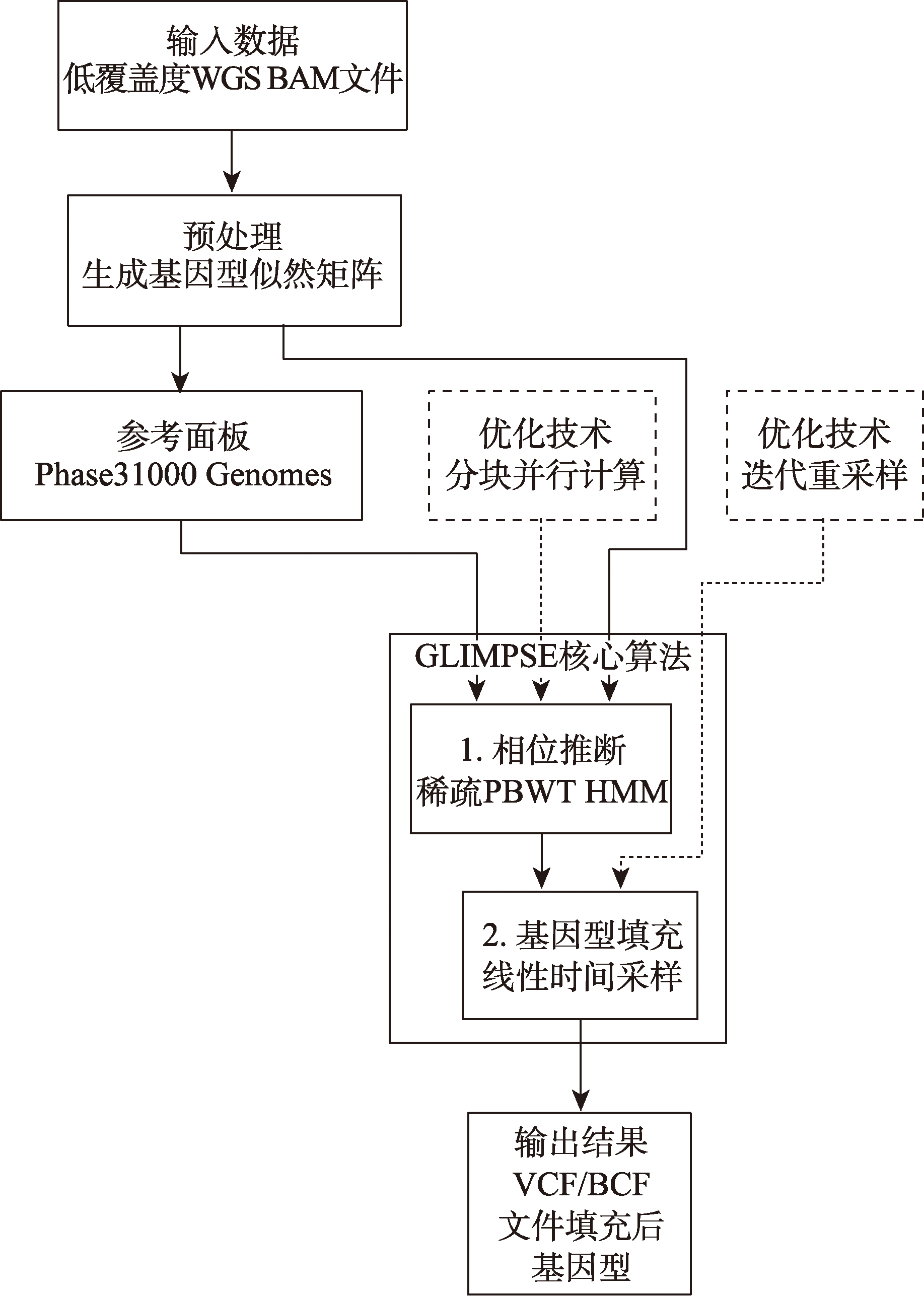
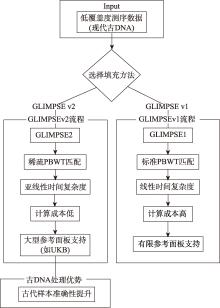
图2
GLIMPSE2相较于GLIMPSE1的算法改进及其在古DNA处理中的优势"
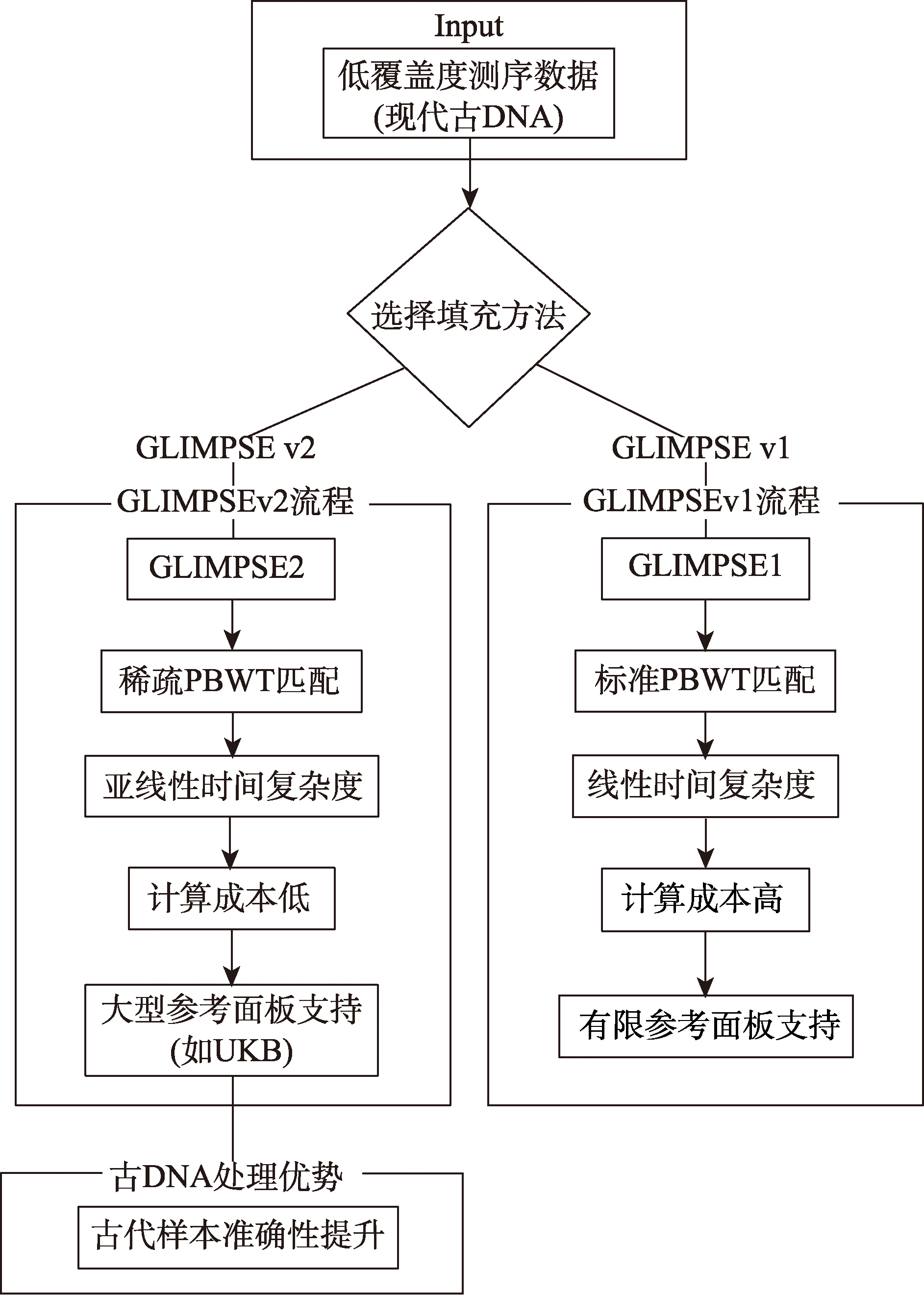
表1
五种基因型填充工具对比"
| 工具名称 | 核心算法 | 数据类型 | 推荐测序深度 | 单倍型参考序列集 要求 | 主要应用场景 | 参考文献 |
|---|---|---|---|---|---|---|
| GLIMPSE | 基于Li-Stephens模型的吉布斯采样 | 低覆盖度全基因组测序(whole genome sequencing, WGS)数据 | ≥0.1× | 需要大规模高质量单倍型参考序列集 | WGS数据,尤其适合古DNA研究和罕见变异填充 | [ |
| STITCH | 基于隐马尔可夫模型(hidden Markov model, HMM)的祖先单倍型拼接 | 低覆盖度WGS数据 | 无特殊要求 | 不需要单倍型参考序列集 | 非人类物种及缺乏单倍型参考序列集的特殊群体研究 | [ |
| Beagle | 基于身份血统(identity by descent, IBD)的隐马尔可夫模型 | 芯片数据/低覆盖度WGS数据 | ≥0.5× | 依赖大规模单倍型参考序列集 | 大规模基因组数据填充,GWAS等准确性要求高的场景 | [ |
| Reveel | 基于HMM的祖先单倍型推断 | 低覆盖度WGS数据 | 适应范围广 | 不需要单倍型参考序列集 | 缺乏单倍型参考序列集时的大规模群体基因分型 | [ |
| QUILT | 迭代吉布斯采样结合读标签分组 | 低覆盖度WGS数据/长读长数据 | ≥0.25× | 需要代表性单倍型参考序列集(≥1 k样本) | 低覆盖度WGS数据,适合多样人群和罕见变异研究 | [ |
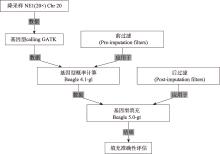
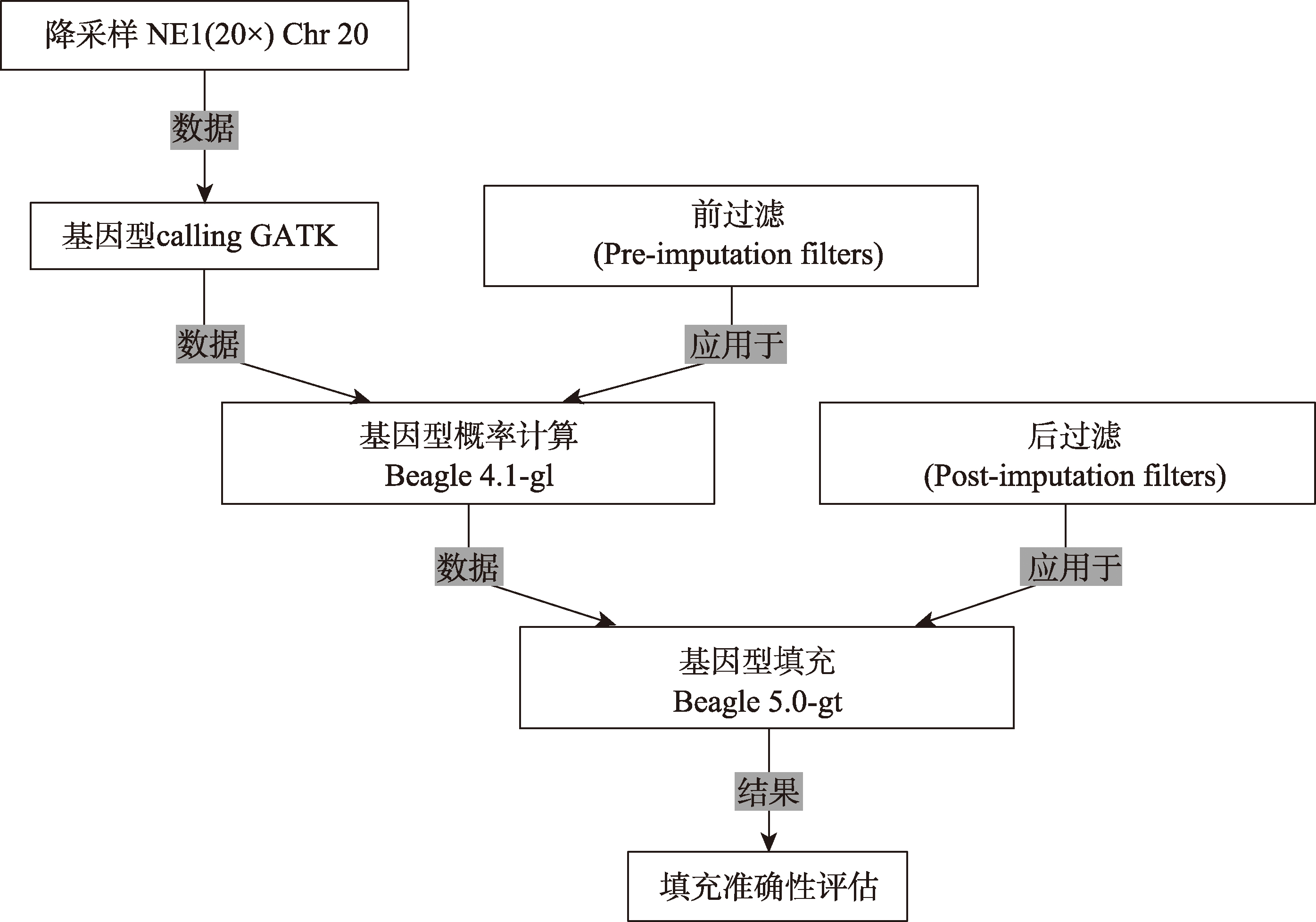
图3
两步填充流程的示意图"
| [1] |
Rohland N, Hofreiter M. Ancient DNA extraction from bones and teeth. Nat Protoc, 2007, 2(7): 1756-1762.
pmid: 17641642 |
| [2] |
Der Sarkissian C, Pichereau V, Dupont C, Ilsøe PC, Perrigault M, Butler P, Chauvaud L, Eiríksson J, Scourse J, Paillard C, Orlando L. Ancient DNA analysis identifies marine mollusc shells as new metagenomic archives of the past. Mol Ecol Resour, 2017, 17(5): 835-853.
pmid: 28394451 |
| [3] |
Schuenemann VJ, Peltzer A, Welte B, van Pelt WP, Molak M, Wang CC, Furtwängler A, Urban C, Reiter E, Nieselt K, Teßmann B, Francken M, Harvati K, Haak W, Schiffels S, Krause J. Ancient Egyptian mummy genomes suggest an increase of Sub-Saharan African ancestry in post-Roman periods. Nat Commun, 2017, 8(1): 15694.
pmid: 28556824 |
| [4] |
Miller W, Drautz DI, Ratan A, Pusey B, Qi J, Lesk AM, Tomsho LP, Packard MD, Zhao FQ, Sher A, Tikhonov A, Raney B, Patterson N, Lindblad-Toh K, Lander ES, Knight JR, Irzyk GP, Fredrikson KM, Harkins TT, Sheridan S, Pringle T, Schuster SC. Sequencing the nuclear genome of the extinct woolly mammoth. Nature, 2008, 456(7220): 387-390.
pmid: 19020620 |
| [5] |
Rasmussen M, Li YR, Lindgreen S, Pedersen JS, Albrechtsen A, Moltke I, Metspalu M, Metspalu E, Kivisild T, Gupta R, Bertalan M, Nielsen K, Gilbert MTP, Wang Y, Raghavan M, Campos PF, Kamp HM, Wilson AS, Gledhill A, Tridico S, Bunce M, Lorenzen ED, Binladen J, Guo XS, Zhao J, Zhang XQ, Zhang H, Li Z, Chen MF, Orlando L, Kristiansen K, Bak M, Tommerup N, Bendixen C, Pierre TL, Grønnow B, Meldgaard M, Andreasen C, Fedorova SA, Osipova LP, Higham TFG, Ramsey CB, Hansen TVO, Nielsen FC, Crawford MH, Brunak S, Sicheritz-Pontén T, Villems R, Nielsen R, Krogh A, Wang J, Willerslev E. Ancient human genome sequence of an extinct palaeo-Eskimo. Nature, 2010, 463(7282): 757-762.
pmid: 20148029 |
| [6] |
Willerslev E, Hansen AJ, Binladen J, Brand TB, Gilbert MTP, Shapiro B, Bunce M, Wiuf C, Gilichinsky DA, Cooper A. Diverse plant and animal genetic records from Holocene and Pleistocene sediments. Science, 2003, 300(5620): 791-795.
pmid: 12702808 |
| [7] |
Kjær KH, Winther Pedersen M, De Sanctis B, De Cahsan B, Korneliussen TS, Michelsen CS, Sand KK, Jelavić S, Ruter AH, Schmidt AMA, Kjeldsen KK, Tesakov AS, Snowball I, Gosse JC, Alsos IG, Wang YC, Dockter C, Rasmussen M, Jørgensen ME, Skadhauge B, Prohaska A, Kristensen JÅ, Bjerager M, Allentoft ME, Coissac E, PhyloNorway Consortium, Rouillard A, Simakova A, Fernandez-Guerra A, Bowler C, Macias-Fauria M, Vinner L, Welch JJ, Hidy AJ, Sikora M, Collins MJ, Durbin R, Larsen NK, Willerslev E, Lawrence Livermore National Laboratory (LLNL), Livermore, CA (United States), PhyloNorway Consortium. A 2-million-year-old ecosystem in Greenland uncovered by environmental DNA. Nature, 2022, 612(7939): 283-291.
pmid: 36477129 |
| [8] |
Higuchi R, Bowman B, Freiberger M, Ryder OA, Wilson AC. DNA sequences from the quagga, an extinct member of the horse family. Nature, 1984, 312(5991): 282-284.
pmid: 6504142 |
| [9] |
van der Valk T, Pečnerová P, Díez-del-Molino D, Bergström A, Oppenheimer J, Hartmann S, Xenikoudakis G, Thomas JA, Dehasque M, Sağlıcan E, Fidan FR, Barnes I, Liu SL, Somel M, Heintzman PD, Nikolskiy P, Shapiro B, Skoglund P, Hofreiter M, Lister AM, Götherström A, Dalén L. Million-year-old DNA sheds light on the genomic history of mammoths. Nature, 2021, 591(7849): 265-269.
pmid: 33597750 |
| [10] |
Barlow A, Cahill JA, Hartmann S, Theunert C, Xenikoudakis G, Fortes GG, Paijmans JLA, Rabeder G, Frischauf C, Grandal-d'Anglade A, García-Vázquez A, Murtskhvaladze M, Saarma U, Anijalg P, Skrbinšek T, Bertorelle G, Gasparian B, Bar-Oz G, Pinhasi R, Slatkin M, Dalén L, Shapiro B, Hofreiter M. Partial genomic survival of cave bears in living brown bears. Nat Ecol Evol, 2018, 2(10): 1563-1570.
pmid: 30150744 |
| [11] |
Palkopoulou E, Mallick S, Skoglund P, Enk J, Rohland N, Li H, Omrak A, Vartanyan S, Poinar H, Götherström A, Reich D, Dalén L. Complete genomes reveal signatures of demographic and genetic declines in the woolly mammoth. Curr Biol, 2015, 25(10): 1395-400.
pmid: 25913407 |
| [12] |
Mallick S, Micco A, Mah M, Ringbauer H, Lazaridis I, Olalde I, Patterson N, Reich D. The Allen Ancient DNA Resource (AADR) a curated compendium of ancient human genomes. Sci Data, 2024, 11(1): 182.
pmid: 38341426 |
| [13] | Bai F, He W, Gao Y, Ping WJ, Fu QM. Ancient genomes revealed the genetic history and interaction of prehistoric populations in the Ngari region of the western Tibetan Plateau. Hereditas(Beijing), 2025, 47(5): 501-512. |
| 白帆, 何伟, 高玉, 平婉菁, 付巧妹. 古DNA揭示青藏高原西部阿里地区史前人群遗传演化及区域人群互动历史. 遗传, 2025, 47(5): 501-512. | |
| [14] | Sheng GL, Zheng MM, Xiao B, Yuan JX. Progress on ancient DNA investigation of Late Quaternary mammals in China. Hereditas(Beijing), 2025, 47(1): 46-57. |
| 盛桂莲, 郑铭旻, 肖博, 袁俊霞. 第四纪晚期中国大型哺乳动物古DNA研究进展. 遗传, 2025, 47(1): 46-57. | |
| [15] | Zhang DX, Dai SR, Cui YQ. The migration and evolutionary mechanisms of northern Asian populations from the perspective of ancient genomics. Hereditas(Beijing), 2025, 47(1): 34-45. |
| 张达轩, 戴沈汝, 崔银秋. 古基因组视角下的亚洲北部人群迁徙和演化机制. 遗传, 2025, 47(1): 34-45. | |
| [16] | Ping WJ, Xue JY, Fu QM. Ancient DNA elucidates the migration and evolutionary history of northern and southern populations in East Asia. Hereditas(Beijing), 2025, 47(1): 18-33. |
| 平婉菁, 薛家旸, 付巧妹. 古DNA解析东亚南北方人群的迁徙与演化历史. 遗传, 2025, 47(1): 18-33. | |
| [17] |
Frantz LAF, Bradley DG, Larson G, Orlando L. Animal domestication in the era of ancient genomics. Nat Rev Genet, 2020, 21(8): 449-460.
pmid: 32265525 |
| [18] |
Spyrou MA, Bos KI, Herbig A, Krause J. Ancient pathogen genomics as an emerging tool for infectious disease research. Nat Rev Genet, 2019, 20(6): 323-340.
pmid: 30953039 |
| [19] |
Zhang KL, Liang JT, Fu YH, Chu JY, Fu LL, Wang YF, Li WJ, Zhou Y, Li JH, Yin XX, Wang HY, Liu XL, Mou CY, Wang CL, Wang H, Dong XX, Yan DW, Yu M, Zhao SH, Li XY, Ma YL. AGIDB: a versatile database for genotype imputation and variant decoding across species Nucleic Acids Res, 2024, 52(D1): D835-D849.
pmid: 37889051 |
| [20] |
Lou RN, Jacobs A, Wilder AP, Therkildsen NO. A beginner’s guide to low-coverage whole genome sequencing for population genomics. Mol Ecol, 2021, 30(23): 5966-5993.
pmid: 34250668 |
| [21] |
Alex Buerkle C, Gompert Z. Population genomics based on low coverage sequencing: how low should we go? Mol Ecol, 2013, 22(11): 3028-3035.
pmid: 23174005 |
| [22] |
Chat V, Ferguson R, Morales L, Kirchhoff T. Ultra low-coverage whole-genome sequencing as an alternative to genotyping arrays in genome-wide association studies. Front Genet, 2022, 12: 790445.
pmid: 35251117 |
| [23] |
Pasaniuc B, Rohland N, McLaren PJ, Garimella K, Zaitlen N, Li H, Gupta N, Neale BM, Daly MJ, Sklar P, Sullivan PF, Bergen S, Moran JL, Hultman CM, Lichtenstein P, Magnusson P, Purcell SM, Haas DW, Liang LM, Sunyaev S, Patterson N, de Bakker PIW, Reich D, Price AL. Extremely low-coverage sequencing and imputation increases power for genome-wide association studies. Nat Genet, 2012, 44(6): 631-635.
pmid: 22610117 |
| [24] |
Wang XQ, Wang LG, Shi LY, Tian JJ, Li MY, Wang LX, Zhao FP. Imputation strategies for low-coverage whole-genome sequencing data and their effects on genomic prediction and genome-wide association studies in pigs. Animal, 2024, 18(9): 101258.
pmid: 39126800 |
| [25] | Zhang ZB, Wang A, Hu HH, Wang LL, Gong M, Yang QM, Liu AG, Li R, Zhang HH, Zhang QQ, Shah AM, Wang XH, Wang YC, Liu QZ, Gao LT, Zhang ZP, Wang CY, Ma Y, Cai YD, Jiang Y. The efficient phasing and imputation pipeline of low-coverage whole genome sequencing data using a high-quality and publicly available reference panel in cattle. Animal Res One Health, 2023, 1(1): 4-16. |
| [26] |
Zhao CH, Teng J, Zhang XH, Wang D, Zhang XY, Li SY, Jiang X, Li HJ, Ning C, Zhang Q. Towards a cost-effective implementation of genomic prediction based on low coverage whole genome sequencing in Dezhou donkey. Front Genet, 2021, 12: 728764.
pmid: 34804115 |
| [27] |
Purnomo GA, Teixeira JC, Sudoyo H, Llamas B, Tobler R. Benchmarking imputed low coverage genomes in a human population genetics context. Mol Ecol Resour, 2025, e70007.
pmid: 40626414 |
| [28] |
Samad H, Coll F, Preston MD, Ocholla H, Fairhurst RM, Clark TG. Imputation-based population genetics analysis of plasmodium falciparum malaria parasites. PLoS Genet, 2015, 11(4): e1005131.
pmid: 25928499 |
| [29] |
Song HL, Ye SP, Jiang YF, Zhang Z, Zhang Q, Ding XD. Using imputation-based whole-genome sequencing data to improve the accuracy of genomic prediction for combined populations in pigs. Genet Sel Evol, 2019, 51(1): 58.
pmid: 31638889 |
| [30] |
Rubinacci S, Ribeiro DM, Hofmeister RJ, Delaneau O. Efficient phasing and imputation of low-coverage sequencing data using large reference panels. Nat Genet, 2021, 53(1): 120-126.
pmid: 33414550 |
| [31] |
Rubinacci S, Hofmeister RJ, Sousa da Mota B, Delaneau O. Imputation of low-coverage sequencing data from 150,119 UK Biobank genomes. Nat Genet, 2023, 55(7): 1088-1090.
pmid: 37386250 |
| [32] |
Davies RW, Flint J, Myers S, Mott R. Rapid genotype imputation from sequence without reference panels. Nat Genet, 2016, 48(8): 965-969.
pmid: 27376236 |
| [33] |
Browning BL, Zhou Y, Browning SR. A one-penny imputed genome from next-generation reference panels. Am J Hum Genet, 2018, 103(3): 338-348.
pmid: 30100085 |
| [34] |
Huang L, Wang B, Chen RT, Bercovici S, Batzoglou S. Reveel: large-scale population genotyping using low-coverage sequencing data. Bioinformatics, 2016, 32(11): 1686-1696.
pmid: 26353840 |
| [35] |
Whalen A, Ros-Freixedes R, Wilson DL, Gorjanc G, Hickey JM. Hybrid peeling for fast and accurate calling, phasing, and imputation with sequence data of any coverage in pedigrees. Genet Sel Evol, 2018, 50(1): 67.
pmid: 30563452 |
| [36] |
Davies RW, Kucka M, Su DW, Shi SN, Flanagan M, Cunniff CM, Chan YF, Myers S. Rapid genotype imputation from sequence with reference panels. Nat Genet, 2021, 53(7): 1104-1111.
pmid: 34083788 |
| [37] |
Byrska-Bishop M, Evani US, Zhao XF, Basile AO, Abel HJ, Regier AA, Corvelo A, Clarke WE, Musunuri R, Nagulapalli K, Fairley S, Runnels A, Winterkorn L, Lowy E, Flicek P, Germer S, Brand H, Hall IM, Talkowski ME, Narzisi G, Zody MC. Human Genome Structural Variation Consortium, High-coverage whole-genome sequencing of the expanded 1000 Genomes Project cohort including 602 trios. Cell, 2022, 185(18): 3426-3440.e19.
pmid: 36055201 |
| [38] |
Sudmant PH, Rausch T, Gardner EJ, Handsaker RE, Abyzo A, Huddleston J, Zhang Y, Ye K, Jun G, Hsi-Yang Fritz M, Konkel MK, Malhotra A, Stütz AM, Shi XH, Paolo Casale F, Chen JM, Hormozdiari F, Dayama G, Chen K, Malig M, Chaisson MJP, Walter K, Meiers S, Kashin S, Garrison E, Auton A, Lam HYK, Jasmine Mu X, Alkan C, Antaki D, Bae T, Cerveira E, Chines P, Chong ZC, Clarke L, Dal E, Ding L, Emery S, Fan X, Gujral M, Kahveci F, Kidd JM, Kong Y, Lameijer EW, McCarthy S, Flicek P, Gibbs RA, Marth G, Mason CE, Menelaou A, Muzny DM, Nelson BJ, Noor A, Parrish NF, Pendleton M, Quitadamo A, Raeder B, Schadt EE, Romanovitch M, Schlattl A, Sebra R, Shabalin AA, Untergasser A, Walker JA, Wang M, Yu FL, Zhang CS, Zhang J, Zheng-Bradley XQ, Zhou WD, Zichner T, Sebat J, Batzer MA, McCarroll SA, 1000 Genomes Project Consortium, Mills RE, Gerstein MB, Bashir A, Stegle O, Devine SE, Lee C, Eichler EE, Korbel JO. An integrated map of structural variation in 2,504 human genomes. Nature, 2015, 526(7571): 75-81.
pmid: 26432246 |
| [39] |
1000 Genomes Project Consortium, Abecasis GR, Altshuler D, Auton A, Brooks LD, Durbin RM, Gibbs RA, Hurles ME, McVean GA. A map of human genome variation from population-scale sequencing. Nature, 2010, 467(7319): 1061-1073.
pmid: 20981092 |
| [40] |
1000 Genomes Project Consortium, Abecasis GR, Auton A, Brooks LD, DePristo MA, Durbin RM, Handsaker RE, Kang HM, Marth GT, McVean GA. An integrated map of genetic variation from 1,092 human genomes. Nature, 2012, 491(7422): 56-65.
pmid: 23128226 |
| [41] |
1000 Genomes Project Consortium, Auton A, Brooks LD, Durbin RM, Garrison EP, Kang HM, Korbel JO, Marchini JL, McCarthy S, McVean GA, Abecasis GR. A global reference for human genetic variation. Nature, 2015, 526(7571): 68-74.
pmid: 26432245 |
| [42] |
McCarthy S, Das S, Kretzschmar W, Delaneau O, Wood AR, Teumer A, Kang HM, Fuchsberger C, Danecek P, Sharp K, Luo Y, Sidore C, Kwong A, Timpson N, Koskinen S, Vrieze S, Scott LJ, Zhang H, Mahajan A, Veldink J, Peters U, Pato C, van Duijn CM, Gillies CE, Gandin I, Mezzavilla M, Gilly A, Cocca M, Traglia M, Angius A, Barrett JC, Boomsma D, Branham K, Breen G, Brummett CM, Busonero F, Campbell H, Chan A, Chen S, Chew E, Collins FS, Corbin LJ, Smith GD, Dedoussis G, Dorr M, Farmaki AE, Ferrucci L, Forer L, Fraser RM, Gabriel S, Levy S, Groop L, Harrison T, Hattersley A, Holmen OL, Hveem K, Kretzler M, Lee JC, McGue M, Meitinger T, Melzer D, Min JL, Mohlke KL, Vincent JB, Nauck M, Nickerson D, Palotie A, Pato M, Pirastu N, McInnis M, Richards JB, Sala C, Salomaa V, Schlessinger D, Schoenherr S, Slagboom PE, Small K, Spector T, Stambolian D, Tuke M, Tuomilehto J, Van den Berg LH, Van Rheenen W, Volker U, Wijmenga C, Toniolo D, Zeggini E, Gasparini P, Sampson MG, Wilson JF, Frayling T, de Bakker PIW, Swertz MA, McCarroll S, Kooperberg C, Dekker A, Altshuler D, Willer C, Iacono W, Ripatti S, Soranzo N, Walter K, Swaroop A, Cucca F, Anderson CA, Myers RM, Boehnke M, McCarthy MI, Durbin R, Haplotype Reference Consortium. A reference panel of 64,976 haplotypes for genotype imputation. Nature Genetics, 2016, 48(10): 1279-1283.
pmid: 27548312 |
| [43] |
Yu CQ, Lan XM, Tao Y, Guo Y, Sun DJY, Qian PY, Zhou YW, Walters RG, Li LX, Zhu YQ, Zeng JY, Millwood IY, Guo RD, Pei P, Yang T, Du HD, Yang F, Yang L, Ren FY, Chen YP, Chen FZ, Jiang XS, Ye ZQ, Dai LL, Wei XF, Xu X, Yang HM, Wang J, Chen ZM, Zhu HH, Lv J, Jin X, Li LM. A high-resolution haplotype-resolved reference panel constructed from the China kadoorie biobank study. Nucleic Acids Res, 2023, 51(21): 11770-11782.
pmid: 37870428 |
| [44] |
Ausmees K, Sanchez-Quinto F, Jakobsson M, Nettelblad C. An empirical evaluation of genotype imputation of ancient DNA. G3 (Bethesda), 2022, 12(6): jkac089.
pmid: 35482488 |
| [45] |
Gamba C, Jones ER, Teasdale MD, McLaughlin RL, Gonzalez-Fortes G, Mattiangeli V, Domboróczki L, Kővári I, Pap I, Anders A, Whittle A, Dani J, Raczky P, Higham TFG, Hofreiter M, Bradley DG, Pinhasi R. Genome flux and stasis in a five millennium transect of European prehistory. Nat Commun, 2014, 5(1): 5257.
pmid: 25334030 |
| [46] |
Martiniano R, Cassidy LM, Ó'Maoldúin R, McLaughlin R, Silva NM, Manco L, Fidalgo D, Pereira T, Coelho MJ, Serra M, Burger J, Parreira R, Moran E, Valera AC, Porfirio E, Boaventura R, Silva AM, Bradley DG. The population genomics of archaeological transition in west Iberia: investigation of ancient substructure using imputation and haplotype-based methods. PLoS Genet, 2017, 13(7): e1006852.
pmid: 28749934 |
| [47] |
Hui RY, D’Atanasio E, Cassidy LM, Scheib CL, Kivisild T. Evaluating genotype imputation pipeline for ultra-low coverage ancient genomes. Sci Rep, 2020, 10(1): 18542.
pmid: 33122697 |
| [48] |
Browning BL, Browning SR. Genotype imputation with millions of reference samples. Am J Hum Genet, 2016, 98(1): 116-126.
pmid: 26748515 |
| [49] | Cox SL, Moots HM, Stock JT, Shbat A, Bitarello BD, Nicklisch N, Alt KW, Haak W, Rosenstock E, Ruff CB, Mathieson I. Predicting skeletal stature using ancient DNA. Am J Biol Anthropol, 2022, 177(1): 162-174. |
| [50] |
Sousa da Mota B, Rubinacci S, Cruz Dávalos DI, G Amorim CE, Sikora M, Johannsen NN, Szmyt MH, Włodarczak P, Szczepanek A, Przybyła MM, Schroeder H, Allentoft ME, Willerslev E, Malaspinas AS, Delaneau O. Imputation of ancient human genomes. Nat Commun, 2023, 14(1): 3660.
pmid: 37339987 |
| [51] |
Çubukcu H, Kılınç GM. Evaluation of genotype imputation using Glimpse tools on low coverage ancient DNA. Mamm Genome, 2024, 35(3): 461-473.
pmid: 39028337 |
| [52] |
Koenig Z, Yohannes MT, Nkambule LL, Zhao XF, Goodrich JK, Kim HA, Wilson MW, Tiao G, Hao SP, Sahakian N, Chao KR, Walker MA, Lyu YF, gnomAD Project Consortium, Rehm HL, Neale BM, Talkowski ME, Daly MJ, Brand H, Karczewski KJ, Atkinson EG, Martin AR. A harmonized public resource of deeply sequenced diverse human genomes. Genome Res, 2024, 34(5): 796-809.
pmid: 38749656 |
| [53] |
Liu JX, Shi YL, Mo DX, Luo LY, Xu SS, Lv FH. The goat pan-genome reveals patterns of gene loss during domestication. J Anim Sci Biotechnol, 2024, 15(1): 132.
pmid: 39367490 |
| [54] |
Erven JAM, Çakirlar C, Bradley DG, Raemaekers DCM, Madsen O. Imputation of ancient whole genome sus scrofa DNA introduces biases toward main population components in the reference panel. Front Genet, 2022, 13: 872486.
pmid: 35903348 |
| [55] |
Erven JAM, Scheu A, Verdugo MP, Cassidy L, Chen NB, Gehlen B, Street M, Madsen O, Mullin VE. A high-coverage mesolithic aurochs genome and effective leveraging of ancient cattle genomes using whole genome imputation. Mol Biol Evol, 2024, 41(5): msae076.
pmid: 38662789 |
| [56] |
Bougiouri K, Aninta SG, Charlton S, Harris A, Carmagnini A, Piličiauskienė G, Feuerborn TR, Scarsbrook L, Tabadda K, Blaževičius P, Parker HG, Gopalakrishnan S, Larson G, Ostrander EA, Irving-Pease EK, Frantz LAF, Racimo F. Imputation of ancient canid genomes reveals inbreeding history over the past 10,000 years. bioRxiv, 2024, doi: 10.1101/2024.03.15.585179.
pmid: 38903121 |
| [57] |
Todd ET, Tonasso-Calvière L, Chauvey L, Schiavinato S, Fages A, Seguin-Orlando A, Clavel P, Khan N, Pérez Pardal L, Patterson Rosa L, Librado P, Ringbauer H, Verdugo M, Southon J, Aury JM, Perdereau A, Vila E, Marzullo M, Prato O, Tecchiati U, Bagnasco Gianni G, Tagliacozzo A, Tinè V, Alhaique F, Cardoso JL, Valente MJ, Telles Antunes M, Frantz L, Shapiro B, Bradley DG, Boulbes N, Gardeisen A, Horwitz LK, Öztan A, Arbuckle BS, Onar V, Clavel B, Lepetz S, Vahdati AA, Davoudi H, Mohaseb A, Mashkour M, Bouchez O, Donnadieu C, Wincker P, Brooks SA, Beja-Pereira A, Wu DD, Orlando L. The genomic history and global expansion of domestic donkeys. Science, 2022, 377(6611): 1172-1180.
pmid: 36074859 |
| [58] |
Todd ET, Fromentier A, Sutcliffe R, Running Horse Collin Y, Perdereau A, Aury JM, Èche C, Bouchez O, Donnadieu C, Wincker P, Kalbfleisch T, Petersen JL, Orlando L. Imputed genomes of historical horses provide insights into modern breeding. iScience, 2023, 26(7): 107104.
pmid: 37416458 |
| [59] |
Hansen A, Willerslev E, Wiuf C, Mourier T, Arctander P. Statistical evidence for miscoding lesions in ancient DNA templates. Mol Biol Evol, 2001, 18(2): 262-265.
pmid: 11158385 |
| [60] |
Hofreiter M, Jaenicke V, Serre D, von Haeseler A, Pääbo S. DNA sequences from multiple amplifications reveal artifacts induced by cytosine deamination in ancient DNA. Nucleic Acids Res, 2001, 29(23): 4793-4799.
pmid: 11726688 |
| [61] | Yang SJ, Lai XL, Tang XH, Shen GL. Experimental techniques for ancient DNA research. Hereditas(Beijing), 2002, 24(5): 551-554. |
| 杨淑娟, 赖旭龙, 唐先华, 盛桂莲. 古代DNA研究实验技术. 遗传, 2002, 24(5): 551-554. | |
| [62] |
Gansauge MT, Gerber T, Glocke I, Korlević P, Lippik L, Nagel S, Riehl LM, Schmidt A, Meyer M. Single-stranded DNA library preparation from highly degraded DNA using T4 DNA ligase. Nucleic Acids Res, 2017, 45(10): e79.
pmid: 28119419 |
| [63] | Li Z, He J, Jiang J, Richard G. Tait Jr., Stewart Bauck, Guo W, Wu XL. Impacts of SNP genotyping call rate and SNP genotyping error rate on imputation accuracy inHolsteincattle. Hereditas(Beijing), 2019, 41(7): 644-652. |
| 李智, 何俊, 蒋隽, Richard G. Tait Jr., Stewart Bauck, 过伟, 吴晓林. 牛SNP芯片分型检出率和分型错误率对基因型填充准确率的影响. 遗传, 2019, 41(7): 644-652. |
| [1] | 蒋雨萱, 边黎明, 周师亮, Charles Chen, Yousry A. El-Kassaby, 陈志强, Harry X. Wu. 基因型填充提高湿地松SNP密度与遗传分析准确性[J]. 遗传, 2026, 48(5): 506-521. |
| [2] | 杨雨甜, 王彩惠, 马志坤, 李青青, 张明. 植物古DNA技术及其应用进展[J]. 遗传, 2026, 48(4): 377-392. |
| [3] | 白帆, 何伟, 高玉, 平婉菁, 付巧妹. 古DNA揭示青藏高原西部阿里地区史前人群遗传演化及区域人群互动历史[J]. 遗传, 2025, 47(5): 501-512. |
| [4] | 张达轩, 戴沈汝, 崔银秋. 古基因组视角下的亚洲北部人群迁徙和演化机制[J]. 遗传, 2025, 47(1): 34-45. |
| [5] | 盛桂莲, 郑铭旻, 肖博, 袁俊霞. 第四纪晚期中国大型哺乳动物古DNA研究进展[J]. 遗传, 2025, 47(1): 46-57. |
| [6] | 郑泽权, 付巧妹, 刘逸宸. 应用古DNA技术探究发酵微生物的适应、演化和驯化历史[J]. 遗传, 2022, 44(5): 414-423. |
| [7] | 平婉菁, 刘逸宸, 付巧妹. 沉积物古DNA探秘灭绝古人类演化[J]. 遗传, 2022, 44(5): 362-369. |
| [8] | 田娇阳, 李玉春, 孔庆鹏, 张亚平. 遗传学视角下东亚人群的起源和演化[J]. 遗传, 2018, 40(10): 814-824. |
| [9] | 盛桂莲,赖旭龙,王,頠. 分子人类学与现代人的起源*[J]. 遗传, 2004, 26(5): 721-728. |
| 阅读次数 | ||||||
|
全文 |
|
|||||
|
摘要 |
|
|||||

www.chinagene.cn
备案号:京ICP备09063187号-4
总访问:,今日访问:,当前在线:

